

Mendelian Inheritance

Presentation
•
Biology
•
9th Grade
•
Hard

JEREMY ROHRBACH
Used 4+ times
FREE Resource
59 Slides • 9 Questions
1


Mendelian Inheritance
2

SOME THINGS YOU NEED TO KNOW…
� Mendel's Laws
� The connection between meiosis and inheritance
� Terms associated with genetics problems: P, F1,
F2, dominant, recessive, homozygous, heterozygous,
phenotype, genotype.
� How to derive the proper gametes when working
a genetics problem (punnett square)
� The difference between an allele and a gene.
3


GREGOR MENDEL
� Austrian monk
�Brought experimental and quantitative approach to genetics
� Bred pea plants to study inheritance
� Why peas? (model organism)
■ Control mating (self- vs.
cross-pollination)
■ Many varieties of traits
■ Short generation time
■ Reproduce in large numbers
■ Ethical
■ Definable traits
4


Mendel’s Pea Traits
5


G-Money
Mendel had many interests, and while
at the University of Vienna
(1851-1853) he studied physics under
Christian Doppler, and took courses in
chemistry and zoology. As part of his
monasterial duties, Mendel taught
high school science at the local
schools, and was remembered as a
kind and good teacher
6

In 1865, Mendel did not know about DNA or genes. In his works, Mendel
called the heritable substance "elementen." For each of the traits Mendel
examined, Mendel focused on how the “elementen” that determined that
trait was distributed among progeny.
Biomolecules had just began to be studied. It's generally recognized that
chromosomes were first discovered by Walther Flemming in 1882. Danish
botanist Wilhelm Johannsen coined the word gene to describe the
Mendelian units of heredity. He also made the distinction between the
outward appearance of an individual (phenotype) and its genetic traits
(genotype). Mendel’s work was not appreciated in its time. Reginald
Punnett and other scientists rediscovered Mendel’s work in 1900.
Some Context
7
Multiple Choice
What type of plant did Mendel observe?
Wheat
Corn
Pea
Weeds
8
Law # 1
Law of Dominance: Some traits are dominant and will be expressed. Other traits are recessive, and will thus be “masked” or “hidden” in the presence of a dominant trait. Recessive traits only appear if neither homologous chromosome carries a dominant allele.
Mendel didn’t fully understand the complexity of some inheritance. If we told him eye color is determined by 8 main, 16 total, different genes, he would have been flabbergasted!
9
Law #2
Law of Segregation: Organisms carry two alleles for each trait-one on each homologous chromosome. Chromosomes, and the genes they are comprised of, are separated during the creation of sex cells.
Segregation is about homologous chromosomes pulling apart (to different cells) during anaphase 1. Gametes are haploid, not diploid!
10
Law # 3
Law of Independent Assortment: Traits that are not on homologous chromosomes will separate randomly and independently from one another. i.e. alleles for hair color will not impact an individual's chances of having freckles because they are disturbed to sex cells separately/independently during meiosis.
Independent assortment is about the random alignment and separation of chromosomes during metaphase 1. 23 chromosomes go to one cell and 23 to the other cell (independently).
11


ALLELES: Different versions of the same gene.
one of two or more alternative forms of a gene that arise by
mutation and are found at the same place on a chromosome.
12

Homologous Chromosomes
Homologous chromosomes are two pieces
of DNA within a diploid organism that
possess the same genes (possibly different
forms of that gene), one from each
parental source. Both of your parents
provide a complete genome; Each parent
provides 23 chromosomes, which encode
the same genes (possibly different alleles).
When those combine, you have pairs
(homologues) of each chromosome (46).
9
Even the centromere
location is the same!
13

Karyotypes
*Karyo means nucleus
What do you find in the nucleus?
12
14
What is a Karyotype?
A karyotype is simply a picture of a person’s chromosomes. In order to get this picture, the chromosomes are isolated, stained, and examined under the microscope. Most often, this is done using the chromosomes in the white blood cells. A picture of the chromosomes is taken through the microscope. Then, the picture of the chromosomes is cut up and rearranged by the chromosome’s size. The chromosomes are lined up from largest to smallest. A trained cytogeneticist can look for missing or extra pieces of chromosome
13
Basically, a karyotype is a picture of an organisms chromosomes
15

This is a Karyotype
14
16

Karyotype Vocabulary
Autosome
⬦ These are your “body” chromosomes
⬦For humans, these are chromosomes 1-22 (1-44)
⬥ Sex Chromosomes (sex-linked inheritance)
⬦ These are the chromosomes responsible for determining if an organism is male or female
⬦ For humans, this is our pair of 23rdchromosomes
15
Genes in autosomes function to create every cell, develop the body plan, create necessary enzyme, hormones, tissues, bones, organs, etc. (most things)
Females have two X chromosomes (XX)
Males have an X chromosome and a Y chromosome (XY)
X and Y contain genes for developing sex organs.
17

23rd
Chromosome
X chromosome is much larger than the Y chromosomes.
This means that it carries more genetic information.
16
Sex-linked
Inheritance
The Y chromosome is one-third the size of the X chromosome, the Y
contains about 140 genes, while the X chromosome has about 1,200 genes.
18

Males are more likely to have
certain disorders. This includes,
but is not limited to, baldness
and being colorblind.
17
Female Male
19

18
20

Having children someday?
19
Karyotypes allow us to
determine the sex of an
unborn child, determine if
there is a major genetic
disorder present, and even
to test your own genetic
variations before making
the decision to have a child.
Now days, karyotypes of an
infant are taken via a
simple blood sample from
the mother.
21

Recap:
1. What is passed on from parents to their offspring?
2.
What is a gene? What is an allele?
3.
What does recessive and dominant mean in terms of inheritance?
4.
What is a karyotype?
5.
What are karyotypes used for?
6.
Is the karyotype to the right
a male or female? How do
you know?
7.What is an autosome?
8.
If a gene has sex-linked inheritance,
where would it be found?
21
22


� homozygous = 2 same alleles
� heterozygous = 2 different alleles
23


Alleles for dominant & recessive
Dominant alleles are denoted with capital letters. Recessive alleles are denoted with lower case letters.
So, you could say purple flower color is….
Which letter is the dominant one?
24
Categorize
BB
AA
EE
Aa
Bb
Dd
aa
bb
dd
Organize these options into the right categories- alleles
25

dominant (P), recessive (p)
� homozygous = 2 same alleles (PP or pp)
� heterozygous = 2 different alleles (Pp)
26
Multiple Choice
Which of the following is NOT a true statement about dominant and recessive alleles?
A dominant allele always masks the effect of a recessive allele when paired together.
Recessive alleles can only be expressed when paired with another recessive allele.
An organism can be heterozygous for a dominant trait.
Dominant alleles are always more common in a population than recessive alleles.
27


� Phenotype: expressed physical traits (Seen)
� Genotype: genetic makeup (DNA/gene)
What are the two phenotypes seen in the example below?
What are the two genotypes seen in the example below?
What is the phenotypic ratio seen in the example below?
What is the genotypic ratio seen in the example below?
28
Multiple Choice
The genotype of an organism refers to:
Its physical appearance
The environment it lives in
its behavior
The genetic makeup of its cells
29

PUNNETT SQUARE
� Device for predicting offspring from a cross
� Example: Tt x Tt (T = tall, t = dwarf)
Genotypic Ratio: 1 : 2 : 1
Phenotypic Ratio: 3 : 1
“For pea plants, tall is a dominant trait
and dwarfism is a recessive trait.”
“What would be the outcome of a cross
between a heterozygous tall pea plant
and another plant that is heterozygous
for height?”
30
Fill in the Blanks
31
Multiple Choice
In a certain species of rabbits, black coat color is dominant over brown coat color. The probability of producing a rabbit with brown coat color from two rabbits that are both heterozygous with black coat color is
25%
50%
75%
100%
32

1.
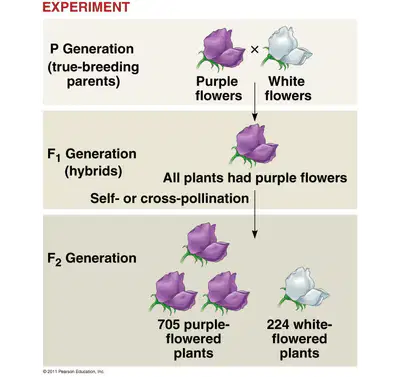
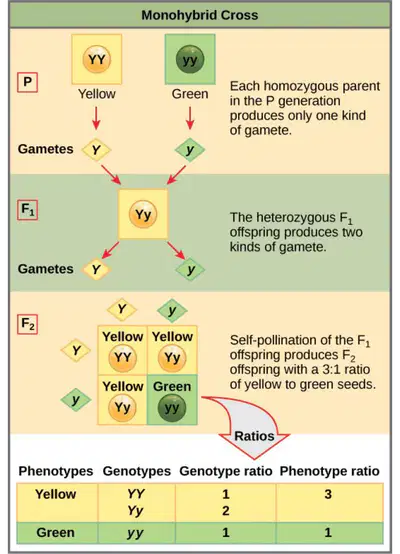
P generation = true breeding plants
2.
F1 generation = offspring of P gen
3.
F2 generation = F1 offspring
33


Mendell may or may not have
realized it, but his laws, still used
today, were all about meiosis!
34

Gametes
only have 1
“Y” gene &
1 “R” gene
(haploid)
The “Y” gene and the
“R” gene are on
different chromosomes
Just because a
pea is yellow
doesn’t mean it
will be round.
Which alleles are dominant?
Yellow or green?
Round or wrinkled?
35

36


LAW OF SEGREGATION
37

Law of Independent Assorment
� Genes/traits that are on different chromosomes will separate independently of each other.
� Eg. just because a pea pod is yellow, doesn’t mean it will be wrinkled-color is
separate from shape
38


Cleft
Chin
39


Hitch Hiker’s Thumb
Hitchhikers Thumb
40


Thumb Crossing
41


earlobe
42


Widows Peak
43


Tongue Roll Tonge Fold
44


Bent Little Finger
45


Middle Digit
46


dimples
47


Genetic Cross
The deliberate breeding of two different individuals that results in offspring that carry part of the genetic material of each parent
48

7
CHARACTERS
IN PEA
PLANTS
Dominant vs. Recessive
(expressed) or (hidden)
49

PUNNETT SQUARE
� Device for predicting offspring from a cross
� Example: Tt x Tt (T = tall, t = dwarf)
Genotypic Ratio: 1 : 2 : 1
Phenotypic Ratio: 3 : 1
“For pea plants, tall is a dominant trait
and dwarfism is a recessive trait.”
“What would be the outcome of a cross
between a heterozygous tall pea plant
and another plant that is heterozygous
for height?”
50


Testcross:
determine if dominant
trait in an organism is
homozygous or
heterozygous by
crossing with an
organisms baring the
recessive (pp) allele
51


Gene Linkage
The law of
independent
assortment
Works for genes
on different
chromosomes, but
not so much for
genes on the
same
chromosomes.
Fix
Slide
52


� Monohybrid cross: study 1 character
⚫ eg. flower color
� Dihybrid cross: study 2 characters at one time
⚫ eg. flower color & seed shape
53


A Dihybrid Cross looks at 2 genes at one time
Possible
results of F2
Phenotypic Ratio
9:3:3:1 Ratio
54


55

Practice
In a cross, the parental generation
consists of one plant that is
heterozygous for axial flower
position, heterozygous Tall, green,
and wrinkled. The other plant is
heterozygous for axial position,
dwarf, heterozygous for yellow, and
homozygous dominant for round.
What is the probability of offspring
having axial position, as well as
being green, tall, and round?
56

Explain Mendel's Three Laws
1. Law of Dominance
2. Law of Segregation
3. Law of Independent Assortment
57
Law # 1
Law of Dominance: Some traits are dominant and will be expressed. Other traits are recessive, and will thus be “masked” or “hidden” in the presence of a dominant trait. Recessive traits only appear if neither homologous chromosome carries a dominant allele.
Mendel didn’t fully understand the complexity of some inheritance. If we told him eye color is determined by 8 main, 16 total, different genes, he would have been flabbergasted!
58
Law #2
Law of Segregation: Organisms carry two alleles for each trait-one on each homologous chromosome. Chromosomes, and the genes they are comprised of, are separated during the creation of sex cells.
Segregation is about homologous chromosomes pulling apart (to different cells) during anaphase 1. Gametes are haploid, not diploid!
59
Law # 3
Law of Independent Assortment: Traits that are not on homologous chromosomes will separate randomly and independently from one another. i.e. alleles for hair color will not impact an individual's chances of having freckles because they are disturbed to sex cells separately/independently during meiosis.
Independent assortment is about the random alignment and separation of chromosomes during metaphase 1. 23 chromosomes go to one cell and 23 to the other cell (independently).
60


61
Match
Match the following
Homozygous
Allele
Heterozygous
Phenotype
Genotype
Each parent donates the same allele
The set of alleles an organism inherits;
different alleles for the trait.
The physical expression of a gene
The different forms of a gene
Each parent donates the same allele
The set of alleles an organism inherits;
different alleles for the trait.
The physical expression of a gene
The different forms of a gene
62

Define the Following Terms
a. Homozygous
b. Allele
c. Heterozygous
d. Phenotype
e. Genotype
63

1.
The set of alleles an organism inherits; represented by two letters
2.
Each parent donates the same allele for a trait to the offspring
3.
The physical expression of a gene in an organism’s appearance (what it looks like)
4.
The different forms of a gene; offspring inherit one from each parent
5.
Genotype with different alleles for the trait.
64
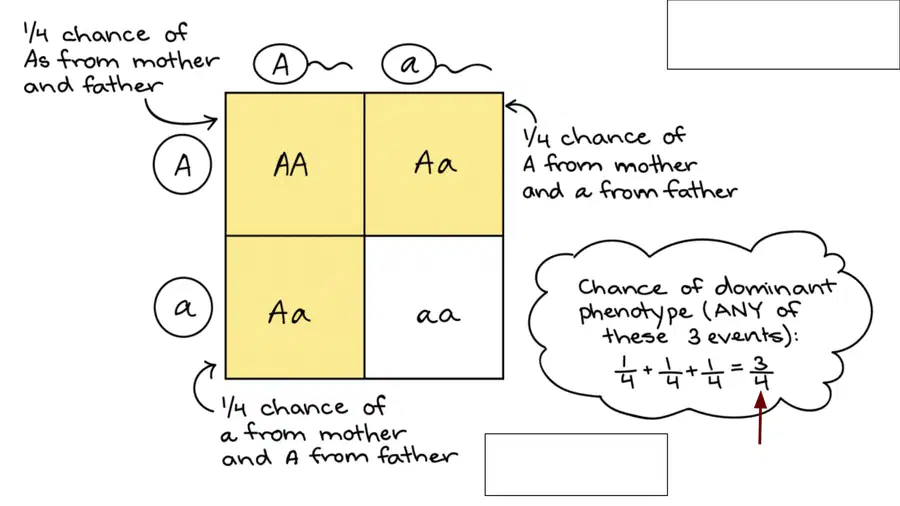
A cross with two
heterozygous parents.
Phenotypic
Ratio 3:1
Genotypic Ratio:
1 : 2 : 1
65

MENDEL’S IDEAS
1.
Alternate version of genes (alleles) cause variations in inherited characteristics among offspring.
2.
For each characteristic, every organism inherits one allele from each parent.
3.
If 2 alleles are different, the dominant allele will be fully expressed; the recessive allele will have no noticeable effect on offspring’s appearance.
4. Law of Independent assortment: the alleles for different traits are passed on singly (no correlations)
5.
Law of Segregation: the 2 alleles for each characteristic separate during gamete formation.
66

Khan Academy Punnett
SquarePractice
67
Multiple Choice
When an egg and sperm form an embryo, the offspring that is formed will have genetic traits that are
Identical to the parents
passed on from two parents
75% from the mother
75% from the father
68
Multiple Choice
Fraternal twins may or may not share similar characteristics due to
Point Source Mutation
Independent Assortment
Mitosis
Homozygous Alleles
Mendelian Inheritance
Show answer
Auto Play
Slide 1 / 68
SLIDE
Similar Resources on Wayground

63 questions
8th Grade Unit 1 Digital Review
Presentation
•
8th - 9th Grade
60 questions
Willowridge Genetic Mutations
Presentation
•
8th - 10th Grade
62 questions
Oceans
Presentation
•
8th Grade
64 questions
Unit 3 Notes
Presentation
•
9th Grade
63 questions
Interactions of Life Forms & Ecosystem Dynamics
Presentation
•
9th Grade
63 questions
Evolution
Presentation
•
9th Grade
64 questions
Punnett Square Stations Answer Doc
Presentation
•
9th Grade
60 questions
Listening Sample CEFR SPM F4 2021
Presentation
•
9th Grade
Popular Resources on Wayground
10 questions
Factors 4th grade

Quiz
•
4th Grade
10 questions
Cinco de Mayo Trivia Questions

Interactive video
•
3rd - 5th Grade
13 questions
Cinco de mayo
Interactive video
•
6th - 8th Grade
20 questions
Math Review
Quiz
•
3rd Grade
20 questions
Main Idea and Details
Quiz
•
5th Grade
20 questions
Context Clues
Quiz
•
6th Grade
20 questions
Inferences
Quiz
•
4th Grade
19 questions
Classifying Quadrilaterals
Quiz
•
3rd Grade
Discover more resources for Biology
50 questions
Biology EOC Review
Quiz
•
9th Grade
20 questions
Food Chains and Food Webs
Quiz
•
7th - 12th Grade
18 questions
Population Dynamics
Quiz
•
7th - 12th Grade
50 questions
NC EOC Biology Review part 1
Quiz
•
9th - 12th Grade
25 questions
photosynthesis and cellular respiration
Quiz
•
9th Grade
10 questions
Ameoba Sisters: Introduction to cells
Interactive video
•
9th - 12th Grade
10 questions
Exploring Food Webs and Energy Pyramids
Interactive video
•
6th - 10th Grade
15 questions
Evidence of Evolution
Quiz
•
8th - 12th Grade