
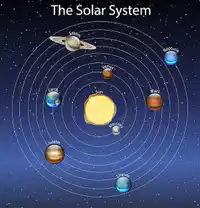
Solar System Ap Hd

Presentation
•
Science
•
7th Grade
•
Hard

Henry D
FREE Resource
10 Slides • 21 Questions
1
Discover Science: Geocentric vs. Heliocentric
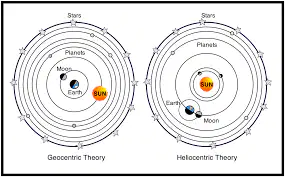
Geocentric means that everything revolves around the Earth. Heliocentric means that everything in the solar system revolves around the Sun. We found out that everything revolves around the Sun because in the early sixteen hundreds the telescope was invented.
2
Multiple Choice
Geocentric means what
3
Multiple Choice
Heliocentric means what
The Earth and planets revolve around the Sun
The Earth is the center of the universe
The Moon is the center of the solar system
The Sun revolves around the Earth
4
Fill in the Blanks
5
What Is The Solar System
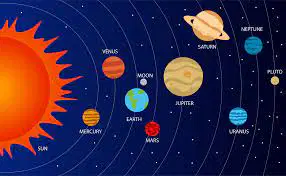
In older times there were only five planets Mercury, Venus Mars, Saturn, and Jupiter. The Solar System is part of the Milky Way. Our Solar System has the Sun, Planets, Dwarf Planets, Moons, Asteroids, Comets, and Meteoroids.
6
Multiple Choice
What are the five planets that older people new of
Mercury, Venus, Mars, Saturn, and Jupiter.
Mercury, Venus, Sun, Earth, and Neptune
Earth. Moon, Venus, Pluto, and Uranus
Saturn, Earth, Pluto, Mars, and Mercury,
Pluto, Jupiter, Venus, Neptune, and Earth
7
Multiple Choice
Our Solar System is part of which galaxy
Andromeda
8
The Sun
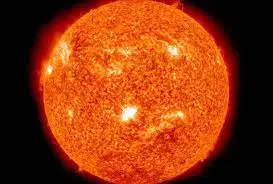
The Suns gravitational pull holds the planets and other things in orbit. The Sun is a star, a star is an extremely hot dense mass of gases. The light and heat that we get comes from the Sun.Our Sun is a medium sized star.
9
Multiple Choice
The Suns gravitational pull holds what in orbit
The Milky Way Galaxy
10
Multiple Choice
Whats a Star
A star is a extremely hot dense ball of gases
A star is a big planet
11
Planets
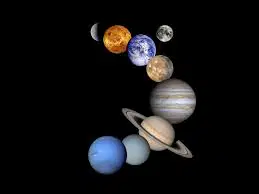
Within our Solar System there are 8 major planets. The planets closer to the Sun are small and rocky. The planets farthest to the Sun are gas giants.
12
Multiple Choice
The closest planets are
Small and rocky
Gas giants
13
Fill in the Blanks
14
The Inner Planets
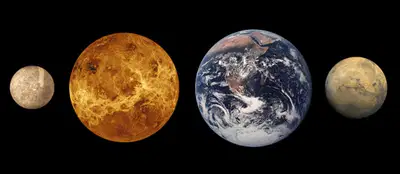
Mercury is the closest planet to the Sun. Venus is the second closest planet to the Sun. Earth is the third closest planet to the Sun. Mars is the fourth closest to the Sun. It takes Mercury 88 days to do one orbit around the Sun. Venus spins so slowly that it orbits around the Sun bfore it does one day cycle. There are 4 inner planets
15
Multiple Choice
How long does it take to travel one year on Mercury
72 days
666 days
21 days
88 days
16
Multiple Choice
How many inner planets are there
4
3
5
6
17
The Outer Planets
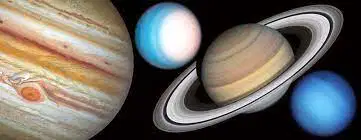
Jupiter, Saturn, Uranus, and Neptune are the outer planets. They all have freezing temperatures, many moons, and ring systems. Jupiter is the largest planet. Saturn has the largest ring system. Neptune is named after the Roman God of the sea.
18
Multiple Choice
Whats the biggest planet
19
Multiple Choice
All the Outer Planets have rings
True
False
20
Planets to scale
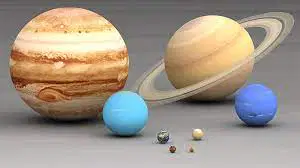
The Gas Giants are the biggest planets. The planets from biggest to smallest are Jupiter, Saturn, Uranus, Neptune, Earth, Venus, Mars, and Mercury.
21
Multiple Choice
What are the 4 biggest planets in order
22
Multiple Choice
What are the 4 smallest planets
23
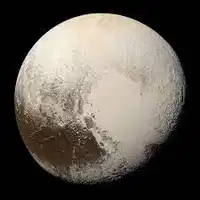
Pluto is No Longer A Major Planet
A planet must have The object is in orbit around the Sun, The object has a nearly spherical shape, and The object has cleared the neighborhood around its orbit of smaller objects. Pluto didn't meet the third criteria due to the large number of other frozen worlds that share its orbit. Since 2006 Pluto is considered a Dwarf Planet. Pluto is part of the Kuiper belt.
24
Multiple Choice
What was Pluto classified as before 2006
25
Multiple Choice
What is the third rule for being classified as a planet
Must have cleared the neighborhood around its orbit of smaller objects
26
Moons
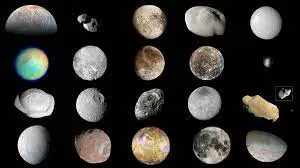
About 180 moons orbit the planets in our Solar System. Moons are smaller than the planet they orbit and are held in place by the pull of gravity from the planet its orbiting. Gas giants attract more moons, and bigger moons.
27
Multiple Choice
There are about _____ moons
180
250
28
Multiple Choice
What do moons orbit
29
Smaller Bodies
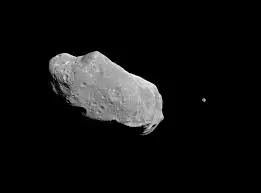
Asteroids are rocky objects that orbit the Sun. When a Asteroid is hit out of orbit it becomes a meteoroid and could be a potential threat to planets, moons, spacecrafts, and satellites. A comet is a small mass of dust and ice that originates in an area beyond Pluto called the Oort cloud. A coma is a trail of dust and gas that travels behind a comet.
30
Multiple Choice
When a Asteroid is hit it turns into a
31
Multiple Choice
Whats a coma
A coma is a comets trail
A coma is a type of punctuation mark used in writing
A coma is a moon
A coma is a planet
Discover Science: Geocentric vs. Heliocentric
Geocentric means that everything revolves around the Earth. Heliocentric means that everything in the solar system revolves around the Sun. We found out that everything revolves around the Sun because in the early sixteen hundreds the telescope was invented.
Show answer
Auto Play
Slide 1 / 31
SLIDE
Similar Resources on Wayground

25 questions
7.12DE Cell Organelles
Presentation
•
7th Grade
25 questions
Ecosystem Relationships
Presentation
•
7th Grade
25 questions
Global Warming
Presentation
•
7th Grade
23 questions
Earthquakes
Presentation
•
7th Grade
23 questions
Thermal Energy and Heat
Presentation
•
7th Grade
26 questions
Levels of Organization
Presentation
•
7th Grade
23 questions
Evidence of Evolution
Presentation
•
7th Grade
24 questions
Interpreting Distance Time Graphs
Presentation
•
7th Grade
Popular Resources on Wayground
16 questions
Grade 3 Simulation Assessment 2

Quiz
•
3rd Grade
19 questions
HCS Grade 5 Simulation Assessment_1 2526sy
Quiz
•
5th Grade
10 questions
Cinco de Mayo Trivia Questions

Interactive video
•
3rd - 5th Grade
17 questions
HCS Grade 4 Simulation Assessment_2 2526sy
Quiz
•
4th Grade
24 questions
HCS Grade 5 Simulation Assessment_2 2526sy
Quiz
•
5th Grade
13 questions
Cinco de mayo
Interactive video
•
6th - 8th Grade
20 questions
Math Review
Quiz
•
3rd Grade
30 questions
GVMS House Trivia 2026
Quiz
•
6th - 8th Grade
Discover more resources for Science
16 questions
Interactions within Ecosystems
Presentation
•
6th - 8th Grade
20 questions
genetics, punnett squares, heredity
Quiz
•
7th Grade
16 questions
Photosynthesis and Cellular Respiration Review
Quiz
•
7th Grade
20 questions
Food Webs + Energy Pyramids
Quiz
•
7th Grade
10 questions
Exploring the Rock Cycle
Interactive video
•
6th - 8th Grade
10 questions
Exploring Earth's Seasons and Their Causes
Interactive video
•
6th - 8th Grade
26 questions
Amplify Chemical Reactions
Quiz
•
6th - 8th Grade
19 questions
Natural and Artificial Selection
Quiz
•
7th Grade