

Ch 11 Sexual Reproduction and Meiosis

Presentation
•
Biology
•
9th - 12th Grade
•
Medium

Mansi Patel
Used 5+ times
FREE Resource
42 Slides • 19 Questions
1
2
Reorder
Reorder the phases of mitosis
Prophase
Metaphase
Anaphase
Telophase
3
Match
Nuclear envelope disappears; spindle fibers begin to form; chromatin condenses into chromosomes
Chromosomes line up in the middle of the cell
Sister chromatids are pulled away from each other
Nuclear envelope begins to form; spindle fibers fall apart; chromosomes relax into chromatin
Nuclear envelope disappears; spindle fibers begin to form; chromatin condenses into chromosomes
Chromosomes line up in the middle of the cell
Sister chromatids are pulled away from each other
Nuclear envelope begins to form; spindle fibers fall apart; chromosomes relax into chromatin
4
Multiple Choice
Which of the following does NOT accurately describe homologous pairs of chromosomes?
Homologous chromosomes code for the same genes and may have different alleles.
Homologous pairs contain one chromosome inherited from the father and one from the mother.
Homologous pairs contain one original chromosome and one replicated copy.
Human cells contain 23 pairs of homologous chromosomes.
5
Open Ended
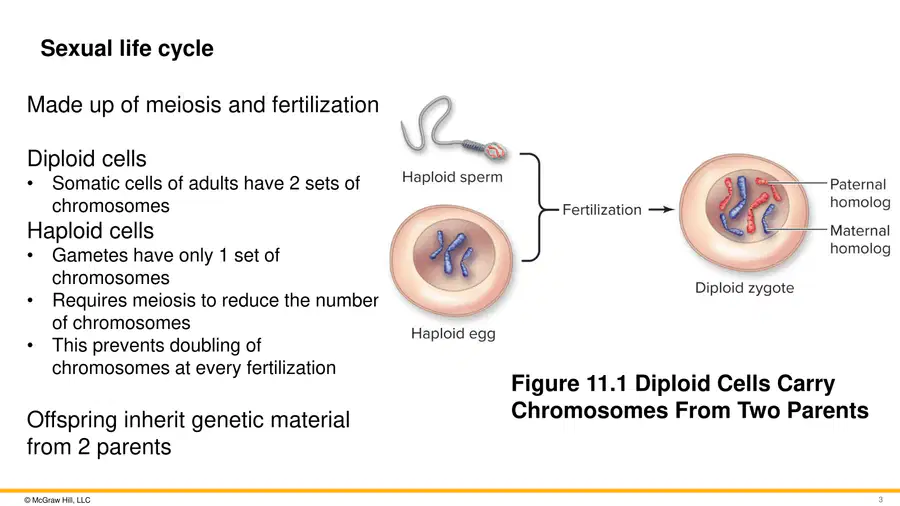
What kind of cells would need to be HAPLOID and why.
6
7
8
9
10
11
12
Multiple Choice

State the ploidy level and the number of chromosomes shown in the figure.
n=8
2n=8
n=16
2n=16
13
Multiple Choice
If a diploid cell contains 10 chromosomes, choose the correct ploidy level and the number of chromosomes in the cell after;
Mitosis: 2n=20
Meiosis: n=10
Mitosis: 2n=10
Meiosis: n=5
Mitosis: n=20
Meiosis: 2n=10
Mitosis: n=10
Meiosis: 2n=5
14
15
16
17

18
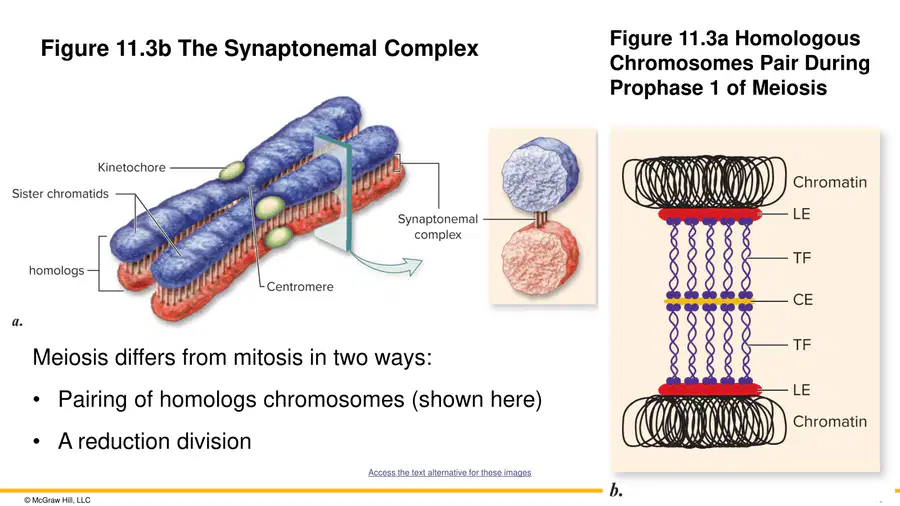
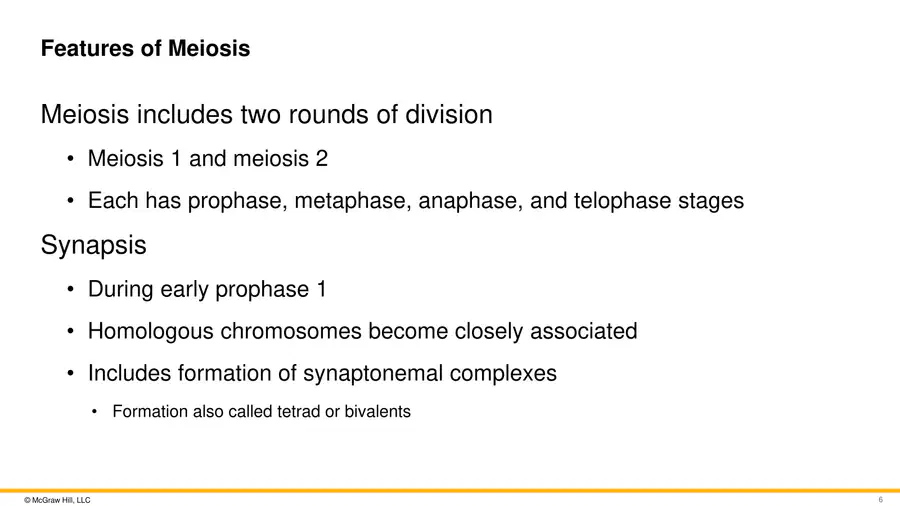
LE Lateral element
TF Transverse Filament
CE Central Element
19

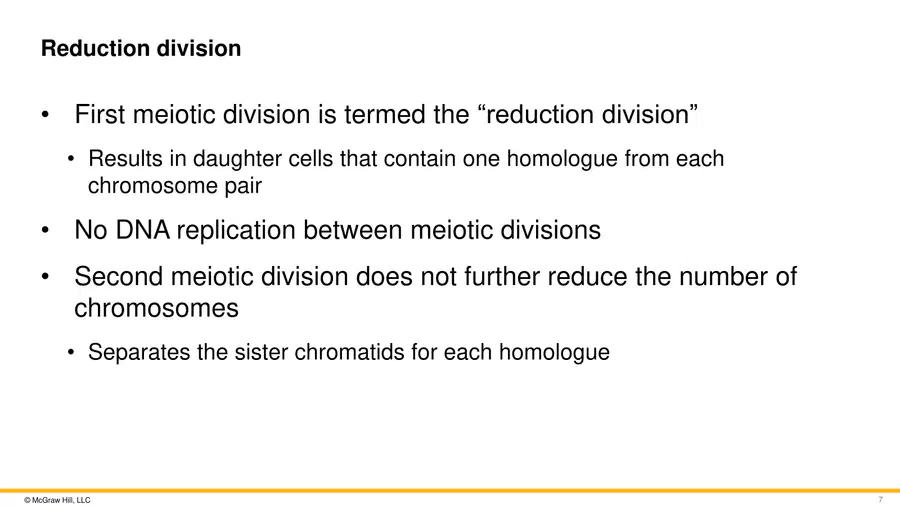
Sister chromatids: the identical copies (chromatids) formed by the DNA replication of a chromosome
Homologous chromosomes:Two chromosomes in a pair – normally one inherited from the mother and one from the father.
The chromosomes in a homologous pair each have the same genes in the same order, but there may be variation between them, resulting in different alleles.

/tetrad
Bivalent/ tetrad: Each pair of homologous chromosomes consists of four chromatids which are undergoing synapsis.
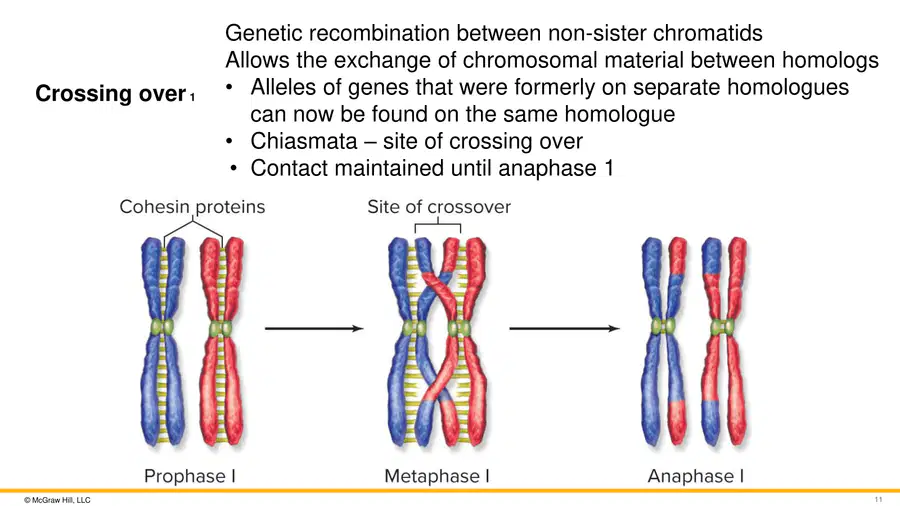
Chiasma: a point at which paired chromosomes undergo crossing over and exchange of genetic material occur between the strands.
Synapsis
The pairing and physical connection of one duplicated chromosome to its homolog during Prophase I
Crossing Over:
the exchange of genetic
material between non-sister
chromatids of homologous
chromosomes during meiosis
20
21
22
23


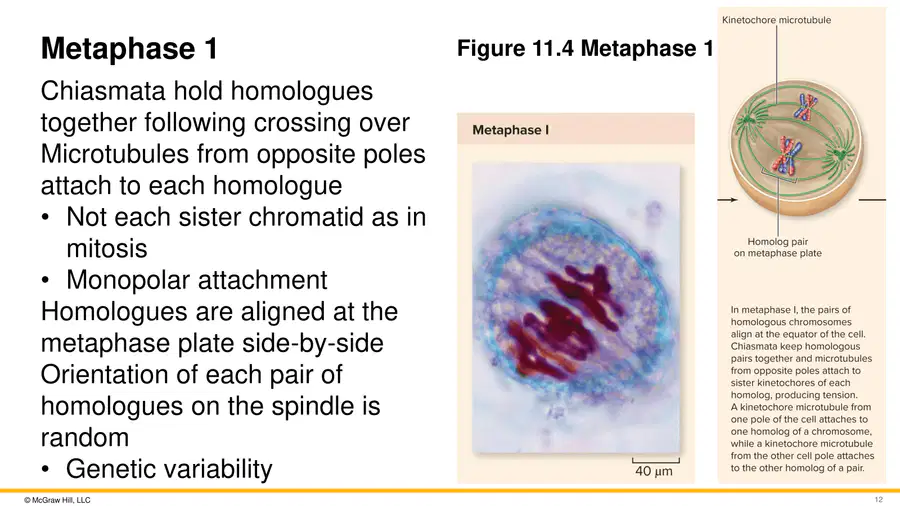
Law of Segregation:
Happens during Metaphase I
What Do I
Need To
Know?
24
25


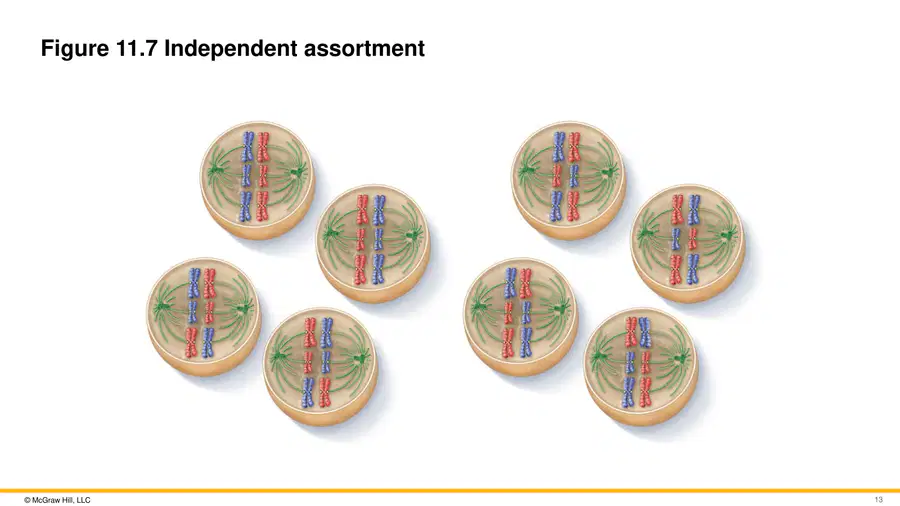
o During independent
assortment,
homologous
chromosome are
divided in half to form
haploid cells randomly.
o Happens during
Metaphase I.
What Do I
Need To
Know?
26
27
Multiple Choice
Which of Mendel's laws states that Chromosomes are distributed to gametes independent of one another?
Law of Dominance
Law of Segregation
Law of Independent Assortment
28
Multiple Choice
Which of Mendel's laws states that alleles are separated during meiosis?
Law of Dominance
Law of Segregation
Law of Independent Assortment
29
Multiple Choice
Which of the following best explains why meiosis results in greater genetic diversity than mitosis?
After meiosis, daughter cells are diploid and have twice as much genetic material, which can be divided in many more possible combinations.
After meiosis, haploid daughter cells are fertilized, which doubles their number of chromosomes and increases the number of possible genes.
During meiosis, chromosomes assort themselves independently of each other, which allows for more different possible combinations of chromosomes.
During meiosis, more daughter cells are produced, which increases the likelihood that fertilization will occur.
30
Multiple Choice

This diagram shows a diploid cell with two pairs of homologous chromosomes.
Due to independent assortment, what is the possible genetic make-up of gametes produced by this organism?
SsTt
Ss, Tt
S, s, T, t
ST, St, sT, st
31
Sources of Genetic Variation:
crossing over - exchange of genetic information
independent assortment of chromosomes
segregation of alleles
random fertilization

32
33
34
35
36
37
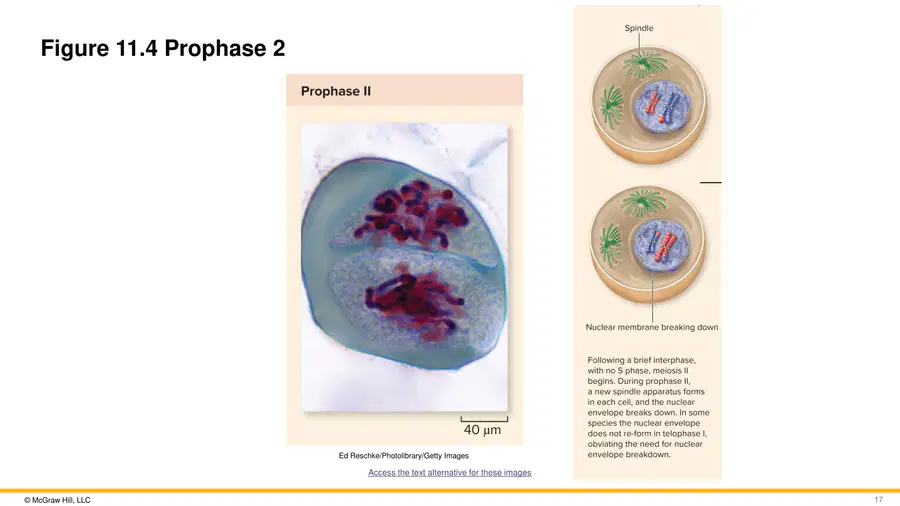
38
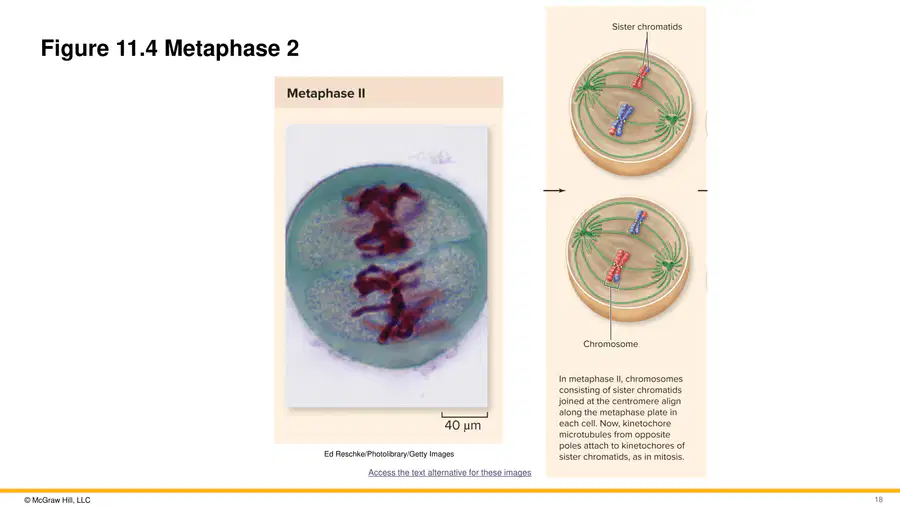
39
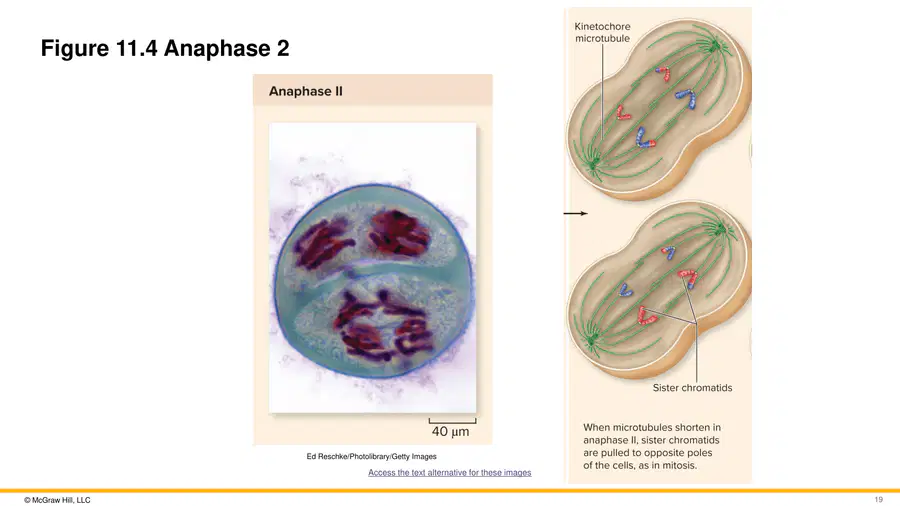
40
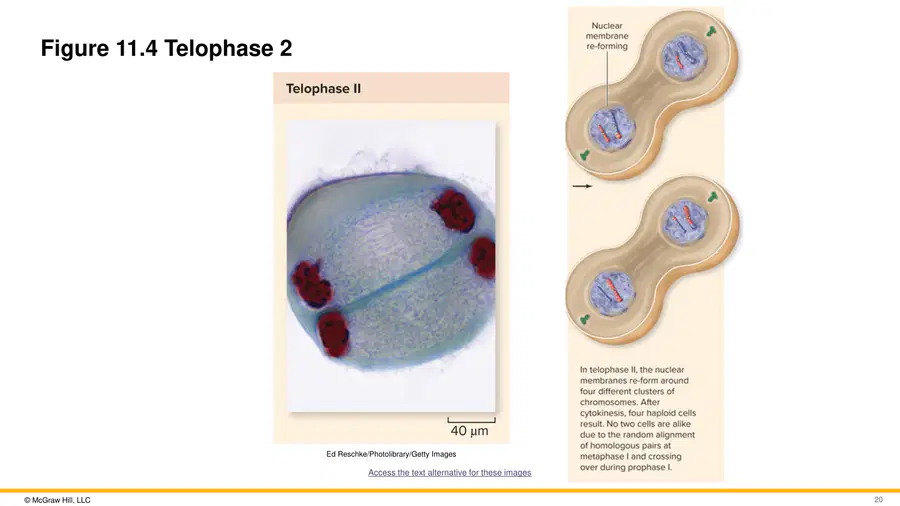
41
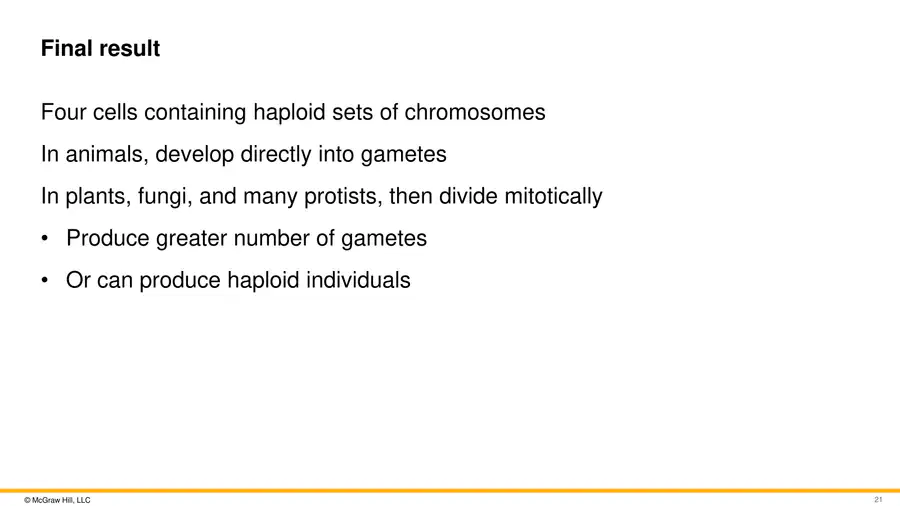
42
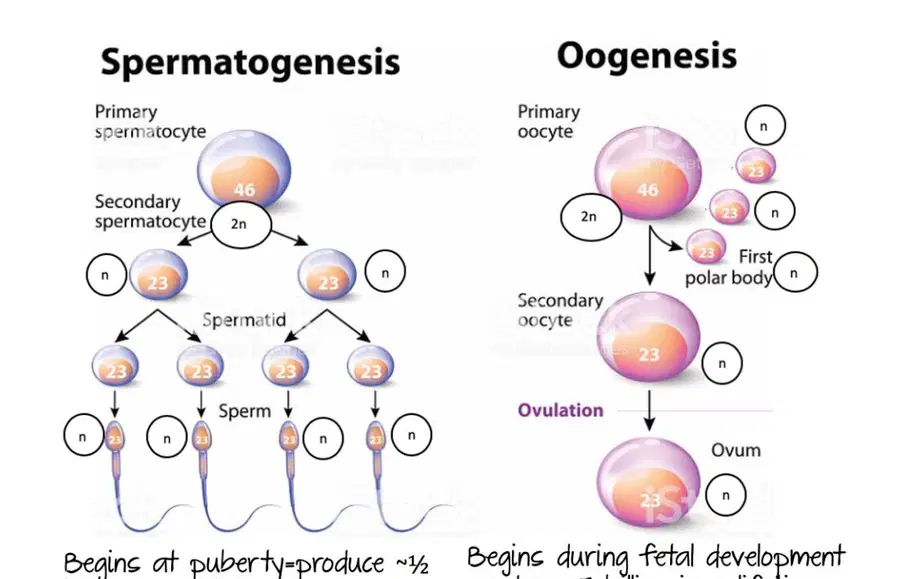
43
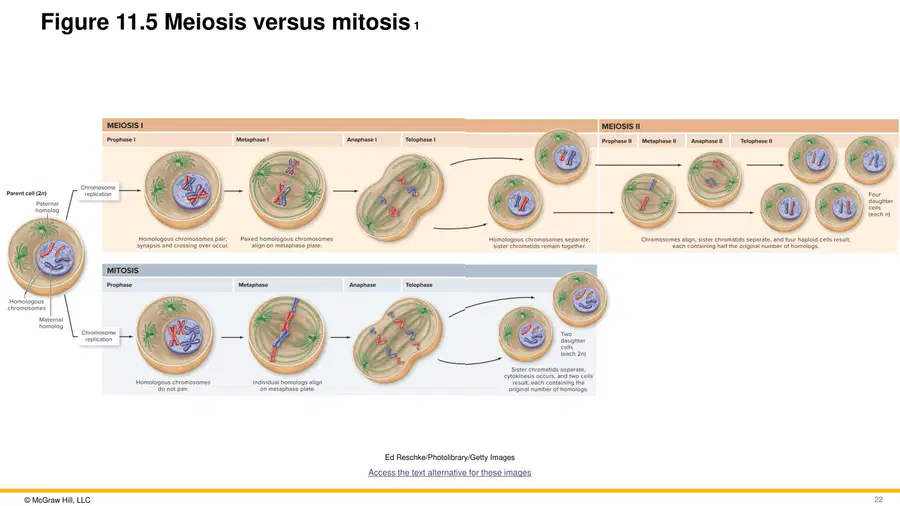
44
Match
Match the correct statements with the corresponding type of cell division.
Mitosis is defined as
Meiosis
type of cell?
Mitosis
type of cell?
Meiosis
End result
Mitosis
End result
the division of the replicated contents of the nucleus of somatic cells
Haploid Cells
diploid cells
4 different daughters' cells
2 identical daughters' cells
the division of the replicated contents of the nucleus of somatic cells
Haploid Cells
diploid cells
4 different daughters' cells
2 identical daughters' cells
45
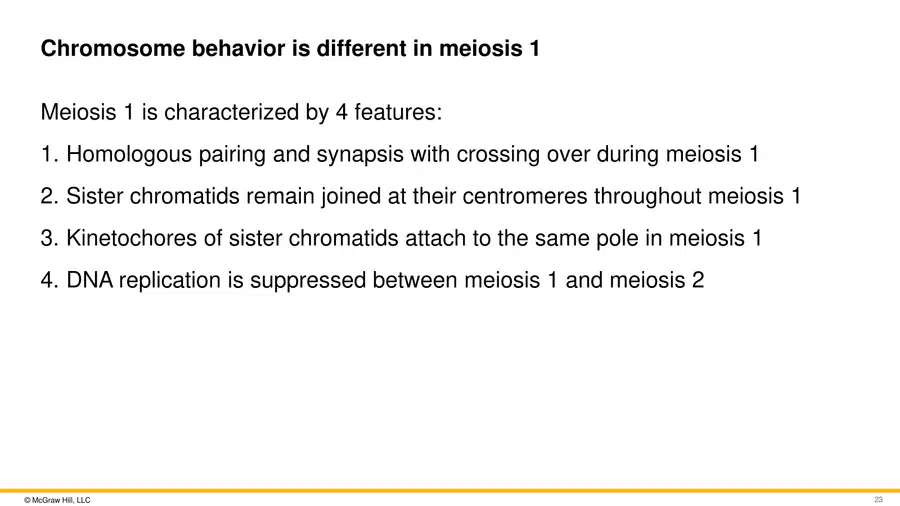
46
47
48

General Rules
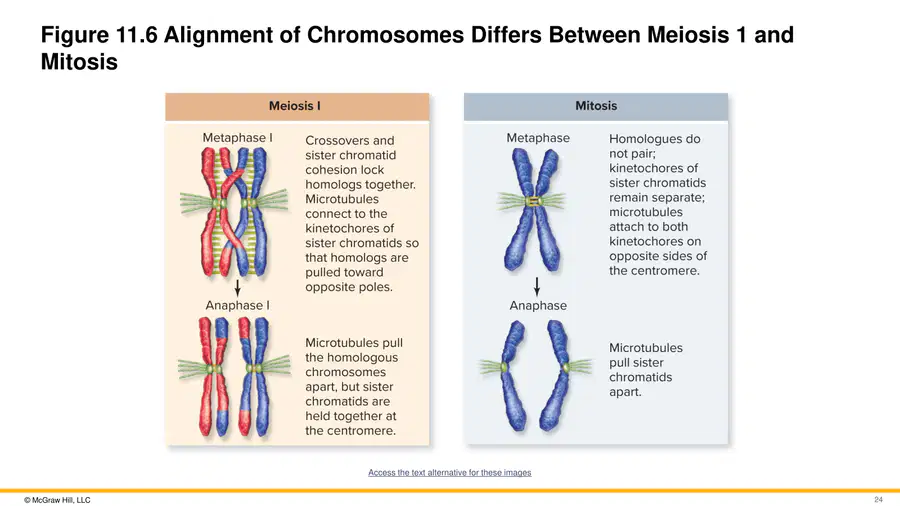
Mitosis vs Meiosis I: different chromosomal behaviour but same number of chromosomes.
Mitosis vs Meiosis II: similar chromosomal behaviour but different number of chromosomes (chromosome number is half/n in meiosis II)
Meiosis I vs Meiosis II:
different chromosomal behaviour and number of chromosomes
(chromosome number is half/n in meiosis II)

49


Similarities
Chromatin / chromosome shortens, thicken and condense
Nuclear membrane & nucleolus disintegrate / disappear
A pair of sister chromatids attached together at centromere
Centrosome migrate to opposite poles / spindle fiber begins to form
No synapsis
No crossing over
Chromosome number is diploid.
Synapsis (Homologous chromosomes pair up)
Crossing over occurs at chiasmata.
Chromosome number is diploid
No synapsis (Sister chromatids line up)
No crossing over
Chromosome number is haploid
50
Multiple Choice

State the phase and the chromosomal event shown in the figure.
Prophase: no synapsis and crossing over between non-sister chromatids
Prophase I: synapsis and crossing over occurs between non-sister chromatids
Prophase II: no synapsis and crossing over between non-sister chromatids
Prophase II: synapsis and crossing over occurs between non-sister chromatids
51
Multiple Choice

State the phase and the chromosomal number shown in the figure.
Prophase, n=6
Prophase, 2n=6
Prophase I, n=6
Prophase I, 2n=6
Prophase II, n=6
52
Chromosomes align at metaphase plate
Homologous chromosomes align at metaphase plate (Chromosomes line up in pairs)
Chromosomes align at metaphase plate (same chromosomal behaviour as Metaphase but chromosomal number is halved)


53
Multiple Choice

A diploid cell has 6 chromosomes. Determine the phase and chromosomal behaviour of the cell as shown in the figure.
Metaphase: chromosomes align at metaphase plate
Metaphase I: Homologous chromosomes align at metaphase plate
Metaphase II: Chromosomes align at metaphase plate
Metaphase II: Homologous chromosomes align at metaphase plate
54
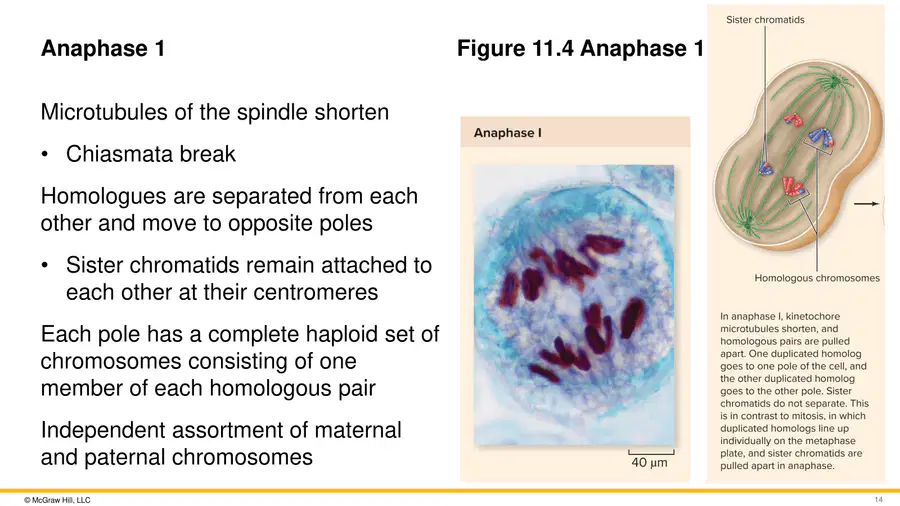
Sister chromatids separate and move to the opposite poles
Centromeres split
Homologous chromosome separate and move to the opposite poles
Centromeres do not split
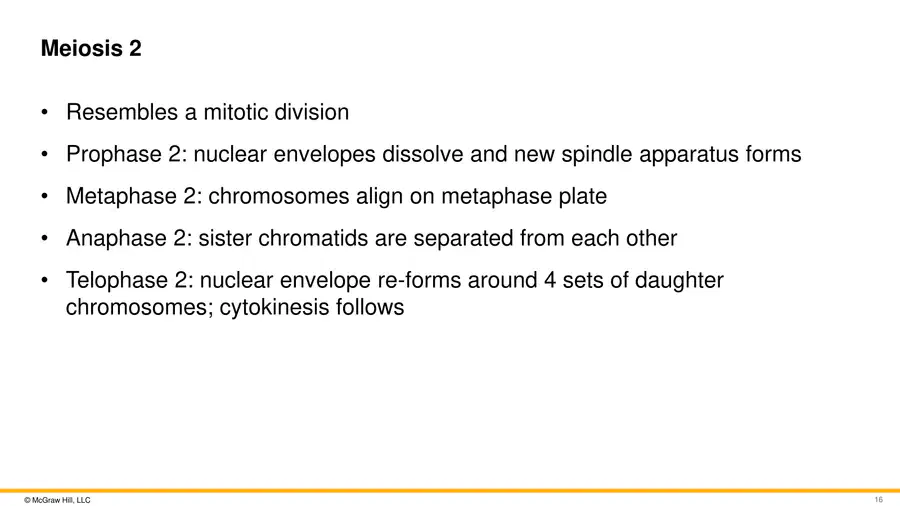
Sister chromatids separate and move to the opposite poles
Centromeres split
(same chromosomal behaviour as Anaphase but chromosomal number is halved)


55
Multiple Choice

State the phase and the chromosomal behaviour shown in the figure.
Anaphase: Sister chromatids separate & move to the opposite poles
Anaphase: Homologous chromosomes separate & move to the opposite poles
Anaphase I: Sister chromatids separate & move to the opposite poles
Anaphase I: Homologous chromosomes separate & move to the opposite poles
Anaphase II: Sister chromatids separate & move to the opposite pol
56
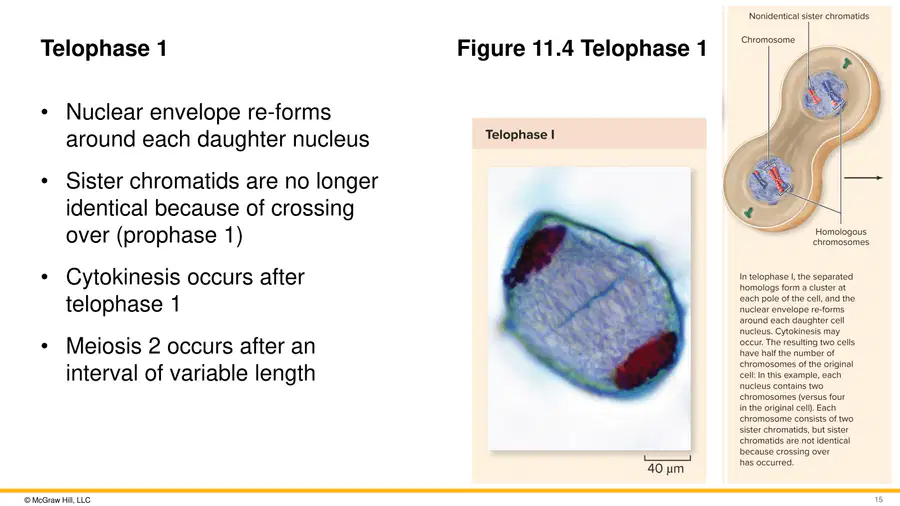
Chromosomes arrive at the opposite poles (each chromosomes consist of 1 chromatids)
Each pair of homologous chromosomes arrive at the opposite poles.
Chromosomes arrive at the opposite poles (each chromosomes consist of 1 chromatids)
*same chromosomal behaviour as Telophase but chromosomal number is halved


Similarities
Nuclear membrane & nucleolus reappear
Spindle fibre disintegrates.
57
Multiple Choice

Name the phase shown in the figure. What is the ploidy level and chromosomal number in each cell at the end of this phase?
Telophase. n=3
Telophase. 2n=6
Telophase I. n=3
Telophase I. 2n=6
Telophase II. n=3
58
Multiple Choice
Cells and the organisms they make up reproduce through cell division. Some organisms reproduce through mitosis, while others reproduce through meiosis and fertilization. What advantage does meiosis give to organisms that reproduce sexually?
Meiosis ensures that offspring inherit genes from their parents.
Meiosis ensures that offspring will not inherit any genetic disorders.
Meiosis ensures that offspring are genetically different from their parents.
Meiosis ensures that offspring will have identical phenotypes to their parents.
59
Multiple Choice
Some organisms are able to reproduce asexually through mitosis, while cells of organisms that reproduce sexually will undergo meiosis to produce gametes. Which process do you predict would be most beneficial to a species during drastic change in environmental conditions?
Meiosis; it results in more daughter cells, which increases the population of the species.
Meiosis; it results in more genetic variation, which would help ensure the species will survive.
Mitosis; it results in more genetic mutations, which may be advantageous to the species.
Mitosis; it results in more offspring in a short time, which increases the odds that some will survive.
60
61
Categorize
Asexual division
Cell division for growth and repair
Results in two identical daughter cells
Occurs in somatic cells
Consists of prophase, metaphase, anaphase, and telophase
Chromosomes line up in the center of the cell during metaphase
Reduction division
Results in two haploid daughter cells
Consists of prophase I, metaphase I, anaphase I, and telophase I
Crossing over occurs during prophase I
Homologus chromosomes are separated during Anaphase I
Results in four haploid daughter cells
Occurs in reproductive cells
Consists of prophase II, metaphase II, anaphase II, and telophase II
Sister Chromatids are separated during Anaphase II
Similar to mitosis
Sexual division
Creates Gametes
Independant assortment occurs to ensure random assortment of parental chromosomes
Show answer
Auto Play
Slide 1 / 61
SLIDE
Similar Resources on Wayground

49 questions
Patterns of Inheritance
Presentation
•
9th - 12th Grade
49 questions
Classification and Evolution
Presentation
•
9th - 12th Grade
60 questions
DNA introduction
Presentation
•
9th - 12th Grade
57 questions
Genes and Punnett squares
Presentation
•
9th - 12th Grade
53 questions
Protein Synthesis Lesson
Presentation
•
9th - 12th Grade
50 questions
DNA Structure and Replication
Presentation
•
9th - 12th Grade
63 questions
Evolution
Presentation
•
10th Grade - University
51 questions
SC9 DNA,Chromosomes
Presentation
•
9th - 12th Grade
Popular Resources on Wayground
10 questions
Safety Day 2026 – Student Review

Quiz
•
9th Grade
21 questions
Continents and Oceans
Quiz
•
6th Grade
20 questions
Parts of Speech
Quiz
•
5th Grade
16 questions
Subject & Predicate
Quiz
•
5th Grade
25 questions
Multiplication Facts
Quiz
•
5th Grade
12 questions
Map Skills
Quiz
•
3rd Grade
22 questions
Continents and Oceans
Quiz
•
5th Grade
15 questions
Rounding Decimals
Quiz
•
5th Grade
Discover more resources for Biology
20 questions
Cell organelles and functions
Quiz
•
10th Grade
20 questions
Cell Transport
Quiz
•
9th - 12th Grade
25 questions
photosynthesis and cellular respiration
Quiz
•
9th Grade
20 questions
Cell Cycle
Quiz
•
9th Grade
8 questions
DNA vs. RNA
Presentation
•
9th - 12th Grade
14 questions
Ecological Succession: Primary and Secondary
Quiz
•
9th Grade
20 questions
Macromolecules
Quiz
•
10th Grade
20 questions
Characteristics of Life
Quiz
•
9th - 10th Grade