

Age of Innovation and Industry

Presentation
•
Social Studies
•
9th - 12th Grade
•
Medium

Carie Barry
Used 2+ times
FREE Resource
6 Slides • 11 Questions
1
The Age of Innovation and Industry
In September 1878, a young inventor from Menlo Park, New Jersey, traveled to observe a particular set of experimental arc lights. Although the lights were too hot and bright for practical use, they continued to fascinate him, and the more he studied the lights and the generator that powered them, the greater the impression they left.
2
The inventor, Thomas Alva Edison, knew he could invent a superior lighting system, one that could be universally used. At the age of 31, he had already been dubbed the “Wizard of Menlo Park” because of his many inventions, including the phonograph and a highly efficient automated telegraph system. Now, Edison vowed to invent a practical incandescent lamp—what we would eventually call a lightbulb.
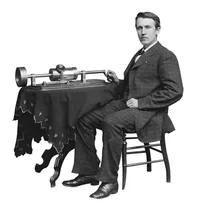
Thomas Edison set up his first laboratory when he was just 10 years old. He would eventually become one of the most productive inventors in American history, with over 1,000 inventions credited to his name.
3
Edison and his team of scientists and mechanics set to work. Other inventors had for decades attempted to produce a practical lightbulb. However, it was extremely difficult to find a filament—a thin fiber or wire—that would heat to a bright glow but not melt when electric current passed through it. Edison tried thousands of materials, from platinum to twine to human hair. Finally, around 1879, he used bamboo fibers that he had taken from a Japanese fan. After carbonization—the process of converting a fiber to pure carbon—the bamboo filament burned without melting, and Edison finally had his lightbulb.

Thomas Edison conducted scientific experiments in his laboratory in New Jersey.
4
That major success would not slow Edison’s ultimate quest. He and his team were already hard at work developing other components of a complete electric lighting system as well as designing generators, meters, and cables. They were making plans for distributing electricity and installing lighting displays to promote the benefits of the electric lamp. Edison did not simply invent the lightbulb. He envisioned the future of electricity, and he worked to make his vision a reality.

5
Inventions like Edison’s lightbulb helped generate a new age of innovation and industry after the Civil War. This period also saw the rise of big business, which would create great wealth. This lesson explores how industrialization affected the nation as a whole, and the next lesson examines its effects on workers.

6
7
Multiple Choice
What was the result of carbonizing bamboo fibers for use in light bulbs?
The fibers melted immediately
The fibers produced a weak light
The fibers burned without melting
The fibers were too fragile to use
8
Dropdown
9
Drag and Drop
The Electric Innovator
The Light Bulb Creator
The Generator Genius
10
Multiple Choice
What motivated Thomas Edison to invent a better lighting system?
The challenge of creating a long-lasting light source
The excitement from studying lights and generators
The need for a new type of generator
The desire to improve the telegraph system
11
Multiple Choice
What was the main problem Edison faced when trying to invent the practical light bulb?
Finding a suitable power source
Designing a switch for the light bulb
Finding a filament that would not melt
Creating a bulb that could change colors
12
Open Ended
What did Edison do besides inventing the light bulb?
13
Multiple Choice
How did Edison's light bulb invention affect the post-Civil War period?
It slowed down industrial growth
It had little impact on innovation
It sparked a new age of innovation and industry
It led to the decline of electric companies
14
Dropdown
15
Drag and Drop
More than 6,000
About 5,000
Over 3,000
16
Dropdown
17
Drag and Drop
Bamboo fiber
Silk thread
Carbonized cotton
The Age of Innovation and Industry
In September 1878, a young inventor from Menlo Park, New Jersey, traveled to observe a particular set of experimental arc lights. Although the lights were too hot and bright for practical use, they continued to fascinate him, and the more he studied the lights and the generator that powered them, the greater the impression they left.
Show answer
Auto Play
Slide 1 / 17
SLIDE
Similar Resources on Wayground

13 questions
slope
Presentation
•
9th - 12th Grade
13 questions
Earthquake Safety: Drop, Cover, and Hold On
Presentation
•
9th - 12th Grade
14 questions
Hidden Histories: Songhai Empire
Presentation
•
9th - 12th Grade
16 questions
Bocce
Presentation
•
9th - 12th Grade
12 questions
Midpoint
Presentation
•
9th - 12th Grade
12 questions
Domain 2 Lesson 1
Presentation
•
9th - 12th Grade
12 questions
The present progressive
Presentation
•
9th - 12th Grade
11 questions
Camera Angles
Presentation
•
9th - 12th Grade
Popular Resources on Wayground
10 questions
Impact of 9/11 and the War on Terror

Interactive video
•
10th - 12th Grade
21 questions
Continents and Oceans

Quiz
•
6th Grade
5 questions
9/11
Interactive video
•
9th Grade
20 questions
Parts of Speech
Quiz
•
5th Grade
16 questions
Subject & Predicate
Quiz
•
5th Grade
10 questions
Riddles Riddles fun Riddles
Quiz
•
6th - 12th Grade
21 questions
Lab Safety
Quiz
•
10th Grade
6 questions
PRIDE in the Hallways and Bathrooms
Presentation
•
12th Grade
Discover more resources for Social Studies
5 questions
9/11
Interactive video
•
9th Grade
6 questions
PRIDE in the Hallways and Bathrooms
Presentation
•
12th Grade
10 questions
Exploring the Age of Exploration: Key Events and Figures
Interactive video
•
6th - 10th Grade
16 questions
USHC 4.8 Immigration and Urbanization
Quiz
•
9th - 12th Grade
64 questions
USHC 4 Key Terms 22-23
Quiz
•
11th Grade - University
10 questions
Exploring Types of Maps for Middle Schoolers
Interactive video
•
6th - 10th Grade
16 questions
Unit 3.1 Quiz Review
Quiz
•
11th Grade
30 questions
Reconstruction Era Test
Quiz
•
11th Grade