Search Header Logo
Category 3 Biology Review

Category 3 Biology Review

Assessment

Presentation

Biology

9th - 12th Grade

Medium

NGSS
MS-LS4-2, MS-LS4-4, MS-LS4-1

+9

Standards-aligned

Created by

PRISCILLA LUMBRERAS

Used 4+ times

FREE Resource

13 Slides • 62 Questions

1

media
media
media
media
media
media

Evidence of

Evolution

2

media
media
media
media

Fossils

Provide historical evidence about the order in
which changes have occurred

Fossils found in young layers of rock (ie closer
to the surface) tend to be more similar to
present day organisms; oldest ancestors in
deepest layers

Extinction of organisms allow for new
resources to be available and allow for new
mutations to be shown as beneficial or not.

3

Multiple Choice

Which of the following can be learned by using the fossil record?

1

When organisms changed or evolved

2

when organisms became extinct

3

when organisms appeared on Earth

4

All the above

4

Multiple Choice

How do fossils provide evidence that evolution has happened on Earth?
1

Fossils show how the sizes of certain animals has changed drastically over millions of years

2

Fossils show that some species have gone extinct

3

Fossils show how life forms present today are different than those from the past

4

Different sedimentary rock layers provide evidence for how the environment has changed over time

5

media
media
media
media

1.Remnants of structures that were
once useful, but do not serve a
purpose now.

2.

Help in identifying relationships
between organisms.

Vestigial Structures

6

media
media

Structures are formed and set
up the same way.

Homologous structures may
not necessarily perform the
same function but they share
a common ancestral origin
due to how they develop.

Homologous
Structures

7

media
media
media

Structures of different
species having similar
function but not from
the same origin.

Structures are not
formed the same way,
but they have a similar
appearance/function.

Analogous
Structures

8

Multiple Choice

What term describes part of organisms, that have a similar structure but a different function?

1

homologous structure

2

homologous chromosome

3

vestigial structure

4

analogous structure

9

Multiple Choice

Question image

The appendix has no apparent function in humans today, but scientists think it used to help human ancestors digest certain foods. The appendix could be considered a _____________.

1

Homologous structure

2

Vestigial structure

3

Analogous structure

4

Adaptive structure

10

Multiple Choice

Question image

Two body structures, found in unrelated species, have different structures but serve similar functions in each species. This describes___________.

1

Homologous structures

2

Analogous structures

11

Multiple Choice

Which would NOT be an example of an analogous structure?

1

a bird wing and a bat wing

2

a cat arm and a whale fin

3

a dolphin fin and whale fin

4

a bird wing and a butterfly wing

12

media
media
media

1.

Embryos from different vertebrates are very similar
during early stages of development.

2.

The longer they are similar during development the
more closely related they are.

Embryonic
Structure

13

Multiple Choice

Question image
In stage one (top row) of these embryos, most of the embryos________
1

look very similar.

2

have very different features.

3

show different stages of development.

4

have only a tail if they are non-human.

14

media
media

All organisms share the same
genetic material.

The more alike two organisms are,
the more alike their DNA base
sequence, the more amino
acids/proteins they have in
common (genetic sequence).

DNA

What does this cladogram diagram tell us?

15

Multiple Choice

Question image
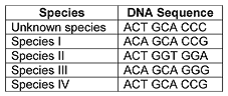
According to this data, the unknown bacterial species is most closely related to: 
1

Species I

2

Species II

3

Species III

4

Species IV

16

Multiple Choice

If two organisms have similar traits of DNA they are probably
1

share a common ancestor

2

share a common environment

3

share a common population

4

speciation

17

Multiple Choice

Question image
Which species’ DNA is most similar to the DNA of the toothed whale? 
1

Hippopotamus 

2

Baleen Whale

3

Grazing Mammals

4

Camels

18

Multiple Choice

Question image

What number is the common ancestor of C and D

1

1

2

2

3

3

4

4

19

Match

Match the following

Analogous Structure

Homologous Structure

Comparative Embryology

Biochemical Evidence

Vestigial Structures

Same function different structure

Same structure different function

Comparing embryological development of different species

Comparing DNA and amino acid sequences of different species

Structures in the body of an organism that no longer work.

20

Multiple Choice

Question image
Two organisms that are closely related would have
1

very similar DNA sequence

2

exactly the same DNA sequences

3

no proteins in common

4

completely different DNA sequence

21

media
media
media

Fast lion vs. slow zebra Strong, healthy person vs. weak, sick person

Turn and talk: Who has the greatest
chance of survival?

22

media
media
media
media
media

Darwin’s Theory of Natural Selection

1.There is variation within any species

2. All organisms tend to over-reproduce
making competition for food and
water.

3.There is a struggle for survival which
can lead to extinction.

4.The fittest survive and pass on their
genes which may lead to new
species.

5.The environment determines who is
the fittest.

23

media
media

Evolution Recap

24

Multiple Choice

Question image

This makes an organism more suited to its environment

1

species

2

lifespan

3

adaptation

4

mutation

25

Multiple Choice

Question image
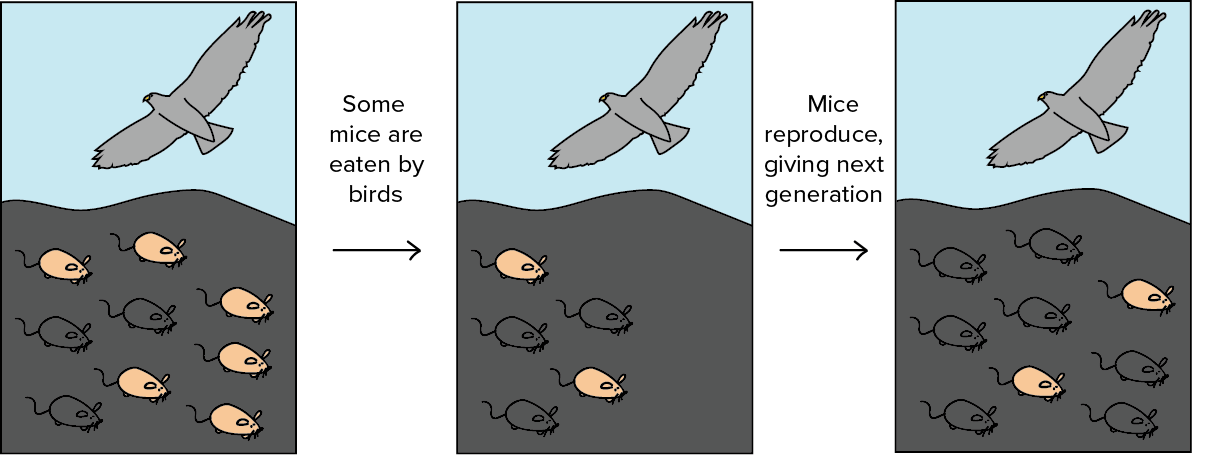
Why is the mouse population changing over time?
1

The light mice can reproduce more successfully than the dark mice

2

The hawks eat more dark mice than light mice because the dark mice taste better

3

The hawks eat more light mice than dark mice because they can see the light mice more easily

4

The hawks eat more dark mice than light mice because they can see the dark mice more easily

26

Multiple Choice

Question image

Click on the image to increase size, then answer the question.

1

A

2

B

3

C

4

D

27

Multiple Choice

Question image
Process by which individuals that are better suited to their environment survive and reproduce most successfully; also called survival of the fittest.
1
Extinction
2
Speciation
3
Natural Selection
4
Artificial Selection

28

Multiple Choice

Question image

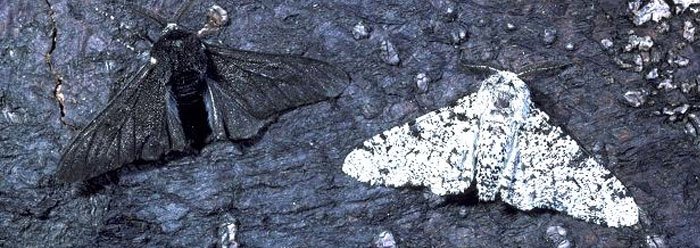
The trees these moths used to live on were white, but have been covered in soot from coal factories. Which moth will be more successful in this environment?

1

Dark moth

2

Light moth

3

Both will be equally successful

4

Neither will be successful

29

media

In
biology, what is classification?

There are millions and millions of species,
so classifying organisms into proper
categories can be a difficult task. To make
it easier for all scientists to do, a
classification system had to be developed.

This Photo by Unknown Author is licensed under CC BY

30

media

Linnaean Classification

The Linnaean system of classification consists of a
hierarchy of groupings, called taxa (singular, taxon). Taxa
range from the kingdom to the species. The kingdom is
the largest and most inclusive grouping. It consists of
organisms that share just a few basic similarities.
Examples are the plant and animal kingdoms.
The species is the smallest and most exclusive
grouping. It consists of organisms that are similar enough
to produce fertile offspring together. Closely related
species are grouped together in a genus.

31

media

Binomial Nomenclature

Perhaps the single greatest contribution
Linnaeus made to science was his method of
naming species. This method, called binomial
nomenclature, gives each species a unique,
two-word Latin name consisting of the genus
name and the species name. An example
is Homo sapiens, the two-word Latin name for
humans. It literally means “wise human.” This
is a reference to our big brains.

Why is having two names so important? It is
similar to people having a first and a last
name. You may know several people with the
first name Michael, but adding Michael’s last
name usually pins down exactly whom you
mean. In the same way, having two names
uniquely identifies a species.

32

Multiple Choice

The correct order of classification from the BROADEST group to the most narrow is:

1

Species, Genus, Family, Order, Class, Phylum, Kingdom

2

Kingdom, Phylum, Class, Family, Order, Genus, Species

3

Domain, Kingdom, Family, Order, Phylum, Class, Genus, Species

4

Domain, Kingdom, Phylum, Class, Order, Family, Genus, Species

33

Multiple Choice

Question image

An organism that LACK a NUCLEUS (NO NUCLEUS)

1

Eukaryote

2

Prokaryote

3

Heterotroph

4

Autotroph

34

Multiple Choice

Question image
Which kingdom has the following characteristics... Eukaryotic, Sexual, Multicellular, Heterotrophic.
1
Bacteria
2
Protista
3
Plant
4
Animal

35

Multiple Choice

Question image
Which kingdom has the following characteristics... Eukaryotic, Sexual, Multicellular, and Autotrophic
1
Bacteria
2
Protista
3
Plant
4
Animal

36

Multiple Choice

Question image
Which kingdom has the following characteristics... Prokaryotic, Asexual, Unicellular, and can be both Autotrophic and Heterotrophic.
1
Bacteria
2
Protista
3
Fungi 
4
Plant

37

Multiple Choice

Question image
Which type of cells contain a nucleus?
1
Prokaryotes
2
Eukaryotes
3
Both prokaryotes and eukaryotes 

38

Multiple Choice

Question image

Which of the following is a common trait to all members of the six kingdoms: Eubacteria, Archaebacteria, Protista, Fungi, Plantae, and Animalia?

1

Presence of a cell wall

2

Capable of sexual reproduction

3

Presence of genetic material

4

Presence of a nucleus

39

Match

Match the kingdom with the substance that composes their cell wall.

cellulose

chitin

peptido.

no peptido

plantae

fungi

eubacteria

archaebacteria

40

Multiple Choice

Question image
Which rank contains the largest number of organisms?
1
Genus
2
Species
3
Class
4
Order

41

Multiple Choice

Question image

what taxon contains the least amount of organisms?

1

kingdom

2

phylum

3

genus

4

species

42

Multiple Choice

Question image
Lions and housecats share some common traits, but can't breed with one another. What can you infer about how they're classified?
1
They might belong to the same family, but a different genus and species
2
They might belong to the same order, but different phyla
3
They might belong to the same domain, but different kingdoms
4
They might belong to the same species, but different subspecies

43

Multiple Choice

A wolf's scientific name is Canis rufus. Which genus does it belong to?

1

Canis

2

rufus

3

wolf

4

animal

44

Multiple Choice

What levels of classification are used in the scientific name?

1

Kingdom, Phylum

2

Kingdom, Species

3

Genus, Species

4

Phylum, Genus

45

Multiple Choice

Question image

Based on the DNA sequences shown, the unknown species is most closely related to ________.

1

Species I

2

Species II

3

Species III

4

Species IV

46

Multiple Choice

Homologous structures are defined as anatomical structures originating from the same structure in ancestral form. For instance, a bird's wing and the front flippers of a seal are examples of homologous structures. Which of the following does the presence of homologous structures in vertebrates suggest?

1

All vertebrates developed at the same rate.

2

All vertebrates developed internally.

3

All vertebrates evolved from different animals.

4

All vertebrates have a common ancestor.

47

Multiple Choice

Question image

The example shown of these 2 mammals incubating their offspring in a pouch provides evidence that they______.

1

belong to the same species

2

must range great distances to eat

3

have very similar skeletal structures

4

are descended from a common ancestory

48

Multiple Choice

Question image

Each labeled area of this diagram represents organisms in a taxonomic level. In this diagram, level A represents marine mammals. The area of the diagram labeled B most likely represents which of the following taxonomic levels?

1

fish

2

mammals

3

invertebrates

4

primates

49

Multiple Choice

Question image

Based on the map shown, which organisms are more closely related?

1

1 and 4

2

2 and 6

3

7 and 8

4

2 and 3

50

Multiple Choice

Scientists compared the fossil remains of a species that lived 5,000 years ago to members of the same species living today. Scientists concluded that the species changed very little over this period of time. Which statement best accounts for this lack of change?

1

The environment did not change significantly, and those offspring expressing new characteristics survived their natural enemies.

2

The environment changed significantly, but the species had no natural enemies for a long period of time.

3

The environment did not change significantly, and those offspring expressing new characteristics did not survive.

4

The environment changed significantly, and those offspring without favorable characteristics did not survive.

51

Multiple Choice

Question image

Based on the table, which organisms are more closely related?

1

G. atlantica and G. stehini

2

G. galloti palmae and G. stehini

3

G. galloti eisentrauti and G. stehini

4

G. galloti eisentrauti and G. galloti palmae

52

Multiple Choice

Question image

Scientists can determine relatedness among organisms by comparing partial amino acid sequences. The table shows four partial amino acid sequences from four organisms. Which organism is the LEAST related to the other three organisms?

1

Organism 1

2

Organism 2

3

Organism 3

4

Organism 4

53

Multiple Choice

Question image

Which beetles are more fit for the environment?

1

Green beetles

2

Brown beetles

54

Multiple Choice

Question image

A student used a microscope to study four members of the phylum Ciliophora. Members of this phylum move when propelled by hundreds of tiny cilia. Although these organisms belong to the same phylum, they are classified as different —

1

families

2

species

3

kingdoms

4

orders

55

Multiple Choice

What is biological fitness?

1

Being able to escape from predators

2

Being among the strongest in a population

3

Being able to survive, find a mate, and produce offspring.

4

Being ale to survive long enough to reach adult age.

56

Multiple Choice

Question image

Which list correctly identifies characteristics that protists share with animals?

1

F

2

G

3

H

4

J

57

Multiple Choice

Question image

Based on the cladogram, the chimp will be more closely related to the _________.

1

Hagfish

2

Salamander

3

Lizard

4

Mouse

58

Multiple Choice

Question image

The diagram shows light- and dark-colored beetles that live on a tree. Which result is most likely to occur to the beetle population due to predation over time?

1

The number of light-colored beetles in the population will increase.

2

There will be more dark-colored beetles than light-colored beetles.

3

The number of light-colored beetles will decrease.

4

The dark-colored beetles will move to a different type of tree.

59

Multiple Choice

Question image

Based on the dichotomous key, which organism is purple and has a pointy hump?

1

Deerus octagis

2

Deerus humpis

3

Derus purplinis

4

Derus deafus

60

Multiple Choice

Question image

The image shows part of the humerus bone in different genera of primates. Which statement is best supported by the observable structures of the different humerus

bones?

1

The primates lived in similar environments

2

The primates shared a common ancestor.

3

The primates interbreed with similar organisms in a population.

4

The primates had diets that consisted of similar types of foods.

61

Multiple Choice

Question image

Which two trees are the most closely related?

1

Taiwan beech and Taiwan catkin yew

2

Taiwan catkin yew and Lodgepole pine

3

Lodgepole pine and Japanese maple

4

Japanese maple and Taiwan beech

62

Multiple Choice

Question image
A cladogram is shown below.
All the animals to the right of the hagfish would have the common characteristic of -
1
Fur
2
claws or nails
3
lungs
4
jaws

63

Multiple Choice

Question image

Which organisms belong to the kingdom bacteria?

1

Organisms 1 and 2

2

Organisms 3 and 4

3

Organisms 1 and 4

4

Organisms 2 and 3

64

Multiple Choice

The scientific name for an organism is made from the:
1
class and family name
2
genus and species name
3
domain and kingdom name
4
kingdom and phylum name

65

Multiple Choice

Question image
The 8 levels of classification, broadest to most specific.
1
Domain, Genus, Family, Order, Class, Phylum, Kingdom, Species
2
Domain, Species, Kingdom, Genus, Phylum, Family, Class, Order
3
Domain, Kingdom, Phylum, Class, Order, Family, Genus, Species
4
Order, Kingdom, Species, Domain, Phylum, Family, Class, Genus

66

Multiple Choice

Question image
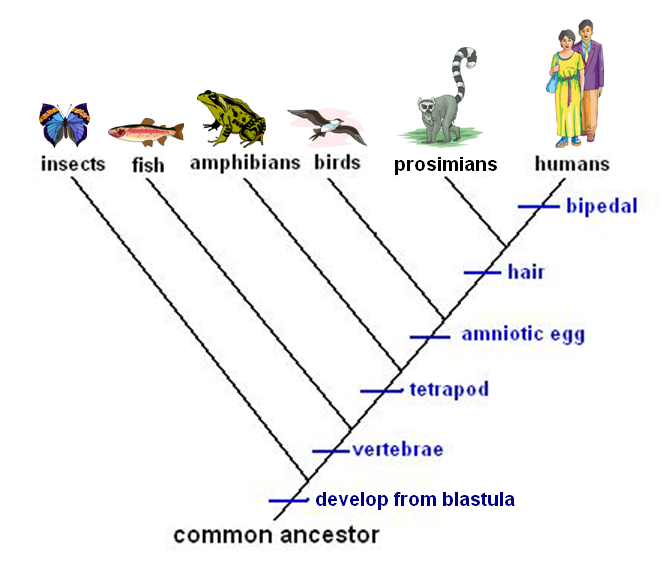
Which organisms pictured on the cladogram have hair?
1
prosimians only
2
prosimians and humans
3
humans only
4
prosimians and birds

67

Multiple Choice

Question image
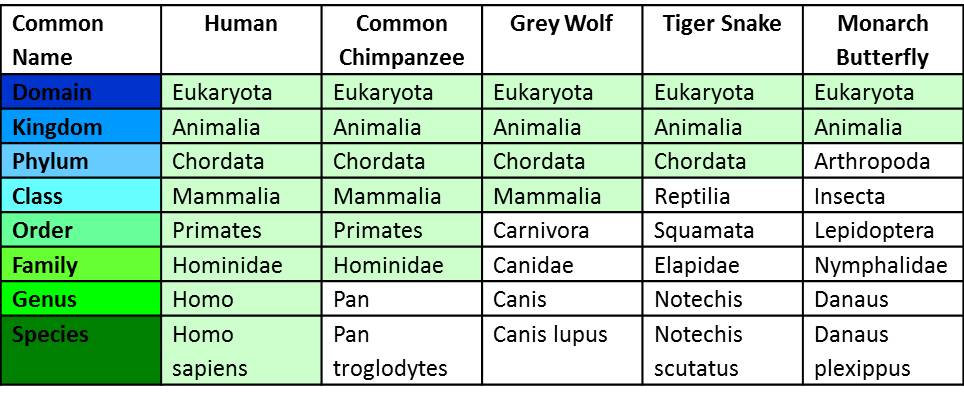
Which organism in the table is least closely related to the chimpanzee?
1
human
2
grey wolf
3
tiger snake
4
monarch butterfly

68

Multiple Choice

Question image
An illustration and a dichotomous key are given. What is the correct classification for this organism?
1
Class Insecta
2
Order Amblygygi
3
Order Araneae
4
Order Scorpiones

69

Multiple Choice

Organisms in this smallest taxonomic group share many characteristics.
1
domain
2
kingdom
3
species
4
class

70

Multiple Choice

This organism is multicellular, heterotroph, that has a cell wall made of chitin.  What kingdom does it belong in?
1
fungi
2
plantae
3
animalia
4
eubacteria

71

Multiple Choice

Mutations are important because they bring about
1
death of the organism in which they develop
2
genetic variation needed for a population to evolve
3
benefits for the individual, not for the population
4
Hardey-Weinberg equilibrium within a population

72

Multiple Choice

Question image
Some organisms that share a common ancestor have features that have different functions, but similar structures.  These are known as
1
vestigial structures
2
analogous structures
3
homologous structures
4
fossil structures

73

Multiple Choice

Ostrich wings are examples of
1
homologous structures
2
vestigial structures
3
adaptations
4
traits

74

Multiple Choice

What do scientists generally find when comparing the relationship of living things in different geographic areas?
1
Species living further apart geographically typically share a more recent common ancestral species than those living closer together
2
Species living closer geographically typically share a more recent common ancestral species than those living further apart
3
The location of where an organism lives gives no insight into their evolutionary relationships to other species
4
Their protein sequences depend on the protein intake from the local watering hole.

75

Multiple Choice

Which of the following does NOT describe a beneficial use of fungi to humans?
1
Fungi provide humans with oxygen during photosynthesis.
2
Fungi are nature's "recyclers" and return nutrients to the environment.
3
Fungi are used to create many medicines.
4
Fungi are used for food for making certain foods.
media
media
media
media
media
media

Evidence of

Evolution

Show answer

Auto Play

Slide 1 / 75

SLIDE