Law of Conservation of Mass
Presentation
•
Science
•
9th - 12th Grade
•
Medium
+12
Standards-aligned
Marissa Brown
Used 1+ times
FREE Resource
15 Slides • 22 Questions
1
Multiple Choice
2
Multiple Choice
3
Multiple Choice
4
Multiple Choice
2Mg + O2 ---> 2MgO
5
Multiple Choice
If I burn this piece of paper what type of change is taking place
Physical
Chemical
6
​
Would the mass of remaining Ash from a burnt paper be the same as that of the paper burnt ?
7
Poll
Do you believe the mass that is not accounted for was destroyed by the fire ?
yes
no
8
During a chemical reaction matter is neither created or destroyed even though it might appear that way . Matter is changed into another form affecting the mass of the original reactants
9
Law of Conservation of Mass
by Garfield Baker
10
This is called the Law of Conservation of Mass. The Law of Conservation of Mass states that during a chemical Reaction mass is neither created or destroyed
11
​
In a chemical reaction the starting mass of the reactants must be the same as that of the products .
12
Open Ended
Why is it that mass of the product APPEARS to have being destroyed ?
13
​
The reason was that the water vapor and CO2 escaped in the air . It is not destroyed but just changed the state that it was in .
This happens in a OPENED SYSTEM
14
In an OPEN SYSTEM matter can enter or leave increasing or decreasing the mass of the final product . For example when baking soda and vinegar is mixed and the gas escaped that is an OPEN system
15
In a CLOSE SYSTEM no matter is able to enter in the reaction as a result the mass is not affected . For example if Vinegar and Baking Soda is mixed together and Covered no matter ( mass) will be added or lost ,because nothing will be able to enter or leave
16
Multiple Choice
17
Multiple Choice
18
Multiple Choice
19
Multiple Choice
What do we call the chemicals that result from a chemical reaction?
reactants
products
subscripts
coefficients
20
Multiple Choice
According to the Law of Conservation of Mass, what happens to the wood and oxygen when it is burned?
The wood disappears.
It stays the same chemically.
The atoms in the wood and oxygen rearrange and form smoke and ash.
Nothing.
21
Multiple Choice
The Law of Conservation of Mass States
Energy cannot be created nor destroyed, it can only change form.
Mass cannot be created nor destroyed, it can only change form.
Mass can be created or destroyed, it cannot change form.
22
Multiple Choice
23
Multiple Choice
24
Multiple Choice
25
Does the equation below that represent a chemical reaction shows the Law of Conservation of mass to be true ?
26
Balancing Equations
Because we know that the reactants should be the same as that of the products but is not the case in an OPEN system , Chemical Equations must be balanced
Balancing Equation satisfies the LAW of CONSERVATION OF MASS
To do this Coefficient are added before the elements or compounds
Coefficient are used to multiply the subscript (number of atoms ) of each elements until both sides are equal
27
Chose different elements and add keep adding coefficient until both sides are balanced (same). If there is a subscript when a Coefficient is added they will multiply together . Ex. there were 2 O atoms and a Coefficient of 11 was added making it 22
28
Make a Table to show how many atoms of each elements are present on either sides
This Equation is not balanced . There are 7 Carbon (C) atoms on left while there is 1 on the right. There are 16 Hydrogen(H) on the left while 2 are on the right . There are 2 Oxygen on the on the left while 3 on the right
29
Is this Equation Balanced ?
30
​
2 Al2O3-------- 4Al + 3O2
Reactant Product
Al = 4 Al = 4
O = 6 O= 6
31
Multiple Choice
Is the following equation balanced or unbalanced ?
N2 +3 H2 --> 2NH3
Balanced
Unbalanced
32
Multiple Choice
Al + O2 --> Al2O3
33
Multiple Choice
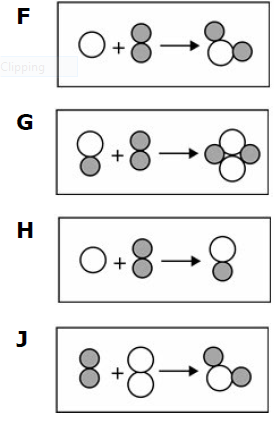
Which of the following models best demonstrates a balanced chemical equation?
F
G
H
J
34
Multiple Choice
35
Multiple Choice
36
Multiple Choice
37
Reactants Product
Al - 2 Al - 1
O - 3 O - 2
Show answer
Auto Play
Slide 1 / 37
MULTIPLE CHOICE

Similar Resources on Wayground
30 questions
Unit 2.6: Fossil Fuels
Presentation
•
9th - 12th Grade
35 questions
Nuclear fission vs fusion
Presentation
•
9th - 12th Grade
35 questions
Regulating the Cell Cycle + Cancer (part 3)
Presentation
•
9th - 12th Grade
30 questions
Ohm's Law in Series and Parallel Circuits
Presentation
•
9th - 12th Grade
30 questions
Earthquakes
Presentation
•
8th - 12th Grade
30 questions
5.1 Plate Tectonics
Presentation
•
9th - 12th Grade
Popular Resources on Wayground
10 questions
Impact of 9/11 and the War on Terror
Interactive video
•
10th - 12th Grade
21 questions
Continents and Oceans
Quiz
•
6th Grade
5 questions
9/11
Interactive video
•
9th Grade
20 questions
Parts of Speech
Quiz
•
5th Grade
16 questions
Subject & Predicate
Quiz
•
5th Grade
10 questions
Riddles Riddles fun Riddles
Quiz
•
6th - 12th Grade
21 questions
Lab Safety
Quiz
•
10th Grade
6 questions
PRIDE in the Hallways and Bathrooms
Presentation
•
12th Grade
Discover more resources for Science
10 questions
Exploring Chemical and Physical Changes
Interactive video
•
6th - 10th Grade
20 questions
Atomic Structure
Quiz
•
9th Grade
30 questions
Atomic Structure and Periodic Table Review
Quiz
•
10th Grade
21 questions
Cell Organelles
Quiz
•
9th Grade
20 questions
Observation vs. Inference
Quiz
•
7th - 9th Grade
20 questions
ELEMENTS, COMPOUNDS, AND MIXTURES
Quiz
•
9th Grade
10 questions
Physical and Chemical Changes
Quiz
•
5th - 10th Grade
43 questions
1st SW Vocab Biology
Quiz
•
9th Grade