
Origins of the Universe

Presentation
•
Science
•
10th Grade
•
Easy
+11
Standards-aligned

Teri Kman
Used 1+ times
FREE Resource
19 Slides • 5 Questions
1

6.2 Origins of the Universe
Kman Science
2

The Beginning
3

Have you ever wondered how the universe started?
How did everything come into being?
Ever heard of the the Big Bang Theory? No, not the TV show.
The Big Bang Theory is a theory astronomers use to explain how our universe came to be. The Big Bang Theory is the current model that describes the early development of the universe.
4

The Beginning
Everything in the universe started out as a little speck of hot, super-massive and super-dense material.
Everything that is in the universe now came from that speck, which we call a
singularity.
Every single proton, neutron, electron, and so forth came from the singularity “speck.”
Every star, planet, and galaxy came from that speck!
5
6

Universe Timeline
7

Universe
Timeline
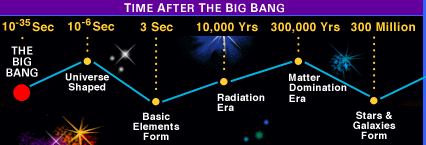
So, about 13.7 billion years ago the Big
Bang occurred. The universe expanded
quickly after that and continues to expand today.
You can visualize the development of the universe by imagining a timeline.
1.The timeline starts with the birth of
the universe. That’s where you
would see the initial singularity.
Then, in an instant, the Big Bang
occurred and all energy and matter
was created.
2.One second later, the universe
expanded and all particles formed.
8

Universe
Timeline
3. Three minutes later
the universe began to take shape. The particles (protons, neutrons) came together to form elements.
At this point, the universe was made up mostly of hydrogen and helium, the two simplest elements in existence.
Remember, hydrogen has just one
proton and helium has just two. Think of
their place at the top or “start” of the
Periodic Table of the Elements.

9


Universe
Timeline
4.Five hundred thousand
(500,000) years after the Big Bang, the universe was a huge, hot cloud of gas that began to cool.
10

Universe
Timeline
5.One billion years
(1,000,000,000) after the Big Bang, stars and galaxies were
“born.” How?
Gravity began to exert its force.
Although the universe as a whole expanded, certain pockets of gas condensed. Stars formed within these pockets and groups of stars became the earliest galaxies
11


Universe
Timeline
6.Three billion years
(3,000,000,000)after the Big
Bang, smaller galaxies merged into larger ones.
These galaxies were shaped like spirals or spheres.
Sometimes the galaxies that
formed merged so violently that
they formed gigantic black holes.
12


Universe
Timeline
7.Six billion years (6,000,000,000)
after the Big Bang, within galaxies,
stars were “born” and “died”, often in enormous explosions called
supernovas (supernovae).
The explosion of these stars
distributed common elements like
oxygen, carbon, nitrogen, calcium, and iron into space.
13


Universe
Timeline
8.Only five billion years ago
(5,000,000,000) our sun was
“born” and the Milky Way galaxy
that we are a part of was formed.
14


Model 1 of
the Timeline
of the
Universe
Here’s a model I
really like.
It was sent to me
with no credits
attached, so I
cannot cite it.
There are two
different models on
the next two slides.
15


Model 2 of
the Timeline
of the
Universe
Note that Model 1
and Model 2 look
different but
attempt to explain
the same thing.
Models can be
different! Check out
Model 3 on the
next slide.
(This one is from
designua)
16


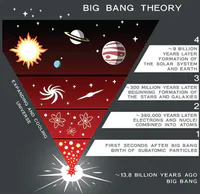
Model 3 of the Timeline
of the Universe
Look at Model 3. It has a lot
more information than Models 1
or 2.
Models can be complicated or
simple. They can show several
different types of observations
or just one!
(This one is from Universe
Today)
17

The Future
18


The Future
Universe
Timeline
If we look into the future 3
billion years from now, our
Milky Way will be swallowed
up by our neighboring galaxy,
Andromeda.
100 billion years
(100,000,000,000) from now,
a few galaxies will survive, but
most will have flown apart. Our
Sun and Earth will have long
since “died.”
19


Summar
Albert Einstein once said, “The most incomprehensible
thing about the universe is that it is comprehensible.”
It’s amazing that we can learn about the universe at all. That we can discover how we began and think about where we are going.
Our universe started with a tiny speck and expanded to what we see and know about today.
In the future, billions of years from now, scientists think
most stars will have “died” out, no new stars will form,
and only red dwarfs will be left in our universe.
20
Multiple Choice
What was contained in the singularity that gave rise to the Big Bang? Choose the best answer.
a. Gamma rays
b. Electrons in a highly excited state
c. One atom of every known element in our universe
d. All the mass, energy, and time in our universe
21
Multiple Choice
Most scientists believe the Big Bang Theory explains which of the following questions?
How our planets and moons formed
How our universe began
How the sun turns hydrogen into helium
How fast light travels through space
22
Multiple Choice
The evidence we have suggests that...
the universe has just always existed
the universe began with a huge explosion
the universe is shrinking
the universe started with a singularity and continues to expand
23
Multiple Choice
What were the original two elements in our universe?
Hydrogen and Lithium
Helium and Oxygen
Helium and Hydrogen
None of the above
24
Open Ended
In one sentence, explain how the universe formed. (This is the end of the lesson. Thanks.)
6.2 Origins of the Universe
Kman Science
Show answer
Auto Play
Slide 1 / 24
SLIDE
Similar Resources on Wayground

18 questions
Cell membrane
Presentation
•
9th Grade
20 questions
Fenomenos ondulatorios
Presentation
•
10th Grade
19 questions
The study of cells using the Microscope
Presentation
•
10th Grade
19 questions
Volume of Spheres
Presentation
•
10th Grade
19 questions
Electron Configuration- Practice
Presentation
•
10th Grade
18 questions
Plant response
Presentation
•
10th Grade
16 questions
Sex-linked traits
Presentation
•
10th Grade
20 questions
Soil Formation and Earth’s Structure
Presentation
•
9th - 10th Grade
Popular Resources on Wayground
10 questions
How much do you know about our Portrait of an Eagle?

Quiz
•
10th Grade
10 questions
Fast Food Slogans
Quiz
•
6th - 8th Grade
21 questions
Continents and Oceans
Quiz
•
6th Grade
20 questions
Parts of Speech
Quiz
•
5th Grade
16 questions
Subject & Predicate
Quiz
•
5th Grade
25 questions
Multiplication Facts
Quiz
•
5th Grade
12 questions
Map Skills
Quiz
•
3rd Grade
22 questions
Continents and Oceans
Quiz
•
5th Grade
Discover more resources for Science
10 questions
Exploring Chemical and Physical Changes

Interactive video
•
6th - 10th Grade
10 questions
Decoding the Periodic Table of Elements
Interactive video
•
6th - 10th Grade
10 questions
Exploring the Periodic Table
Interactive video
•
6th - 10th Grade
14 questions
Physical and Chemical Changes
Quiz
•
10th Grade
22 questions
Periodic Table Review
Quiz
•
9th - 12th Grade
10 questions
Exploring the States of Matter
Interactive video
•
6th - 10th Grade
10 questions
Exploring Physical and Chemical Changes
Interactive video
•
6th - 10th Grade
21 questions
Macromolecules and Enzymes Study Guide
Quiz
•
9th - 10th Grade