Search Header Logo
  1. Resource Library
  2. Science
  3. Biology
  4. Genetics
  5. Lesson 15 Genetics
Lesson 15 - Genetics

Lesson 15 - Genetics

Assessment

Presentation

Science

9th - 12th Grade

Hard

NGSS
HS-LS3-2, HS-LS3-1, HS-LS1-1

+4

Standards-aligned

Created by

Samah Al-hamadi

Used 2+ times

FREE Resource

24 Slides • 25 Questions

1

media

2

media

3

Draw

Label the DNA strand below: Include bases (Adenine, Guanine, Thymine, Cytosine), Sugar, and phosphate

4

media

5

Multiple Choice

Question image

6A A segment of DNA is represented in the illustration


How is information for a specific protein carried on the DNA molecule?

1

As a sequence of nucleotides

2

In the double-helix shape of the condensed chromosome

3

In the ratio of adenines to thymines

4

As a pattern of phosphates and sugars

6

media

7

Multiple Choice

6A Each strand of a DNA molecule contains nitrogenous bases that pair with other nitrogenous bases in very specific ways. A diagram of a section of DNA is shown.


3' T G T A G C T G C G C G T 5'


Which DNA strand is complementary to the one shown above?

1

5' A G U G C U G C G C G U A 3'

2

5' T G T A G C T G C G C G T 3'

3

5' A C A T C G A C G C G C A 3'

4

5' T C G C G C A G C T A C A 3'

8

media

9

Multiple Choice

Question image

6C Which of the following polypeptides is coded for by the mRNA sequence ′5 AUGGUUAAACGACAAUCC 3'?

1

Val, Lys, Phe, Gly, Ser

2

Met, Asp, Phe, Ala, Arg

3

Met, Val, Lys, Arg, Gln, Ser

4

Ile, Gln, Lys, Asp, Gly, Leu, Ser

10

media

11

Multiple Choice

Question image

6C Part of an important cellular process involving a DNA strand is modeled.


What is the purpose of this cellular process?

1

Preserving genetic information for future generations

2

Deleting the information in the sequence produced from the DNA template

3

Transcribing information in the DNA sequence for use by the cell

4

Producing more nucleotides for the DNA sequence

12

media

13

Multiple Choice

6E Exposure to the building material asbestos has been linked to certain types of cancers. Asbestos causes mutations in the p53 gene, which controls tumor suppression.


Which statement best explains why people with cancer due to asbestos exposure do not pass the mutation on to their offspring?

1

The mutation occurred in gametic cells.

2

The mutation occurred in somatic cells.

3

The mutation is recessive.

4

The mutation is sex-linked.

14

media

15

Multiple Choice

Question image

6E: Different types of mutations can occur in DNA. The diagram represents a type of mutation. Which statement describes the mutation in the diagram?

1

A silent mutation results in the insertion of a different amino acid

2

A substitution occurs with the adenine base

3

A deletion of a cytosine base occurs

4

A base is inserted into one strand of the DNA

16

media

17

Multiple Choice

6G: Which diagram demonstrates how crossing-over contributes to genetic variety during meiosis?

1
2
3
4

18

Multiple Choice

6G Gametes produced by an organism contain a combination of genes from that organism. In every gamete, this combination is —

1

the same because it is created from the same DNA

2

the same because chromosomes are copied prior to meiosis

3

different due to DNA replication prior to mitosis

4

different due to independent assortment during meiosis

19

media

20

Multiple Choice

6B Organisms can be classified based on homology, which is shared characteristics inherited from a common ancestor. In the past, homologies were based on studies of anatomical structures and patterns of embryonic development. In more recent years, the use of molecular biology techniques has allowed homologies to be compared at the level of nucleotide sequences. Nucleotide sequence comparisons are possible because all organisms share which of the following?

1

DNA bases

2

Cellular organelles

3

Division of the nuclear chromosomes

4

Types of proteins needed for cellular functions

21

media

22

Multiple Choice

6D CRISPR-Cas9 is a genetic modification technique that edits parts of the genome of an organism. Using this technique scientists can add, remove, or modify sections of the DNA sequence.

How can scientists use this technique to control gene expression?

1

By activating or deactivating specific genes

2

By calculating the number of genes different organisms produce

3

By identifying how closely related one individual is to another

4

By determining the number of chromosomes in an organism

23

Genetics - Punnett Squares Review

24

What is Genetics?

Genetics is the study of heredity, which is the passing of traits from one generation to another.

25

media

Are a sequence in DNA that code for a protein, thus for a specific traits

Genes

26

Alleles are different possibilities for a given trait!

  • Every trait has two alleles. One from mother and one from father.

  • Ex: blue/black eyes, brown/blonde hair, tall/short

Alleles?

Traits are specific characteristics that varies from one individual to another.

  • Blue eyes

  • Brown hair

  • Tall

Traits?

What is the difference between Traits and alleles?

27

Multiple Choice

In pea plants, the tall allele is dominant to the short allele. What key would demonstrate this?

1

Tall = T

Short = S

2

Tall = t

Short = T

3

Tall = T

Short = t

4

Tall = TT

Short = tt

28

An organism with a recessive allele combination will only exhibit that trait when the dominant allele isn't present.

  • Represented by a lowercase letter "r"

Recessive

Is stronger so it masks the other trait if present.

  • Represented by a capital letter "R"

Dominant

Dominant vs recessive

29

Multiple Choice

Identify the homozygous dominant genotype:

1

FF

2

Ff

3

ff

4

30

Multiple Choice

What are genes?

1

Something you wear

2

The powerhouse of cells.

3

Segments of DNA that carry traits for offspring.

4

None of the answers are right

31

media

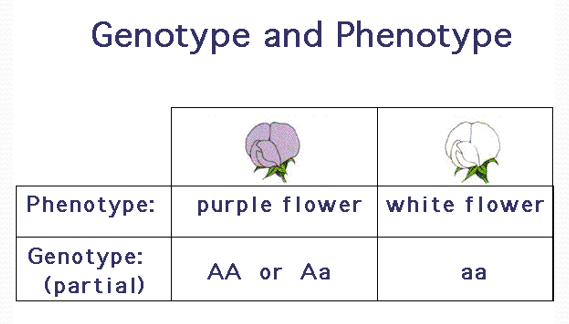
​Genotypes vs Phenotypes

Genotype: The genetic makeup of an organism. The gene (or allele) combination an organism has.

  • Examples: Tt, SS, Bb, aa

Phenotype: The physical characteristics of an organism

  • Examples: Tall or short, Straight hair or wavy hair...

32

Multiple Choice

Which of the following is an example of phenotype?

1

bb

2

blue eyes

3
4

33

Homozygous vs Heterozygous

Homozygous - Term used to refer to an organism that has two IDENTICAL alleles for a particular trait. Considered as purebred! EXAMPLE: TT or tt

Heterozygous - Term used to refer to an organism that has two DIFFERENT alleles for a particular trait. Considered as hybrids.

EXAMPLE: Tt

34

Multiple Choice

Which of the following genotypes are purebred?

1

Pf

2

Bb

3

BB

4

pF

35

Multiple Choice

Which of these is homozygous recessive?

1

Rr

2

RR

3

Ba

4

bb

36

Multiple Choice

Question image

An organism's physical appearance or visible traits. (what it looks like)

1

phenotype

2

genotype

37

media

38

media

39

Multiple Choice

Question image

What allele combination should go in the missing box?

1

aa

2

AA

3

Aa

4

None

40

Multiple Choice

Question image

What is the phenotype of the offspring? (A-Brown hair; a-blond hair) 

1

50 % Brown Hair and 50% Blond Hair 

2

75 % Brown Hair and 25% Blond Hair 

3

25 % Brown Hair and 75% Blond Hair 

4

0% Brown Hair and 100% Blond Hair 

41

Multiple Choice

Which of the following genotypes is heterozygous?

1

GG

2

hh

3

T

4

Aa

42

Match

Match the following.

genes are the same

genes are different

T - tall

t - short

the study of heredity

homozygous

heterozygous

dominant allele

recessive allele

genetics

43

Match

Match the following

homozygous dominant genes

heterozygous dominant genes

homozygous recessive genes

genetic material of an orgnism (DNA)

physical characteristics of an organism

AA

Hh

bb

genotype

phenotype

44

media

45

media

46

Multiple Choice

6F Tomato plants usually have hairy stems. Hairless stems are present in tomato plants that are homozygous recessive for this trait. If the stem characteristics are determined by a single gene, what is the expected outcome of crossing two tomato plants that are heterozygous for hairy stems?

1

75% hairy stems: 25% hairless stems

2

100% hairy stems

3

100% hairless stems

4

50% hairy stems: 50% hairless stems

47

media

48

media

49

Multiple Choice

6F: In Holstein cattle, the allele for black hair color (B) is dominant over the allele for red hair color (r), and the allele for polled (P), or lacking horns, is dominant over the allele for having horns (p). What is the expected phenotypic ratio of the offspring of a BbPp x BbPp cross if these alleles sort independently?

1

16 black/polled : 0 black/horned : 0 red/polled : 0 red/horned

2

12 black/polled : 0 black/horned : 0 red/polled : 4 red/horned

3

4 black/polled : 4 black/horned : 4 red/polled : 4 red/horned

4

9 black/polled : 3 black/horned : 3 red/polled : 1 red/horned

media

Show answer

Auto Play

Slide 1 / 49

SLIDE