

Ensci_ midterm review_ fall 2024

Presentation
•
Science
•
9th Grade
•
Medium
+8
Standards-aligned

Heather Glazebrook
Used 1+ times
FREE Resource
24 Slides • 47 Questions
1
Fall 2024

Use this to help you complete your midterm review packet :)
2

Section 1: Vocabulary and Conceptual Understanding
3

In ecology, a "population" refers to a group of individuals belonging to the same species that live in a particular area and can interbreed with each other, essentially meaning they are capable of reproducing with one another within that geographic region
Define the term "population" in an ecological organization context. Provide examples from different ecosystems.


4

Biological organization helps ecologists understand ecosystems by providing a structured hierarchy to study living organisms and their interactions within an environment, allowing them to examine specific levels of complexity, from individual organisms to entire populations, communities, and ultimately the ecosystem as a whole, which enables focused research on particular ecological processes and relationships within a given environment
How does the use of Biological Organization help ecologists understand ecosystems?
5
Multiple Choice

All the alligators in a swamp are an example of a(n) _______________.
organism
community
population
group
6
Multiple Choice
7
Multiple Choice

8
Multiple Choice

9
Multiple Choice

10
Multiple Choice

11
Multiple Choice

12
Multiple Choice

Which DOES NOT represent an Ecosystem?
A
B
C
D
13

Biotic factors refer to all living organisms within an ecosystem, like plants, animals, and bacteria, while abiotic factors are the non-living components of the environment, such as sunlight, temperature, water, and soil.
Compare and contrast biotic and abiotic factors. Provide examples specific to forest ecosystems.
14

Sunlight and water, as abiotic factors in a pond ecosystem, significantly impact the biotic community by directly influencing the growth of primary producers like algae and plants through photosynthesis, which in turn determines the abundance and diversity of organisms throughout the food web, from small invertebrates to larger fish, depending on the availability of light and water quality; essentially, the amount of sunlight dictates the rate of plant growth, while water availability controls the overall health and distribution of all aquatic organisms in the pond.
How do abiotic factors like sunlight and water impact the biotic community in a pond ecosystem?
15
Multiple Choice
What are biotic factors in an ecosystem?
The temperature of an ecosystem
Non-living things in an ecosystem such as rocks and water
The amount of sunlight an ecosystem receives
Living things in an ecosystem such as plants, animals, fungi, and bacteria.
16
Multiple Choice
How do biotic and abiotic factors interact in an ecosystem?
Biotic factors have complete control over the distribution and abundance of abiotic factors in an ecosystem
Biotic and abiotic factors interact in various ways, such as through dependence on abiotic factors for survival and through the influence of abiotic factors on the distribution and abundance of biotic factors.
Biotic factors have no impact on abiotic factors in an ecosystem
Abiotic factors are solely responsible for the survival of biotic factors in an ecosystem
17
Multiple Choice
What is the main difference between biotic and abiotic factors?
Visible vs invisible components
Living organisms vs non-living physical and chemical components
Natural vs man-made components
Living organisms vs non-living organisms
18

The nitrogen cycle is a biogeochemical process where atmospheric nitrogen gas is converted into forms usable by living organisms, primarily through the action of bacteria which fix nitrogen into ammonia and later decompose organic matter, releasing nitrogen back into the soil as usable compounds like nitrate and nitrite; this cycle involves key steps like nitrogen fixation, nitrification, and denitrification, with bacteria playing a crucial role in each stage.
DESCRIBE the nitrogen cycle, focusing on the roles of bacteria in nitrogen fixation and decomposition.
19

Photosynthesis is the primary process that removes carbon dioxide from the atmosphere and stores it in organic compounds within plants .
Cellular respiration in both plants and animals releases carbon dioxide back into the atmosphere .
The ocean acts as a significant carbon sink, absorbing large amounts of carbon dioxide .
LABEL this diagram of the carbon cycle, highlighting how respiration and photosynthesis move carbon between reservoirs.
20
Multiple Choice

How do animals get the nitrogen they need?
From the air they breathe
From the water they drink
From the food they eat
From the sun
21
Multiple Choice
Bacteria fix nitrogen from the atmosphere into a form plants can use.
True
False
22
Multiple Choice

What is the process where bacteria turns Nitrogen gas from the atmospheres into usable compounds?
nitrogen composition
nitrogen fixation
ammonia
denitrification
23
Multiple Choice
Their bodies are lifted up and decompose in the atmosphere
Their nitrogen returns to the soil through decomposers
They keep their nitrogen and don't decompose
They stay on earth forever as fossil fuels
24
Multiple Choice
25
Multiple Choice
Which describes the relationship between plants and animals in the carbon cycle?
Plants produce and release oxygen that animals need
Plants produce and release carbon dioxide that animals need
Animals produce and release oxygen that plants need
Animals produce oxygen that plants turn into carbon dioxide
26
Multiple Choice
27
Multiple Choice
Which statement is an example of how carbon moves through a food chain as part of the cycle?
Producers release carbon dioxide, and consumers take it it.
Producers take in carbon dioxide, and consumers release it.
Producers take in carbon from the soil, and they release it when they decompose.
Producers release carbon into the soil, and consumers take it in from the soil.
28

Energy decreases as it moves up trophic levels because at each step in a food chain, a significant portion of the energy is lost as heat due to metabolic processes like respiration and digestion, meaning only a small percentage of the energy from one level is transferred to the next, resulting in progressively less energy available at higher trophic levels; this is often referred to as the "10% rule" where roughly only 10% of energy moves from one level to the next.
EXPLAIN why energy decreases as it moves up trophic levels.
29

There are fewer apex predators in an ecosystem compared to primary consumers because of the energy pyramid concept in ecology; as energy moves up the food chain, only a small percentage is transferred to the next level, meaning there is significantly less energy available to support a large population of top predators compared to the large base of primary consumers feeding directly on producers.
Why are there fewer apex predators in an ecosystem compared to primary consumers?
30
Multiple Choice

31
Multiple Choice
The primary consumer receives 400 kj of energy from the producer. How much energy will the secondary consumer receive?
40
4000
400
4
32
Multiple Choice
33
Multiple Choice
34

The main difference between a food chain and a food web is that a food chain is a linear sequence of organisms, while a food web is a complex network of interconnected food chains
Complete the food web below by drawing the arrows. Write 3 food chains in the food web.
35

If all deer were to disappear from this ecosystem, the most immediate impact would be a significant decrease in the populations of predators that rely on deer as a primary food source, like wolves and mountain lions, likely leading to their decline in numbers due to lack of prey. This would then cause a cascading effect throughout the food web, leading to an increase in the plant population that deer typically feed on (like grasses and shrubs), potentially impacting the diversity of plant life by allowing certain species to dominate, while simultaneously decreasing the populations of smaller herbivores that might compete with deer for the same plants.
ANALYZE the food web chart and DESCRIBE what would happen to the ecosystem if all of the deer were to disappear from the ecosystem.
36
Multiple Choice
Which of the following best explains why energy transfer between trophic levels is inefficient?
Energy is lost as heat during metabolic processes.
Energy is destroyed during transfer.
Energy is converted into water.
Energy is stored indefinitely in organisms.
37
Multiple Choice
How do food web interactions affect ecosystem stability?
They decrease biodiversity and ecosystem resilience.
They increase competition and reduce resource availability.
They enhance biodiversity and contribute to ecosystem resilience.
They have no impact on ecosystem stability.
38
Multiple Choice

39
Multiple Choice

40
Multiple Choice

The Mayfly is a food source for which 3 organisms?
41
Multiple Choice

42

Adaptations are specific physical characteristics or behaviors that organisms develop over time through evolution, allowing them to better survive and reproduce in their particular environment by providing advantages like accessing food, evading predators, or coping with extreme conditions; for example, a polar bear's thick fur helps it insulate against cold temperatures, while a desert cactus's spines protect it from herbivores and its fleshy stem stores water during dry periods.
EXPLAIN how specific adaptations (e.g., white fur in polar bears) help organisms survive in their environment.
43

If an organism's environment shifts drastically due to deforestation or climate change, its role in the ecosystem could change significantly, potentially leading to population decline, migration to new areas, altered feeding patterns, or even extinction, depending on its ability to adapt to the new conditions; for example, a tree-dwelling species might need to find new food sources or shelter if its habitat is cleared, while a species sensitive to temperature changes might need to migrate to cooler regions to survive.
PREDICT how an organism’s role in its ecosystem might change if its environment shifts drastically (e.g., deforestation or climate change).
44
Multiple Choice
Biodiversity, aka biological diversity, usually refers to
the number of people on Earth
the variety of species on Earth
the number of animal species in a specific area
the number of plant species in a specific area
45
Multiple Choice
The lionfish is a venomous fish found primarily in the Red Sea and the Indian Ocean. In the 1990s, lionfish were accidentally released into the Atlantic Ocean, where they found abundant resources and favorable environmental conditions. Which of the following scenarios is most likely to result in the lionfish having a major impact on the communities into which they were introduced?
With no natural predators, the lionfish population will become very large.
Some native species of invertebrates will develop a resistance to lionfish venom.
46
Multiple Choice
47
Multiple Choice
48
Multiple Choice
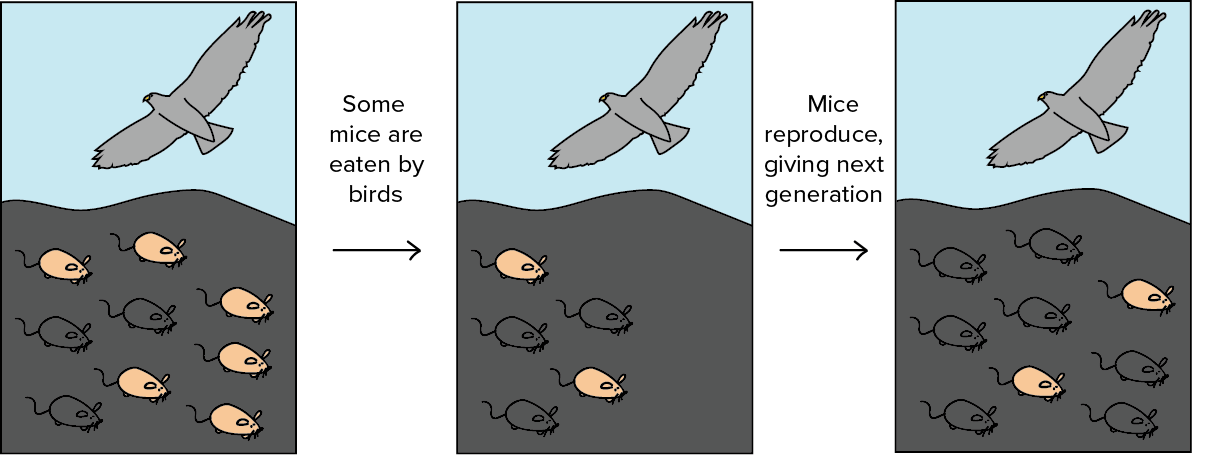
The light mice can reproduce more successfully than the dark mice
The hawks eat more dark mice than light mice because the dark mice taste better
The hawks eat more light mice than dark mice because they can see the light mice more easily
The hawks eat more dark mice than light mice because they can see the dark mice more easily
49

Primary and secondary succession are both ecological processes where a community of organisms gradually changes over time, but the key difference lies in the initial conditions: primary succession occurs in areas with no existing soil or life, like newly formed volcanic rock, while secondary succession happens in a previously disturbed area where some soil and life forms already exist, such as after a wildfire or logging operation.
DESCRIBE the similarities and differences between primary and secondary succession. Provide examples of each.
50
Primary and secondary succession are both ecological processes where a community of organisms gradually changes over time, but the key difference lies in the initial conditions: primary succession occurs in areas with no existing soil or life, like newly formed volcanic rock, while secondary succession happens in a previously disturbed area where some soil and life forms already exist, such as after a wildfire or logging operation.
DESCRIBE the similarities and differences between primary and secondary succession. Provide examples of each.
51
Multiple Choice

After a forest fire, an ecosystem would start regrowth through -
primary succession
secondary succession
climax community
limiting factors
52
Multiple Choice
Which of the following best describes primary succession?
Volcano wipes out ecosystem that gradually grows back from ash covered soil
Volcano creates a new island of rock that must break down to form an ecosystem
Forest fire burns down forest that must bounce back over time
Tornado destroys a crop that must slowly grow back over time.
53
Multiple Choice
Which progression best explains secondary succession?
lichens>grass>shrubs>small trees> big trees
mosses>creates soil>grasses>small trees> big trees
Fire destroys ecosystem>grasses>shrubs>small trees>big trees
Volcano forms new island> lichens>grasses>shrubs>small trees>big trees
54
The question asks for the best explanation of secondary succession. The correct choice is 'Fire destroys ecosystem>grasses>shrubs>small trees>big trees.' This option highlights the process of fire destroying the existing ecosystem, followed by the growth of grasses, shrubs, small trees, and eventually big trees. The answer explanation is within the limit of 75 words and does not mention the option number. It is important to note that the question is about secondary succession, not the formation of a new island or the creation of soil by mosses.
55

Volcanic emissions, particularly sulfur dioxide gas, can cause a short-term cooling effect on global temperatures by releasing particles into the stratosphere which reflect sunlight back into space, effectively shading the Earth and lowering surface temperatures for several years following a large eruption; this is due to the creation of sulfate aerosols that act as a reflective barrier to incoming solar radiation.
DESCRIBE the short-term effects of volcanic emissions on global temperature.
56

During an El Niño event, the United States typically experiences wetter conditions in the southern regions, particularly along the Gulf Coast, while the northern parts tend to be drier and warmer; conversely, La Niña brings drier conditions to the south and potentially wetter weather to the Pacific Northwest, with overall changes primarily driven by shifts in the jet stream caused by the Pacific Ocean temperature fluctuations.
How might the United States climate change in weather patterns during El Niño and La Niña events?
57
Multiple Choice
Both El Nino and La Nina have this in common
Influence birds that migrate over the ocean
Influence rainy / dry weather world wide
The weather at the polar regions
The directions that ships travel in the oceans
58
Multiple Choice

The image is of a(n):
El Nino event
La Nina event
Non-El Nino (normal conditions)
59
Multiple Choice

The picture below is of a(n) ____ event.
Non-El Nino (Normal)
El Nino
La Nina
60
Multiple Choice
In Florida, El Nino impacts our weather by:
creating larger waves at the beach
more thunderstorms and crows flying around
dry and hot
wetter and more flood-prone
61
Multiple Choice
In Florida, La Nina impacts our weather by:
dryer and warmer
warmer and wetter
wetter and colder
more rain and crows flying around
62
Multiple Choice
During an El Nino year, in North Carolina we will likely have what kind of winter?
cold and snowy
hot and dry
cold and dry
no change in weather
63
Multiple Choice
64
Eutrophication is a process that occurs when a body of water becomes enriched with nutrients, causing an overgrowth of algae and other aquatic plants
Define Eutrophication:

65

Agricultural practices can significantly impact local water bodies by introducing pollutants like fertilizers, pesticides, sediment, and animal waste through runoff, which can lead to algal blooms, depleted oxygen levels, disrupted aquatic ecosystems, and reduced biodiversity, ultimately affecting the health of fish and other aquatic life in the water body; this is particularly concerning when improper land management practices like excessive tillage or lack of cover crops are used.
How do agricultural practices impact ecosystems in local water bodies?
66
Multiple Select
Too much of a good thing, such as _____________ and _________________nutrients in the lakes and ponds can cause an imbalance resulting in eutrophication
oxygen
phosphorus
xenon
nitrogen
67
Multiple Choice

The green plants on the surface of the lake turned out the be algae! There is a sudden increase in the rate of growth of the algae. What would happen next?
The algae continue to grow due to excess nutrients, and some of the algae die
The algae would stop growing
The algae are not affected by the fertilisers
68
Multiple Choice
How does eutrophication cause the death of aquatic organisms
the build up of carbon dioxide in the water
the lack of nitrogen in the water
the lack of carbon dioxide in the water
the lack of oxygen in the water
69

Kudzu—or kuzu (クズ)—is native to Japan and southeast China. It was first introduced to the United States during the Philadelphia Centennial Exposition in 1876 where it was touted as a great ornamental plant for its sweet-smelling blooms and sturdy vines. How does Kudzu affect local plant species?
70
Propose a plan to mitigate the impact of agricultural runoff on a local lake ecosystem.
71
Use your knowledge to answer the last 4 questions on your own. Make sure to show your teacher once you have completed :)
Fall 2024
Use this to help you complete your midterm review packet :)
Show answer
Auto Play
Slide 1 / 71
SLIDE
Similar Resources on Wayground

62 questions
The Periodic Table
Presentation
•
8th Grade
65 questions
Cells and Cell Transport
Presentation
•
10th Grade
67 questions
Introduction to Cybersecurity -Module 2
Presentation
•
9th Grade
64 questions
Endocrine System
Presentation
•
10th Grade
69 questions
Central Dogma: DNA-RNA-Protein
Presentation
•
9th Grade
66 questions
Waves Review
Presentation
•
7th - 9th Grade
62 questions
Plasma Globes ~ How Do They Work?
Presentation
•
8th Grade
67 questions
WEEK 1 - Respiratory System
Presentation
•
9th Grade
Popular Resources on Wayground
10 questions
Safety Day 2026 – Student Review

Quiz
•
9th Grade
21 questions
Continents and Oceans
Quiz
•
6th Grade
20 questions
Parts of Speech
Quiz
•
5th Grade
16 questions
Subject & Predicate
Quiz
•
5th Grade
25 questions
Multiplication Facts
Quiz
•
5th Grade
12 questions
Map Skills
Quiz
•
3rd Grade
22 questions
Continents and Oceans
Quiz
•
5th Grade
15 questions
Rounding Decimals
Quiz
•
5th Grade
Discover more resources for Science
10 questions
Exploring Chemical and Physical Changes

Interactive video
•
6th - 10th Grade
20 questions
Atomic Structure
Quiz
•
9th Grade
10 questions
Exploring the Electromagnetic Spectrum for Middle School Science
Interactive video
•
6th - 10th Grade
10 questions
Exploring Force and Motion Concepts
Interactive video
•
6th - 10th Grade
10 questions
Exploring Air Masses and Weather Fronts
Interactive video
•
6th - 10th Grade
10 questions
Exploring the States of Matter
Interactive video
•
6th - 10th Grade
10 questions
Exploring Forces: Net Force, Normal Force, Gravity, and Friction
Interactive video
•
6th - 10th Grade
10 questions
Differentiating Thermal Energy and Temperature
Interactive video
•
6th - 10th Grade