
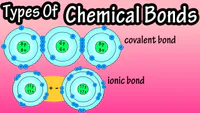
Types of Chemical Bonds

Presentation
•
Science
•
9th Grade
•
Hard

James Gonzalez
FREE Resource
10 Slides • 8 Questions
1

2
Ions are atoms that have lost or gained electrons.

3

4
Metals are elements that will lose electrons and will form cations.
Nonmetals are elements that will gain electrons and will form anions.

5
Multiple Select
Which of the following are examples of anions?
K+
S-2
Cl-
Mg+2
6
Multiple Select
Which of the following are cations?
Cr+3
O-2
S-2
Ba+2
7
Multiple Choice
Potassium (K) is a group 1 element. Elements in this group are _____.
metals and form anions
nonmetals and form cations
metals and form cations
nonmetals and form anions
8
Multiple Choice
Iodine (I) is a group 17 element. Elements in this group are _____.
metals and form anions
nonmetals and form cations
metals and form cations
nonmetals and form anions
9
Think about it:
What happens when potassium (K) and iodine (I) atoms form chemical bonds?

10
Potassium
is a group 1 element with 1 VE
When potassium bonds with iodine it will lose a valence electron
Iodine
is a group 17 element with 7 VE
it will gain 1 electron on its outer ring (shell) from potassium.
In this case the electrons are TRANSFERRED, not shared.
11

12
These are formed when valence electrons are transferred from one atom to another.
ionic bonds are formed between metals and nonmetals

13
The charges that you see written next to ions after they have gained or lost electrons are called superscripts.
Superscript means "written above."
Superscripts tell us:
how many electrons were gained or lost
if it is an anion or a cation

14
Multiple Choice
Magnesium is a group 2 element. When it bonds with a nonmetal in group 16 what will the superscript be and what does it mean?
+2; meaning it has gained electrons
-2; meaning it has gained electrons
+2; meaning it has lost electrons
-2; meaning it has lost electrons
15
Fill in the Blanks
The ion O-2 has a superscript of -2, what does this tell us?
Type answer...
16
These types of bonds happen when valence electrons are shared between atoms.
Covalent bonds are formed between 2 or more nonmetals
Molecules are the result of atoms sharing electrons to form neutral atoms

17
Multiple Choice
Covalent bonds are formed between what types of elements?
metals and nonmetals
transition elements
nonmetals
metals
18
Multiple Select
Which of the following are examples of covalent bonds?
LiF
NH3
NaBr
CO
Show answer
Auto Play
Slide 1 / 18
SLIDE
Similar Resources on Wayground

12 questions
Electrolytes and Non Electrolytes
Presentation
•
10th Grade
15 questions
Neutrons and Isotopes
Presentation
•
9th - 10th Grade
15 questions
Properties of Water
Presentation
•
9th Grade
16 questions
Photosynthesis and Cellular Respiration
Presentation
•
10th Grade
14 questions
Boundary and Volcanoes-P2
Presentation
•
9th Grade
12 questions
G9_Unit 1: Quantum Numbers
Presentation
•
9th Grade
12 questions
DNA Structure
Presentation
•
9th Grade
17 questions
Biochemistry Introduction
Presentation
•
9th Grade
Popular Resources on Wayground
10 questions
How much do you know about our Portrait of an Eagle?

Quiz
•
10th Grade
10 questions
Fast Food Slogans
Quiz
•
6th - 8th Grade
21 questions
Continents and Oceans
Quiz
•
6th Grade
20 questions
Parts of Speech
Quiz
•
5th Grade
16 questions
Subject & Predicate
Quiz
•
5th Grade
25 questions
Multiplication Facts
Quiz
•
5th Grade
12 questions
Map Skills
Quiz
•
3rd Grade
22 questions
Continents and Oceans
Quiz
•
5th Grade
Discover more resources for Science
10 questions
Exploring Chemical and Physical Changes

Interactive video
•
6th - 10th Grade
20 questions
Atomic Structure
Quiz
•
9th Grade
10 questions
Decoding the Periodic Table of Elements
Interactive video
•
6th - 10th Grade
10 questions
Exploring the Periodic Table
Interactive video
•
6th - 10th Grade
22 questions
Periodic Table Review
Quiz
•
9th - 12th Grade
20 questions
Observation vs. Inference
Quiz
•
7th - 9th Grade
10 questions
Exploring the States of Matter
Interactive video
•
6th - 10th Grade
10 questions
Exploring Physical and Chemical Changes
Interactive video
•
6th - 10th Grade