

Lesson Minerals

Presentation
•
Science
•
6th - 8th Grade
•
Hard

Joseph Anderson
FREE Resource
30 Slides • 53 Questions
1

2

3

4
Multiple Choice
What is the maximum depth geologists have drilled into the Earth to collect rock samples?
5 kilometers
8 kilometers
12.3 kilometers
15 kilometers
5
Multiple Choice
Volcanoes bring rocks to the surface. True or False?
True
False
6
Multiple Choice
Rocks provide clues about how ______ and energy flow.
matter
water
air
light
7
Multiple Choice
What type of waves travel through both solids and liquids?
S-waves
P-waves
T-waves
Q-waves
8
Multiple Choice
S-waves only travel through ______.
liquids
gases
solids
plasma
9

10

11
Multiple Choice
What forms Earth's outer layer?
Mantle
Crust
Core
Atmosphere
12
Multiple Choice
The main elements in the Earth's crust are ______ and oxygen.
Carbon
Hydrogen
Silicon
Nitrogen
13
Multiple Choice
Which type of crust is thinnest beneath the ocean floor?
Continental Crust
Oceanic Crust
14
Multiple Choice
The continental crust is thickest under what geographical feature?
Deserts
Plains
High mountains
Valleys
15

16
Multiple Choice
What is the Earth's mantle primarily composed of?
Magnesium and iron
Silicon and oxygen
Carbon and nitrogen
Hydrogen and helium
17
Multiple Choice
The lithosphere contains the crust and the uppermost part of the mantle. It is a type of rock that is strong, hard, and ____.
Soft
Brittle
Flexible
Liquid
18
Multiple Choice
Which part of the mantle is described as being able to bend like a metal spoon?
Lithosphere
Asthenosphere
Lower Mantle
Outer Core
19
Multiple Choice
The lower mantle is located below which part of the mantle?
Lithosphere
Crust
Asthenosphere
Outer Core
20

21
Multiple Choice
What is the thickness of the Earth's outer core?
1,220 km
2,260 km
3,480 km
4,560 km
22
Multiple Choice
The Earth's inner core is a dense ball of solid metal. It mainly consists of iron and nickel and has a radius of ______.
1,220 km
2,260 km
3,480 km
4,560 km
23

24

25
Multiple Choice
What is a form of energy that flows and transfers matter?
Light
Heat
Sound
Electricity
26
Multiple Choice
Heat from the core drives ______ currents.
Conduction
Radiation
Convection
27

28

29

30
Multiple Choice
Which of the following is a characteristic of minerals?
A) Formed by natural processes
B) Always liquid
C) Part of living things
D) No definite shape
31
Multiple Choice
Minerals have a _______ structure where particles are lined up in repeating patterns.
Random
Crystal
Liquid
Gas
32
Multiple Choice
What does 'Definite Chemical Composition' mean in the context of minerals?
Contains different elements in varying proportions
Always contains the same elements in the same proportions
Changes composition frequently
Composed of living organisms.
33

34
Multiple Choice
What is the term used to describe how light reflects from a mineral?
Color
Streak
Luster
Cleavage & Fracture
35
Multiple Choice
The streak of a mineral is the color of its ______.
Surface
Powder
Core
Edge
36
Multiple Choice
Which of the following describes how a mineral breaks?
Color
Streak
Luster
Cleavage & Fracture
37

38
Multiple Choice
What is the characteristic of each mineral that is calculated by mass divided by volume?
Hardness
Density
Crystal Structure
Special Properties
39
Multiple Choice
All of the crystals of a mineral have the same ________.
Density
Hardness
Crystal Structure
Special Properties
40
Multiple Choice
Which of the following is NOT a special property of minerals?
Ability to bend light
Conduct electricity
Glow
Taste
41

42
Multiple Choice
Which of the following is an example of organic mineral formation?
Crystallization
Formation of skeletons
Cooling of lava
Evaporation of water
43
Multiple Choice
Minerals from solutions are formed when elements dissolved in water form solutions and the water ________.
A) freezes
B) evaporates
C) condenses
D) boils
44
Multiple Choice
What determines the size of crystals formed from magma and lava?
The type of minerals
The rate of cooling
The color of lava
The depth of magma
45

46
Multiple Choice
Which of the following statements is true about mineral formation? A) Graphite and diamond are both made of silicon. B) A change in temperature or pressure can alter one mineral into a new mineral. C) Diamonds form under low temperature and pressure. D) Graphite is made of diamond.
Graphite and diamond are both made of silicon.
A change in temperature or pressure can alter one mineral into a new mineral.
Diamonds form under low temperature and pressure.
Graphite is made of diamond.
47
Multiple Choice
Fill in the blank: Graphite and diamond are both made of ______.
Silicon
Oxygen
Carbon
Hydrogen
48

49

50

51
Multiple Choice
What does a light-colored rock indicate about its mineral composition?
High in silica and oxygen
Low in silica and oxygen
High in iron
Low in iron
52
Multiple Choice
Fill in the blank: The origin of a rock describes how it formed. The three main types of rock origins are igneous, sedimentary, and ________.
Metamorphic
Volcanic
Crystalline
Organic
53
Multiple Choice
Which of the following terms is used by scientists to describe the texture of a rock?
Color
Size, shape, and pattern of the grains
Mineral composition
Origin
54
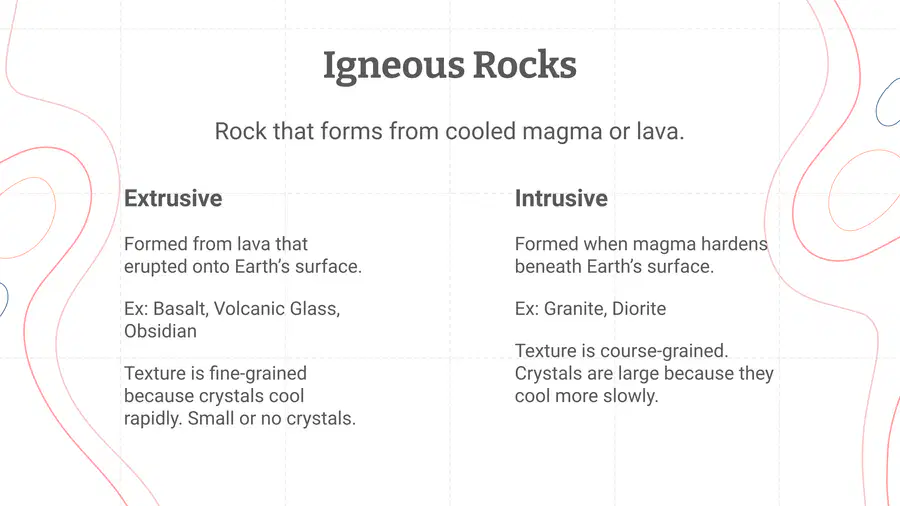
55
Multiple Choice
Which of the following is an example of an extrusive igneous rock?
Granite
Diorite
Basalt
Gabbro
56
Multiple Choice
Intrusive igneous rocks are formed when magma hardens beneath Earth's surface. True or False?
True
False
57
Multiple Choice
Fill in the blank: Extrusive igneous rocks have a _______ texture because crystals cool rapidly.
Fine-grained
Coarse-grained
Glassy
Porous
58

59
Multiple Choice
What is the first step in the formation of sedimentary rocks?
Transportation
Weathering & Erosion
Deposition
Cementation
60
Multiple Choice
In the process of forming sedimentary rocks, what happens during the 'Compaction' stage?
Sediment settles into layers
Eroded material is moved by wind and water
The layers of sediment are squeezed and compacted under the weight above
Dissolved minerals glue sediment together.
61
Multiple Choice
Sedimentary rocks form when small particles of rocks or the remains of plants and animals are pressed and ________ together.
glued
cemented
compacted
eroded
62

63
Multiple Choice
What are metamorphic rocks?
Rocks formed by cooling magma
Rocks changed by heat, pressure, or chemical reactions
Rocks formed from sediment
Rocks that contain fossils.
64
Multiple Choice
Foliated metamorphic rocks have grains arranged in ______.
Random patterns
Parallel layers or bands
Circular patterns
No specific order
65
Multiple Choice
Which of the following is an example of a nonfoliated metamorphic rock?
Gneiss
Slate
Marble
Schist
66

67
Multiple Choice
What is the source of energy that affects the formation of rocks?
Wind
Water
Heat from the sun or Earth's interior
Electricity
68
Multiple Choice
The energy that drives the formation of rocks comes in the form of ______.
Light
Sound
Heat from the sun or Earth's interior
Magnetism
69

70

71

72
Multiple Choice
What is the rock cycle?
A) A series of processes that occur on Earth's surface and in the crust and mantle that change rock from one kind to another.
B) A process that only occurs in the ocean.
C) A cycle that involves only the atmosphere.
D) A process that does not involve rocks.
73
Multiple Choice
Fill in the blank: The rock cycle is a series of processes that occur on Earth's surface and in the _______ and mantle.
ocean
crust
atmosphere
core
74

75
Multiple Choice
Which process is responsible for the formation of sediments?
Melting
Weathering & Erosion
Cooling
Heat and Pressure
76
Multiple Choice
Sedimentary rocks are formed by _________.
Cooling
Compaction & Cementation
Melting
Heat and Pressure
77
Multiple Choice
What type of rocks are formed by heat and pressure?
Igneous
Sedimentary
Metamorphic
Magma
78

79

80
Multiple Choice
Which of the following drives the rock cycle in part?
Ocean currents
Plate tectonics
Wind erosion
Solar radiation
81
Multiple Choice
As the plates move, they carry the continents and ______ with them.
mountains
ocean floor
rivers
deserts
82
Multiple Choice
What happens when oceanic plates move apart?
A) Mountains form
B) Magma moves upward and fills the gap with new igneous rock
C) Earthquakes occur
D) Rivers change course
83

Show answer
Auto Play
Slide 1 / 83
SLIDE
Similar Resources on Wayground

78 questions
7.LS.1.2-DAY 2: Passive Transport — Diffusion and Osmosis
Presentation
•
7th Grade
78 questions
DNA-> Traits QUIZ
Presentation
•
7th Grade
72 questions
Human Body systems
Presentation
•
6th - 8th Grade
78 questions
Sp 1 - Resource Book - LP Practice
Presentation
•
6th - 8th Grade
74 questions
The Cell and Cell Theory
Presentation
•
6th - 8th Grade
74 questions
The Cell Theory
Presentation
•
6th - 8th Grade
77 questions
2425_T1_WW3 - Reviewer
Presentation
•
7th Grade
77 questions
Solving Equations
Presentation
•
6th - 8th Grade
Popular Resources on Wayground
10 questions
How much do you know about our Portrait of an Eagle?

Quiz
•
10th Grade
10 questions
Fast Food Slogans
Quiz
•
6th - 8th Grade
21 questions
Continents and Oceans
Quiz
•
6th Grade
20 questions
Parts of Speech
Quiz
•
5th Grade
16 questions
Subject & Predicate
Quiz
•
5th Grade
25 questions
Multiplication Facts
Quiz
•
5th Grade
12 questions
Map Skills
Quiz
•
3rd Grade
22 questions
Continents and Oceans
Quiz
•
5th Grade
Discover more resources for Science
17 questions
7.6D Aqueous Solutions
Quiz
•
7th Grade
20 questions
Scientific Method and Variables
Quiz
•
8th Grade
20 questions
Scientific method and variables
Quiz
•
8th Grade
27 questions
Counting Atoms - Subscripts
Quiz
•
8th Grade
10 questions
6.6D - Relative Density Review
Quiz
•
6th Grade
20 questions
Claim, Evidence and Reasoning (CER)
Quiz
•
6th - 8th Grade
18 questions
Counting Atoms
Quiz
•
7th - 8th Grade
20 questions
Density
Quiz
•
6th Grade