

MS-PS2-4: Gravitational Interactions

Presentation
•
Science
•
8th Grade
•
Practice Problem
•
Medium
+3
Standards-aligned

Barbara White
Used 22+ times
FREE Resource
14 Slides • 25 Questions
1

Gravitational
Interactions
Middle School

2
Define gravity as an attractive force dependent on mass and distance.
Describe Galileo’s experiments on acceleration due to gravity.
Explain the concept of an orbit using Newton’s thought experiments.
Compare and contrast different methods used for detecting exoplanets.


3
Key Vocabulary

Mass
Mass is the scientific measure of the amount of matter that makes up an object.

Gravity
Gravity is an attractive force that exists between any two objects that have mass.

Attractive Force
An attractive force is a fundamental force in nature that pulls objects toward one another.

Acceleration
Acceleration is the rate of change of speed, approximately 9.8 m/s2 on Earth's surface.

Terminal Velocity
This is the constant speed an object reaches when air resistance equals the force of gravity.

Orbit
An orbit is the curved path of an object as it revolves around another due to gravity.
4
Key Vocabulary

Centripetal Force
A force that is directed toward the center of a circular path, keeping an object moving.

Exoplanet
An exoplanet is a planet that is located far outside of our own Solar System.

Barycenter
The barycenter is the common center of mass around which two or more celestial bodies orbit.

Transit
A transit is a special celestial event where one astronomical body passes in front of another.

Giant Impact Theory
The Giant Impact Theory explains the formation of the Moon from a collision with early Earth.

Doppler Shift
The Doppler shift is the change in light wave frequency caused by an object's relative motion.
5
Aristotle's View
For nearly 2,000 years, it was believed that heavier objects fall faster than lighter ones.
This view was based on logical arguments rather than direct, precise experimental evidence.
His ideas were widely accepted and went unchallenged for a very long period of time.

Galileo's Discovery

Galileo used experiments to test the long-held beliefs about gravity and falling objects.
He demonstrated that objects of different masses fall at the same rate, ignoring air resistance.
His work marked a major shift towards modern scientific methods based on experimentation.
6
Multiple Choice
What was the central idea in Aristotle's widely accepted view of gravity?
Heavier objects fall to the ground faster than lighter objects.
Objects fall at the same rate regardless of their mass.
The speed of a falling object depends on its shape.
Gravity does not affect objects on Earth.
7
Multiple Choice
What is the key difference between how Galileo and Aristotle developed their ideas about gravity?
Galileo used experiments, while Aristotle used logical arguments.
Galileo believed heavy objects fall faster, while Aristotle did not.
Galileo's ideas were accepted for longer than Aristotle's.
Galileo studied gravity, while Aristotle studied motion.
8
Multiple Choice
If a heavy cannonball and a much lighter baseball were dropped from a high tower at the exact same moment, what would Galileo predict would happen, ignoring air resistance?
The cannonball would hit the ground first because it is heavier.
The baseball would hit the ground first because it is lighter.
They would both hit the ground at the same time.
The cannonball would fall for a longer period of time.
9
The Scale of Gravity
A gravitational force exists between any two masses.
This force is only significant for very large masses.
Earth's large mass creates a strong gravitational pull.
10
Multiple Choice
According to the principles of gravity, between which of the following does a gravitational force exist?
Only between planets and stars
Only between objects on Earth
Between any two objects with mass
Only between objects that are moving
11
Multiple Choice
What is the primary reason you don't feel a gravitational pull between yourself and a pencil?
The force is only significant when at least one of the objects has a very large mass.
Gravitational force does not exist for small objects.
The force depends on the material the objects are made of.
Gravitational force only pulls objects downward.
12
Multiple Choice
Imagine two planets are discovered. Planet A has a mass much larger than Earth's, and Planet B has a mass similar to Earth's moon. Which planet would have a stronger gravitational pull and why?
Planet A, because its larger mass creates a stronger gravitational pull.
Planet B, because smaller planets have a more concentrated pull.
Their gravitational pulls would be identical.
It's impossible to tell without knowing their distance from the sun.
13
Gravity, Mass, and Interaction
Objects with mass attract each other through an invisible force called gravity.
The more mass an object has, the stronger its gravitational pull is.
The Earth's larger mass is what keeps the smaller Moon orbiting it.
The Sun's immense mass keeps all the planets of our solar system in orbit.


14
Multiple Choice
What is gravity?
A force of attraction between any two objects that have mass.
A force that pushes two objects away from each other.
A type of energy that only comes from the Sun.
A force that only affects planets and stars.
15
Multiple Choice
What is the relationship between an object's mass and the strength of its gravitational pull?
The object with more mass has a stronger gravitational pull.
The object with more mass has a weaker gravitational pull.
An object's mass has no effect on its gravitational pull.
Only very large objects like planets have a gravitational pull.
16
Multiple Choice
Which statement best explains why the planets in our solar system orbit the Sun?
The Sun is the hottest object, and its heat keeps the planets in their paths.
The planets are all moving too fast to escape the Sun's pull.
The Sun has an immense mass, creating a strong gravitational pull that keeps the planets in orbit.
The planets push on each other, which keeps them all in a stable formation around the Sun.
17
Acceleration of Falling Objects


18
Multiple Choice
What does it mean for a falling object to accelerate?
Its speed constantly increases.
It maintains a constant speed.
It travels in a curved path.
Its speed gradually decreases.
19
Multiple Choice
Why did Galileo use ramps to study falling objects?
To make the object fall faster.
To change the direction of gravity.
To slow the object's acceleration for easier measurement.
To eliminate the effects of air resistance.
20
Multiple Choice
An object is dropped and falls for 3 seconds. Using the rounded value for Earth's gravity (10 m/s2), what is its approximate speed?
10 m/s
13 m/s
30 m/s
100 m/s
21
The Limit to Falling: Terminal Velocity
Air resistance is a frictional force that opposes gravity, increasing with speed.
When air resistance equals gravity, the forces are balanced, and acceleration stops.
The object then falls at a constant maximum speed called terminal velocity.
Increasing surface area, like with a parachute, increases air resistance and slows falling.


22
Multiple Choice
What is terminal velocity?
The speed at which an object begins to fall.
The force of gravity pulling an object down.
The constant maximum speed a falling object reaches when air resistance balances gravity.
The acceleration an object experiences as it falls.
23
Multiple Choice
What is the relationship between forces that causes a falling object to reach terminal velocity?
The force of gravity becomes stronger than air resistance.
The object's mass suddenly increases during the fall.
The force of air resistance increases to equal the force of gravity.
The force of air resistance disappears completely.
24
Multiple Choice
If a skydiver is falling at terminal velocity and then opens their parachute, what is the most likely outcome?
It will speed up because the parachute makes it heavier.
It will continue falling at the same constant speed.
It will slow down because the parachute increases the force of air resistance.
It will immediately stop and hover in the air.
25
Gravity and Orbits in Space
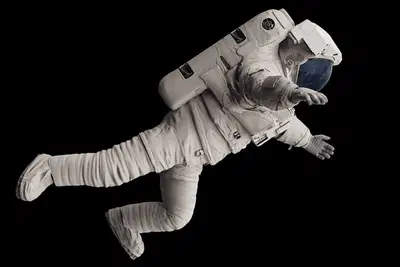
Gravity isn't absent in space; it keeps the Moon in orbit around Earth.
On the ISS, astronauts feel weightless because they are in constant free fall.
An orbit is the curved path an object follows around a larger object.
Newton's cannon shows how an object can orbit by falling around Earth.

26
Multiple Choice
What is an orbit?
The curved path an object follows around a larger object
A state of complete weightlessness in space
The force that pulls all objects toward each other
A straight line an object travels through the cosmos
27
Multiple Choice
What is the relationship between gravity and the Moon's orbit around Earth?
Gravity provides the force that keeps the Moon moving along its curved path.
The Moon's orbit is a path where Earth's gravity is completely absent.
The Moon's orbit creates the force of gravity between the two objects.
Gravity only affects objects on Earth, not objects in space like the Moon.
28
Multiple Choice
Which statement best explains why astronauts on the ISS feel weightless while in orbit?
They are in a state of constant free fall around Earth, along with their spacecraft.
There is no gravity from Earth affecting them at that distance.
The ISS has its own artificial gravity that cancels out Earth's pull.
They have traveled beyond Earth's gravitational pull and are now floating freely.
29
The Giant Impact Theory
The Giant Impact Theory states a Mars-sized object struck the early molten Earth.
The massive collision vaporized the object and sent rock and debris into space.
Earth's gravity captured much of this debris, forming a ring in orbit around it.
Over millions of years, this orbiting debris clumped together to form the Moon.

30
Multiple Choice
What does the Giant Impact Theory primarily explain?
How the Earth was formed.
How the Moon was formed.
Why Mars is a red planet.
Why the Earth has a molten core.
31
Multiple Choice
According to the theory, what was the direct cause for the space debris to eventually form the Moon?
The debris was launched from a volcano on Earth.
The planetesimal was made of ice, which melted.
Gravity caused the rock and debris to clump together.
The Earth's magnetic field pulled the debris into a sphere.
32
Multiple Choice
Based on the process described, what would have been the most likely outcome if the debris from the collision had not been captured by Earth's gravity?
The Earth would have become much larger.
The Moon would have formed, but much faster.
The Moon would not have formed in orbit around Earth.
The Earth would have developed rings like Saturn.
33
Wobble Method
A planet's gravity pulls on its star, causing the star to wobble around a common center of mass.
Astronomers detect this wobble by observing a Doppler shift in the star's light from our point of view.
The star's light shifts to blue as it moves towards us and to red as it moves away.

Transit Method

A transit is when an exoplanet passes directly between its star and Earth, from our point of view.
This event blocks a tiny fraction of the star's light, causing a temporary dip in the star's brightness.
This measurable dimming of starlight provides evidence of an orbiting body crossing in front of its star.
34
Multiple Choice
What is the primary purpose of both the Wobble and Transit methods in astronomy?
To find evidence of exoplanets orbiting distant stars
To measure the exact size and mass of a star
To determine the chemical composition of a star's atmosphere
To map the locations of black holes in a galaxy
35
Multiple Choice
How does the evidence gathered by the Wobble method differ from the evidence gathered by the Transit method?
The Wobble method detects changes in a star's light color, while the Transit method detects changes in a star's brightness.
The Wobble method relies on a planet's gravity, while the Transit method relies on a planet's magnetic field.
The Wobble method can only find large planets, while the Transit method can only find small planets.
The Wobble method involves observing a star's wobble, while the Transit method involves observing a planet's transit across the sun.
36
Multiple Choice
An astronomer observes that a distant star's light regularly dims for a few hours. At the same time, they observe that the star's light spectrum repeatedly shifts from blue to red. What is the best conclusion that can be drawn from this data?
The star's brightness is naturally fluctuating.
An exoplanet is orbiting the star, causing it to both wobble and be periodically eclipsed.
The astronomer's telescope is likely malfunctioning.
A cloud of interstellar dust is passing in front of the star.
37
Misconception | Correction |
|---|---|
There is no gravity in space. | Gravity exists everywhere; astronauts are in constant free-fall around Earth. |
Heavy objects fall faster than light objects. | Ignoring air resistance, all objects fall at the same rate. |
The Moon is outside of Earth's gravity. | Earth's gravity is the force that holds the Moon in orbit. |
Gravity is a force that only pulls things down. | Gravity is an attractive force that pulls objects toward each other. |
38
Gravity is an attractive force that depends on mass and distance.
Gravity is significant only when one object has a very large mass.
Without air resistance, all objects fall at the same acceleration.
An orbit is a balance between forward motion and gravitational pull.
Orbital periods of planets and moons reveal gravity's strength.
Scientists find exoplanets using the "wobble" and "transit" methods.
39
Poll
On a scale of 1-4, how confident are you about explaining the concept of gravity and orbits?
1
2
3
4
Gravitational
Interactions
Middle School
Show answer
Auto Play
Slide 1 / 39
SLIDE
Similar Resources on Wayground

35 questions
Newton's Laws of Motion
Presentation
•
8th Grade
32 questions
Genetic Engineering
Presentation
•
8th Grade
35 questions
Life Science Review for Benchmark
Presentation
•
8th Grade
31 questions
Natural Selection
Presentation
•
8th Grade
32 questions
STAAR Chemistry Review Day 2
Presentation
•
8th Grade
31 questions
Fossils
Presentation
•
8th Grade
30 questions
Properties of Light
Presentation
•
8th Grade
33 questions
Organs & Organ Systems
Presentation
•
7th Grade
Popular Resources on Wayground
10 questions
How much do you know about our Portrait of an Eagle?

Quiz
•
10th Grade
10 questions
Fast Food Slogans
Quiz
•
6th - 8th Grade
21 questions
Continents and Oceans
Quiz
•
6th Grade
20 questions
Parts of Speech
Quiz
•
5th Grade
16 questions
Subject & Predicate
Quiz
•
5th Grade
25 questions
Multiplication Facts
Quiz
•
5th Grade
12 questions
Map Skills
Quiz
•
3rd Grade
22 questions
Continents and Oceans
Quiz
•
5th Grade
Discover more resources for Science
20 questions
Scientific Method and Variables
Quiz
•
8th Grade
20 questions
Scientific method and variables
Quiz
•
8th Grade
27 questions
Counting Atoms - Subscripts
Quiz
•
8th Grade
20 questions
Claim, Evidence and Reasoning (CER)
Quiz
•
6th - 8th Grade
18 questions
Counting Atoms
Quiz
•
7th - 8th Grade
20 questions
Elements, Compounds and Mixtures
Quiz
•
8th Grade
10 questions
Exploring Chemical and Physical Changes

Interactive video
•
6th - 10th Grade
10 questions
Decoding the Periodic Table of Elements
Interactive video
•
6th - 10th Grade