Search Header Logo
Basics of Chemistry

Basics of Chemistry

Assessment

Presentation

•

Science

•

10th Grade

•

Medium

•
NGSS
MS-PS1-4, MS-PS3-4, MS-PS2-5

+4

Standards-aligned

Created by

Emily Timian

Used 2+ times

FREE Resource

103 Slides • 31 Questions

1

Multiple Choice

What determines whether a liquid will sink or float in another liquid?

1

Density

2

Temperature

3

Viscosity

4

Color

2

Multiple Choice

What happens to the motion of particles when a solid is heated?

1

It decreases

2

It remains the same

3

It increases

4

It stops

3

media

4

Multiple Choice

What allows the molecules of a liquid to move past one another?

1

Strong attractions

2

Weak attractions

3

No attractions

4

Fixed positions

5

Multiple Choice

What happens to the particles of a solid when it is heated?

1

They move slower

2

They stay in place

3

They vibrate in place

4

They move faster

6

media

7

Multiple Choice

What is the process called when a gas changes directly to a solid without going through the liquid phase?

1

Sublimation

2

Condensation

3

Deposition

4

Evaporation

8

Multiple Choice

Question image

Which of these is correct?

1

Dry ice evaporates, meaning it goes from a liquid to a gas

2

Dry ice sublimes, meaning it goes from a liquid to a gas.

3

Dry ice sublimes, meaning it goes from a solid to a gas

4

Dry ice melts, meaning it goes from a solid to a liquid

9

Multiple Choice

What happens to molecules when they freeze?

1

They speed up

2

They slow down

3

They disappear

4

They change color

10

media

11

Draw

draw me a solid,liquid,and gas

12

Open Ended

Describe what happens to the molecules of CO2 during the sublimation of dry ice at room temperature and normal pressure.

13

Multiple Choice

What causes hydrogen bonds to form between water molecules?

1

The high kinetic energy of water molecules

2

The ionic bonds between hydrogen and oxygen atoms within a water molecule

3

The partial positive charge of hydrogen atoms and the partial negative charge of oxygen atoms

4

The covalent bonds that hold hydrogen and oxygen atoms together

14

Multiple Choice

Which of the following increases the rate of condensation?

1

Heating

2

Cooling

3

Increasing pressure

4

Decreasing pressure

15

Multiple Choice

What is the relationship between density, mass, and volume?

1

Density is independent of mass and volume

2

Density depends on mass and volume

3

Density is the same as mass

4

Density is the same as volume

16

media

17

Multiple Choice

Question image

Look at the graduated cylinder in the image showing 200 mL of blue liquid. The space that this liquid takes up is called its ___

1

density

2

weight

3

volume

4

mass

18

Multiple Choice

Which process describes the direct change of a gas to a solid without passing through the liquid phase?

1

Deposition

2

Sublimation

3

Condensation

4

Freezing

19

Fill in the Blank

The formula for density is Density = _________________

20

media

21

Open Ended

Question image

Which box has the greater density? Why? (think back to the video)

22

Multiple Choice

Which of the following statements about freezing is true?

1

Molecules slow down and arrange themselves in fixed positions.

2

Molecules move further apart as they freeze in all liquids.

3

All liquids have the same freezing point.

4

Freezing is the same as deposition.

23

Multiple Choice

Why is copper more dense than aluminum?

1

Copper atoms have more mass than aluminum atoms.

2

Copper atoms are larger than aluminum atoms.

3

Copper atoms are arranged differently than aluminum atoms.

4

Copper atoms are less dense than aluminum atoms.

24

media

25

Multiple Choice

A sample of a substance with a higher density will always have a greater mass than the same size sample of a substance with a lower density. For example, a sample of lead weighs more than the same size sample of wax. What can be inferred about the relationship between density and mass?

1

Higher density means lower mass

2

Higher density means greater mass

3

Density has no effect on mass

4

Mass is independent of density

26

media

27

Multiple Choice

What is the difference between mass and weight?

1

Mass is the amount of matter in an object

2

Weight is a measure of the force of gravity

3

Mass and weight are the same

4

Weight is independent of mass

28

Open Ended

Explain why water is considered an exception when it freezes compared to other liquids.

29

Multiple Choice

What is the first step in finding the volume using the water displacement method?

1

Fill a graduated cylinder with water

2

Record the final water level

3

Carefully place an object in the water

4

Record the initial level of the water

30

media

31

Reorder

Reorder the following from highest density to lowest density.

mercury

sea water

fresh water

air

1
2
3
4

32

media

33

Multiple Choice

What determines whether an object will sink or float?

1

The color of the object

2

The density of the object and the liquid

3

The shape of the object

4

The size of the object

34

Multiple Choice

Which of the following is NOT true about the melting point of substances?

1

It is the temperature at which a solid becomes a liquid.

2

All substances have the same melting point.

3

It depends on the attraction between molecules.

4

Different solids melt at different temperatures.

35

Multiple Choice

What are the two possible ways to make an object that normally sinks float?

1

Increase the density of the water

2

Decrease the volume of the object

3

Increase the volume of the object

4

Decrease the density of the water

36

media

37

Multiple Choice

What happens to the density of hot water when it is placed on cold water?

1

It sinks

2

It floats

3

It evaporates

4

It freezes

38

Reorder

Question image
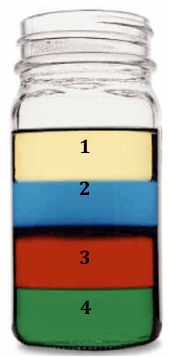
Put the liquids in order from most dense to least dense?

4

3

2

1

1
2
3
4

39

media

40

Multiple Choice

What happens to the molecules of water when it gets below 4 °C?

1

They get closer together

2

They stay the same distance apart

3

They get further apart

4

They disappear

41

media

42

media

43

media

44

media

45

media

46

media

47

media

48

media

49

media

50

media

51

media

52

media

53

Categorize

Options (7)

Positive Charge

No Charge

Negative Charge

Orbit Nucleus

Along with protons, determines the atom’s mass.

Determines the atom’s elemental identity

Determines what chemical bonds the atom will form.

Identify each statement as describing a proton (p), neutron (n), or electron (e). - Positively charged. - Negatively charged. - No charge. - Orbit the nucleus. - Determines the atom’s elemental identity. - Determines what chemical bonds the atom will form. - Along with protons, determines the atom’s mass.

Proton
Neutron
Electron

54

media

55

media

56

media

57

Multiple Choice

Question image
If the two charges represented in the figure were brought near each other, they would
1
attract each other.
2
repel each other.
3
cause static discharge.
4
have no affect on each other

58

media

59

media

60

media

61

media

62

media

63

media

64

media

65

media

66

media

67

media

68

media

69

media

70

media

71

media

72

media

73

media

74

media

75

media

76

media

77

media

78

media

79

media

80

media

81

media

82

media

83

media

84

media

85

media

86

media

87

media

88

media

89

media

90

media

91

media

92

media

93

media

94

media

95

media

96

media

97

media

98

media

99

media

100

media

101

media

102

media

103

media

104

media

105

media

106

media

107

media

108

media

109

media

110

media

111

media

112

media

113

media

114

media

115

media

116

media

117

media

118

media

119

media

120

media

121

media

122

media

123

media

124

media

125

media

126

media

127

media

128

media

129

media

130

media

131

media

132

media

133

media

134

media

What determines whether a liquid will sink or float in another liquid?

1

Density

2

Temperature

3

Viscosity

4

Color

Show answer

Auto Play

Slide 1 / 134

MULTIPLE CHOICE