

Atomic Theory & Structure

Presentation
•
Chemistry
•
University
•
Practice Problem
•
Hard

Genia Harris
FREE Resource
61 Slides • 26 Questions
1

2

3

4

5
Multiple Choice
Which philosopher proposed the idea that all matter is made up of small, hard, indivisible, and indestructible particles called 'atomos'?
Democritus
Aristotle
John Dalton
Socrates
6

7

8
Fill in the Blanks
The philosopher who believed that matter could be broken down into fire, earth, air, and water, but not atoms, was
Type answer...
9
Multiple Choice
Which of the following statements about Aristotle's beliefs is correct?
He believed matter was made of atoms.
He believed all matter could be broken down to one of the classical elements.
He performed experiments to prove his theories.
He supported Democritus' atomic theory.
10
Open Ended
Compare the views of Democritus and Aristotle on the nature of matter. How did their beliefs differ regarding the existence of atoms?
11

12
Fill in the Blanks
John Dalton proposed his atomic theory based on the
Type answer...
13

14
Open Ended
How did John Dalton's approach to atomic theory differ from that of Democritus and Aristotle?
15

16
Multiple Choice
Which scientist proposed the Atomic Theory in 1803?
John Dalton
Isaac Newton
Dmitri Mendeleev
Marie Curie
17

18
Multiple Choice
According to Dalton's Atomic Theory, what is matter composed of?
Atoms
Molecules
Protons
Electrons
19

20
Open Ended
Explain the significance of Dalton's postulate that all atoms of an element are identical. How does this idea contribute to our understanding of chemical elements?
21

22
23
Fill in the Blanks
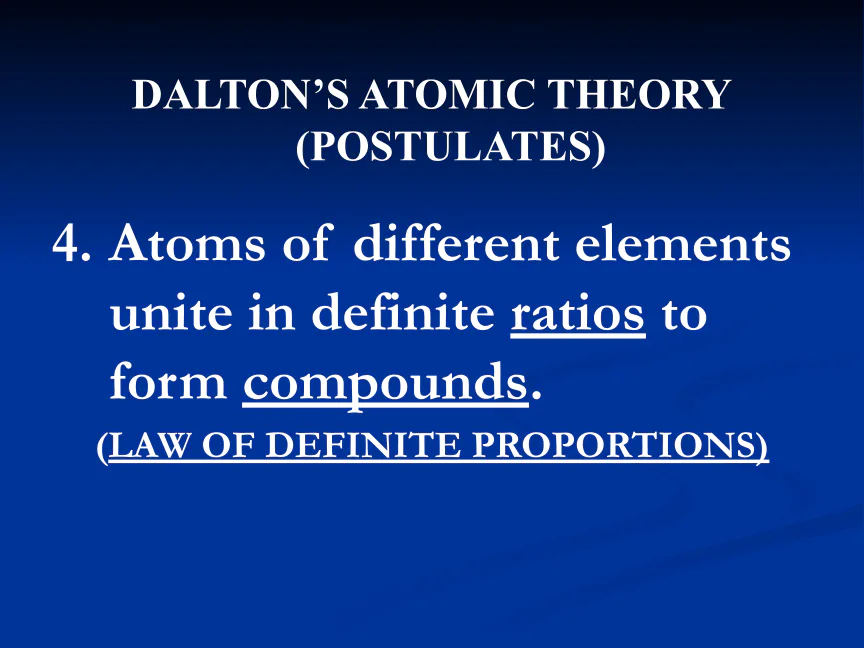
Atoms of different elements unite in definite
Type answer...
24
Multiple Select
Which of the following statements are part of Dalton's Atomic Theory?
Atoms cannot be broken apart, created, or destroyed.
Atoms of different elements unite in definite ratios to form compounds.
All atoms of an element are identical.
Atoms can be divided into smaller particles.
25

26
Open Ended
Describe what happens to atoms during a chemical reaction according to Dalton's Atomic Theory.
27

28
Multiple Choice
Which of Dalton's atomic theory assumptions were modified based on experimental evidence?
Assumptions 1 and 2
Assumptions 2 and 3
Assumptions 3 and 4
Assumptions 1 and 3
29

30

31
Multiple Choice
What experimental apparatus did J.J. Thomson use to show that atoms contained small particles with a negative charge?
Electrolysis cell
Cathode ray tube
Mass spectrometer
Electroscope
32
Open Ended
How did J.J. Thomson's research change our understanding of the structure of the atom?
33

34
Fill in the Blanks
J.J. Thomson calculated the
Type answer...
35

36
Multiple Select
Which of the following statements about electrons and cathode ray tubes are correct?
Electrons travel from the cathode to the anode.
Electrons have a positive charge.
Cathode is negatively charged.
Anode is positively charged.
37

38
Open Ended
Explain the significance of the Plum Pudding Model in the development of atomic theory.
39

40
Multiple Choice
According to J.J. Thomson's atomic model, what is the arrangement of electrons and positive charge in an atom?
Electrons are embedded in a positively charged particle cloud
Electrons orbit around a dense nucleus
Electrons are located only at the surface of the atom
Electrons are randomly scattered outside the atom
41

42
Open Ended
What important observation did J.J. Thomson make about neon atoms, and what is this phenomenon now called?
43

44
Multiple Choice
Which experiment led Ernest Rutherford to discover that an atom has a nucleus?
Gold-foil experiment
Cathode ray experiment
Oil drop experiment
Photoelectric effect experiment
45


46
Multiple Choice
In Rutherford's experiment, what was used to bombard the gold foil?
Alpha particles
Beta particles
Gamma rays
Neutrons
47

48

49
Open Ended
Based on Rutherford's experiment and its results, what conclusions can be drawn about the structure of the atom?
50
Fill in the Blanks
Most of the positively-charged subatomic particles passed through the gold foil. Therefore, the atom must be mostly
Type answer...
51

52

53

54

55

56

57

58

59

60

61

62

63

64

65

66

67

68

69

70

71

72

73

74

75

76

77

78

79

80

81

82

83

84

85

86
Open Ended
How did learning about the early ideas of the atom help you understand the development of scientific knowledge?
87
Multiple Choice
Why were the early ideas about the atom considered less scientific?
Because they were based on philosophical reasoning without experiments
Because they were based on religious beliefs
Because they were based on mathematical calculations
Because they were based on chemical reactions
Show answer
Auto Play
Slide 1 / 87
SLIDE
Similar Resources on Wayground

79 questions
Review ROBO TEST 1st December
Presentation
•
KG - University
79 questions
ENGLISH II - REVIEW
Presentation
•
University
81 questions
printers
Presentation
•
University
84 questions
heliocentric VS geocentric
Presentation
•
KG
81 questions
Math for College Algebra
Presentation
•
University
80 questions
Strategic Planning Analysis Tools
Presentation
•
University
82 questions
Module 05: Integration Management
Presentation
•
University - Professi...
79 questions
DON SINH NHAT SC
Presentation
•
University
Popular Resources on Wayground
10 questions
Safety Day 2026 – Student Review

Quiz
•
9th Grade
21 questions
Continents and Oceans
Quiz
•
6th Grade
20 questions
Parts of Speech
Quiz
•
5th Grade
16 questions
Subject & Predicate
Quiz
•
5th Grade
25 questions
Multiplication Facts
Quiz
•
5th Grade
12 questions
Map Skills
Quiz
•
3rd Grade
22 questions
Continents and Oceans
Quiz
•
5th Grade
15 questions
Rounding Decimals
Quiz
•
5th Grade