

Atoms vs. Ions Notes

Presentation
•
Science
•
9th - 12th Grade
•
Practice Problem
•
Hard
Standards-aligned

Anthony Dellamorte
FREE Resource
11 Slides • 11 Questions
1

2

3
Multiple Choice
Which of the following statements best describes an atom?
An atomic particle with equal number of protons and electrons, and is neutral in charge.
An atomic particle with more protons than electrons, and has a charge.
An atomic particle with more electrons than protons, and has a charge.
An atomic particle with no protons or electrons.
4

5
Multiple Choice
What is the main difference in the impact of lithium and fluorine atoms versus their ions on the human body?
Lithium and fluorine atoms are both essential micronutrients.
Lithium ion helps treat bipolar disorder, while fluorine ion prevents cavities.
Lithium atom helps treat bipolar disorder, while fluorine atom prevents cavities.
Both lithium and fluorine ions are useless to the human body.
6

7
Multiple Choice
According to the octet rule, what do atoms do to achieve energetic stability?
Gain or lose protons to achieve a full valence shell.
Gain or lose electrons to achieve a full valence shell.
Gain or lose neutrons to achieve a full valence shell.
Share protons to achieve a full valence shell.
8
Open Ended
Explain how the octet rule influences the formation of ions from atoms.
9

10

11
Multiple Select
Which statements correctly describe how metals and nonmetals form ions?
Metals lose electrons to form cations.
Nonmetals gain electrons to form anions.
Metals gain electrons to form anions.
Nonmetals lose electrons to form cations.
12

13
Fill in the Blanks
A cation is an ion with a
Type answer...
14

15
Open Ended
Describe the process by which a sodium atom becomes a sodium ion, including changes in electron configuration.
16
17
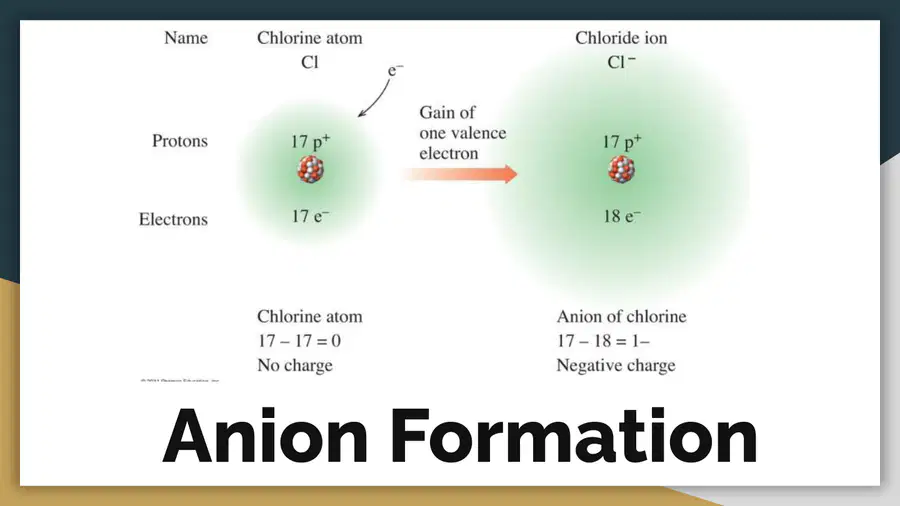
Open Ended
Explain how the number of protons and electrons changes when a chlorine atom becomes a chloride ion. What is the resulting charge and why?
18

19

20
Fill in the Blanks
When an atom gains electrons, it forms an
Type answer...
21
Multiple Choice
Which group on the periodic table typically forms ions with a -1 charge, and what process leads to this charge?
Halogens, by gaining 1 electron
Alkali metals, by losing 1 electron
Oxygen group, by gaining 2 electrons
Aluminum group, by losing 3 electrons
22
Multiple Choice
What is the main difference between an atom and an ion?
Atoms have equal numbers of protons and electrons, while ions do not.
Atoms have a charge, while ions are neutral.
Atoms contain only protons, while ions contain only electrons.
Atoms are always larger than ions.
Show answer
Auto Play
Slide 1 / 22
SLIDE
Similar Resources on Wayground

16 questions
Force fields and matter 1
Presentation
•
9th - 12th Grade
17 questions
leçon panneaux photovoltaïques term E.S.
Presentation
•
9th - 12th Grade
16 questions
Magnetism Notes
Presentation
•
10th - 12th Grade
18 questions
Radiometric Dating
Presentation
•
9th - 12th Grade
15 questions
Ions review (forming compounds and naming)
Presentation
•
9th - 12th Grade
15 questions
Physical Science Review
Presentation
•
8th - 11th Grade
21 questions
1.9 Carbon
Presentation
•
9th - 12th Grade
21 questions
Naming Ionic Compounds
Presentation
•
8th - 12th Grade
Popular Resources on Wayground
10 questions
How much do you know about our Portrait of an Eagle?

Quiz
•
10th Grade
10 questions
Fast Food Slogans
Quiz
•
6th - 8th Grade
21 questions
Continents and Oceans
Quiz
•
6th Grade
20 questions
Parts of Speech
Quiz
•
5th Grade
16 questions
Subject & Predicate
Quiz
•
5th Grade
25 questions
Multiplication Facts
Quiz
•
5th Grade
12 questions
Map Skills
Quiz
•
3rd Grade
22 questions
Continents and Oceans
Quiz
•
5th Grade
Discover more resources for Science
10 questions
Exploring Chemical and Physical Changes

Interactive video
•
6th - 10th Grade
20 questions
Atomic Structure
Quiz
•
9th Grade
10 questions
Decoding the Periodic Table of Elements
Interactive video
•
6th - 10th Grade
10 questions
Exploring the Periodic Table
Interactive video
•
6th - 10th Grade
14 questions
Physical and Chemical Changes
Quiz
•
10th Grade
22 questions
Periodic Table Review
Quiz
•
9th - 12th Grade
20 questions
Observation vs. Inference
Quiz
•
7th - 9th Grade
14 questions
Periodic Trends
Interactive video
•
11th Grade