Search Header Logo
Chapter 2 Example Explainations and Practice

Chapter 2 Example Explainations and Practice

Assessment

Presentation

Science

9th - 12th Grade

Easy

NGSS
MS-PS1-1, HS-PS1-7, HS-PS1-8

Standards-aligned

Created by

Chelsea McBride

Used 1+ times

FREE Resource

32 Slides • 50 Questions

1

​Chemistry: Chapter 2 Explained

By Chelsea McBride

2

Mixtures

When we talk about types of matter, we can place the matter into categories; mixtures and pure substances. Today is an introduction into mixtures.

media

3

Homogeneous Mixtures

The first type of mixture is homogenous. "Homo-" means the same so a homogenous mixture is the same throughout the entire matter.

media

4

Heterogeneous Mixtures

The second type of mixture is heterogeneous. "Hetero-" means different so a heterogeneous. mixture is different throughout the entire matter.

media

5

Multiple Choice

Question image

Is cereal homogeneous or heterogeneous?

1

homogeneous

2

heterogeneous

6

Multiple Choice

Question image

Is the drink "Hawaiian Punch" homogeneous or heterogeneous?

1

homogeneous

2

heterogeneous

7

Multiple Choice

Question image

Are M&M's homogeneous or heterogeneous?

1

homogeneous

2

heterogeneous

8

Multiple Choice

Question image

Is a cheeseburger homogeneous or heterogeneous?

1

homogeneous

2

heterogeneous

9

Multiple Choice

Question image

Is coffee homogeneous or heterogeneous?

1

homogeneous

2

heterogeneous

10

Multiple Choice

Question image

Is this cake homogeneous or heterogeneous?

1

homogeneous

2

heterogeneous

11

Multiple Choice

Question image

Is lemonade homogeneous or heterogeneous?

1

homogeneous

2

heterogeneous

12

Multiple Choice

Question image

Is guacamole homogeneous or heterogeneous?

1

homogeneous

2

heterogeneous

13

Multiple Choice

Question image

Is water (H2O) homogeneous or heterogeneous?

1

homogeneous

2

heterogeneous

3

Wait, this is a trick question. H2O is a chemical compound.

14

Pure Substances

There are 2 types of pure subtances: elements and compounds.

media

15

Elements

  • ALL are listed on the periodic table

  • Made of only 1 type of atom

  • Cannot be broken down with a physical or chemical changes

  • Have consistent properties

media

16

Compounds

  • Are made of two or more types of atoms chemically combined

  • Can be broken down with chemical changes, but not physical

  • Have consistent properties

media

17

Multiple Select

Select all of the ELEMENTS from the list below.

1

Water

2

Aluminum

3

Oxygen

4

Air

5

Copper

18

Multiple Select

Select all the COMPOUNDS from the list below.

1

Table Salt (NaCl)

2

Air

3

Oxygen (O2)

4

Carbon Monoxide (CO)

5

Baking Soda

19

Multiple Choice

Which describes COMPOUNDS?

1

made of one type of atom

2

made of two or more types of atoms

20

Multiple Select

Select all of the ELEMENTS shown below.

1
2
3
4
5

21

Multiple Select

Select all the COMPOUNDS shown below.

1
2
3
4
5

22

Multiple Choice

Which best describes ELEMENTS?

1

made of only 1 type of atom

2

made of 2 or more types of atoms

23

Multiple Select

Select all the ELEMENTS shown below.

1
2
3
4
5

24

Multiple Select

Select all the COMPOUNDS shown below.

1
2
3
4
5

25

Multiple Select

Select all the COMPOUNDS shown below.

1
2
3
4
5

26

Density

You know, just a general measure of how much "stuff" is in there, very technical...

media

27

Particle Diagrams and Density

  • We can imagine the "stuff" as particles and recognize that both the amount of particles (mass) and the space they occupy determine the density

  • Let's compare and discuss A and B...

  • Now let's compare and discuss A and C...

media

28

Multiple Choice

Question image

Which diagram shows the MOST dense object?

1

left

2

center

3

right

29

Multiple Choice

Question image

Which diagram shows the LEAST dense object?

1

left

2

center

3

right

30

Multiple Choice

Question image

Rank the objects from MOST dense to LEAST dense.

1

left, center, right

2

right, center, left

3

left, right, center

4

right, left, center

5

center, left, right

31

Calculating Density

  • This is in the Edpuzzle video for the week and the Notes so make sure you get it down!

  • mass is typically in units of g or kg

  • volume of liquids is in mL

  • volume of liquids is in cm3

  • density has a "combined" unit of g/mL or g/cm3

media

32

Practice calculating density

33

Multiple Choice

A block of aluminum occupies a volume of 15.0 mL and weighs 45.0 g. What is its density?

1

3 g/mL

2

0.3333 g/mL

3

675 g/mL

4

I have no idea

34

Multiple Choice

A sample of liquid has a mass of 300 g and occupies 50 mL in a graduated cylinder. What is the density?

1

15,000 g/mL

2

.16667 g/mL

3

6 g/mL

4

Yup, still no clue

35

media

36

media

37

38

Multiple Choice

Question image
What is an isotope? 
1
A charged atom
2
An atom with different amounts of neutrons
3
An atom with different amounts of protons
4
A neutral atom

39

Multiple Choice

Isotopes of an element have a different number of...

1

Protons

2

Neutrons

3

Electrons

4

Mass

40

media

41

Multiple Choice

How many neutrons does an atom of the isotope Neon-22 have?
1
12
2
10
3
22
4
20

42

Multiple Choice

Question image
How many neutrons does a Sodium 24 isotope have?
1
12
2
13
3
14
4
15

43

Multiple Choice

How many neutrons in C-14?
1
6
2
7
3
14
4
8

44

media

45

media

46

media

47

Multiple Choice

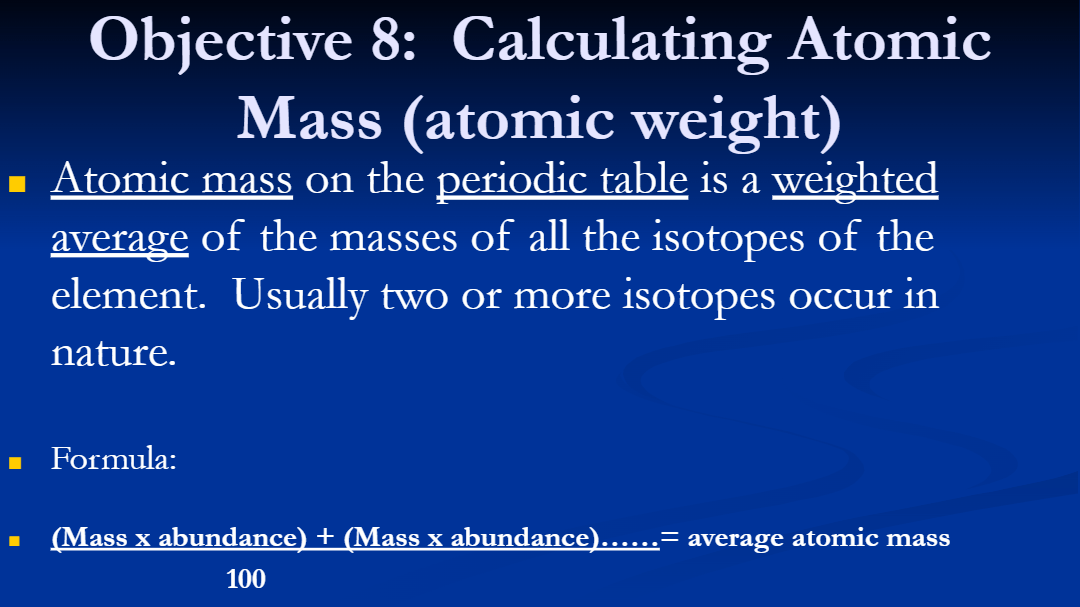
Using the atomic masses and relative abundance of the isotopes of nitrogen given below, determine the average atomic mass of nitrogen.

N-14: 14.003 amu; 99.63% N-15: 15.000 amu; 0.37%

1

14.003 amu

2

14.007 amu

3

14.506 amu

4

15.000 amu

48

Multiple Choice

Gallium has two stable isotopes. The mass of gallium-69 is 68.926 amu and has an abundance of 60.11%. The mass of gallium-71 is 70.925 amu and has an abundance of 39.89%. Which is the average atomic mass of gallium?

1

69.93 amu

2

69.72 amu

3

292.47 amu

4

139.85 amu

49

Fill in the Blank

Oxygen has three stable isotopes. Oxygen-16 has a mass of 15.99 amu and an abundance of 99.76%. Oxygen-17 has a mass of 17.00 amu and an abundance of 0.04%. Oxygen-18 has a mass of 18.00 amu and an abundance of 0.20%. What is the average atomic mass of oxygen using this data?

.

50

Intro to mole

By Monica Youssef

1. What is a mole?

​2. Avogadro's number

51

media

52

media

53

media

54

media

55

Multiple Choice

Which of the following statements regarding the mole is NOT correct?

1

A mole is a counting unit

2

Equal to 6.02 x 10²³ particles.

3

The concept of mole is similar to the concept of dozen

4

none of the above

56

media

57

Multiple Choice

When comparing a mole of oxygen and a mole of sulfur, how many atoms does each have?

1

oxygen has 16 grams of atoms

2

sulfur has 32.06 grams of atoms

3

both contains 6.02 x 10²³ atoms

4

can not be determined

58

Multiple Choice

Which would have more atoms?
1

1 mole of Li

2

1 mole of Au

3

1 mole of Si

4

None, all are equal

59

Multiple Choice

Which has more molecules?
1

1 mole H2O

2

1 mole Al(OH)3

3

1 mole NaCl

4

There are all the same

60

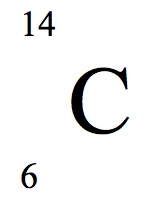
Multiple Choice

Question image
The photo above shows the isotopic notation for which isotope?
1
Carbon 12
2
Carbon 13
3
Carbon 14
4
Carbon 15

61

media

62

Multiple Choice

How many atoms of iodine are in a mole of iodine?
1

53

2

63.55g

3

126.9

4

6.02 x 10²³

63

Multiple Choice

How can you figure out how particles (atoms) there are in 2 moles?
1

2

2

2 x (6.02 x 1023)

3

2 x (atomic mass)

4

2 ÷ (6.02 x 10²³)

64

Multiple Choice

How many Carbon Atoms are in 4 moles of Carbon?

1

6.02 x 10²³

2

1.33 x 10²³

3

4.52

4

2.408 x 1024

65

media

66

media

67

media

68

media

69

Multiple Choice

A mole = Avogadro's number = 6.022x10²³

1

true

2

false

70

Multiple Choice

The number 6.02 x 10²³ is called...
1

Molar number

2
Bohr's number
3

Scientist's number

4
Avogadro's number

71

Multiple Choice

Which of the following statements regarding the mole is correct?

1

A mole is a counting unit equal to 6.02 x 10²³ particles.

2

The number of particles in a mole is known as Avogadro’s number.

3

1 mole = Avogdro's number

4

all of the above

72

Molar Mass

  • molar mass = 1 mole

  • CO2

  • C=12 O=16x2

  • 44 g/mol

media

73

Multiple Choice

CO2 = 44 g/mol

How much would 3 moles of CO2 equal?

1

132

2

33

3

404

74

Multiple Choice

Question image

Molar Mass of CH4

1

12 g/mol

2

16 g/mol

3

4 g/mol

75

Multiple Choice

Molar Mass of K2CO3

1

138.205 g/mol

2

35 g/mol

3

78.2 g/mol

76

Multiple Choice

Molar Mass of Ag2O

1

231.7 g/mol

2

56.2 g/mol

3

734.4 g/mol

77

Mass converted to molar mass

to find the moles of any molecule

mole = mass/molar mass

media

78

20 grams of H2O is how many moles?

Molar mass of H2O = 18

Moles = 20/18

1.1 moles of H2O

media

79

Multiple Choice

88 grams of H2O (18 g/mol) is how many moles?

1

4.88 moles

2

.54 moles

3

6.67 moles

80

Multiple Choice

52 grams of O2 (32 g/mol) is how many moles?

1

1.63 moles

2

.615 moles

3

26 moles

81

Multiple Choice

73 grams of AlBr3 (267 g/mol) is how many moles?

1

.273 moles

2

263 moles

3

4.23 moles

82

Multiple Choice

800 grams of 2NH3 (34 g/mol) is how many moles?

1

23.52 moles

2

.0425 moles

3

834 moles

​Chemistry: Chapter 2 Explained

By Chelsea McBride

Show answer

Auto Play

Slide 1 / 82

SLIDE