

Mock Midterm

Presentation
•
Biology
•
10th Grade
•
Practice Problem
•
Medium
+12
Standards-aligned

Rebecca Lee
Used 6+ times
FREE Resource
41 Slides • 34 Questions
1
By Rebecca Lee
2
Important Biology Midterm Information
3
Midterm Schedule
Monday, December 15th — 6th period (12:45-2:50)
Tuesday, December 16th — 1st period (7:30-9:35) 2nd period (9:50-11:55)
Wednesday, December 17th — 3rd period (7:30-9:35) 4th period (9:50-11:55)
Thursday, December 18th — 5th period (7:30-9:35) 7th period (9:50-11:55)
Friday, December 19th — Make-up day for Midterm Exams (Doctor’s Note to your assistant principal and approval in advance)
4
Extended Time
Please make arrangements with your teacher if you receive extra time accommodations. These are your options:
During Lunch
After 12:05 (If you ride the bus, make sure you have another ride.)
If you complete midterm early from another class.
5
Computers
If you need a computer for any testing day, go to the MEDIA CENTER with your Student ID. Techs will loan you a computer for testing. It is your responsibility to return the computer to the media center after testing. IMPORTANT: PLEASE DO THIS BEFORE YOU GET TO CLASS, SO THAT YOU DON'T LOSE TIME ON THE TEST.
6
If you miss the Biology Midterm, you have a new exam. Students CANNOT take the District Biology Midterm after break. The new exam will cover the same topics as the District Biology Midterm.
7
Please Take the Midterm Seriously
This midterm is a good way for us to see if you have a good chance of passing the EOC. If you get a D or F on this midterm, we are going to see this and decide that you are most likely not going to pass the EOC without extreme intervention.
If you do not do well on the exam, Dr. Castellano will pull you out of your class to speak with you. Your parents will be contacted. There will be additional remediation activities and review/tutoring sessions assigned to you. We want you to do well and be successful. We are going to do everything we can to make that possible.
8
Multiple Choice
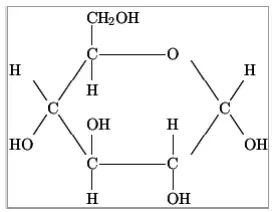
The structural formula shown represents a compound that may serve as the building block of which type of macromolecule?
lipid
protein
nucleic acid
carbohydrate
9
Make sure you know details about the 4 biomolecules. You must know the structure of carbohydrate, lipid, protein, and nucleic acid building blocks, also called monomers. You must know the elements that make them, and what they do (their function).
10
Multiple Choice
In living organisms, what are the functions of lipids?
They store energy and transmit genetic information.
They store energy and give structure to cellular membranes.
They transmit genetic information and catalyze chemical reactions.
They catalyze chemical reactions and give structure to cellular membranes.
11
Multiple Choice
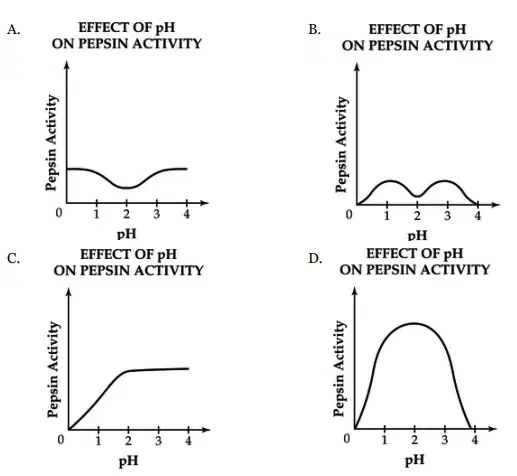
Cells in the stomach produce an enzyme called pepsin to help digest food. Pepsin is most effective at a pH of 2. Which of these graphs in the image most likely shows what will happen to the activity of pepsin as the pH of the stomach is increased?
A
B
C
D
12
Answer Explanation
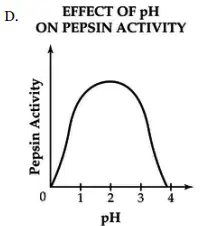
D is the answer because the paragraph said that the most effective pH is 2. Anything below or above that will result in a decrease in pepsin activity. Changes in pH and temperature can cause proteins and enzymes to denature (lose its shape).
13
Multiple Choice
The Internet is a global network of billions of computers and other electronic devices. While it's possible to access data, knowledge, and understanding from sources all over the world, it’s also important to verify the reliability and validity of the information being shared. A student is researching the efficacy of a drug used to treat cancer. Which of the following sources would be most reliable?
An article written by the president of the drug company.
A video produced by the scientists who developed the drug.
An article written by a group of scientists who reviewed the clinical trial data.
A social media post by a patient who was treated with the drug and recovered.
14
Answer Explanation
Option C is best because independent scientists checked the facts and data. "Independent" means they do not work for the drug company. They have no reason to lie. This kind of research is often checked by other experts (peer-reviewed) to make sure it is correct.
Options A and B are not ideal. The people who made the drug or work for the company want the drug to succeed. They might only share good information and hide bad information.
Option D is just one person's story. It is not scientific proof. One person getting better does not mean the drug works for everyone.
15
Multiple Choice
When the cells of most organisms freeze, they burst. Which property of water causes this to occur?
Water is a universal solvent.
Water is a nonpolar molecule.
Water changes temperature rapidly.
Water is less dense as a solid than as a liquid.
16
Answer Explanation
The correct answer is D. Water is less dense as a solid than as a liquid.
"Less dense as a solid than as a liquid" means ice is lighter and takes up more space than the same amount of liquid water.
When the water inside cells freezes into ice, it expands (grows bigger).
This expansion makes the cells explode or burst.
Why the other answers are wrong:
A. Water is a universal solvent. This means water can dissolve many things (like salt or sugar). It has nothing to do with freezing.
B. Water is a nonpolar molecule. This is false; water is polar. Polarity is about how water sticks to things, not how cells freeze.
C. Water changes temperature rapidly. This is also false; water changes temperature slowly. This fact helps keep the Earth's temperature stable.
17
Multiple Choice
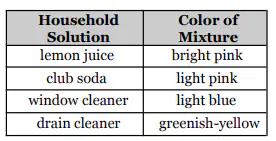
Red cabbage contains a water-soluble pigment. In a highly acidic solution, the pigment turns bright red, and in a moderately acidic solution, it turns pinkish. In a highly basic solution, the pigment turns yellow, and in a moderately basic solution, it turns bluish. A student makes a pH indicator from red cabbage that has a reddish-purple color with a pH of approximately 7. Then the student pours the same amount of the cabbage solution into each of four different beakers. Finally, the student then adds a different household solution to each of the four beakers until a color change is obtained. The student's results are shown in the table in the image. Which variable should be controlled in the investigation to make sure the student obtains valid results?
the pH of the tested household solutions
the amount of household solution placed in each container
the brand of the household solutions added to the cabbage pH indicator
the final color of the cabbage pH indicator after the household solutions are added
18
Answer Explanation
The variable that should be controlled is B. the amount of household solution placed in each container.
To get "valid results" in a science experiment, you need a fair test. A fair test means you change only one thing (the variable you are testing) while keeping everything else the same (controlled variables).
Why the other answers wrong:
In this experiment, the student is testing how different household solutions change the color of the cabbage indicator.
A. the pH of the tested household solutions: The entire point of the experiment is to find out the pH (acid/base strength) of the solutions. You cannot control what you are trying to measure.
C. the brand of the household solutions: Using different brands might introduce slight variations, but it is less critical for validity than standardizing the volume used in the test.
D. the final color of the cabbage pH indicator: The color is the result of the experiment. You observe the final color; you don't control it.
19
Multiple Choice
A scientist is examining pollen grains under a microscope. The microscope uses focused beams of charged particles in a vacuum to observe the surface features of the pollen grains in great detail. Which of the following tools is the scientist most likely using?
dissecting microscope
compound light microscope
scanning electron microscope
transmission electron microscope
20
Answer Explanation
The correct answer is C. scanning electron microscope. The description gives clues about a very powerful tool:
"Focused beams of charged particles" = The tool shoots tiny parts called electrons, not light.
"In a vacuum" = The machine needs all the air removed (an empty space).
"Observe the surface features" = The tool makes a detailed picture of the outside of the pollen.
A scanning electron microscope (SEM) is the only tool that uses electrons in a vacuum to look closely at the surface of an object.
Why the other answers are wrong:
A and B (Dissecting and Compound Light Microscopes): These use regular light, not electron beams or a vacuum. They are less powerful.
D (Transmission electron microscope): This powerful tool also uses electrons and a vacuum, but it looks through an object to see inside it, not at the surface features.
21
Multiple Choice
Cell Theory has three components.
● All cells come from pre-existing cells.
● All living things are made of cells.
● Cells are the basic unit of structure and function for all living things.
Which of the following best explains why Cell Theory is so important to biology?
Cell Theory describes how cells reproduce.
Cell Theory describes why cells make up all living things.
Cell Theory explains how early scientists discovered cells
Cell Theory explains the foundational understanding of living things.
22
Answer Explanation
The correct answer is D. Cell Theory explains the foundational understanding of living things. "Foundational understanding of living things" means the most important, basic rules about life. The Cell Theory is the main idea for all biology. It teaches us:
Everything alive is made of cells.
Cells are the basic building blocks of life.
New cells always come from old cells.
This theory helps all scientists understand what "life" is and how all living things work.
Why the other answers are wrong:
A. Cell Theory describes how cells reproduce. The theory says new cells come from old ones, but it doesn't give the step-by-step instructions for how they divide.
B. Cell Theory describes why cells make up all living things. It states that cells make up all living things, but it doesn't explain the deep reasons (evolution, chemistry) why this is true.
C. Cell Theory explains how early scientists discovered cells. The theory lists the main ideas they found, not the story of how they found them.
23
Multiple Choice
Which of the following would be the best evidence that a cell is using active transport to move a substance across its cell membrane?
Materials are moving from low to high concentrations.
Substances are moving rapidly across the cell membrane.
Oxygen is being rapidly consumed near the cellular membrane.
Channels in the cell membrane are being used to move substances.
24
Answer Explanation
The correct answer is A. Materials are moving from low to high concentrations.
Active transport is like pushing a heavy object up a hill. It requires energy.
Option A describes materials moving from an area where there are few of them (low concentration) to an area where there are many (high concentration). This movement goes against the normal, natural flow, like going up that hill. Because it goes against the natural flow, the cell must use energy. This is the definition of active transport.
25
Multiple Choice
Which cell structure below is correctly paired with its function?
vacuole: gene expression
nucleus: protein packaging
ribosome: protein synthesis
chloroplast: carbon dioxide production
26
Make sure you study all the organelles and their functions from your midterm study guide. The district midterm can ask you about any organelle and what their job is.
The organelles listed in the answers have the following jobs:
Vacuole: storage of water, nutrients, waste
Nucleus: control center of the cell; stores genetic information
Ribosomes: protein synthesis (the answer to the question)
Chloroplast: site of photosynthesis
27
Multiple Choice
Which group of structures is present in both plant and animal cells?
cell wall, mitochondria, nucleus
cell membrane, chloroplast, ribosome
cell membrane, mitochondria, ribosome
cell wall, endoplasmic reticulum, nucleus
28
Answer Explanation
Some parts are only in plant cells, not animal cells.
Cell wall: Plants have an extra, strong outside wall to help them stand up tall. Animals do not have this.
Chloroplast: Plants use these to make food from sunlight (like a little solar panel). Animals eat food, so they do not need chloroplasts.
So, the only group where all three parts are in both cells is cell membrane, mitochondria, ribosome.
29
Multiple Choice
Aaliyah is studying for an upcoming biology test. As she reviews the Theory of Evolution, she overhears a conversation between her brother Terrell and his friends. They are discussing last night’s football game. Terrell says, “I have a theory about why we lost that game.” How is Terrell’s theory different from the scientific theory Aaliyah is studying?
A scientific theory describes a phenomenon, while an everyday theory tries to explain a phenomenon.
An everyday theory is widely accepted in society, while a scientific theory is accepted by scientists.
An everyday theory is supported by prior knowledge, while a scientific theory is supported by scientific laws.
A scientific theory is an accepted explanation supported by evidence, while an everyday theory is based on individual experiences.
30
Answer Explanation
The correct answer is D. A scientific theory is an accepted explanation supported by evidence, while an everyday theory is based on individual experiences.
When Aaliyah studies a scientific theory (like the Theory of Evolution), it is very different. A scientific theory is an explanation for how nature works. It is:
Supported by lots of evidence: Many scientists do many tests and collect lots of data (facts) to prove the theory is correct.
Tested many times: The idea has been tested over and over by different scientists, and the results are always the same.
Widely accepted: Most scientists around the world agree that the theory is the best explanation we have.
Terrell's idea is just a guess (more like a hypothesis), but Aaliyah's theory is a strong, proven explanation!
31
Multiple Choice
Which pair of structures below regulates the movement of gases in and out of the leaf?
cuticle and chlorophyll
guard cells and stomata
stomata and chloroplasts
chlorophyll and mitochondria
32
Answer Explanation
The correct option is B. guard cells and stomata.
Explanation
Stomata (singular: stoma/stomate): These are like small "mouths" or "doors" on the bottom of a leaf. They open and close to let air in and out.
Gases that go IN: Carbon dioxide (CO2), which the plant uses to make food.
Gases that go OUT: Oxygen (O2), which the plant makes as a waste product, and water vapor.
Guard cells: These are special cells around each stoma. They control the "mouth" or "door".
When the guard cells are full of water, they open the stoma.
When they lose water, they close the stoma. This stops the leaf from drying out.
33
Multiple Choice
How do plants use energy from the Sun?
Plants produce sugar molecules in their roots.
Plants produce sugar molecules in their leaves.
Plants obtain heat from the soil through their roots.
Plants obtain heat from the surface of their leaves to break down sugar molecules.
34
Answer Explanation
Plants produce sugar molecules in their leaves. Plants use a special process called photosynthesis to get energy from the sun.
1. Sunlight: The plant takes in energy from the sun using a green chemical called chlorophyll.
2. Water: Water comes up from the roots.
3. Air: Carbon dioxide gas comes in through the little holes (stomata) in the leaves.
The plant mixes these three things together in its leaves to make sugar molecules. This sugar is the plant's food. It is how the plant gets energy
35
Multiple Choice
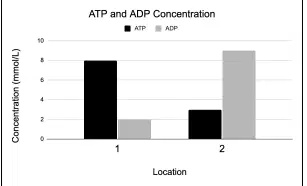
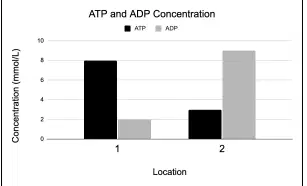
A student is studying how energy is used in cells. She measures the concentration of ADP and ATP at two locations inside a cell. A graph of her data is shown in the image. Which of the following cellular processes are most likely occurring at these locations?
Location 1: osmosis. Location 2: meiosis
Location 1: mitosis. Location 2: photosynthesis
Location 1: protein synthesis. Location 2: diffusion
Location 1: cellular respiration. Location 2: active transport
36
Answer Explanation
Location 1: cellular respiration, Location 2: active transport
Think of ATP and ADP like a battery:
ATP = A full battery (lots of energy).
ADP = An empty battery (no energy, needs charging).
Location 1: Cellular Respiration
This is where the cell "charges" the battery.
The cell takes food (sugar) and oxygen and makes lots of ATP (full batteries).
So, at Location 1, there is a lot of ATP and very little ADP.
Location 2: Active Transport
This is where the cell uses the battery.
Active transport is a job that needs a lot of power (like moving heavy things). It uses the ATP (full battery) and turns it into ADP (empty battery).
So, at Location 2, there is little ATP and a lot of ADP.
37
Multiple Choice
Some organisms that live in the intestines of cows do not require oxygen to survive. Which of the following best identifies the process by which these organisms obtain energy?
aerobic respiration
anaerobic respiration
diffusion
osmosis
38
Answer Explanation
The correct option is B. anaerobic respiration.
Aerobic means "with oxygen".
Anaerobic means "without oxygen".
Most living things (like you and the cow) use oxygen to make energy. This is called aerobic respiration.
The tiny organisms in the cow's intestine live in a dark, wet place with no oxygen. They have a special way to make energy without oxygen. This process is called anaerobic respiration. It lets them get energy from food even in a place where you cannot breathe.
39
Multiple Choice
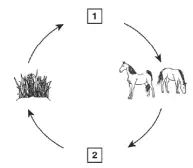
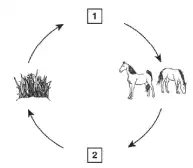
A diagram representing the relationship between photosynthesis and cellular respiration is shown. Which of the following represents the numbered boxes in the diagram?
1: water; 2: nitrogen
1: nitrogen; 2: oxygen
1: oxygen; 2: carbon dioxide
1: carbon dioxide; 2: water
40
Answer Explanation
The picture shows grass and a horse. They are giving each other what they need to stay alive.
Grass → Horse (Arrow 1)
Grass gives something to the horse.
Horse → Grass (Arrow 2)
The horse gives something back to the grass.
Plants do photosynthesis. They take in carbon dioxide (CO₂) and release oxygen (O₂).
Animals need oxygen to breathe.
So Arrow 1 should be oxygen going from the grass to the horse.
Animals breathe out carbon dioxide.
Plants need carbon dioxide to do photosynthesis.
So Arrow 2 should be carbon dioxide going back to the grass.
41
Multiple Choice
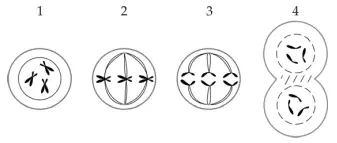
The figure in the image shows a cell in four stages of a cellular process. What is the purpose of this cellular process?
to combine two daughter cells
to produce two identical daughter cells
to form daughter cells with half the number of chromosomes
to form daughter cells with twice the number of chromosomes
42
Answer Explanation
Mitosis is a process where one cell splits to make new cells.
The purpose of mitosis is to make two new cells that are exactly the same as the original cell.
The new cells have the same number of chromosomes.
They have the same DNA.
So the correct answer is:
B. to produce two identical daughter cells
Mitosis = one cell → two same cells.
43
Multiple Choice
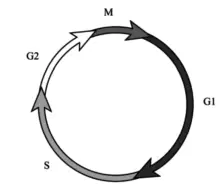
The diagram illustrates the stages of the cell cycle. Which part of the cell cycle consists of the G1 Phase, S Phase, and G2 Phase?
anaphase
interphase
prophase
telophase
44
Answer Explanation
The cell cycle has two main parts:
Interphase – the cell grows, copies its DNA, and gets ready to divide
G1 Phase = the cell grows
S Phase = the cell copies its DNA
G2 Phase = the cell prepares to divide
Mitosis – the cell divides
So the phase that includes G1, S, and G2 is interphase.
Interphase = grow, copy DNA, get ready for cell division
45
Multiple Choice
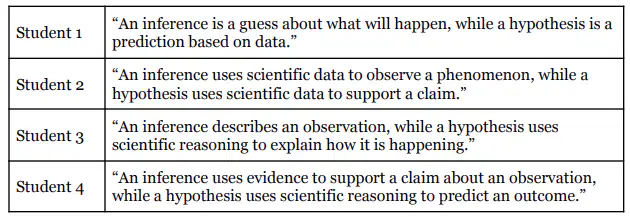
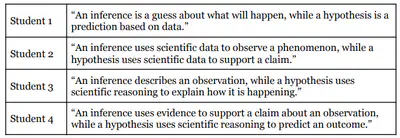
Four students are discussing the methods used by scientists to conduct investigations and evaluate data. They make the following statements about inferences and hypotheses.
Which student’s statement is correct?
Student 1
Student 2
Student 3
Student 4
46
Answer Explanation
Inference = a conclusion or claim you make
based on your observations and evidence.
Hypothesis = a testable prediction about
what will happen, using scientific reasoning.
Student 1: Says inference is a guess about what will happen. ❌
That’s not correct. A hypothesis predicts what will happen.Student 2: Incorrect statement about both.❌
Student 3: Says an inference describes an observation. ❌
An observation is what you see; an inference is what you think from what you see.Student 4: Says
inference = uses evidence to support a claim about an observation ✔
hypothesis = uses reasoning to predict an outcome ✔
47
Multiple Choice
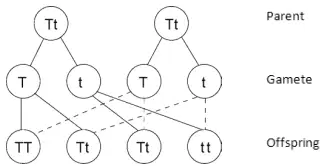
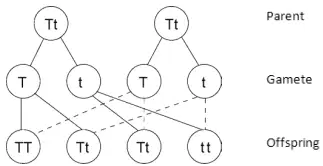
Use the diagram to answer the question. Which two processes are best represented by the diagram above?
meiosis and mitosis
mitosis and sexual reproduction
meiosis and sexual reproduction
mitosis and independent assortment
48
Answer Explanation
In the picture, the T and t are just letters that stand for a trait (something you can see, like height).
Each parent has two letters, and they make reproductive cells (gametes/sperm and egg) that carry one letter each.
The diagram shows two things:
Parents making reproductive cells (dad makes sperm; mom makes egg)
– This process is called meiosis.Reproductive cells coming together to make a baby
– This is sexual reproduction.
So the diagram is showing meiosis and sexual reproduction.
✔ Correct Answer: C. meiosis and sexual reproduction
49
Multiple Choice
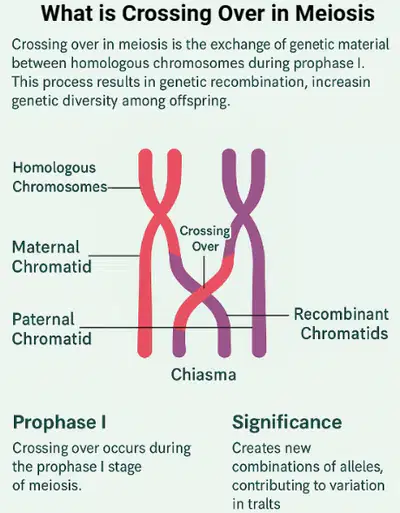
Which of the following is a result of crossing-over during meiosis?
Genes are rearranged, increasing the variability of the offspring
Chromatids thicken and align themselves, helping to ensure genetic continuity.
Chromatids fail to sort independently, creating abnormal chromosome numbers.
Genes are duplicated exactly, ensuring that offspring will be identical to the parents.
50
51
Answer Explanation
Crossing-over happens during meiosis, when chromosomes swap pieces with each other.
This creates new combinations of traits, which means offspring can look different from their parents.
Now look at the choices:
A. Genes are rearranged, increasing the variability of the offspring.
✔ This matches what crossing-over does.B. Chromatids thicken and align…
❌ This describes a different part of cell division.C. Chromatids fail to sort independently…
❌ This causes problems, not normal crossing-over.D. Genes are duplicated exactly…
❌ This would make offspring identical — crossing-over does the opposite.
52
Multiple Choice
Aphids are common insects that are harmful to plants. Aphids alternate between asexual and sexual reproduction. During the summer, aphid populations grow quickly by asexual reproduction. As winter approaches, aphids switch to sexual reproduction. What advantage does the switch to sexual reproduction give the aphids?
Sexual reproduction maintains a constant level of variation in the population and requires less energy.
Sexual reproduction decreases variation in the population and prevents the spread of harmful mutations.
Sexual reproduction increases variation in the population and provides for adaptability in a changing environment.
Sexual reproduction produces individuals that are clones and allows rapid population growth under stable environmental conditions.
53
Answer Explanation
Aphids make copies of themselves in the summer (asexual reproduction). This is fast, but all the babies are almost the same.
When winter comes, the environment changes — it gets colder and harder to survive. The aphids need more variety so some might survive the new conditions.
Sexual reproduction mixes DNA from two parents.
This makes more variation (more differences) in the babies.
More variation = better chance that some will survive the winter.
A – says variation stays the same ❌
B – says sexual reproduction decreases variation ❌
C – says sexual reproduction increases variation and helps survival when the
environment changes ✔
D – describes asexual reproduction, not sexual ❌
54
Multiple Choice
In a portion of a gene, the nitrogenous base sequence is T-C-G-A-A-T. Which nitrogenous base sequence would normally be found bonded to this section of the gene?
A-C-G-T-A-A
A-C-G-U-U-A
A-G-C-T-T-A
U-G-C-A-A-U
55
Answer Explanation
The gene sequence is T-C-G-A-A-T.
Genes are in DNA. So, T-C-G-A-A-T is a DNA sequence.
In the question, it does not say whether the nitrogenous base sequence bonded to the gene would be DNA or mRNA, so you have to consider both.
DNA base pairing rules: G-C, A-T
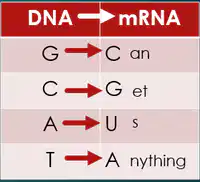
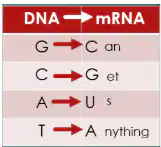
Transcription base paring rules: GCAT Can Get Us Anything
DNA: T-C-G-A-A-T
complimentary DNA: A-G-C-T-T-A
DNA: T-C-G-A-A-T
mRNA: A-G-C-U-U-A
Based on the available choices, A-G-C-T-T-A is the answer. A-G-C-U-U-A is not an option that is available.

56
Multiple Choice
The processes of meiosis and mitosis allow for the transmission and conservation of genetic information. Which process must occur in order for this transmission and conservation to take place?
DNA replication
Nondisjuction
RNA replication
translocation
57
Answer Explanation
The correct answer is A. DNA replication.
DNA replication is the process where a cell makes an exact copy of its genetic instructions (DNA).
Before a cell divides, it must copy all of its DNA.
This ensures that every new cell gets a full set of instructions.
This copying process is necessary for growth, repair, and having babies.
The other answers are wrong:
Nondisjunction means the cell made a mistake in sharing the DNA.
RNA replication is not the main way human cells divide. We never learned this. RNA replication is a special process mainly used by viruses to make more copies of themselves. In human cells, this process does not normally happen
Translocation is when pieces of DNA break and move to the wrong place. We did not learn this.
58
Multiple Choice
What will most likely happen if a base sequence of a strand of DNA is changed from A-T-G to A-T-C?
The tRNA will be changed from C-A-U to C-A-C.
The tRNA will be changed from U-A-C to T-A-C.
The mRNA will be changed from T-U-C to T-U-G.
The mRNA will be changed from U-A-C to U-A-G.
59
Answer Explanation
The correct option is D. The mRNA will be changed from U-A-C to U-A-G.
The change in the DNA base sequence from A-T-G to A-T-C causes a change in the messenger RNA (mRNA) sequence.
DNA bases pair up with mRNA bases in a specific way. Remember -------------->
The original DNA sequence A-T-G corresponds to the mRNA sequence U-A-C.
The new DNA sequence A-T-C corresponds to the new mRNA sequence U-A-G.
So, the change in DNA directly leads to the change in mRNA from U-A-C to U-A-G.
60
Multiple Choice
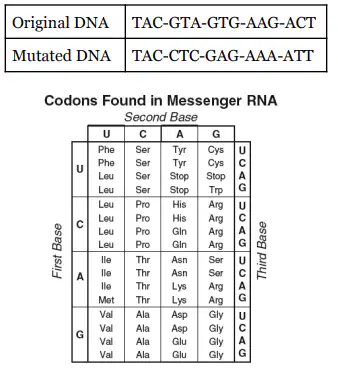
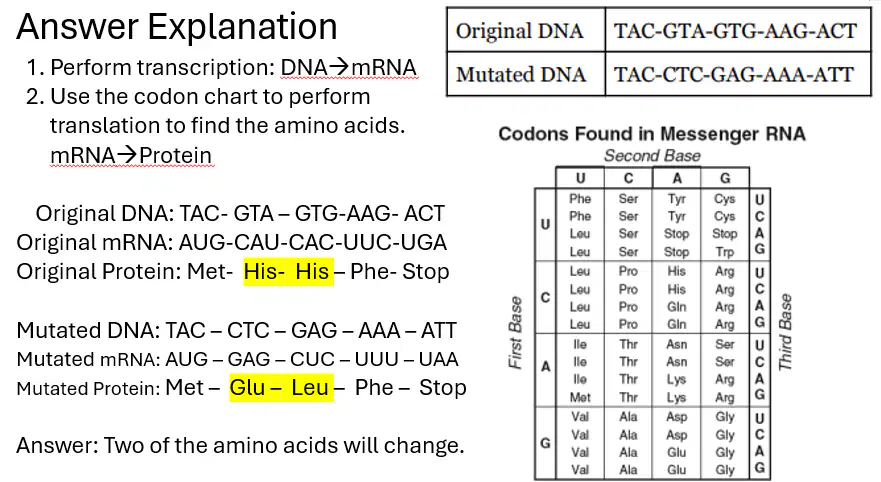
An original DNA sequence, a mutated DNA sequence, and a codon chart are shown in the image.
How will the mutated amino acid sequence be different from the original sequence?
One of the amino acids will change.
Two of the amino acids will change.
Three of the amino acids will change.
Four of the amino acids will change.
61
62
Multiple Choice
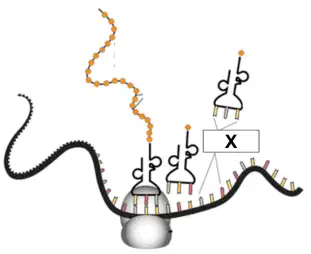
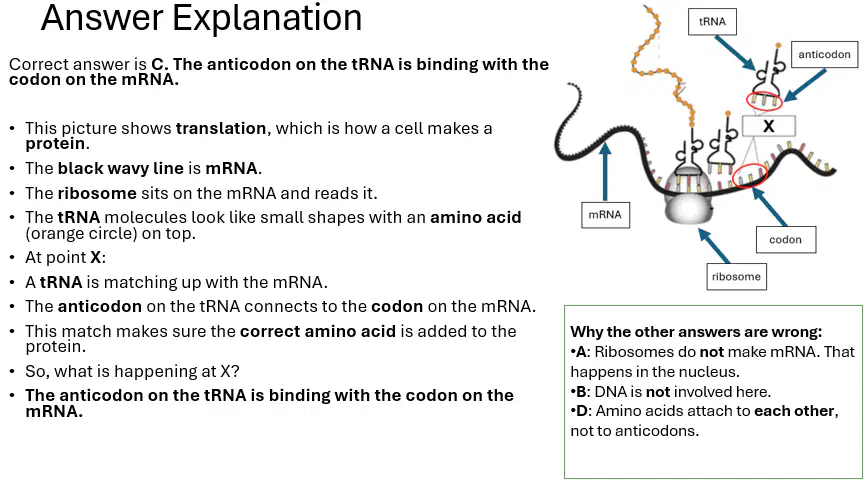
Which of the following describes what is happening at the location marked “X” in the diagram?
The ribosome is transcribing the DNA into mRNA.
The codon on the DNA is binding with the anticodon on the mRNA.
The anticodon on the tRNA is binding with the codon on the mRNA.
The amino acid on the ribosome is binding with the anticodon on the tRNA.
63
64
Multiple Choice
In the laboratory, scientists remove the gene for insulin from human chromosomes. They insert the gene into the DNA of bacterial cells. This causes the bacterial cells to produce human insulin, which is used to treat diabetes in humans. Which of the following best explains why bacteria is able to use human DNA?
The DNA code is the same in bacteria and humans.
The proteins used to make insulin are the same in humans and bacteria.
The mRNA produced by the insulin matches the mRNA produced by bacteria.
The insulin produced by bacteria is different from the insulin produced by humans.
65
Answer Explanation
The correct option is A. The DNA code is the same in bacteria and humans.
The "genetic code" is the set of rules that all living things use to read DNA instructions. This code is almost exactly the same for bacteria and humans. Because they speak the same genetic language, the bacteria can understand the human DNA instructions and make the correct human insulin protein.
Why other answers are wrong:
B. The proteins used to make insulin are the same in humans and bacteria. The insulin protein is the same, but most other proteins in bacteria and humans are different. The key is the shared code, not all proteins.
C. The mRNA produced by the insulin matches the mRNA produced by bacteria. Bacteria do not naturally make insulin mRNA. We force them to by giving them the human gene.
D. The insulin produced by bacteria is different from the insulin produced by humans. The goal is to make the insulin exactly the same as human insulin so it works as medicine.
66
Multiple Choice
Why do scientific theories not become scientific laws?
Theories can explain phenomena but cannot describe how they happen.
Theories are educated guesses about phenomena and cannot be proven.
Laws describe natural phenomena, while theories explain the phenomena based on current scientific data, which could be disproven in the future.
Laws explain many natural phenomena, while theories describe when and where a single phenomenon occurs, which may be disproven in the future.
67
Answer Explanation
The correct option is C. Laws describe natural phenomena, while theories explain the phenomena based on current scientific data, which could be disproven in the future.
In science, "theory" and "law" are different types of scientific knowledge. A theory does not grow up to become a law. They are different things.
A scientific law describes what happens in nature, often with math. It is like a rule that always works (e.g., gravity makes things fall down). A law tells you what happens.
A scientific theory explains why or how something happens, using lots of evidence. A theory is a strong idea, but scientists can always add more information or change the explanation as they learn new things.
Why other answers are wrong:
A. Theories do explain how things happen; they provide the explanation. Laws usually just describe the outcome.
B. Theories are strong explanations with lots of proof, not just "guesses."
D. This switches the definitions. Theories explain widely; laws describe exactly what happens.
68
Multiple Choice
On November 20, 2020, two pharmaceutical companies submitted a joint request to the U.S. Food and Drug Administration for Emergency Use Authorization of their COVID-19 vaccine candidate. They were required to submit all the data from their clinical trials to both the FDA and an external panel of independent experts. What parts of the scientific process does this represent?
data and calculations
peer review and debate
repetition and replication
research and literature review
69
Answer Explanation
The correct option is B. peer review and debate. When scientists finish a study, especially an important one like a new medicine or vaccine, they must show their work to other experts. This is like a "science check."
Peer Review: "Peer" means another person who is an expert in the same field. These experts look closely at the data and experiments to check for mistakes.
Debate: The experts discuss the findings to decide if the medicine is safe and works well.
By sending their data to the FDA and an external (outside) group of experts, the vaccine companies were using this important "science check" process.
Why other answers are wrong:
A. data and calculations: The companies submitted this information, but the core process described is the checking by others (peer review), not the data itself.
C. repetition and replication: This means doing the experiment many times to get the same result. This happens before they submit the data. The external checking happens after the experiments are finished.
D. research and literature review: This happens at the beginning of the project (looking at old science papers). The described action happens at the end of the trials.
70
Multiple Choice
A scientist is studying the effects of a newly identified environmental toxin on a turtle population in the Loxahatchee River. She observes both male and female adult turtles that are exposed to the toxin develop cancerous tumors on their shells. Their offspring are born with tumors and many do not survive. What can the scientist infer about the effect of the toxin?
The toxin only causes a mutation in young turtles.
The toxin does not cause the mutation until the turtles are fully grown.
The toxin causes a mutation in gametes of the adult turtles, which is then passed to their offspring.
The toxin causes a mutation in the somatic cells of the turtles, which is then passed to their offspring.
71
Answer Explanation
The correct option is C. The toxin causes a mutation in gametes of the adult turtles, which is then passed to their offspring.
The key idea is that the babies are born with the problem. This can only happen if the toxin changes the DNA in the parents' reproductive cells.
Gametes are the reproductive cells (sperm and eggs) that create a baby. Changes in these cells pass to offspring.
Why other answers are wrong:
A/B. Both adults and young turtles are affected. The babies are born with the issue, meaning the change happened early on.
D. Somatic cells are body cells (skin, etc.). Changes in body cells only hurt the adult turtle and are not passed to babies.
72
Multiple Choice
A scientist is trying to develop a new treatment to stop cancer cells from dividing. In the cancer cells, which of these processes will stop if the treatment is successful?
mitosis
binary fission
genetic recombination
independent assortment
73
Answer Explanation
The correct option is A. mitosis.
Mitosis is the normal process that body cells use to divide and make exact copies.
Cancer is a disease where cells divide too much and too fast. The new treatment is designed to stop this fast division.
If the treatment works, the cancer cells will stop dividing through mitosis.
Why other answers are wrong:
B. binary fission: This is how simple bacteria cells divide. Human cancer cells use mitosis.
C. genetic recombination and D. independent assortment: These are special mixing processes that happen during meiosis (for making babies). They do not happen in normal body cells or cancer cells that are just growing and dividing rapidly.
74
Multiple Choice
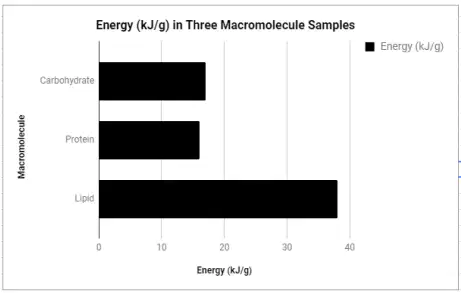
A group of biology students conducted an investigation where they calculated the total energy contained in samples of carbohydrates, proteins, and lipids. The results of the investigation are shown in the graph in the image.
Which hypothesis was most likely being tested in this investigation?
Proteins contain the least amount of energy per gram.
Carbohydrates are the only energy source available to cells.
All macromolecules contain equal amounts of carbon atoms.
Lipids are broken down more rapidly than proteins during digestion.
75
Answer Explanation
Correct answer: A. Proteins contain the least amount of energy per gram.
The graph shows how much energy per gram is in three macromolecules:
Carbohydrates → medium energy
Proteins → lowest energy
Lipids → highest energy
The students measured and compared energy (kJ/g).
So the hypothesis they were testing is about which macromolecule has more or less energy.
From the graph:
Proteins have the smallest bar, meaning the least energy per gram.
Why other answers are wrong:
B: The graph shows lipids and proteins also have energy, not only carbohydrates.
C: The investigation did not measure carbon atoms.
D: The graph does not show digestion speed.
By Rebecca Lee
Show answer
Auto Play
Slide 1 / 75
SLIDE
Similar Resources on Wayground

68 questions
Evidence of Evolution
Presentation
•
10th Grade
73 questions
Macromolecules Part 1
Presentation
•
10th Grade
70 questions
Macromolecules Lesson
Presentation
•
9th Grade
68 questions
Biology Semester Review 2
Presentation
•
9th Grade
70 questions
TLE-ICT ILLUSTRATION
Presentation
•
10th Grade
70 questions
Berry - Gilded Age STAAR review
Presentation
•
11th Grade
69 questions
KLASIFIKASI ALAT MUSIK BARAT
Presentation
•
11th Grade
Popular Resources on Wayground
10 questions
Safety Day 2026 – Student Review

Quiz
•
9th Grade
21 questions
Continents and Oceans
Quiz
•
6th Grade
20 questions
Parts of Speech
Quiz
•
5th Grade
16 questions
Subject & Predicate
Quiz
•
5th Grade
25 questions
Multiplication Facts
Quiz
•
5th Grade
12 questions
Map Skills
Quiz
•
3rd Grade
22 questions
Continents and Oceans
Quiz
•
5th Grade
15 questions
Rounding Decimals
Quiz
•
5th Grade
Discover more resources for Biology
20 questions
Cell organelles and functions
Quiz
•
10th Grade
20 questions
Cell Transport
Quiz
•
9th - 12th Grade
8 questions
DNA vs. RNA
Presentation
•
9th - 12th Grade
20 questions
Macromolecules
Quiz
•
10th Grade
20 questions
Characteristics of Life
Quiz
•
9th - 10th Grade
15 questions
Photosynthesis and Cellular Respiration
Quiz
•
10th Grade
15 questions
DNA Structure and Replication
Quiz
•
9th - 12th Grade
20 questions
Ecological Succession Review
Quiz
•
9th - 12th Grade