

Pharmacokinetics - Part 4

Presentation
•
Instructional Technology
•
Vocational training
•
Practice Problem
•
Medium

Katharine Rusk
Used 1+ times
FREE Resource
25 Slides • 15 Questions
1

2
3
4
5
6
7
8

Review!
9-13
9
Multiple Choice
What does the onset of drug action begin with?
When drug reaches peak plasma level
When drug enters plasma and achieves MEC
When drug is eliminated from plasma
When drug binds to receptor
10
Multiple Choice
Which route of administration achieves peak plasma level immediately?
Oral
Subcutaneous
Intravenous
Intramuscular
11
Drag and Drop
12
Multiple Choice
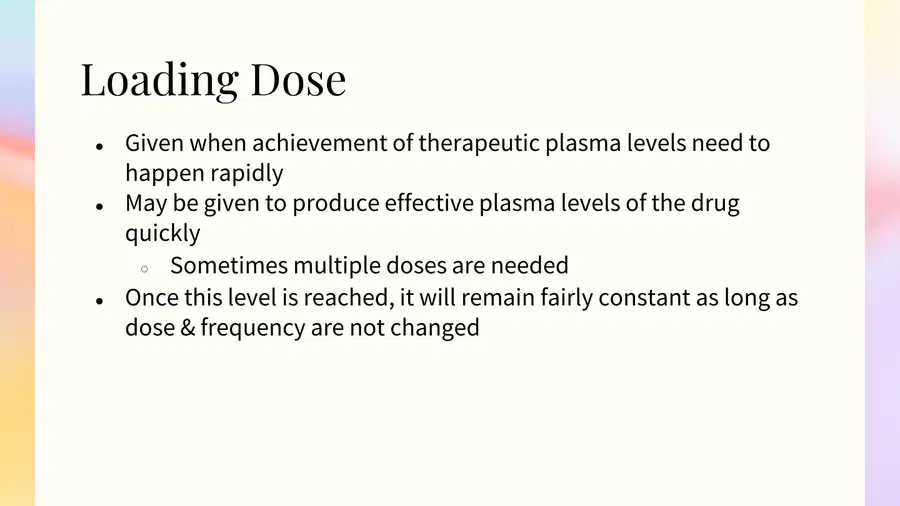
Which statement about loading dose is TRUE?
It is given to rapidly achieve therapeutic plasma levels
It is given to maintain plasma levels over time
It is always a single dose
It prevents drug elimination
13
14
15
Review!
1 slide
16
Multiple Choice
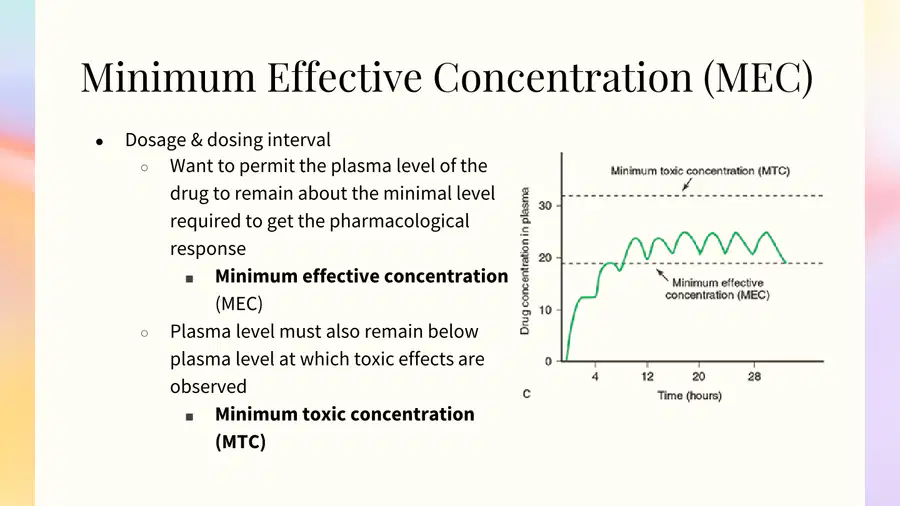
What is the minimum plasma concentration required for a pharmacological response called?
MTC
MEC
Loading dose
Peak level
17
18
19

20
21
22
Review!
23 - 25
23
Drag and Drop
24
Multiple Choice
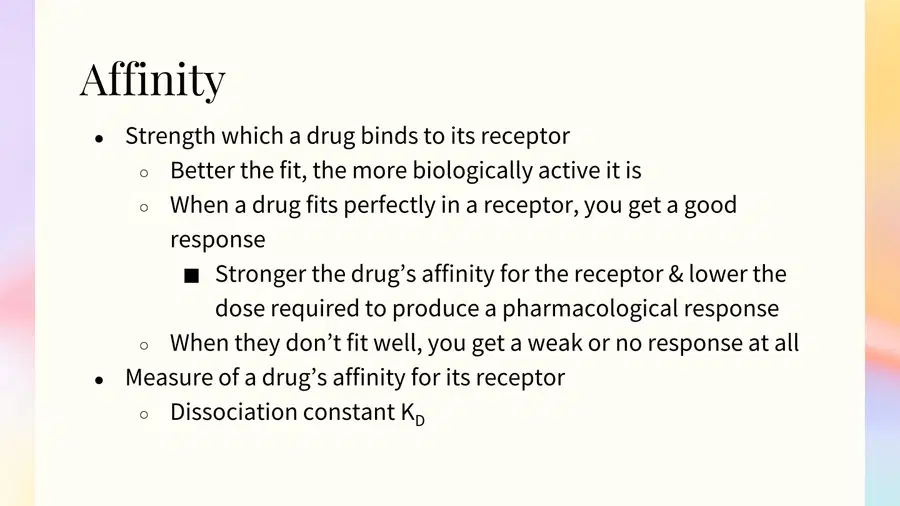
What does affinity measure?
The speed of drug absorption
The rate of drug elimination
The plasma concentration of the drug
The strength of drug binding to its receptor
25
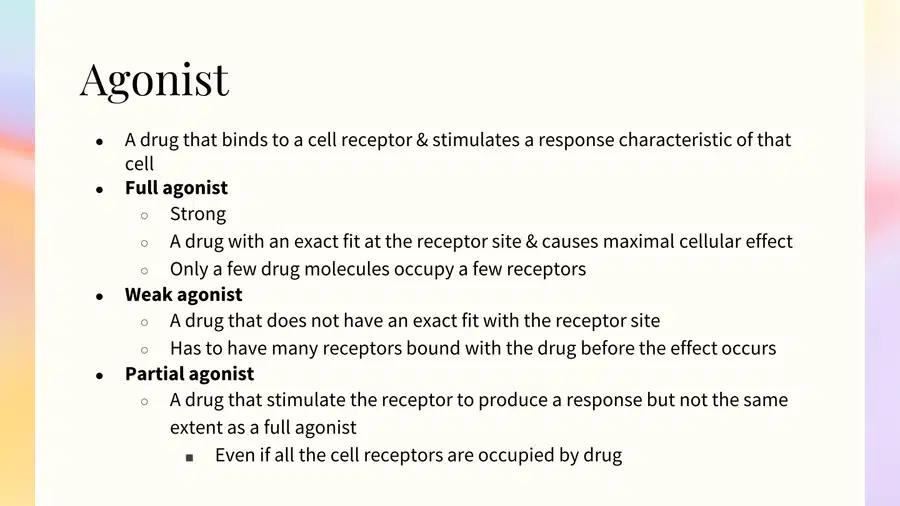
26
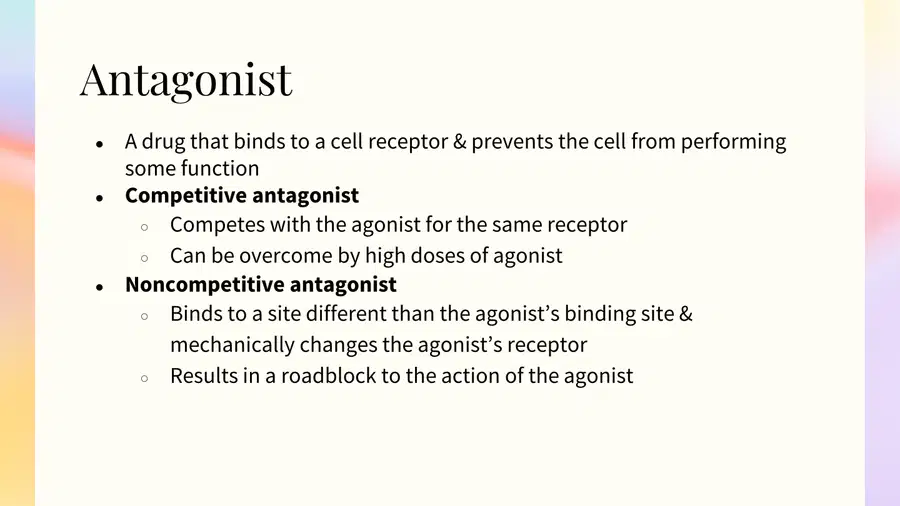
27
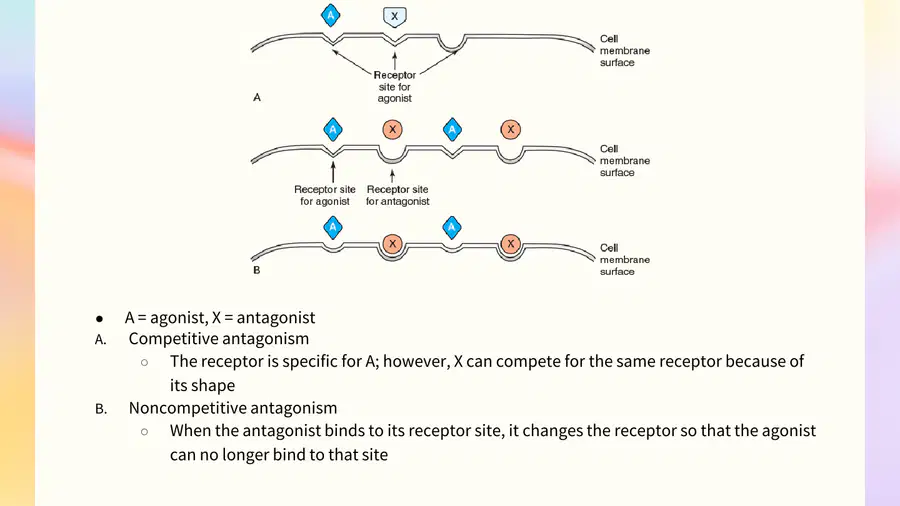
28
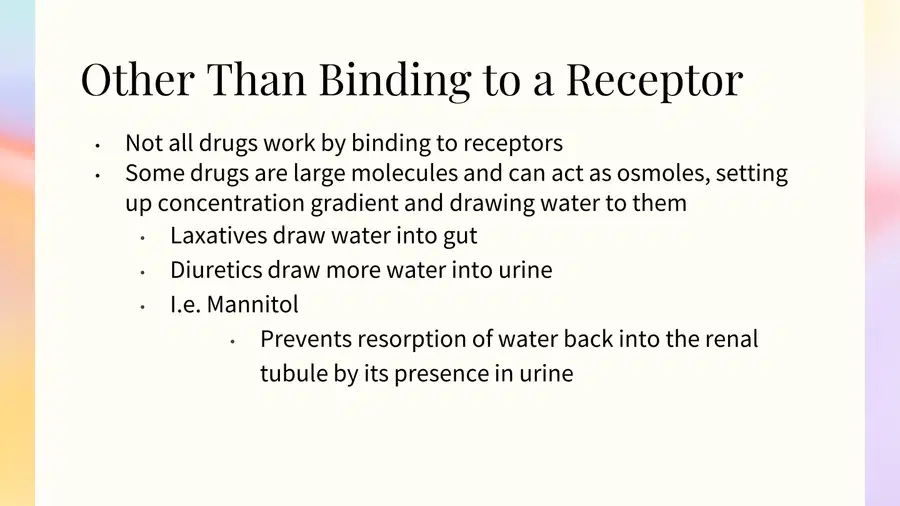
29
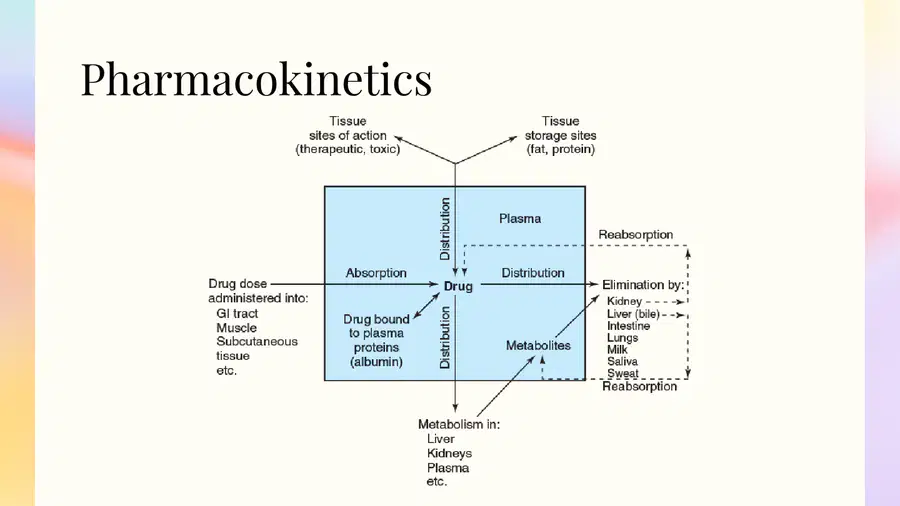
30
Final Review!
31
Multiple Choice
Which drug action does NOT involve receptor binding?
Agonist activity
Osmotic effect of mannitol
Competitive antagonism
Partial agonism
32
Multiple Choice
Which type of antagonist competes for the same receptor site as the agonist?
Noncompetitive antagonist
Partial antagonist
Competitive antagonist
Weak antagonist
33
Drag and Drop
34
Match
Match the term with its definition:
Drug that binds and stimulates a receptor response
Plasma level at which toxic effects occur
Drug that binds and prevents receptor function
Minimum plasma concentration for therapeutic effect
Agonist
MTC
Antagonist
MEC
Agonist
MTC
Antagonist
MEC
35
Categorize
Full agonist
Noncompetitive antagonist
Mannitol
Partial agonist
Categorize the following as Agonist, Antagonist, or Other Mechanism:
36
Fill in the Blanks
37
Multiple Choice
What does agonist mean?
A drug that activates a receptor.
A drug that binds without effect.
A drug that inhibits a receptor.
38
Multiple Choice
What does antagonist mean when it comes to drugs?
39
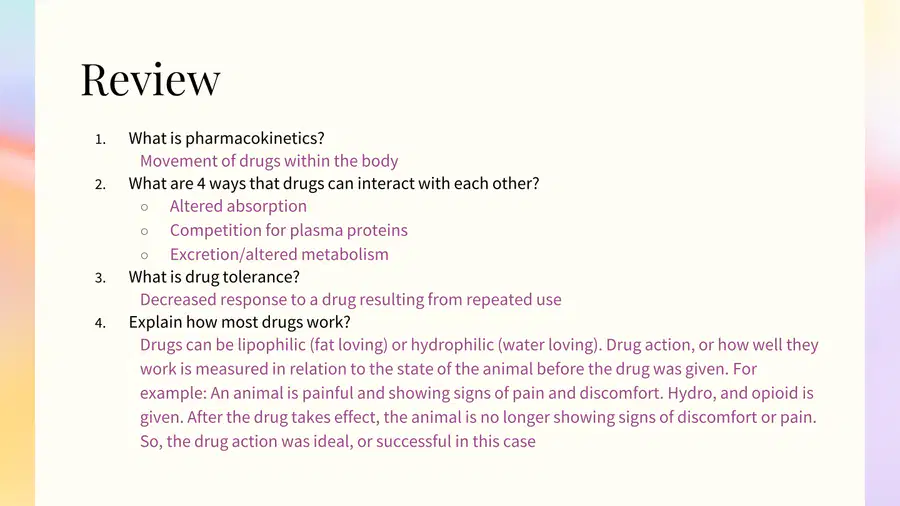
40
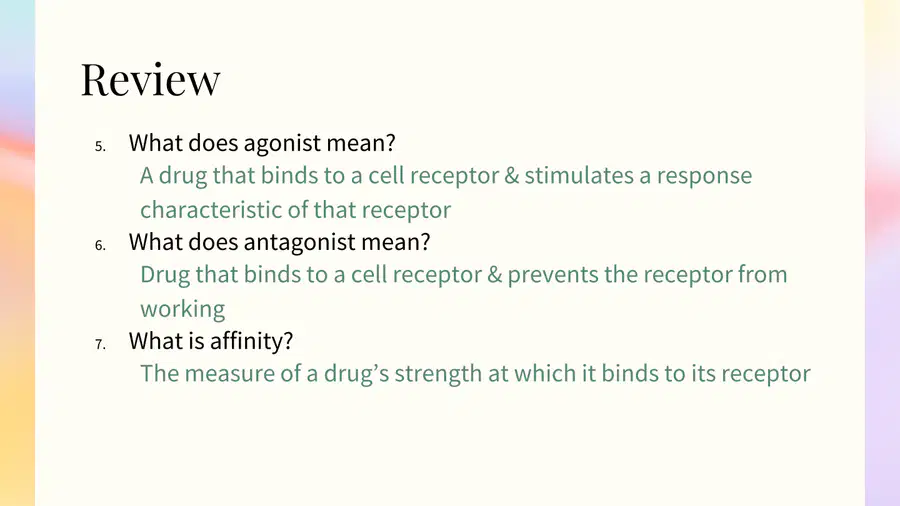
Show answer
Auto Play
Slide 1 / 40
SLIDE
Similar Resources on Wayground

31 questions
Confusing Words and False Friends Set B
Presentation
•
University - Professi...
26 questions
CORPO HUMANO
Presentation
•
KG
42 questions
Investigación-Acción Cap. 2 Antonio Latorre
Presentation
•
Professional Development
35 questions
Proceso de escritura
Presentation
•
University
33 questions
Epithelial Transport
Presentation
•
University
32 questions
IMMU 183 Progress test LO1 and LO2 Review
Presentation
•
University
30 questions
EOG Prep 8
Presentation
•
8th - 12th Grade
37 questions
Instrumentos y técnicas de evaluación
Presentation
•
Professional Development
Popular Resources on Wayground
15 questions
Grade 3 Simulation Assessment 1

Quiz
•
3rd Grade
22 questions
HCS Grade 4 Simulation Assessment_1 2526sy
Quiz
•
4th Grade
16 questions
Grade 3 Simulation Assessment 2
Quiz
•
3rd Grade
19 questions
HCS Grade 5 Simulation Assessment_1 2526sy
Quiz
•
5th Grade
17 questions
HCS Grade 4 Simulation Assessment_2 2526sy
Quiz
•
4th Grade
20 questions
Equivalent Fractions
Quiz
•
3rd Grade
24 questions
HCS Grade 5 Simulation Assessment_2 2526sy
Quiz
•
5th Grade
20 questions
Math Review
Quiz
•
3rd Grade