
Food Webs and Energy Pyramids(Spanish translations)
Authored by Gloria Reche
Science
9th - 12th Grade
NGSS covered
Used 30+ times


AI Actions
Add similar questions
Adjust reading levels
Convert to real-world scenario
Translate activity
More...
Content View
Student View
25 questions
Show all answers
1.
DROPDOWN QUESTION
2 mins • 1 pt

Which organism do the owl and the weasel compete for in the food web?(¿Cual organismo compiten el búho y la comadreja en la red alimenticia?) (a)
Tags
NGSS.MS-LS2-4
2.
MULTIPLE CHOICE QUESTION
2 mins • 1 pt

Which of the following would be the most likely effect, if there were a sudden increase in the cricket population?
¿Cuál de los siguientes sería el efecto más probable si hubiera un aumento repentino en la población de cricket?
There would be a decrease in the small bird population.
Habría una disminución en la población de aves pequeñas.
There would be a decrease in the grass/flowers population.
Habría una disminución en la población de césped / flores.
There would be a decrease in the mice population.
Habría una disminución en la población de ratones.
There would be an increase in the grass/flowers population.
Habría un aumento en la población de hierba / flores.
Tags
NGSS.MS-LS2-2
NGSS.MS-LS2-4
NGSS.MS-LS2-1
3.
MULTIPLE CHOICE QUESTION
2 mins • 1 pt

Fungus and bacteria are decomposers. What do decomposers do for an food web?
Los hongos y las bacterias son descomponedores. ¿Qué hacen los descomponedores para una red alimenticia?
Recycle dead plants and animals into chemical nutrients like carbon and nitrogen that are released back into the soil, air and water
.Recicle plantas y animales muertos en nutrientes químicos como el carbono y el nitrógeno que se liberan de nuevo en el suelo, el aire y el agua.
They use the energy from plants to break down nitrogen in the air
Utilizan la energía de las plantas para descomponer el nitrógeno en el aire.
They use the energy from animals to break down nitrogen in the air
Utilizan la energía de los animales para descomponer el nitrógeno en el aire.
They break down dead plants and animals into oxygen and carbon dioxide that can be used by plants.
Descomponen plantas y animales muertos en oxígeno y dióxido de carbono que pueden ser utilizados por las plantas.
Tags
NGSS.MS-LS2-3
NGSS.MS-LS2-4
4.
DROPDOWN QUESTION
2 mins • 1 pt
Approximately what percentage of energy is passed on to the next higher level in an energy pyramid?
¿Aproximadamente, qué porcentaje de energía pasa al siguiente nivel superior en una pirámide de energía? (a)
Tags
NGSS.MS-LS2-3
NGSS.MS-LS1-6
5.
DROPDOWN QUESTION
2 mins • 1 pt

The diagram shows an energy pyramid.Which level will contain plants?
El diagrama muestra una pirámide de energía.¿Qué nivel contendrá plantas? (a)
Tags
NGSS.MS-LS2-3
6.
MULTIPLE CHOICE QUESTION
2 mins • 1 pt
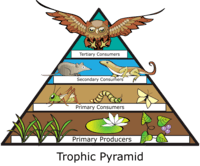
Which organism receives the least amount of energy from the producer?
¿Qué organismo recibe la menor cantidad de energía del productor?
Owl (tertiary consumer)
Búho (consumidor terciario)
Grasshopper (primary consumer)
Saltamontes (consumidor primario)
Lilypad (autotroph)
Lilypad (autótrofo)
Lizard (secondary consumer)
Lagartijo (consumidor secundario)
Tags
NGSS.MS-LS2-3
7.
MULTIPLE CHOICE QUESTION
2 mins • 1 pt
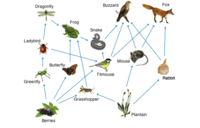
What do the arrows in the diagram represent?
¿Qué representan las flechas en el diagrama?
an increase in population
un aumento de la población
the evolution of organisms
la evolución de los organismos
ecological succession
sucesión ecológica
the flow of energy
el flujo de energia
Tags
NGSS.MS-LS2-3
NGSS.MS-LS2-2


Access all questions and much more by creating a free account
Create resources
Host any resource
Get auto-graded reports

Continue with Google

Continue with Email

Continue with Classlink

Continue with Clever
or continue with

Microsoft
%20(1).png)
Apple

Others
Already have an account?



