
Totalitarianism and Interwar Europe Quiz
Authored by Kb Brown
Social Studies
10th Grade
Used 5+ times


AI Actions
Add similar questions
Adjust reading levels
Convert to real-world scenario
Translate activity
More...
Content View
Student View
30 questions
Show all answers
1.
MULTIPLE CHOICE QUESTION
30 sec • 1 pt
Based on your understanding of totalitarianism, select the most accurate statement:
Totalitarianism is a political system that emphasizes individual freedoms and liberty.
Totalitarianism involves a decentralized system of government with power distributed among various authorities.
Totalitarianism concentrates power in a single authority, controlling all aspects of life in society.
Totalitarianism a strong emphasis on democratic principles, promoting diverse political ideologies
2.
MULTIPLE CHOICE QUESTION
30 sec • 1 pt
After World War I, the rise of Benito Mussolini in Italy and Adolf Hitler in Germany can be intricately linked with:
the development of fascism
the desire for containment
an emphasis on democratic traditions
a return to conservative religious practices
3.
MULTIPLE CHOICE QUESTION
30 sec • 1 pt
Censorship, suppression of dissent in Nazi Germany, one-party dictatorship with Nazi Party dominance, substitution of religious ideals with state-centric doctrines, promotion of a "cult of personality" around leaders like Adolf Hitler, and use of propaganda, exemplify the characteristics of:
democratic governments
limited monarchies
totalitarian governments
parliamentary systems
4.
MULTIPLE CHOICE QUESTION
30 sec • 1 pt
Which statement best illustrates the impact(s) of the Great Depression on Europe and its role in shaping the conditions that led to World War II?
The Great Depression only affected economic stability in Europe, leading to widespread unemployment and poverty.
The Great Depression had far-reaching consequences, not only economically but also politically and socially, contributing significantly to the factors that precipitated World War II.
The Great Depression’s impact on Europe was limited to economic challenges, with minimal influence on the political landscape or the outbreak of World War II.
The Great Depression’s global effects were negligible, and Europe’s path to World War II was predominantly shaped by other factors.
5.
MULTIPLE CHOICE QUESTION
30 sec • 1 pt
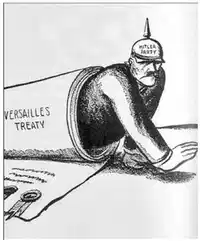
Analyze the political drawing above. Based on what you see, which of the following answers best states the intended message of this illustration?
Hitler’s Nazi government was a result of Treaty of Versailles
The Treaty of Versailles was made very harsh for Germany
Germany won the Second World War and used the Treaty to make peace
Stalin’s communist government was a result of the Treaty of Versailles
6.
MULTIPLE CHOICE QUESTION
30 sec • 1 pt
Neville Chamberlain, Prime Minister of Great Britain, met with Adolf Hitler, Reich Chancellor of Germany, in Munich in 1938 to negotiate the fate of the Sudetenland. Which policy is most closely associated with Britain’s action?
appeasement
nonalignment
reparations
colonialism
7.
MULTIPLE CHOICE QUESTION
30 sec • 1 pt
Which sequence of events is in the correct chronological order?
Rise of Nazism → Treaty of Versailles → German invasion of the Soviet Union
Treaty of Versailles → rise of Nazism → German invasion of the Soviet Union
German invasion of the Soviet Union → rise of Nazism → Treaty of Versailles
Treaty of Versailles → German invasions of the Soviet Union → rise of Nazism

Access all questions and much more by creating a free account
Create resources
Host any resource
Get auto-graded reports

Continue with Google

Continue with Email

Continue with Classlink

Continue with Clever
or continue with

Microsoft
%20(1).png)
Apple

Others
Already have an account?


