
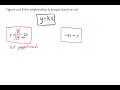
Proportional Relationships and Linear Equations

Interactive Video
•
Mathematics
•
9th - 10th Grade
•
Practice Problem
•
Hard

Thomas White
FREE Resource
Read more
15 questions
Show all answers
1.
MULTIPLE CHOICE QUESTION
30 sec • 1 pt
What is the main question being addressed in this video?
How to graph linear equations
How to determine if a relationship is proportional
How to solve quadratic equations
How to find the area of a circle
2.
MULTIPLE CHOICE QUESTION
30 sec • 1 pt
Which formula represents a proportional relationship?
y = x^2
y = KX
y = ax^2 + bx + c
y = mx + b
3.
MULTIPLE CHOICE QUESTION
30 sec • 1 pt
What must be true about the y-intercept in a proportional relationship?
It can be any value
It must be zero
It must be negative
It must be positive
4.
MULTIPLE CHOICE QUESTION
30 sec • 1 pt
In the equation y = 3/4 - 2x, why is it not considered proportional?
Because it has no constant
Because it has a non-zero y-intercept
Because the slope is positive
Because it is not linear
5.
MULTIPLE CHOICE QUESTION
30 sec • 1 pt
What is the slope of the equation y = 3/4 - 2x?
-2
3/4
0
2
6.
MULTIPLE CHOICE QUESTION
30 sec • 1 pt
What is the constant of proportionality in the equation -4x = y?
4
-4
0
1
7.
MULTIPLE CHOICE QUESTION
30 sec • 1 pt
Which of the following equations is proportional?
y = x^2
y = 2x - 1
y = -4x
y = 5x + 3
Access all questions and much more by creating a free account
Create resources
Host any resource
Get auto-graded reports

Continue with Google

Continue with Email

Continue with Microsoft
or continue with

%20(1).png)
Apple

Others
By signing up, you agree to our Terms of Service & Privacy Policy
Already have an account?

