Free biogeochemical cycles worksheets and printables help students explore how carbon, nitrogen, water, and phosphorus cycle through Earth's systems with practice problems and answer keys.
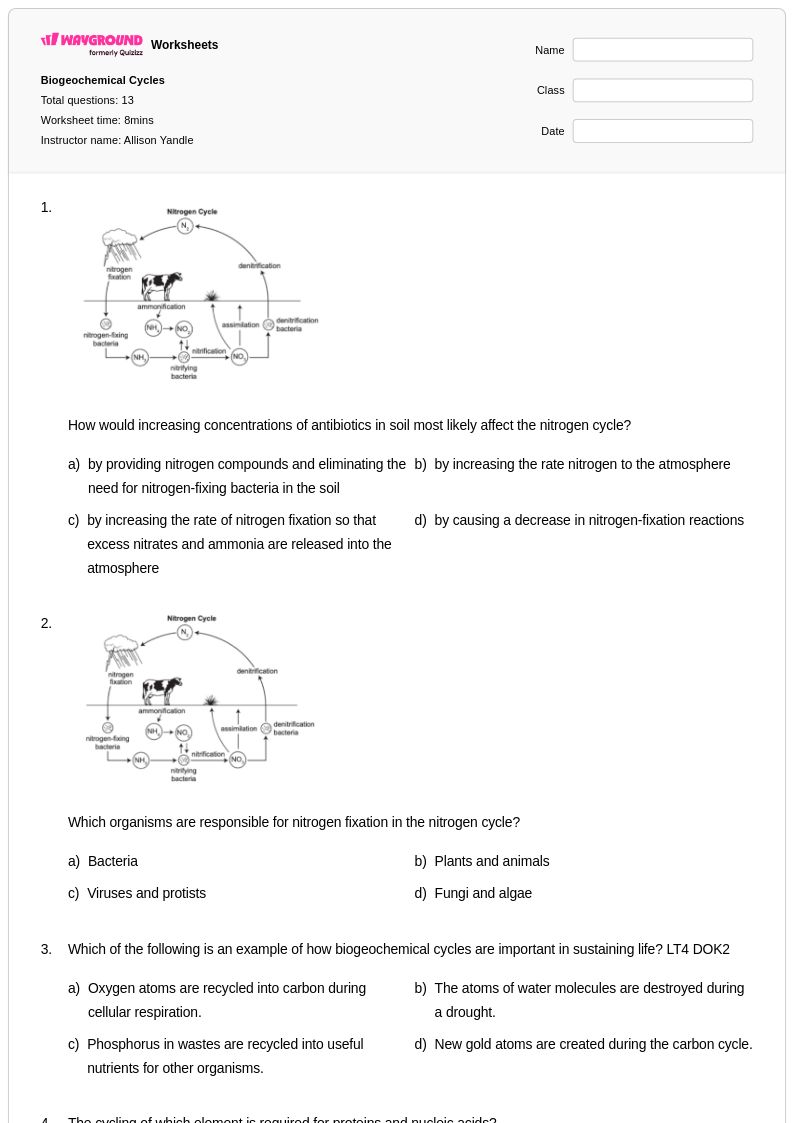
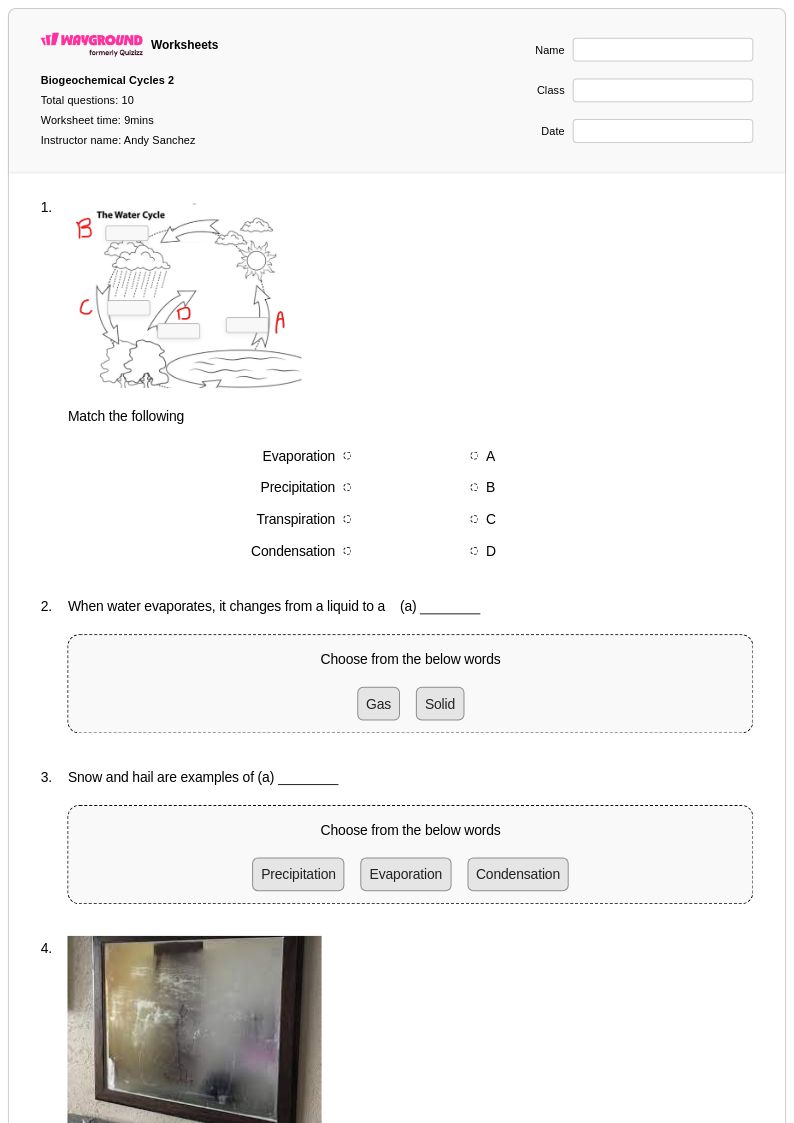
Biogeochemical cycles worksheets available through Wayground (formerly Quizizz) provide comprehensive practice materials that help students understand the complex movement of elements and compounds through Earth's interconnected systems. These educational resources focus on essential cycles including carbon, nitrogen, phosphorus, water, and sulfur cycles, offering detailed practice problems that challenge students to trace pathways, identify reservoirs, and analyze the biological, geological, and chemical processes that drive these critical Earth systems. Each worksheet collection includes answer keys and is available as free printable pdf resources, enabling students to master fundamental concepts such as nutrient cycling, atmospheric interactions, and the role of living organisms in maintaining planetary equilibrium.
Wayground (formerly Quizizz) supports science educators with millions of teacher-created biogeochemical cycles resources that streamline lesson planning and enhance student understanding of Earth and space science concepts. The platform's robust search and filtering capabilities allow teachers to quickly locate materials aligned with specific learning standards, while differentiation tools enable customization for diverse student needs and ability levels. These flexible worksheet collections are available in both printable and digital formats, including downloadable pdf versions, making them ideal for remediation activities, enrichment assignments, and targeted skill practice that reinforces students' comprehension of how matter and energy flow through Earth's biosphere, atmosphere, hydrosphere, and geosphere.
FAQs
How do I teach biogeochemical cycles in a way students will actually understand?
Start by grounding each cycle in a tangible context — for example, tracing carbon through photosynthesis, respiration, decomposition, and combustion before introducing abstract reservoir diagrams. Use visual pathway diagrams that require students to label inputs, outputs, and transformation processes at each stage. Connecting cycles to real-world issues like the carbon cycle's role in climate change or the nitrogen cycle's link to fertilizer runoff gives students a reason to engage with the material beyond memorization.
What exercises help students practice tracing biogeochemical cycles?
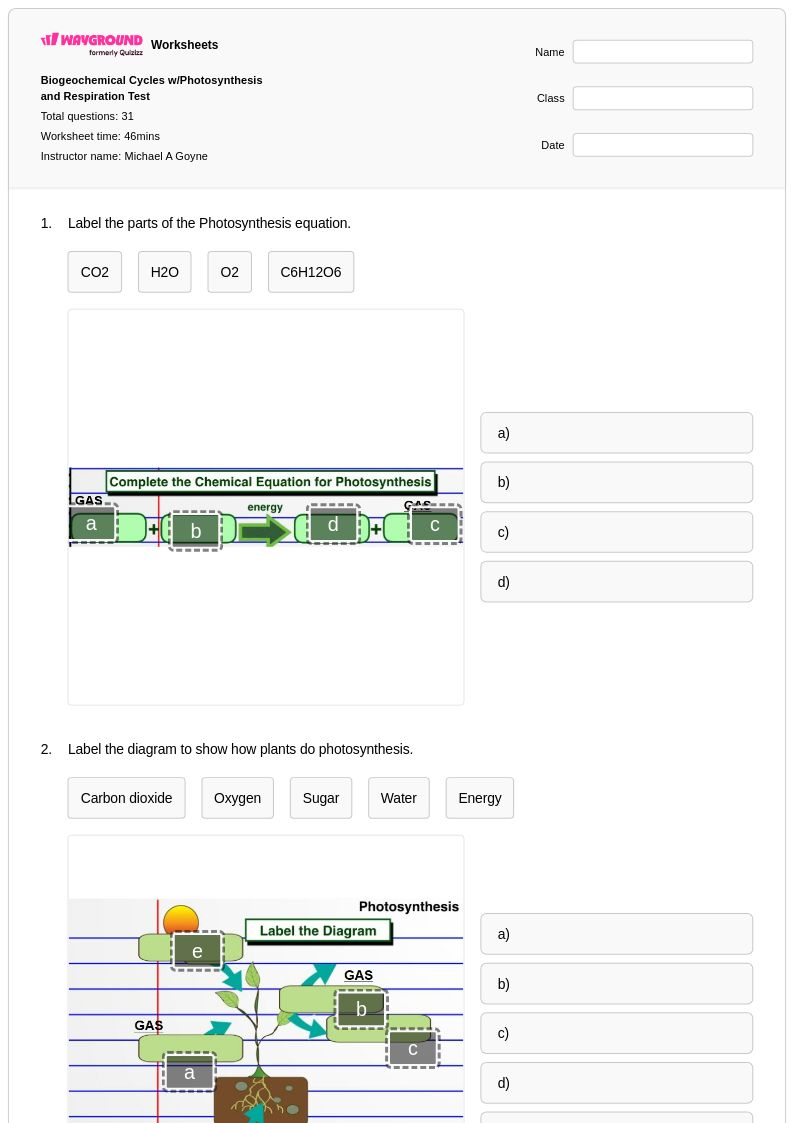
Pathway-tracing problems are among the most effective practice formats — students follow a single atom of carbon, nitrogen, or phosphorus through every reservoir and transformation it passes through. Labeling diagrams of each cycle, identifying which organisms or processes drive each step, and answering questions about what happens when a cycle is disrupted all reinforce deep understanding. Biogeochemical cycles worksheets that combine diagram completion with short-answer analysis questions push students beyond surface-level recall.
What mistakes do students commonly make when learning biogeochemical cycles?
A frequent misconception is that cycles are linear rather than circular — students often assume matter is 'used up' rather than continuously transformed and recycled. Many students also confuse the roles of producers, decomposers, and consumers within cycles, particularly in the nitrogen cycle where nitrification, denitrification, and nitrogen fixation involve distinct microbial processes. Another common error is conflating energy flow with matter cycling; unlike energy, matter is not lost but continuously moves between biotic and abiotic reservoirs.
How do I differentiate biogeochemical cycles instruction for students at different skill levels?
For students who struggle, simplify by focusing on one cycle at a time and providing partially completed diagrams that reduce cognitive load before introducing full pathway tracing. More advanced students benefit from cross-cycle analysis tasks, such as explaining how disruptions in the nitrogen cycle affect the carbon cycle. On Wayground, teachers can apply accommodations such as read aloud, reduced answer choices, and extended time to individual students, allowing differentiated support within the same assignment without signaling differences to the rest of the class.
How can I use biogeochemical cycles worksheets from Wayground in my classroom?
Wayground's biogeochemical cycles worksheets are available as printable PDFs for traditional classroom use and in digital formats for technology-integrated environments, including the option to host them as a live quiz on the Wayground platform. Printable versions work well for guided notes, homework, or lab follow-up activities, while digital formats support real-time feedback and whole-class pacing. Both formats include complete answer keys, making them practical for independent practice, small group work, or formative assessment.
How do I assess whether students truly understand biogeochemical cycles versus just memorizing diagrams?
Effective assessment goes beyond diagram labeling and asks students to explain what would happen if a specific process were removed — for example, if all decomposers disappeared from the nitrogen cycle or if deforestation doubled the carbon stored in the atmosphere. Questions that require students to connect a cycle to a real environmental disruption, such as ocean acidification or eutrophication, reveal whether they understand mechanism rather than just sequence. Short constructed-response questions following a diagram activity are a practical way to gauge conceptual depth.