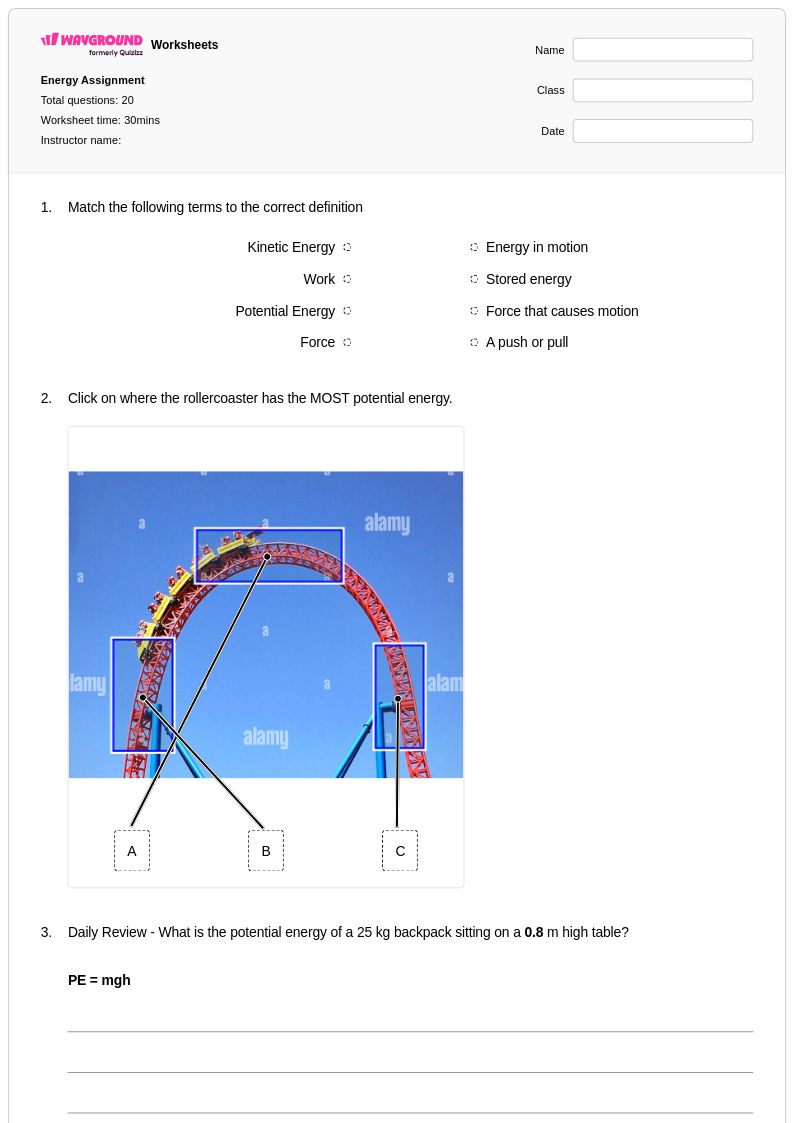
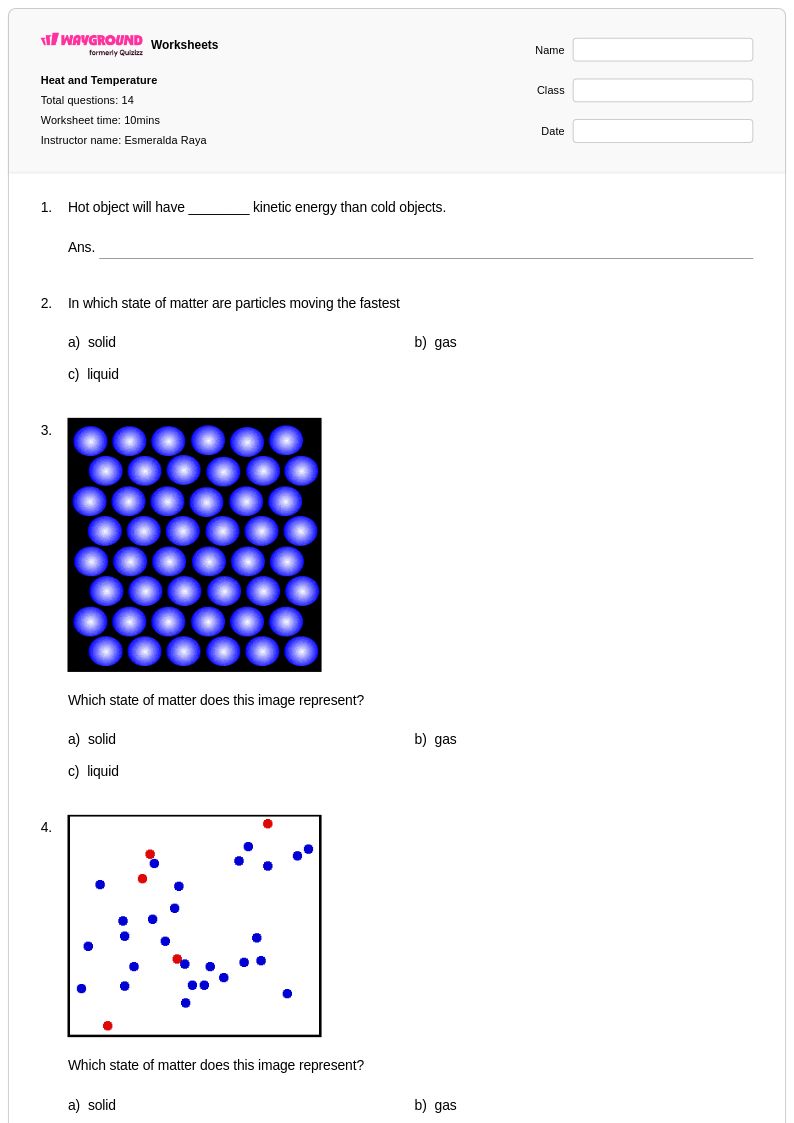
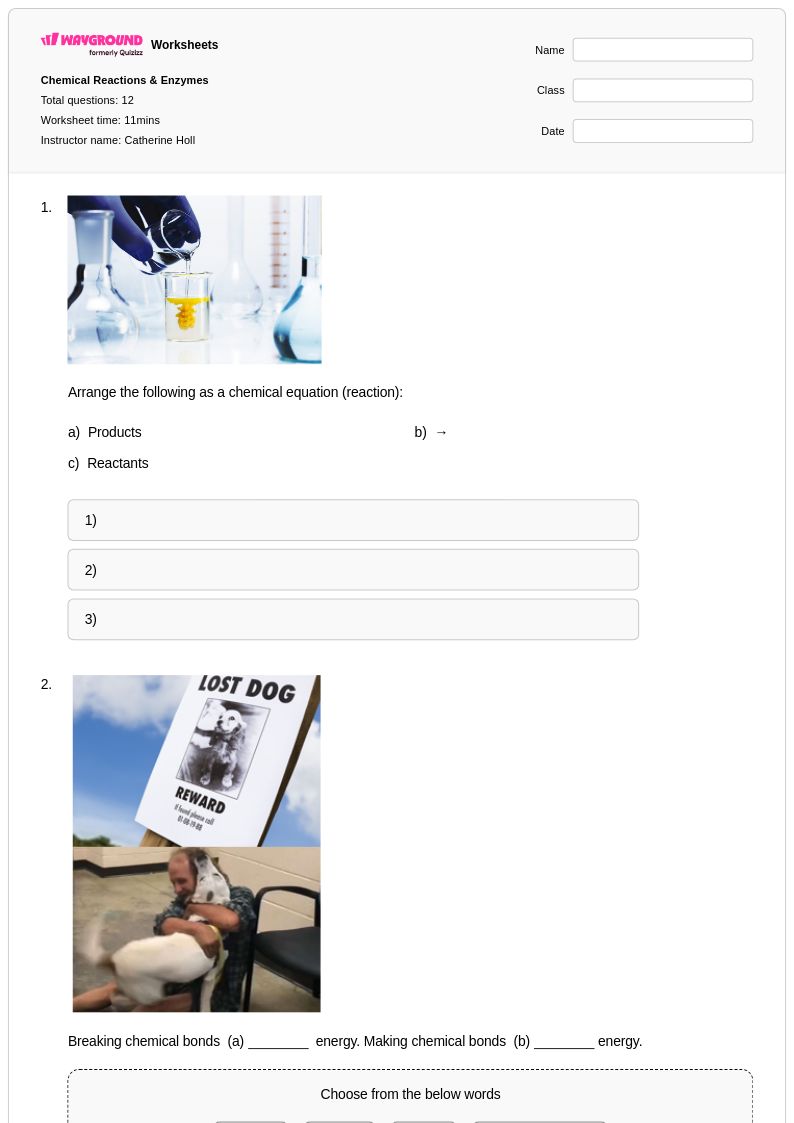
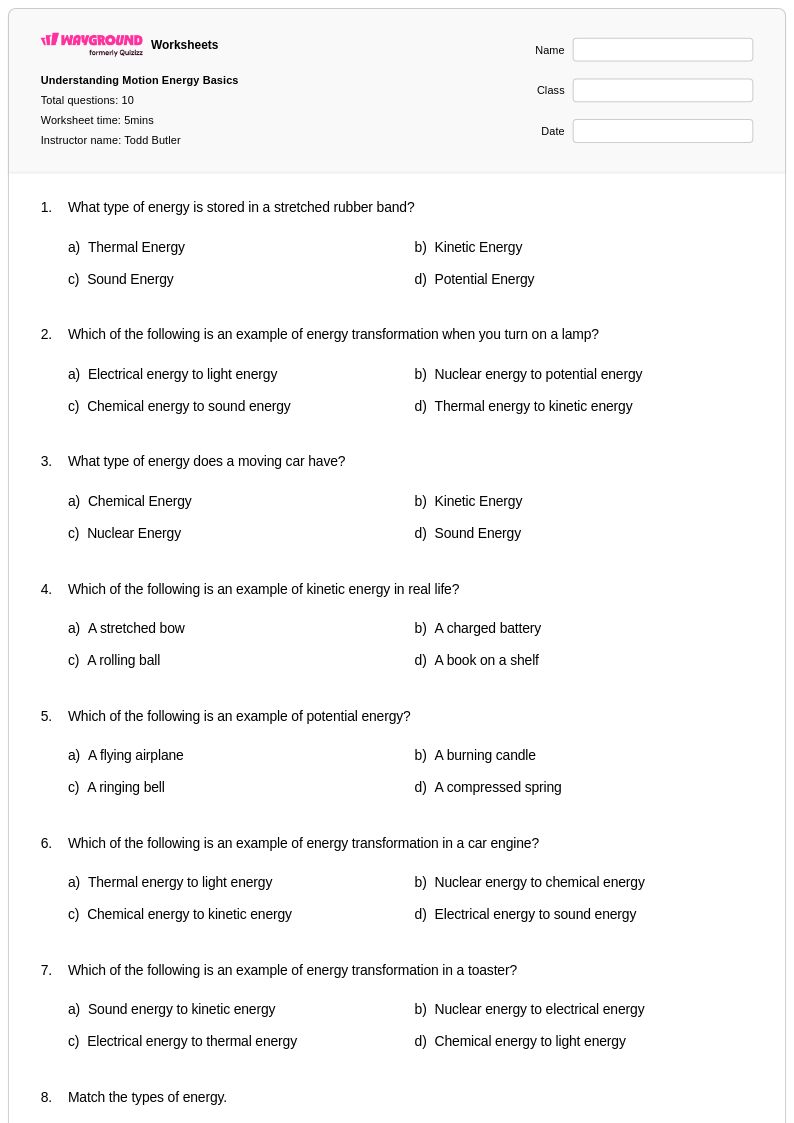
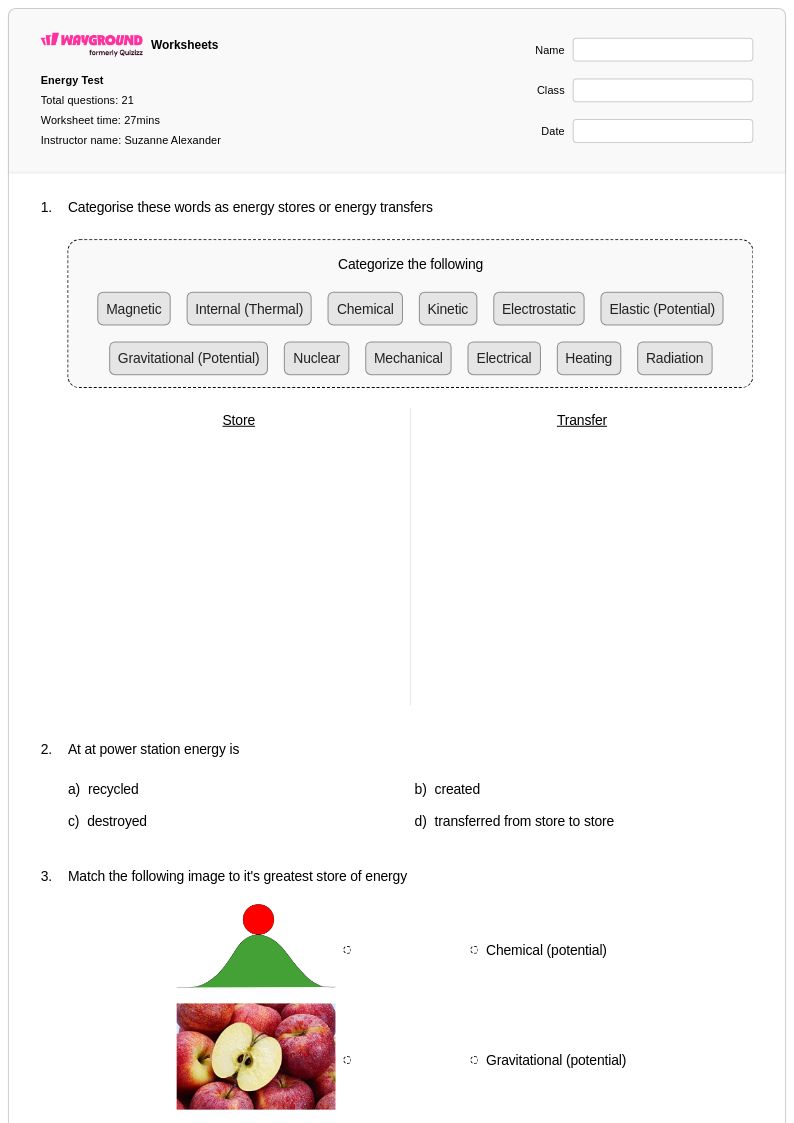
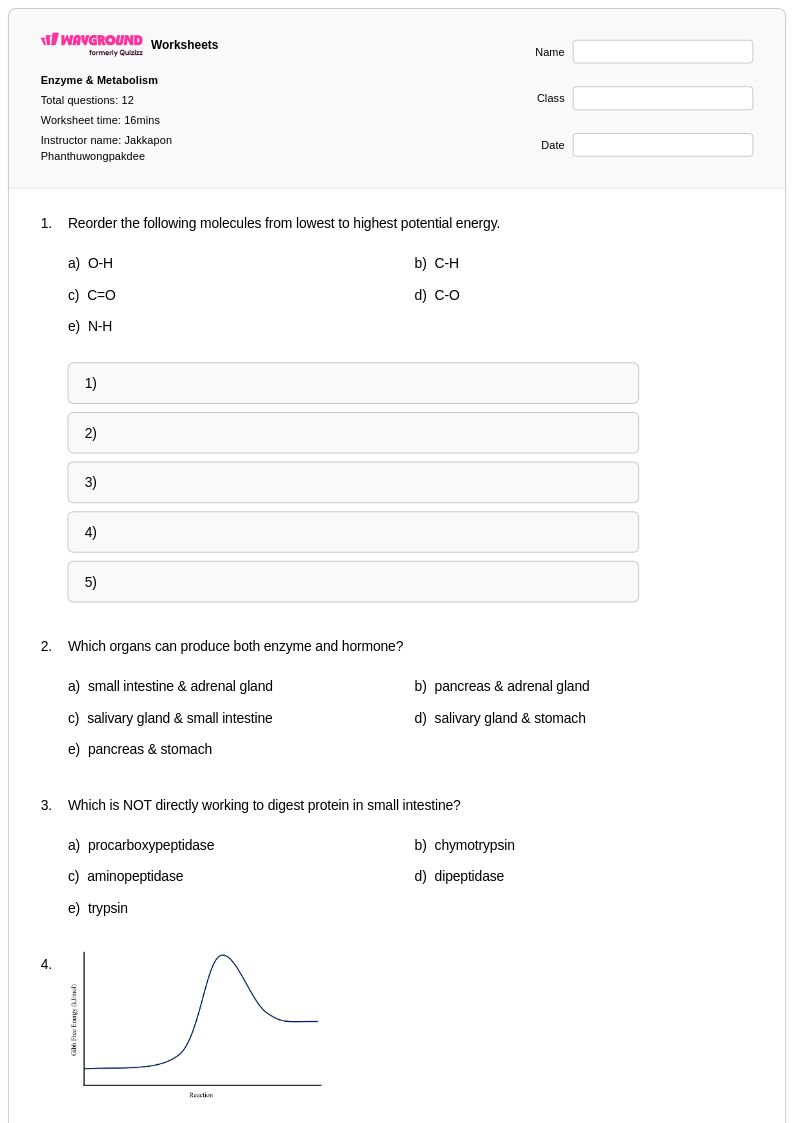
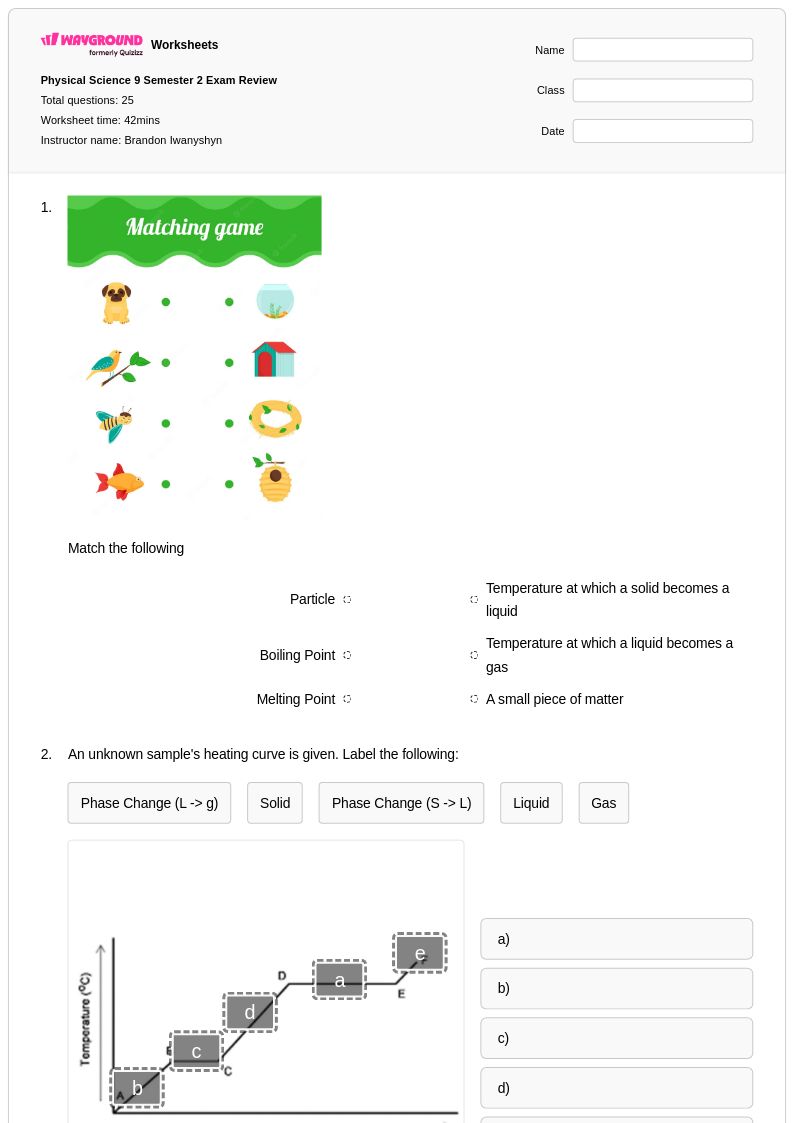
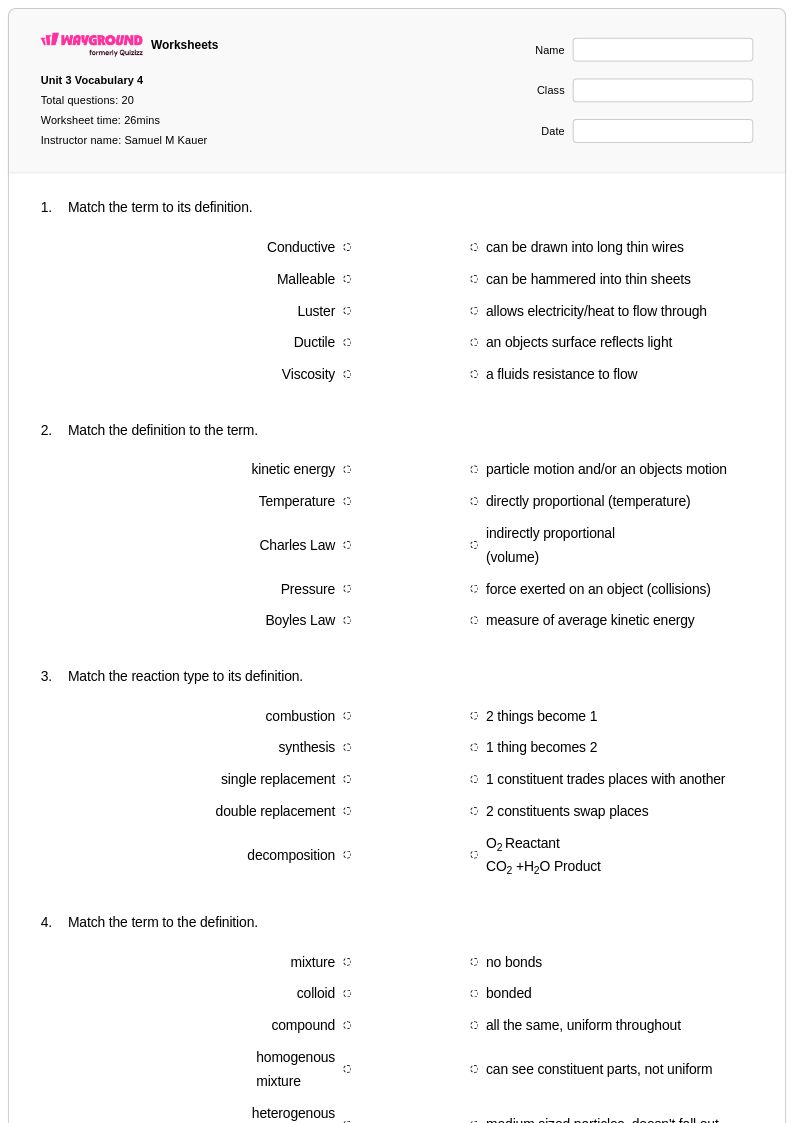
Enhance Year 10 physics understanding with comprehensive kinetics worksheets from Wayground, featuring free printable PDFs, practice problems, and answer keys to help students master motion, velocity, and acceleration concepts.
Year 10 kinetics worksheets available through Wayground (formerly Quizizz) provide comprehensive coverage of motion analysis, velocity calculations, and acceleration principles that form the foundation of advanced physics study. These expertly designed practice problems strengthen students' ability to interpret position-time and velocity-time graphs, solve multi-step kinematics equations, and analyze real-world motion scenarios involving projectiles, free fall, and uniform acceleration. Each worksheet collection includes detailed answer keys that guide students through complex problem-solving strategies, while the free printable pdf format ensures accessibility for both classroom instruction and independent study sessions.
Wayground (formerly Quizizz) empowers educators with millions of teacher-created kinetics resources that feature robust search and filtering capabilities aligned to physics curriculum standards. Teachers can easily differentiate instruction by selecting from worksheets that range from basic motion concepts to advanced projectile motion calculations, with flexible customization tools allowing modification of problem sets to match individual student needs. The platform's digital and printable pdf formats facilitate seamless lesson planning, targeted remediation for students struggling with kinematic equations, and enrichment opportunities for advanced learners ready to tackle complex motion analysis scenarios, ensuring comprehensive skill practice across diverse learning environments.
FAQs
How do I teach kinetics to high school physics students?
Start with conceptual foundations before introducing equations: have students describe everyday motion in words before transitioning to position-time and velocity-time graphs. Once students can interpret graphs qualitatively, introduce displacement, velocity, and acceleration equations in a scaffolded sequence, beginning with constant velocity before adding acceleration. Connecting each equation to a real-world scenario, such as a car braking or a ball in free fall, helps students build intuition alongside procedural fluency.
What exercises help students practice kinetics and kinematics?
Effective kinetics practice combines graph interpretation, equation solving, and multi-step word problems that mirror real scenarios. Students benefit from working through position-time and velocity-time graph readings, solving for unknown variables in kinematic equations, and analyzing problems that require selecting the correct equation before calculating. Sequencing problems from single-step to multi-step builds the computational fluency students need for exams and standardized assessments.
What mistakes do students commonly make when solving kinematics problems?
The most frequent errors include confusing displacement with distance, misreading the slope of a graph as position rather than velocity or acceleration, and applying the wrong kinematic equation because they haven't identified which variables are known and unknown before solving. Students also regularly drop negative signs when dealing with deceleration or motion in opposite directions, which produces incorrect answers even when the method is right. Explicitly requiring students to list known and unknown variables before writing any equation helps interrupt most of these error patterns.
How do students typically confuse velocity and acceleration in kinetics?
Students often treat velocity and acceleration as interchangeable, particularly when an object is moving fast but slowing down, which they may describe as having high acceleration. A key misconception is that a large velocity always implies a large acceleration, when in fact acceleration measures the rate of change in velocity, not its magnitude. Using motion graphs where velocity is constant but acceleration is zero, alongside graphs where velocity changes steadily, helps students distinguish the two concepts through direct visual comparison.
How can I use Wayground's kinetics worksheets in my classroom?
Wayground's kinetics worksheets are available as printable PDFs for traditional classroom distribution and in digital formats for technology-integrated instruction, making them suitable for homework, in-class practice, or assessment preparation. Teachers can also host the worksheets as a live or asynchronous quiz directly on Wayground. Each worksheet includes a detailed answer key, so students can check their work independently or teachers can use them for guided review. For students who need additional support, Wayground's accommodation tools, including read aloud and reduced answer choices, can be applied individually so differentiation is built into the same assignment.
How do I differentiate kinetics instruction for students at different skill levels?
Differentiation in kinetics typically means varying the complexity of problems rather than changing the core concepts: beginners work with single-variable equations and labeled graphs, while advanced students tackle multi-step problems involving multiple kinematic equations or non-constant acceleration scenarios. On Wayground, teachers can apply student-level accommodations such as reduced answer choices or extended time to individual students without alerting the rest of the class, so the same digital worksheet can serve different learners simultaneously. Filtering Wayground's worksheet collection by skill level also allows teachers to assign targeted remediation or enrichment without building separate assignments from scratch.