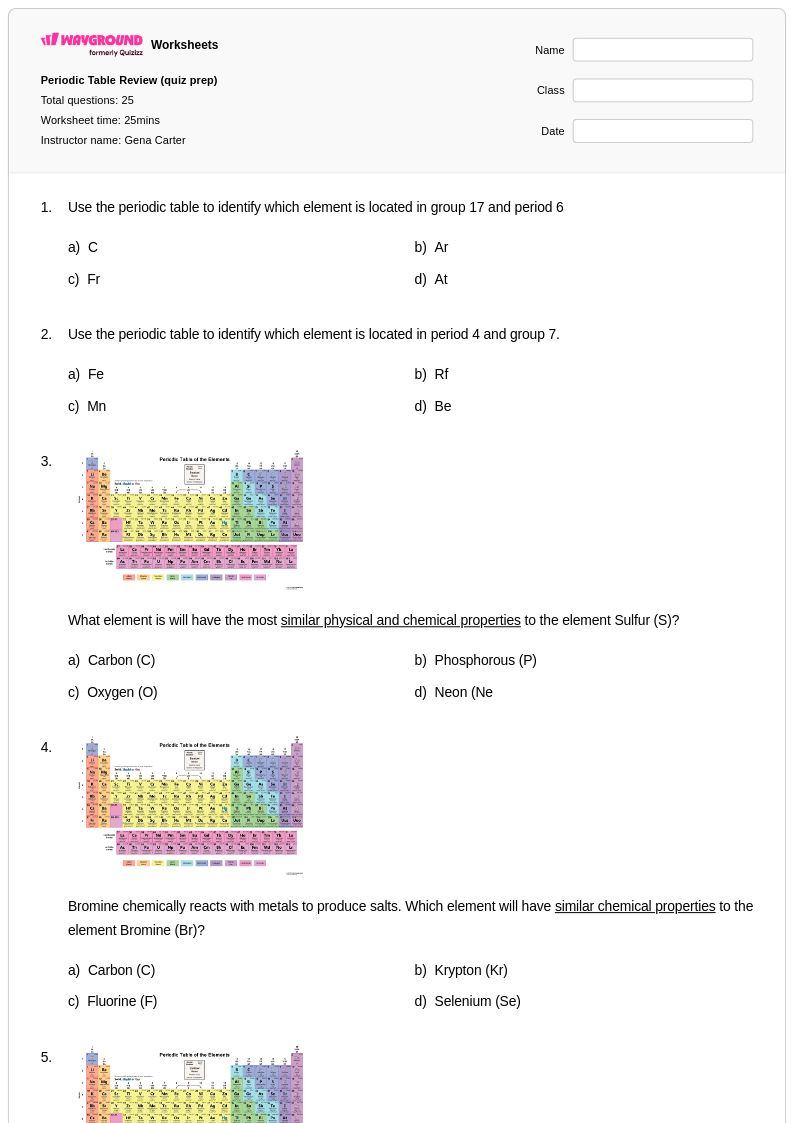
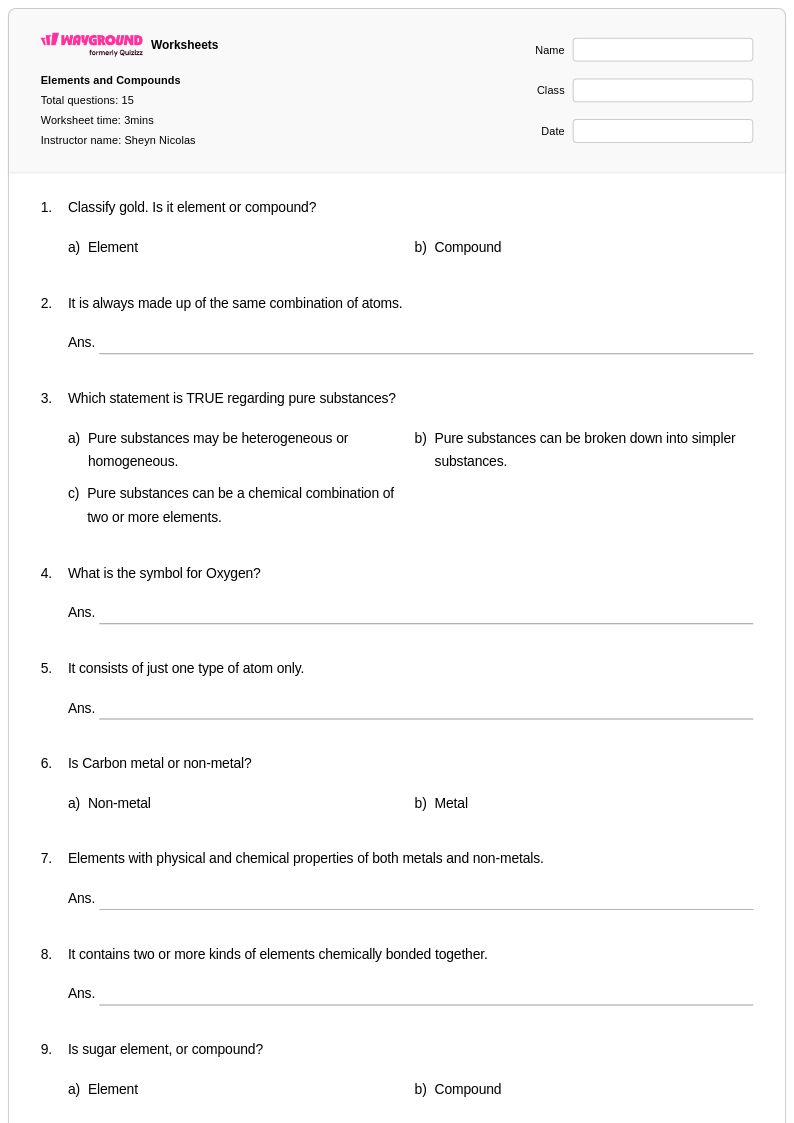
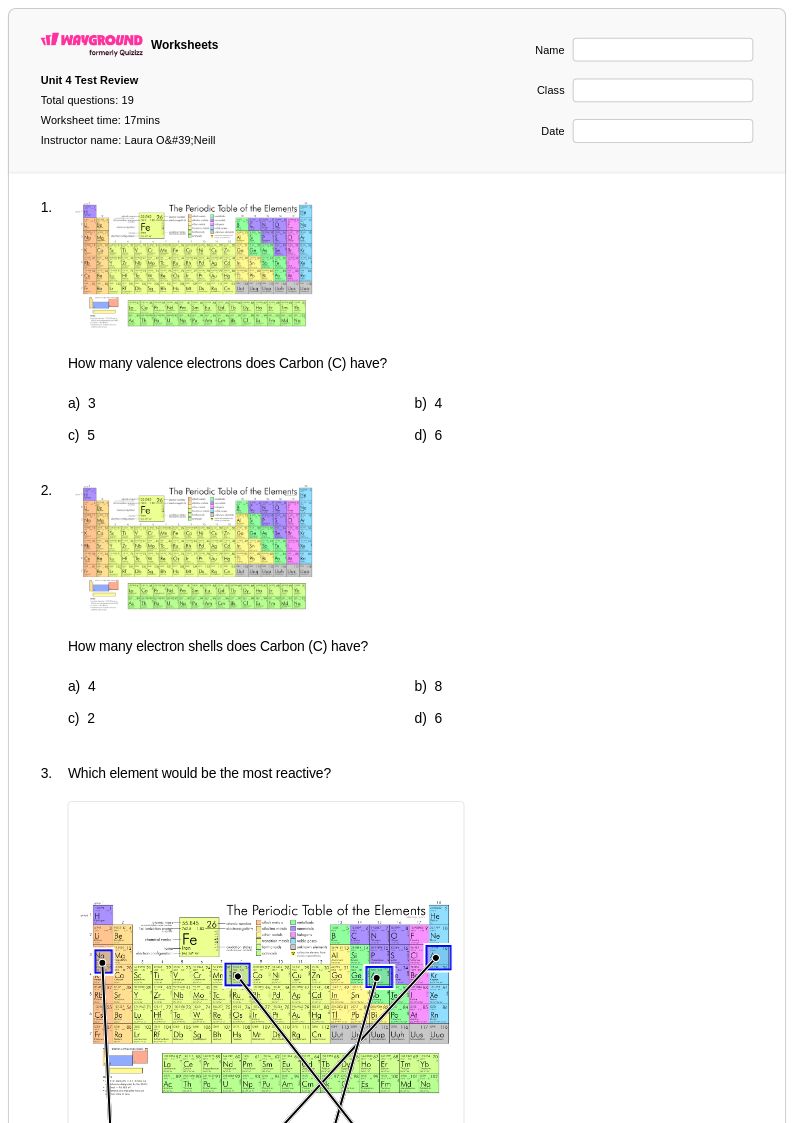
Explore Year 7 metalloids worksheets and printables through Wayground that help students practice identifying semiconductor properties, understand the periodic table placement of elements like silicon and boron, with comprehensive answer keys included.
Explore printable Metalloids worksheets for Year 7
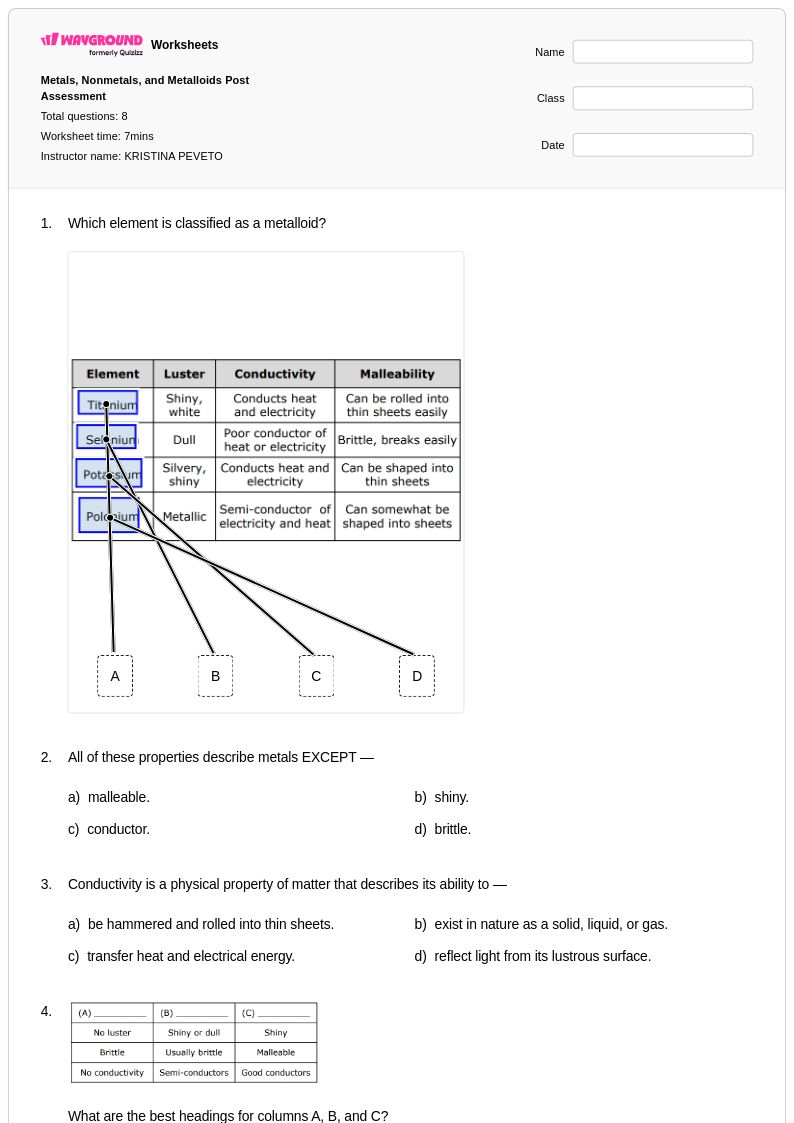
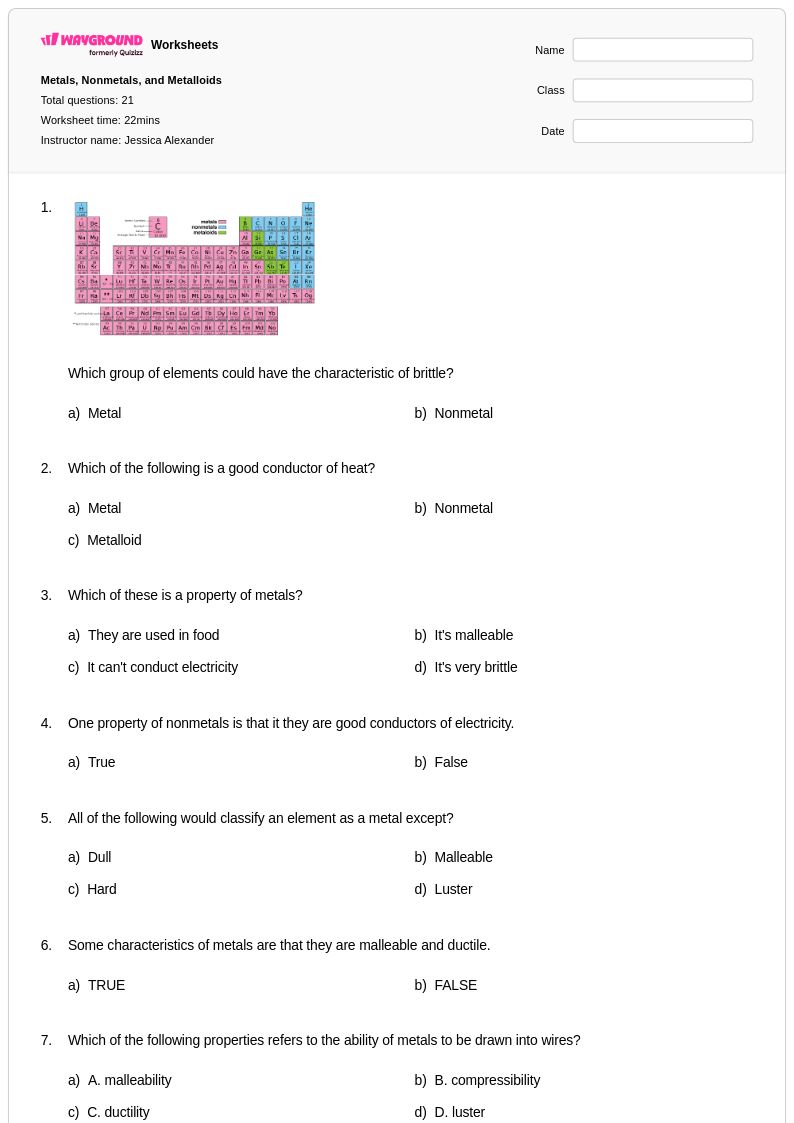
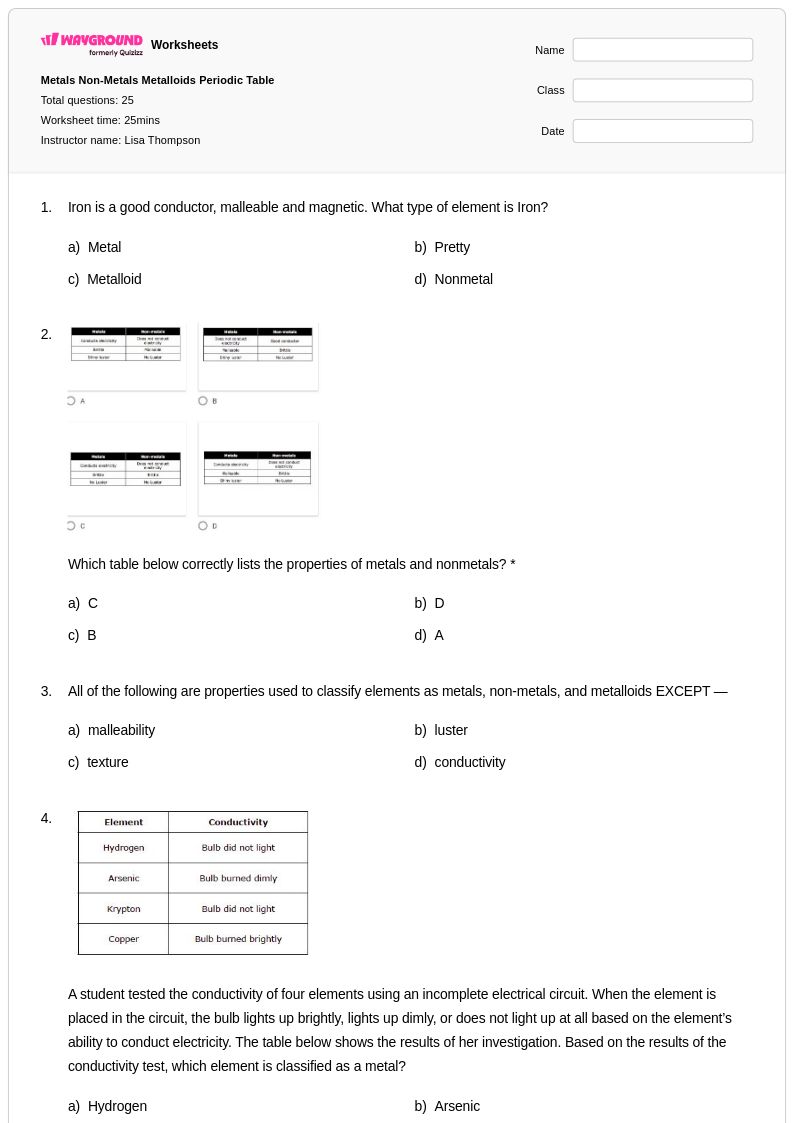
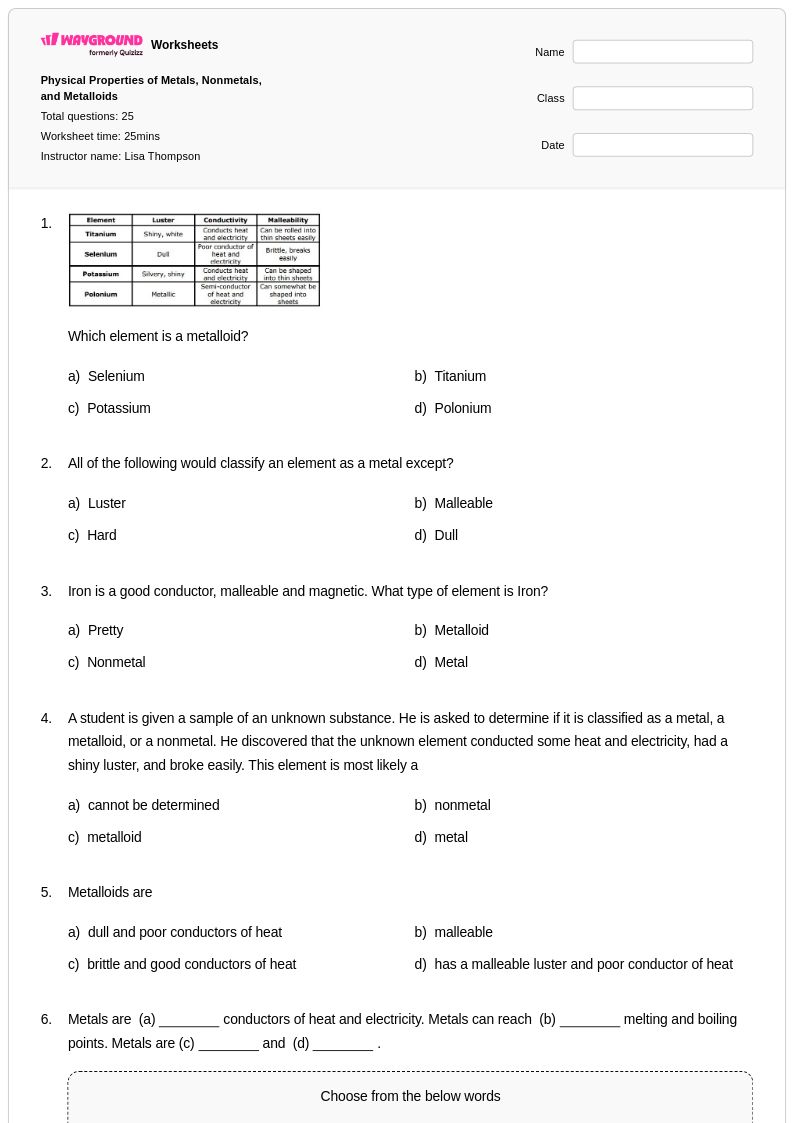
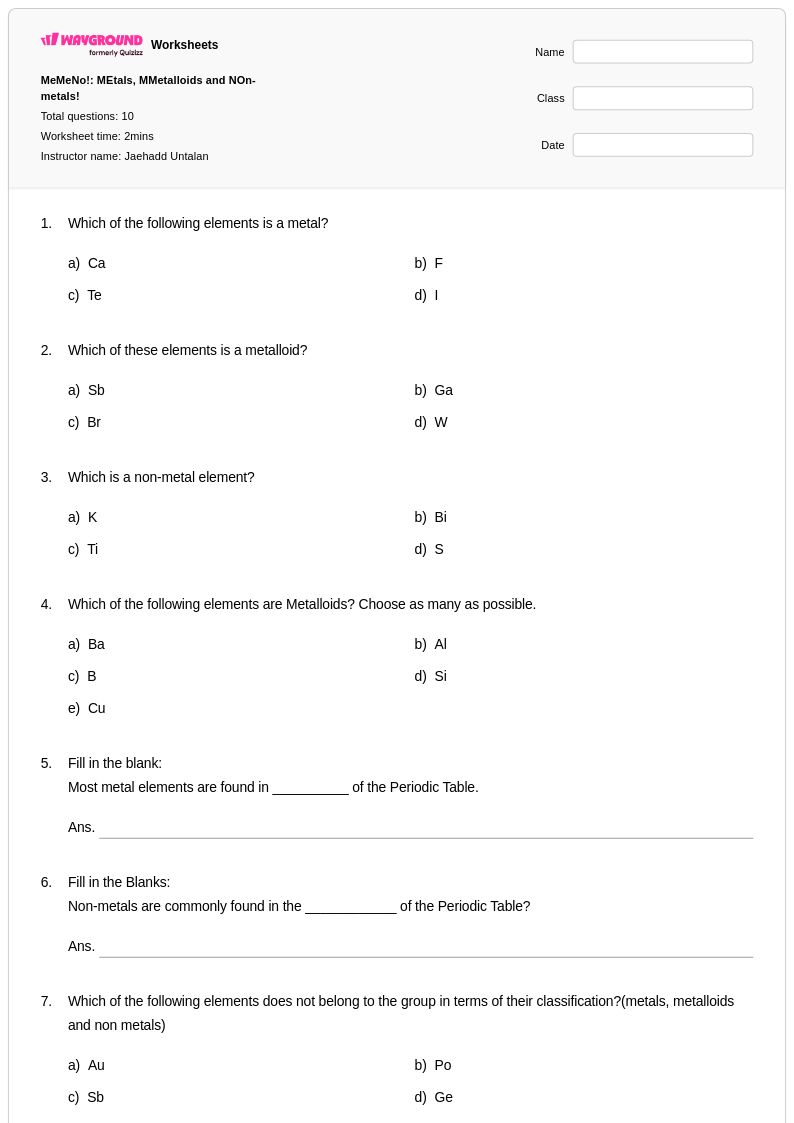
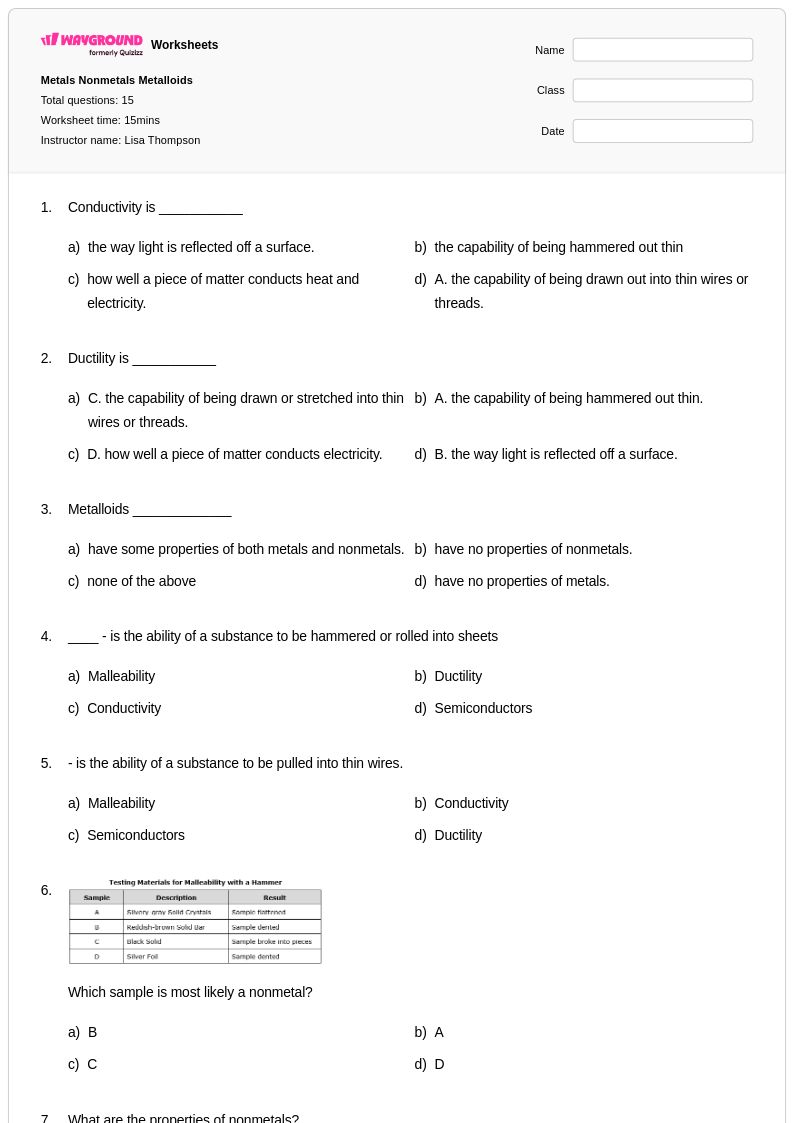
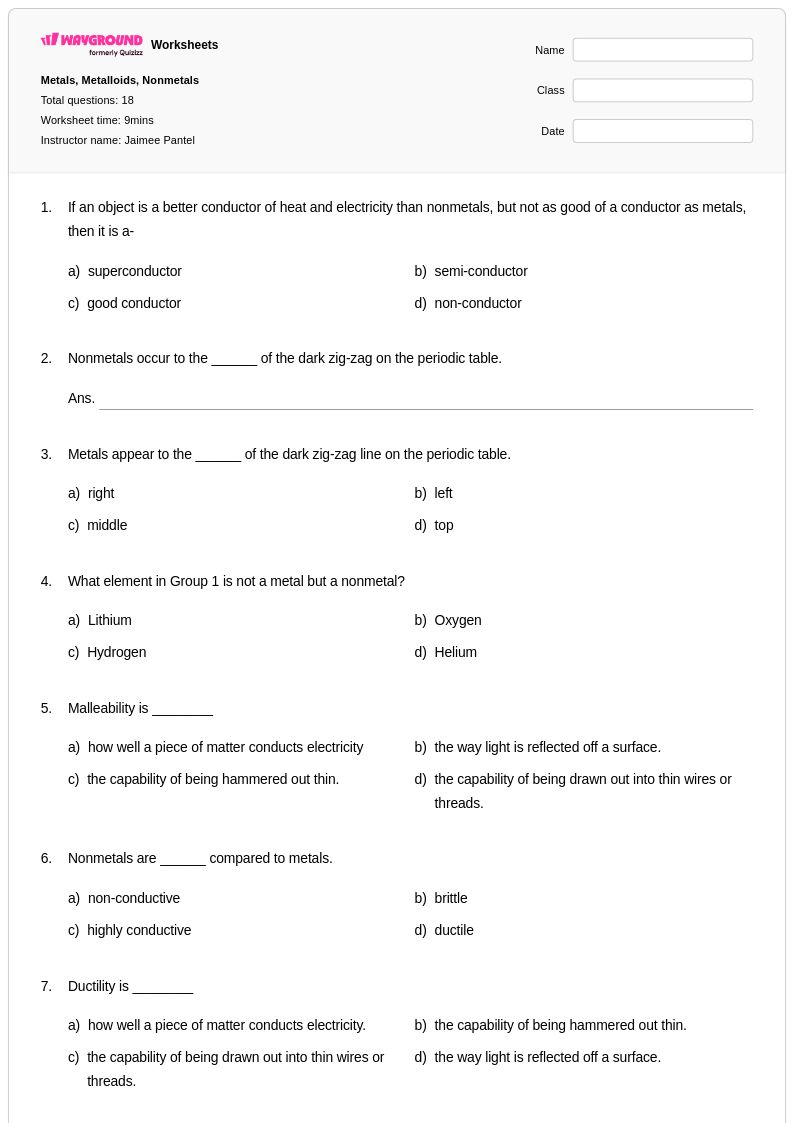
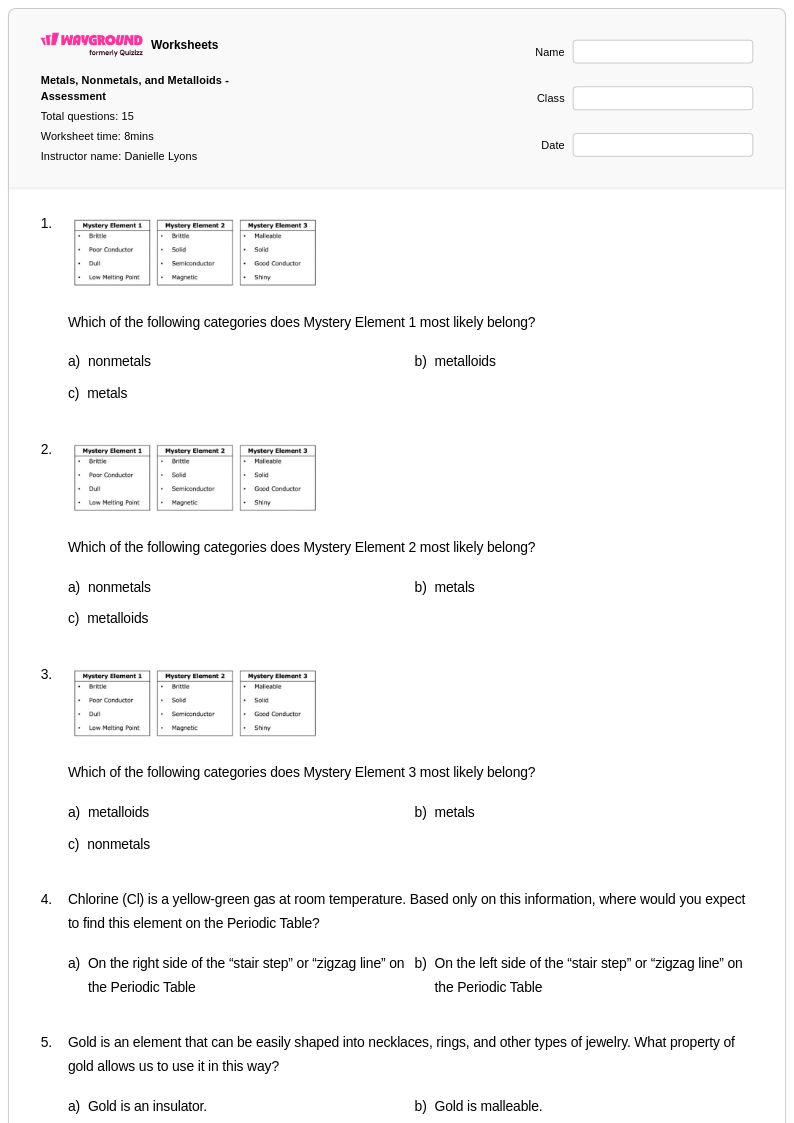
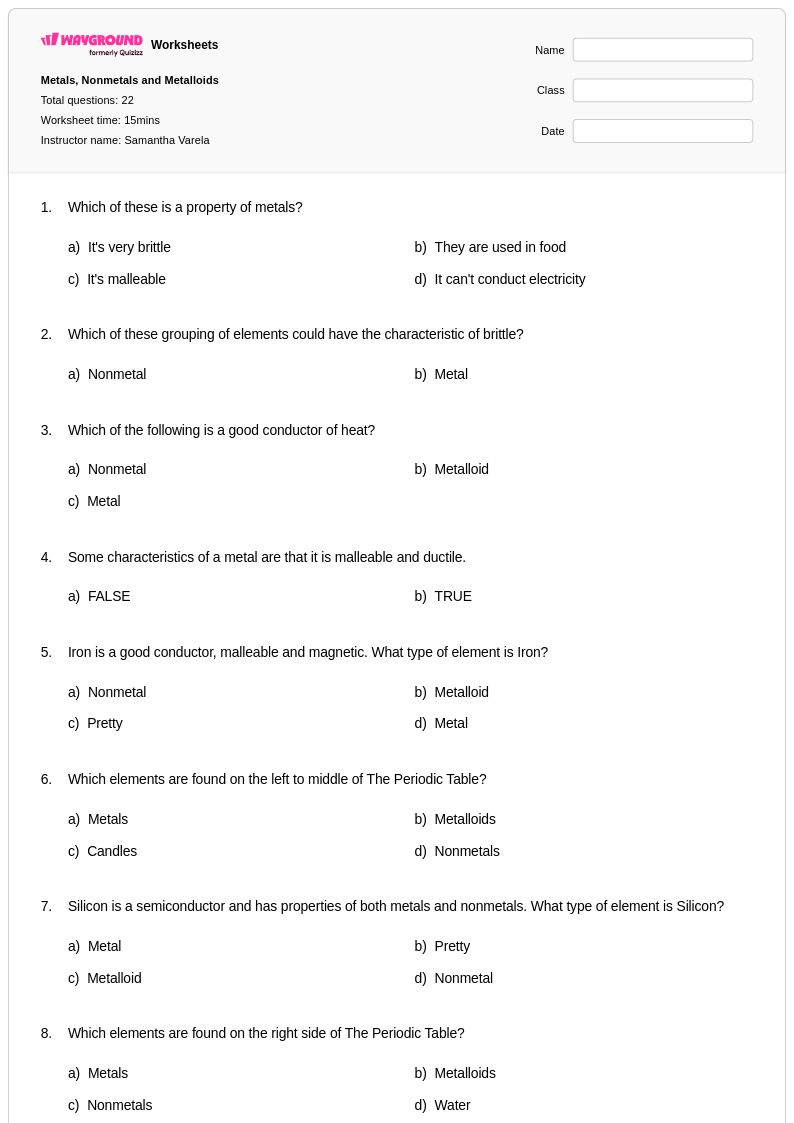
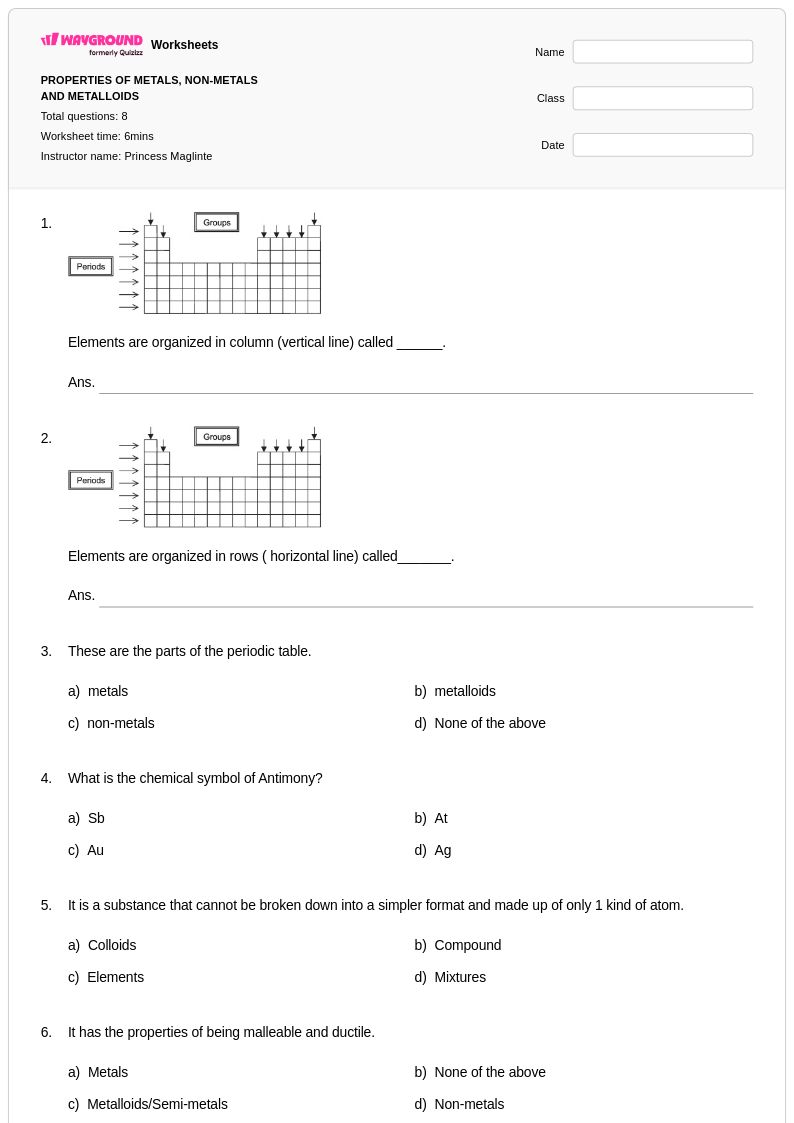
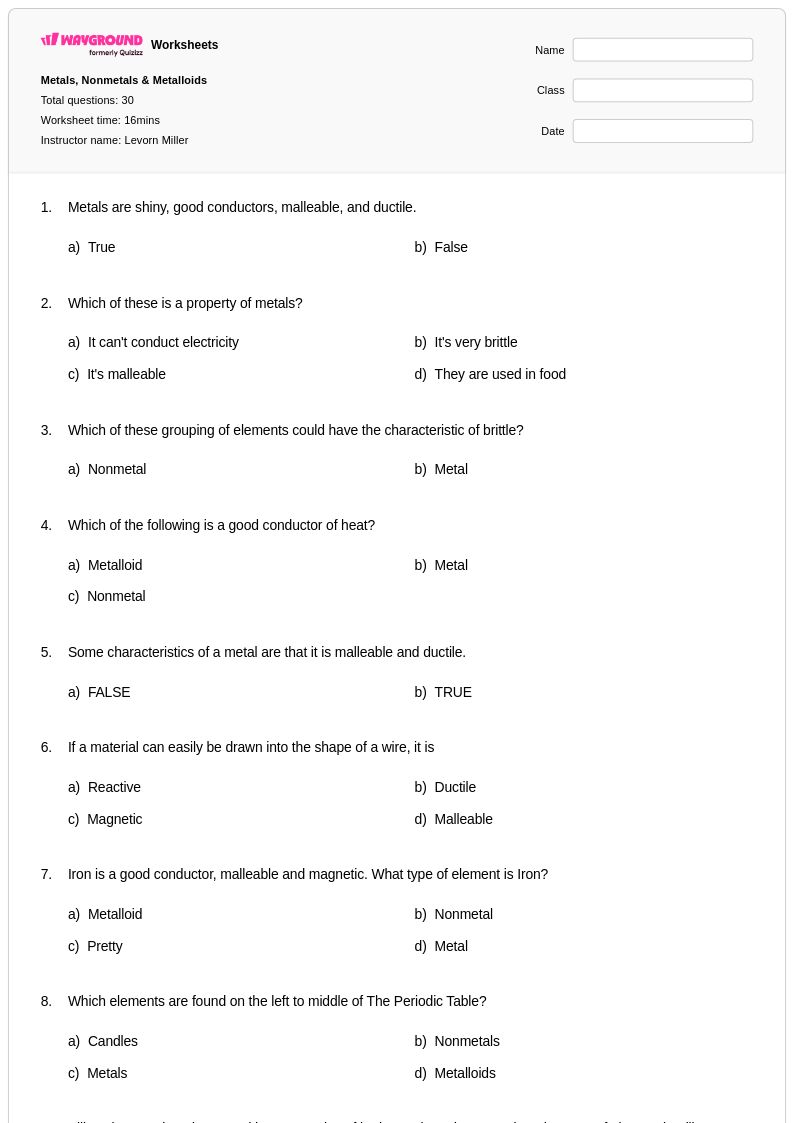
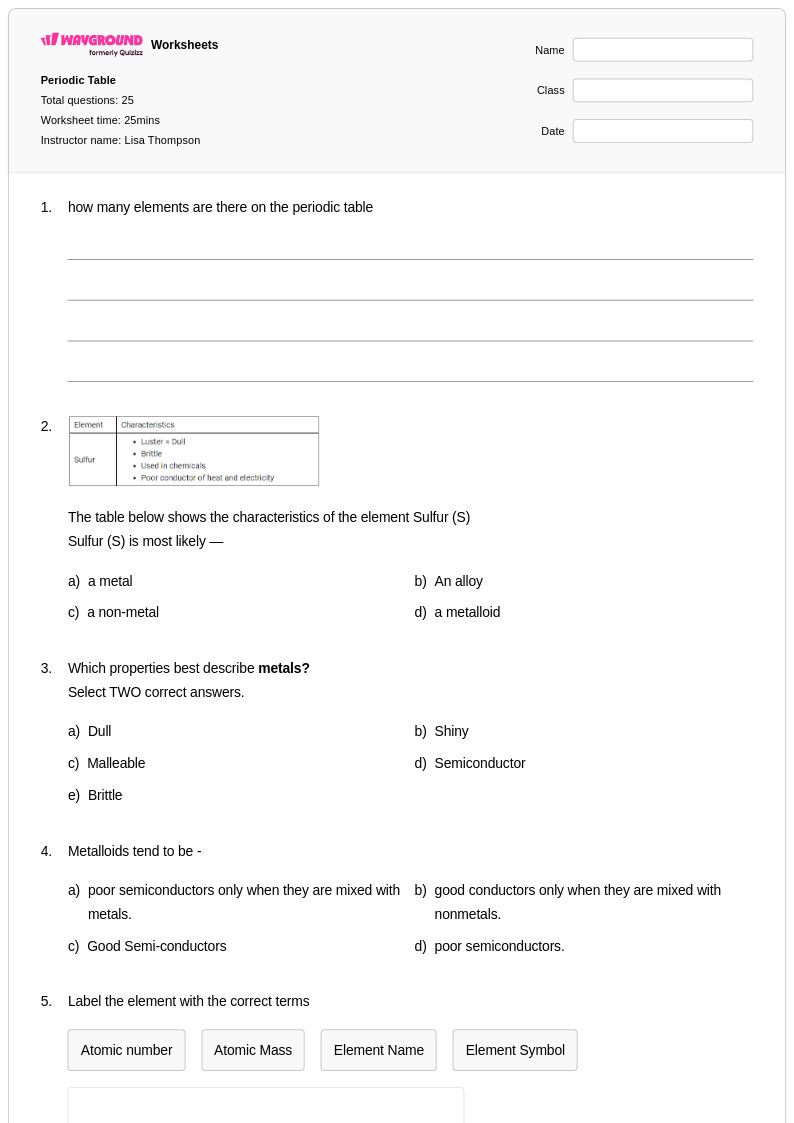
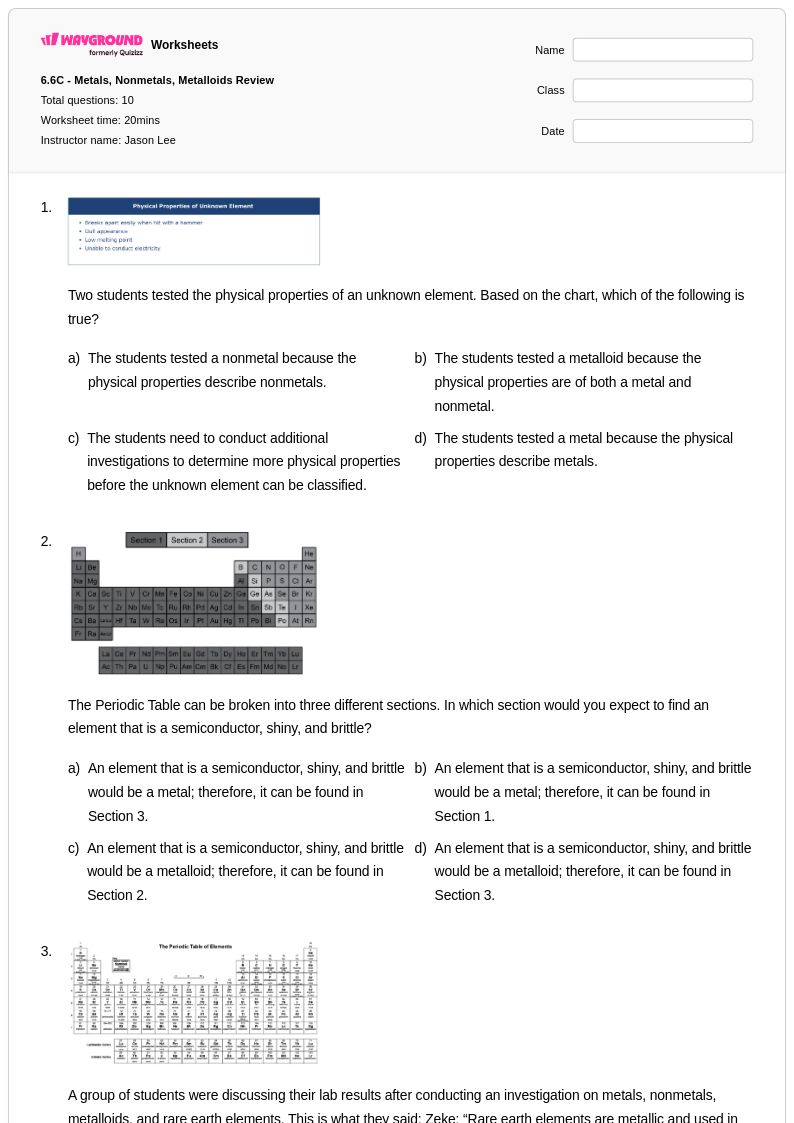
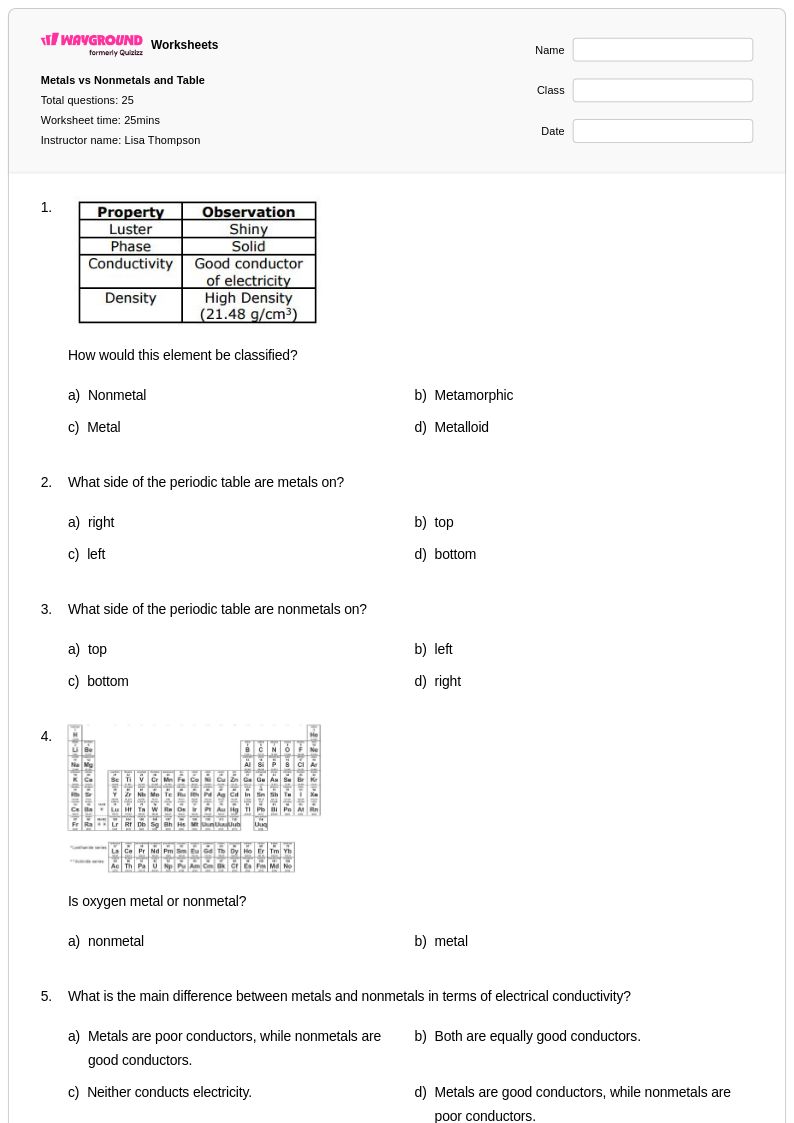
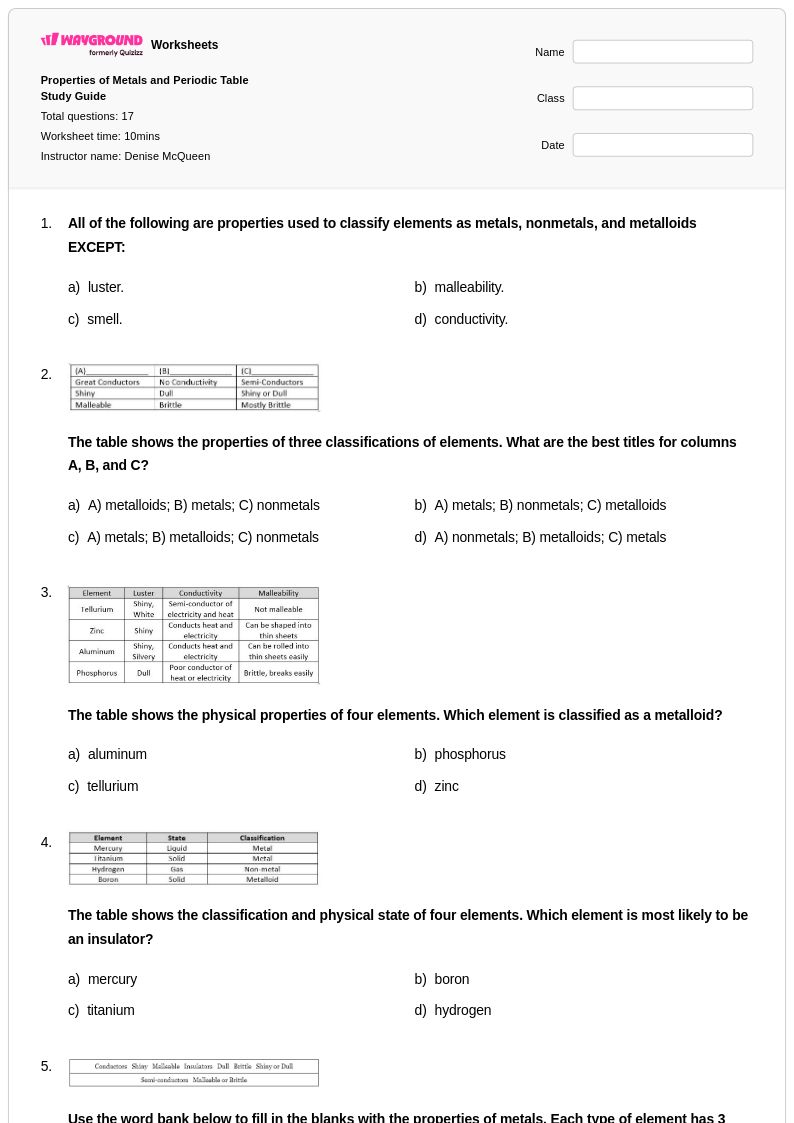
Metalloids worksheets for Year 7 through Wayground (formerly Quizizz) provide comprehensive coverage of these unique elements that bridge the gap between metals and nonmetals on the periodic table. These educational resources help seventh-grade students master the distinctive properties of metalloids like silicon, boron, and arsenic while developing critical thinking skills about elemental classification. Students engage with practice problems that explore how metalloids exhibit both metallic and nonmetallic characteristics, their semiconductor properties, and their important applications in modern technology. The collection includes free printables with detailed answer keys, allowing students to work independently while teachers can easily assess understanding of concepts like electrical conductivity, luster variations, and the stair-step location of metalloids on the periodic table.
Wayground (formerly Quizizz) empowers educators with millions of teacher-created metalloids worksheets that streamline lesson planning and support differentiated instruction for Year 7 chemistry units. The platform's robust search and filtering capabilities enable teachers to quickly locate resources aligned with specific curriculum standards, while customization tools allow adaptation of materials to meet diverse learning needs within the classroom. These versatile worksheet collections are available in both digital and printable pdf formats, making them ideal for traditional classroom settings, remote learning environments, or hybrid instruction models. Teachers can efficiently implement these resources for initial concept introduction, targeted skill practice, remediation for struggling students, or enrichment activities for advanced learners, ensuring that all seventh-grade students develop a solid foundation in understanding the unique role metalloids play in the periodic table and their significance in scientific applications.
FAQs
How do I teach metalloids to chemistry students?
Start by positioning metalloids as a bridge concept between metals and nonmetals on the periodic table, emphasizing that elements like silicon, boron, germanium, arsenic, antimony, and tellurium display properties of both groups depending on conditions. A strong teaching sequence moves from identifying metalloids by location on the periodic table to analyzing their physical and chemical properties, and then connecting those properties to real-world applications like semiconductors and computer chips. Using comparison charts that place metalloids alongside a metal and a nonmetal helps students internalize the distinctions rather than memorize them.
What are common misconceptions students have about metalloids?
One of the most persistent misconceptions is that metalloids are simply 'in-between' metals and nonmetals in a fixed, predictable way, when in fact their behavior is highly context-dependent — silicon conducts electricity under certain conditions but not others, which is precisely what makes it useful as a semiconductor. Students also frequently confuse metalloids with transition metals, largely because both occupy middle regions of the periodic table. Another common error is assuming all metalloids share the same properties, when the group is defined more by their intermediate character than by a uniform set of traits.
What practice exercises help students identify and understand metalloids?
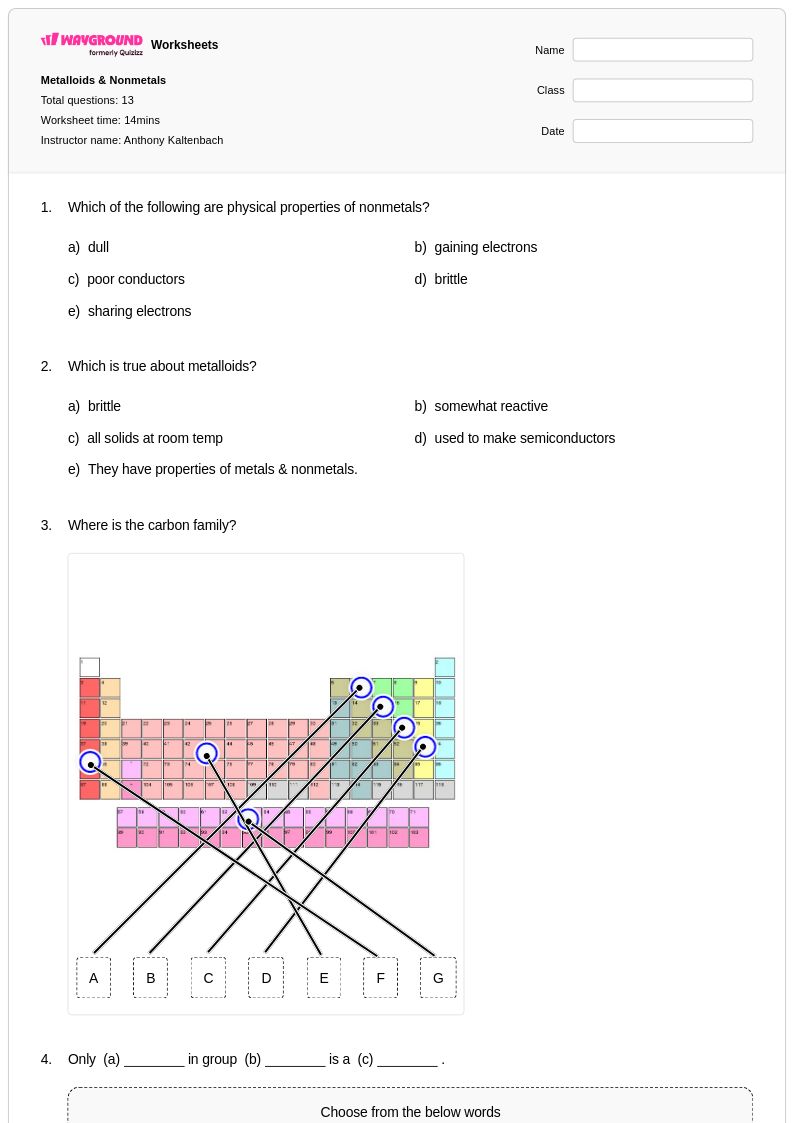
Effective practice for metalloids includes periodic table labeling exercises where students locate and shade the metalloid staircase region, followed by property-sorting tasks that ask them to classify given characteristics as metallic, nonmetallic, or both. Electron configuration analysis problems for elements like silicon and arsenic reinforce why metalloids behave the way they do at the atomic level. Application-based questions connecting specific metalloids to technologies such as semiconductors, solar panels, and fiber optics give students a concrete context that deepens retention.
How do I use Wayground's metalloids worksheets in my classroom?
Wayground's metalloids worksheets are available as printable PDFs, making them straightforward to distribute in a traditional classroom setting, and in digital formats for technology-integrated environments, including the option to host them as a quiz directly on Wayground. Each worksheet includes a detailed answer key, so teachers can use them for guided practice, independent work, or formative assessment without additional preparation. For students who need support, Wayground's platform offers built-in accommodations such as read aloud, extended time, and reduced answer choices, which can be configured individually without disrupting the rest of the class.
How do metalloids connect to real-world technology, and how can I use that connection in lessons?
Metalloids are foundational to modern electronics because their semiconducting properties allow them to control electrical current in ways that pure metals and nonmetals cannot, making silicon the backbone of computer chips, solar cells, and transistors. Boron is used in glass and ceramics manufacturing, and arsenic compounds appear in certain LEDs and solar panels. Anchoring metalloid lessons in these applications gives students a reason to care about the chemistry, and using worksheet problems that ask students to match a metalloid to its industrial use reinforces both factual knowledge and analytical thinking.
How can I differentiate metalloids instruction for students at different skill levels?
For students who need foundational support, start with visual periodic table activities that focus purely on locating and naming the seven metalloids before introducing property analysis. More advanced students can tackle electron configuration problems and compare how the same metalloid behaves differently as a conductor versus an insulator depending on temperature or doping. Wayground's platform supports differentiation directly within assignments, allowing teachers to adjust content complexity and apply accommodations such as reduced answer choices or adjustable font sizes for individual students while the rest of the class works with standard settings.