Free Printable Relationship Boundaries Worksheets for Year 7
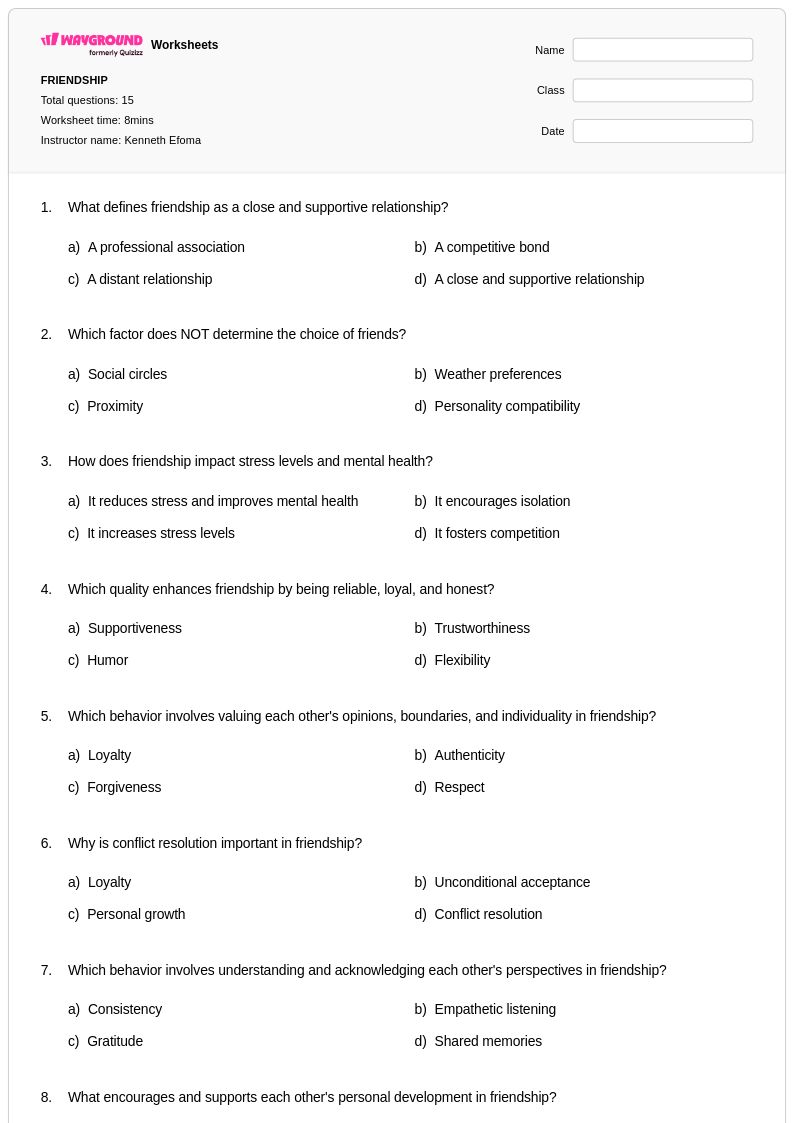
Free Year 7 relationship boundaries worksheets and printables help students develop healthy social skills through engaging practice problems, downloadable PDFs, and comprehensive answer keys available on Wayground.
Explore printable Relationship Boundaries worksheets for Year 7
Relationship boundaries worksheets for Year 7 social studies provide essential practice in understanding personal limits, respect, and healthy interpersonal connections. These comprehensive worksheet collections through Wayground (formerly Quizizz) help seventh-grade students develop critical social-emotional skills by exploring concepts such as identifying appropriate versus inappropriate behavior, understanding consent, recognizing emotional boundaries, and communicating personal limits effectively. The printable resources include scenario-based practice problems that challenge students to analyze real-world situations, while accompanying answer keys enable teachers to facilitate meaningful discussions about boundary-setting strategies. These free pdf worksheets strengthen students' ability to navigate complex social relationships by teaching them to recognize warning signs of boundary violations, understand the difference between healthy and unhealthy relationship dynamics, and develop confidence in asserting their personal boundaries.
Wayground (formerly Quizizz) supports educators with millions of teacher-created relationship boundaries resources specifically designed for Year 7 social studies curricula. The platform's robust search and filtering capabilities allow teachers to quickly locate worksheets that align with social-emotional learning standards while addressing diverse student needs through built-in differentiation tools. Teachers can customize these printable and digital pdf materials to target specific skill gaps, whether focusing on peer relationships, family dynamics, or digital citizenship boundaries. The extensive worksheet library facilitates seamless lesson planning while providing flexible options for remediation, enrichment, and ongoing skill practice, enabling educators to create comprehensive learning experiences that help students develop healthy relationship skills essential for adolescent development and future success.
FAQs
How do I teach relationship boundaries to students?
Teaching relationship boundaries is most effective when grounded in realistic, relatable scenarios rather than abstract definitions. Start by helping students distinguish appropriate from inappropriate interactions in familiar contexts like friendships, family, and school. Build from recognition to response by practicing assertiveness language and boundary-setting strategies through role play and guided reflection. Anchoring lessons in concrete situations gives students the vocabulary and confidence to apply these skills in real life.
What exercises help students practice setting healthy relationship boundaries?
Scenario-based activities are among the most effective tools for practicing relationship boundaries because they require students to evaluate real-feeling situations and decide how to respond. Exercises that ask students to identify boundary violations, practice refusal language, and reflect on how boundaries differ across contexts build both awareness and skill. Structured worksheets that include guided reflection prompts help students internalize boundary principles rather than simply memorize definitions.
What common mistakes do students make when learning about relationship boundaries?
A frequent misconception is that setting a boundary is unkind or confrontational, which can cause students to avoid asserting limits even when they are uncomfortable. Students also often confuse boundaries with rules imposed by others, rather than understanding them as personal limits they have the right to define and communicate. Another common error is applying boundary concepts rigidly without recognizing that appropriate limits vary depending on relationship type and context, such as a friendship versus a family relationship.
How do I use relationship boundaries worksheets in my classroom?
Relationship boundaries worksheets work well for whole-class instruction, small group discussion, or individual reflection depending on the sensitivity of the content and your students' comfort levels. Wayground's worksheets are available as printable PDFs for traditional classroom use and in digital formats for technology-integrated environments, and can also be hosted as a quiz directly on Wayground. Answer keys are included with each worksheet, making them practical for independent work or structured review.
How can I differentiate relationship boundaries instruction for students with varying social-emotional skill levels?
For students who need additional support, simplifying scenario complexity and providing sentence starters for assertiveness language can reduce barriers to engagement. For students ready for more challenge, activities that explore nuanced dynamics, such as digital boundaries or consent in group settings, extend thinking beyond foundational concepts. On Wayground, teachers can apply accommodations such as reduced answer choices or read-aloud support to individual students, allowing the same worksheet to serve diverse learners simultaneously without singling anyone out.
How do relationship boundaries worksheets connect to social-emotional learning standards?
Relationship boundaries instruction maps directly to core SEL competencies including self-awareness, responsible decision-making, and relationship skills. Worksheets that ask students to identify their own limits, recognize others' boundaries, and practice communicating assertively address multiple SEL strands within a single activity. This alignment makes relationship boundaries worksheets a natural complement to existing SEL curriculum rather than a standalone addition.