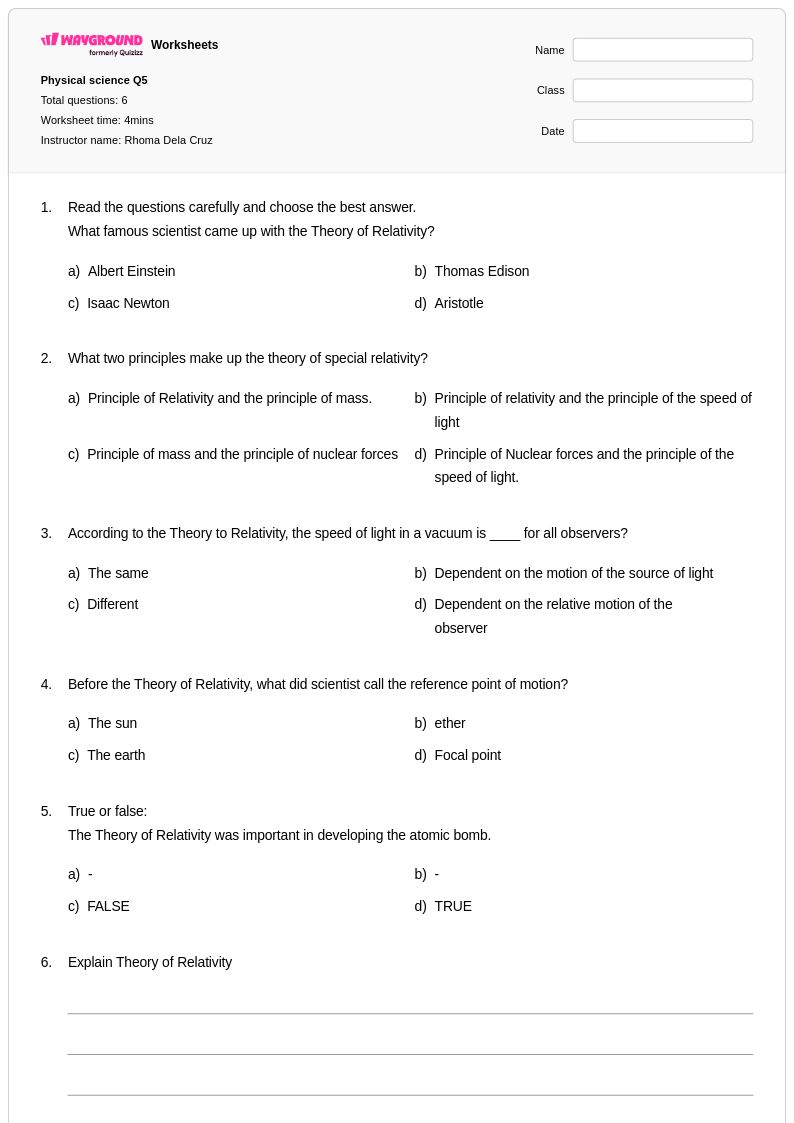
Master special relativity concepts with Wayground's comprehensive collection of free physics worksheets, featuring printable PDFs with practice problems and answer keys to help students understand time dilation, length contraction, and relativistic effects.
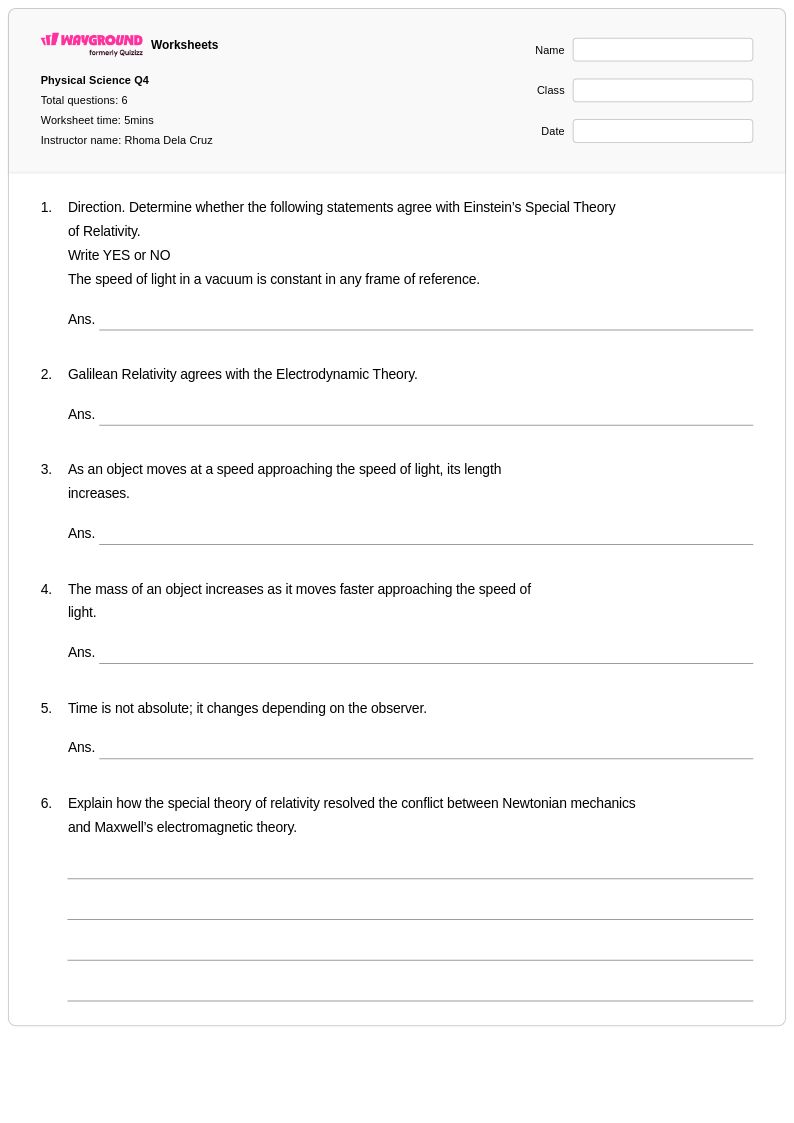
Special relativity worksheets available through Wayground (formerly Quizizz) provide comprehensive coverage of Einstein's groundbreaking theory and its fundamental principles. These educational resources strengthen students' understanding of time dilation, length contraction, mass-energy equivalence, and the invariance of the speed of light across all reference frames. The worksheets feature carefully crafted practice problems that guide learners through complex calculations involving Lorentz transformations, relativistic velocity additions, and energy-momentum relationships. Each printable worksheet includes detailed answer keys that help students verify their solutions and identify areas requiring additional study. The free pdf resources systematically build conceptual understanding while developing mathematical proficiency in applying relativistic formulas to real-world scenarios involving high-speed particles and astronomical observations.
Wayground (formerly Quizizz) empowers educators with millions of teacher-created special relativity worksheet collections that support diverse instructional needs and learning objectives. The platform's robust search and filtering capabilities enable teachers to locate resources aligned with specific physics standards while accommodating various skill levels through built-in differentiation tools. These customizable worksheets are available in both printable and digital formats, including downloadable pdf versions that facilitate seamless classroom integration and remote learning environments. Teachers can efficiently plan comprehensive units covering relativistic concepts, provide targeted remediation for struggling students, and offer enrichment opportunities for advanced learners through the platform's extensive collection of practice problems and assessment materials. The flexible formatting options and standards alignment features streamline lesson preparation while ensuring consistent skill practice across diverse educational settings.
FAQs
How do I teach special relativity to high school or college physics students?
Teaching special relativity effectively starts with grounding students in the two postulates: the constancy of the speed of light and the equivalence of physical laws across all inertial reference frames. From there, build sequentially through time dilation and length contraction before introducing Lorentz transformations and mass-energy equivalence. Using thought experiments, such as the twin paradox or a light clock, helps students develop conceptual intuition before tackling the mathematics. Worked examples involving high-speed particles or GPS satellite corrections make the theory feel tangible rather than abstract.
What practice problems help students get better at special relativity calculations?
Students benefit most from problems that require applying the Lorentz factor across different contexts, including time dilation, length contraction, relativistic velocity addition, and energy-momentum relationships. Scaffolded problem sets that start with identifying the rest frame and the moving frame before plugging into formulas reduce procedural errors. Practice with real-world scenarios, such as muon decay in Earth's atmosphere or particle accelerator energetics, reinforces why relativistic corrections matter at high velocities.
What mistakes do students commonly make when solving special relativity problems?
The most common error is confusing which observer measures proper time or proper length, leading to inverted Lorentz factor applications. Students also frequently misapply classical velocity addition instead of the relativistic addition formula when combining speeds near the speed of light. Another persistent misconception is treating mass-energy equivalence as applying only to nuclear reactions rather than understanding it as a universal relationship. Requiring students to explicitly label reference frames before solving any problem significantly reduces these errors.
How can I use special relativity worksheets to support students at different skill levels?
Differentiated special relativity worksheets work well when conceptual questions and formula-based calculations are separated so struggling students can build understanding before tackling quantitative problems. On Wayground, teachers can assign individual accommodations such as extended time per question, read aloud support for complex problem stems, and reduced answer choices for students who need lower cognitive load. These settings can be applied to specific students without affecting the rest of the class, making it straightforward to support diverse learners within the same assignment.
How do I use Wayground's special relativity worksheets in my classroom?
Wayground's special relativity worksheets are available as printable PDFs for traditional classroom use and in digital formats for technology-integrated or remote learning environments. Teachers can also host them as a quiz directly on Wayground, enabling real-time student responses and instant feedback. Each worksheet includes a complete answer key, so students can self-check their work or teachers can use them for efficient grading. The digital format also supports individual accommodations, including extended time and read aloud, which can be configured per student from the Students or Classes tab.
How does special relativity connect to other physics topics I'm already teaching?
Special relativity connects directly to mechanics through the breakdown of Newtonian momentum and kinetic energy formulas at high velocities, making it a natural extension of classical dynamics units. It also ties into electromagnetism, since Maxwell's equations are Lorentz-invariant and historically motivated Einstein's postulates. For courses covering modern physics, special relativity is foundational to understanding particle physics, nuclear reactions, and cosmology, so teaching it well pays dividends across multiple subsequent units.