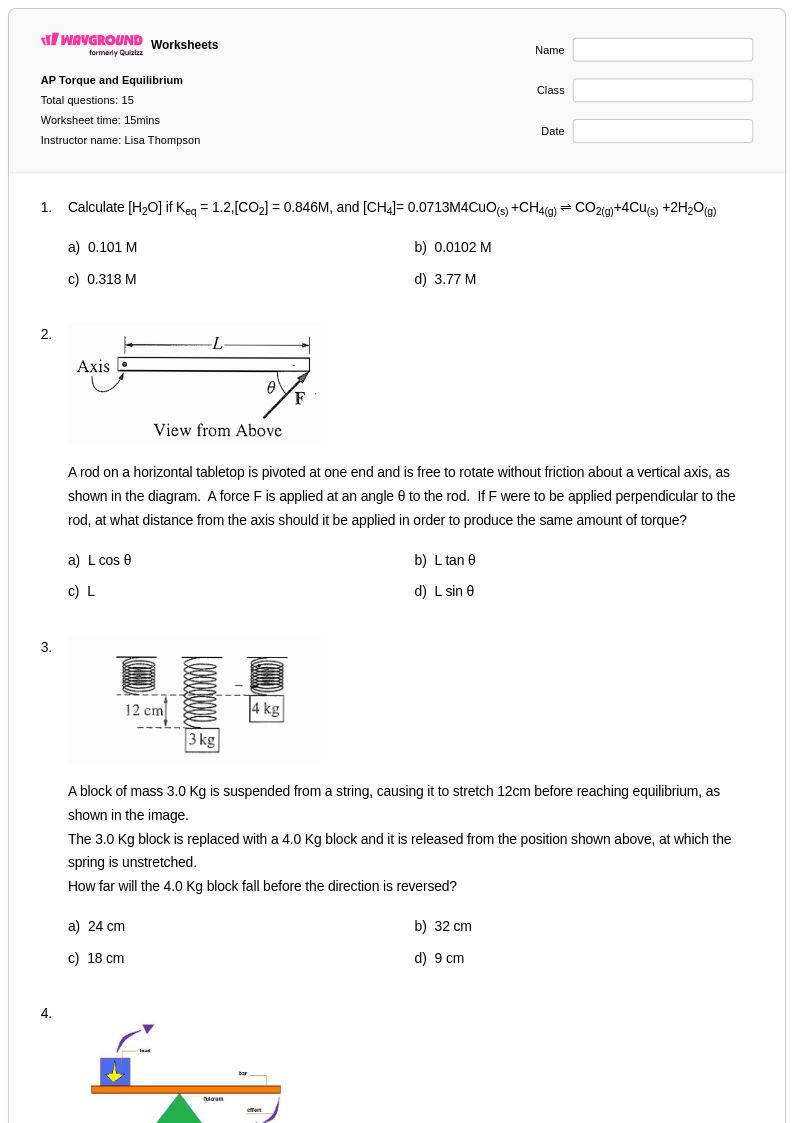
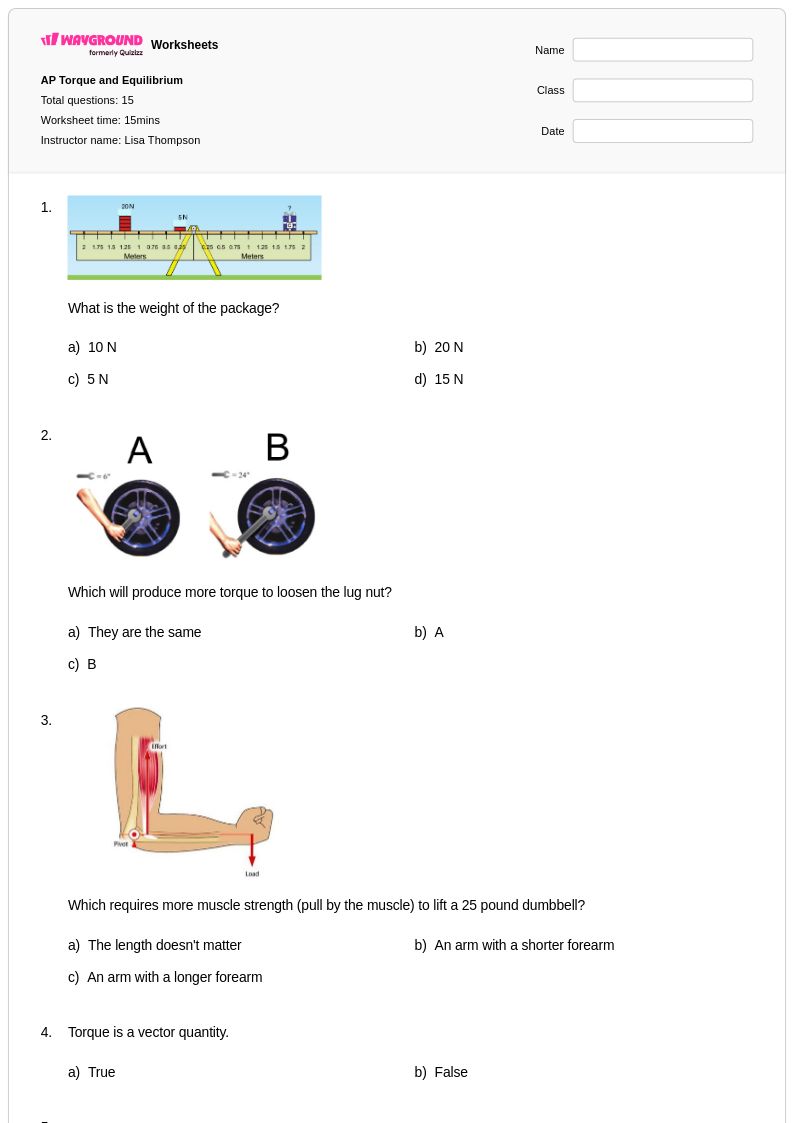
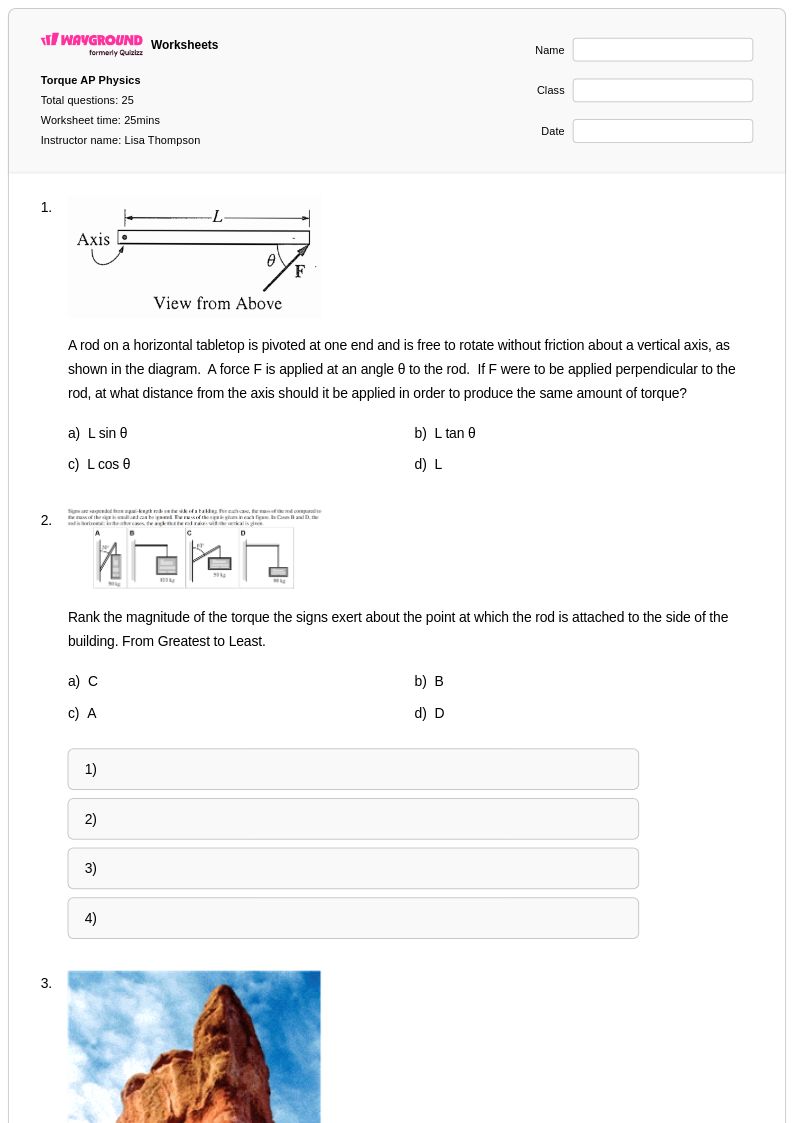
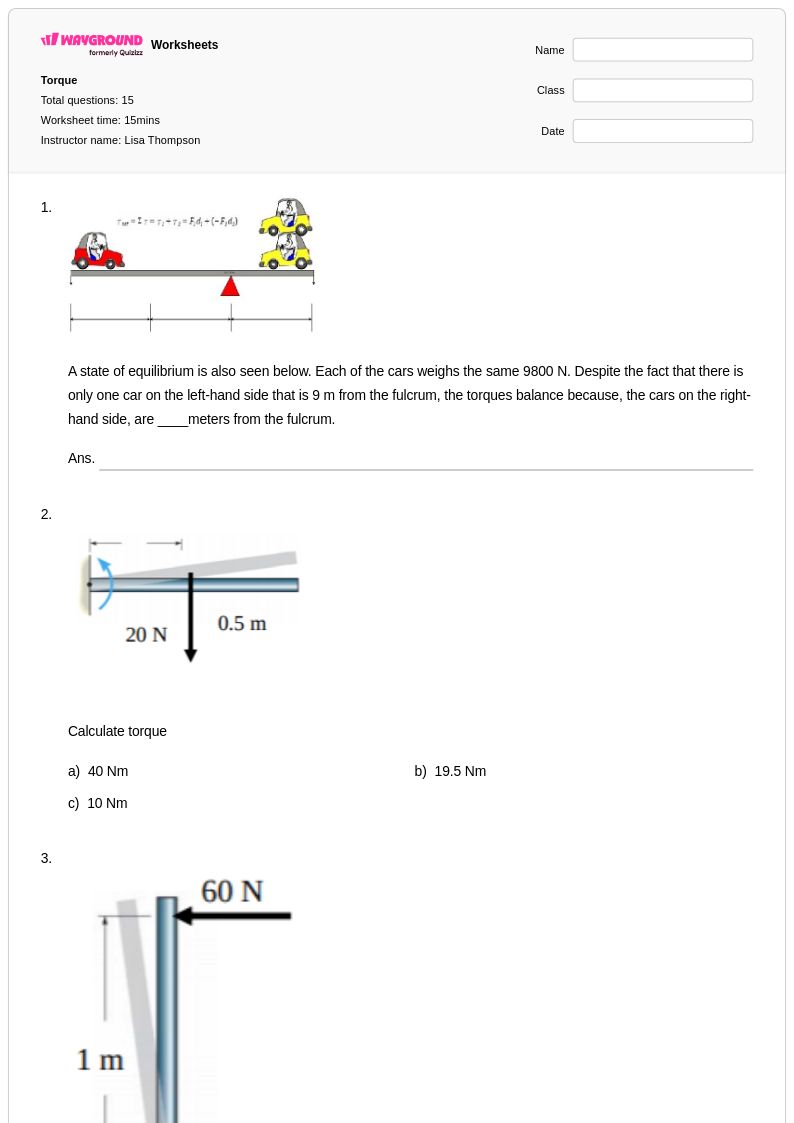
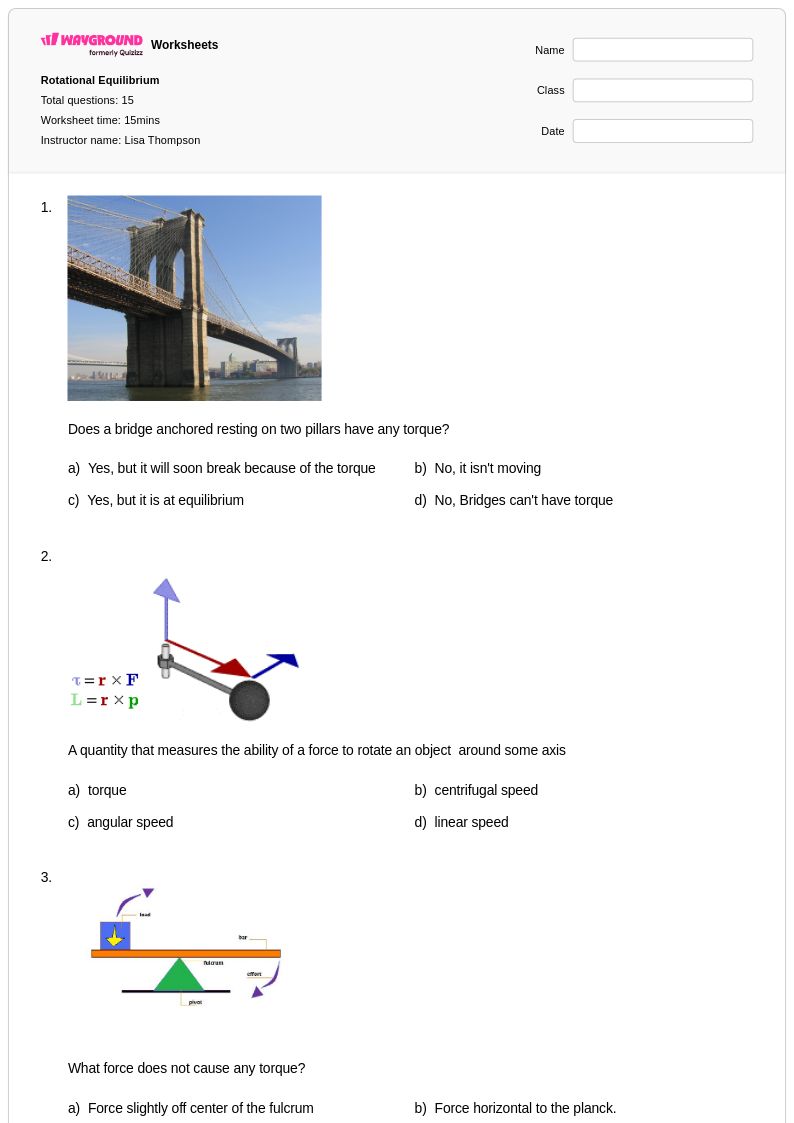
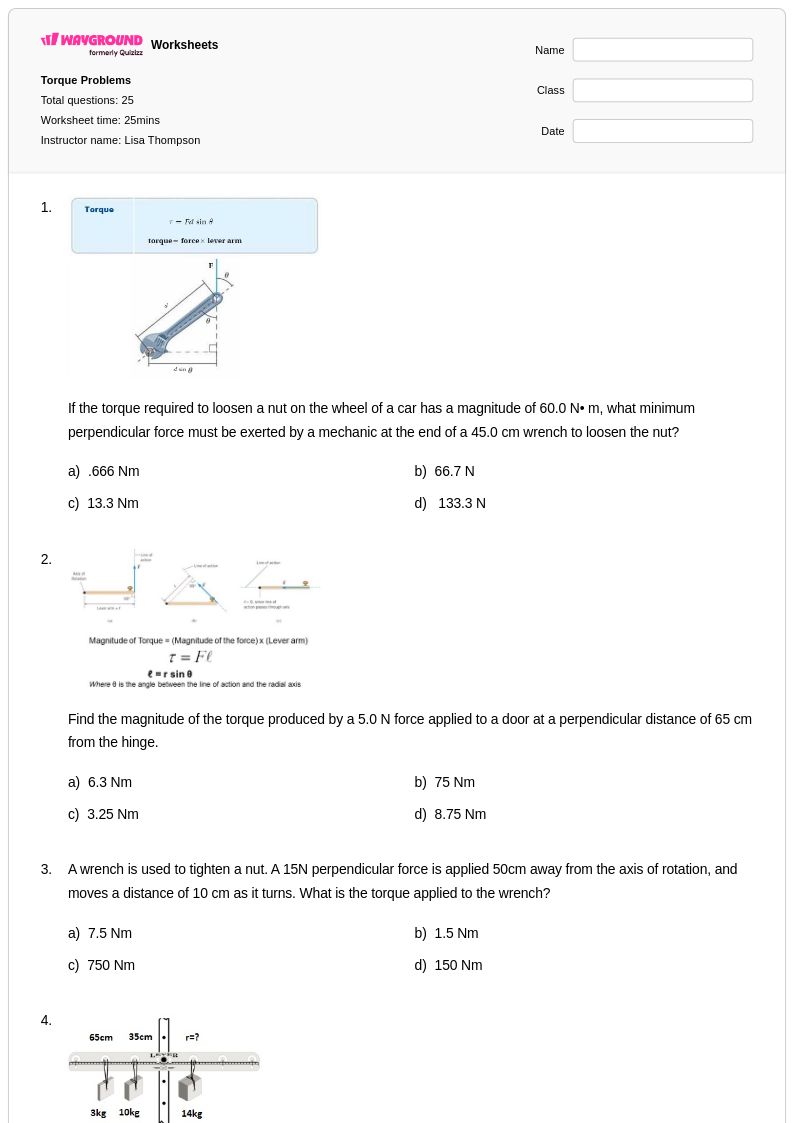
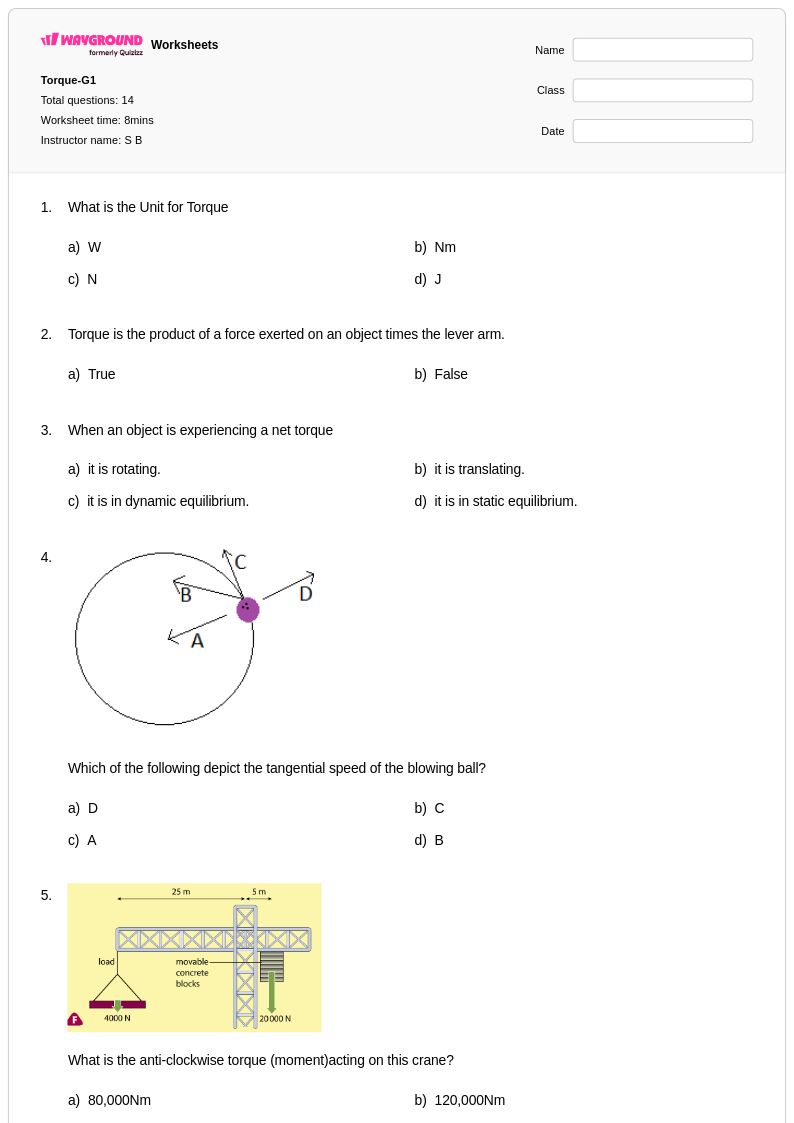
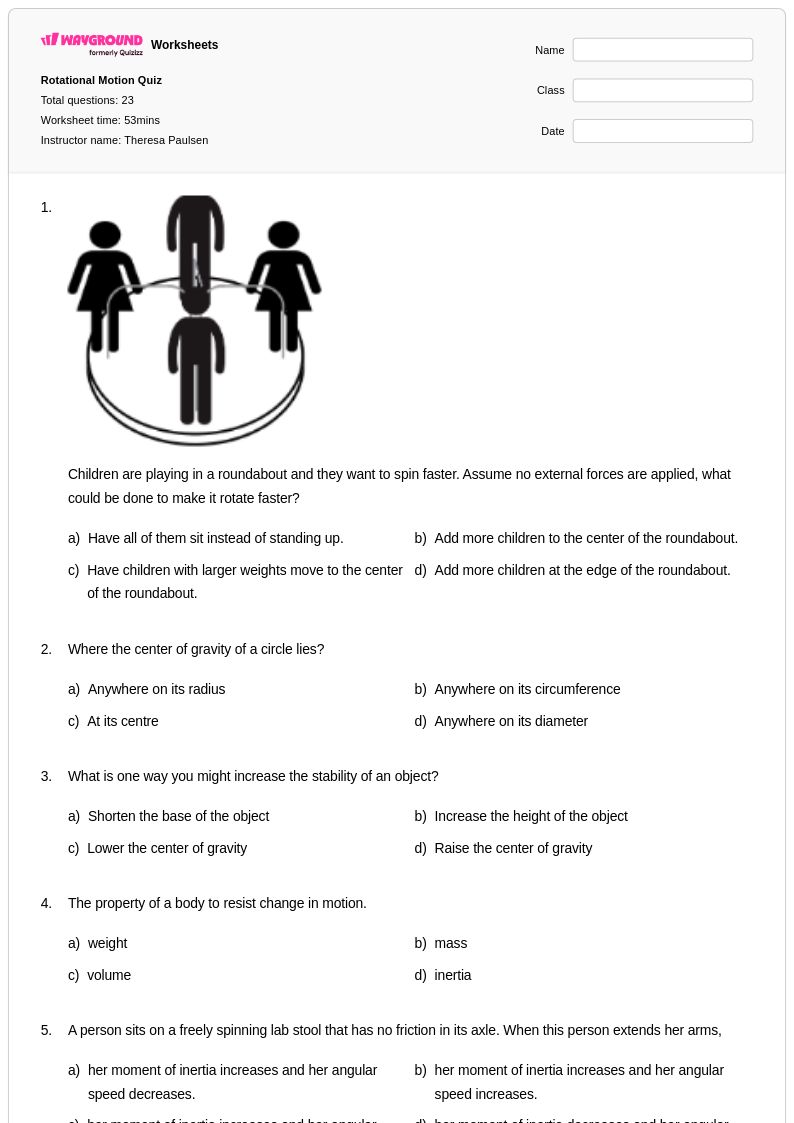
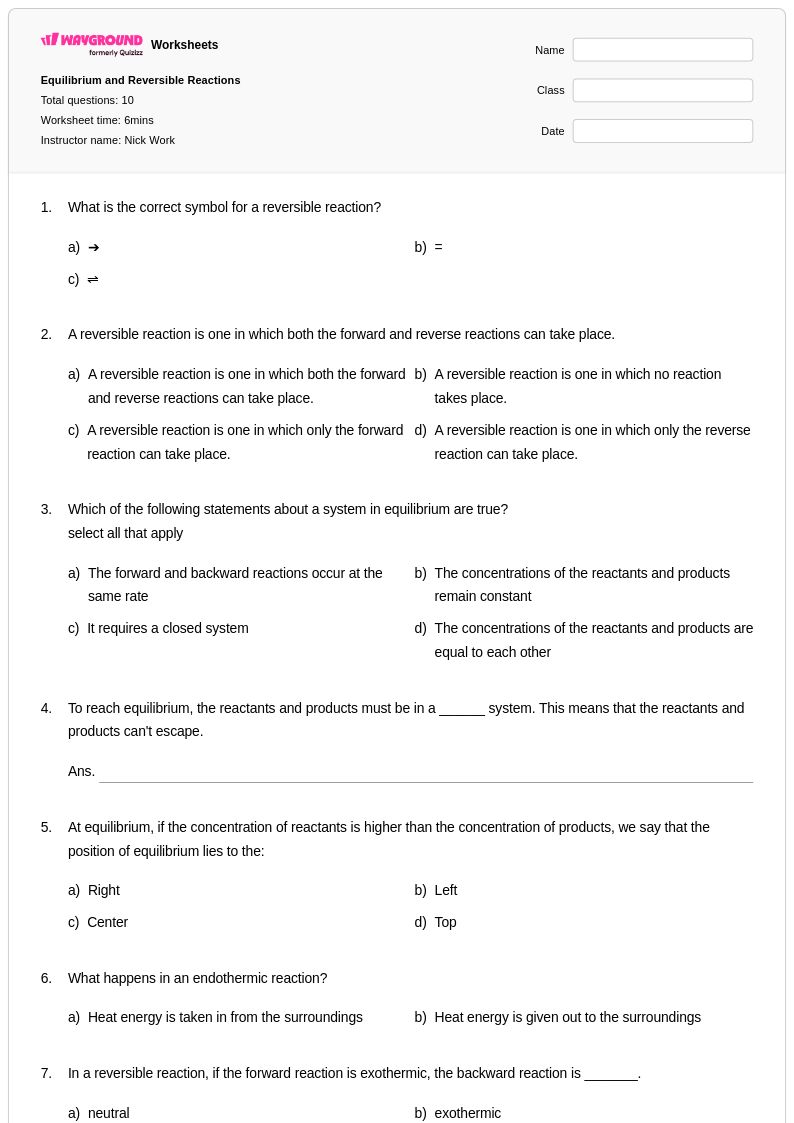
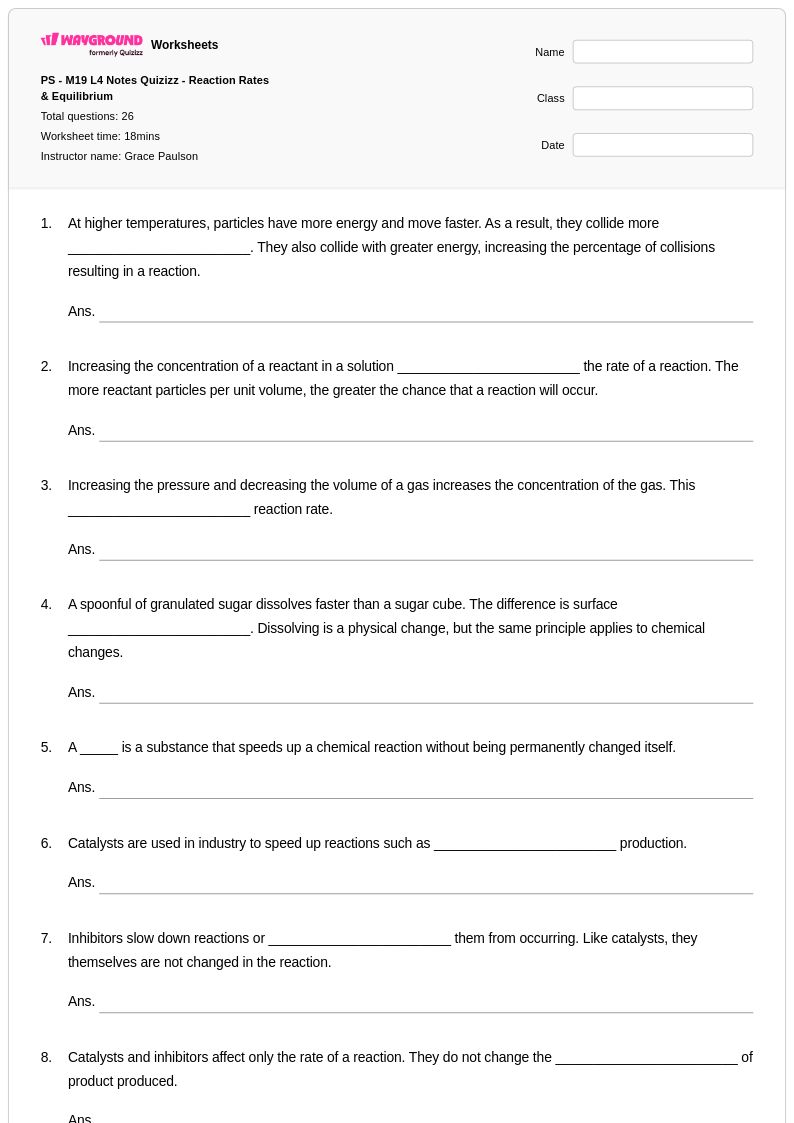
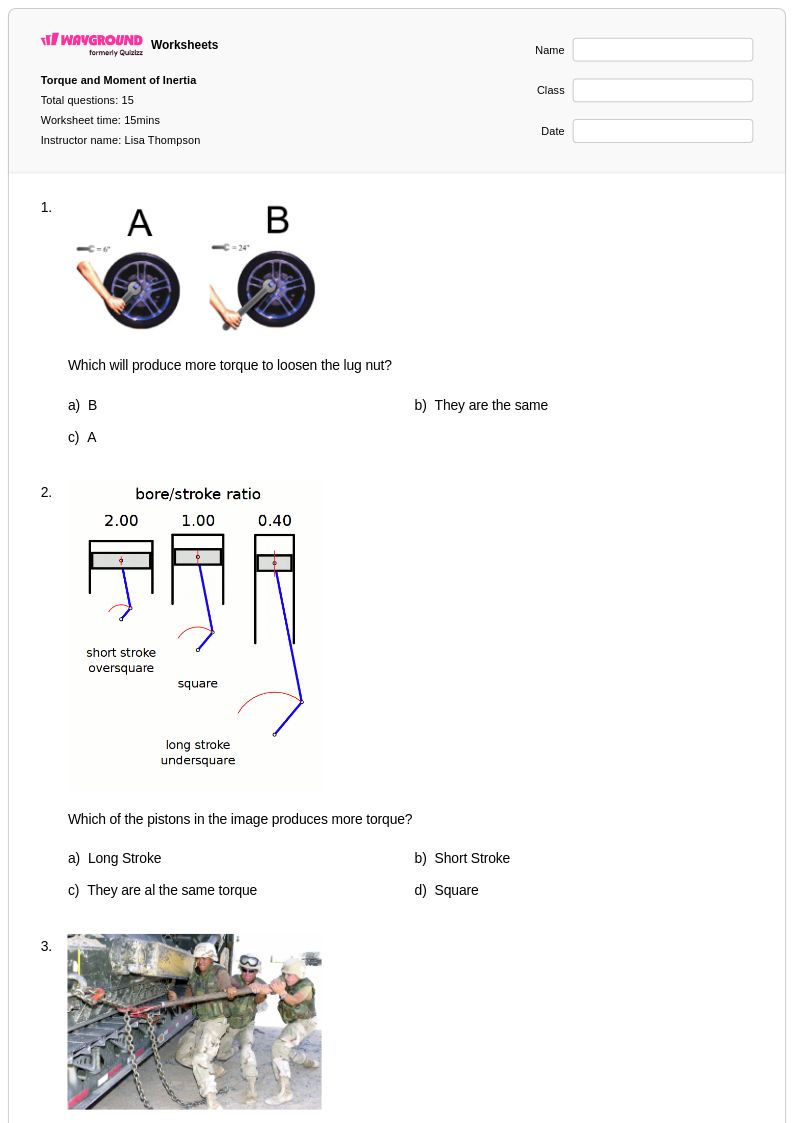
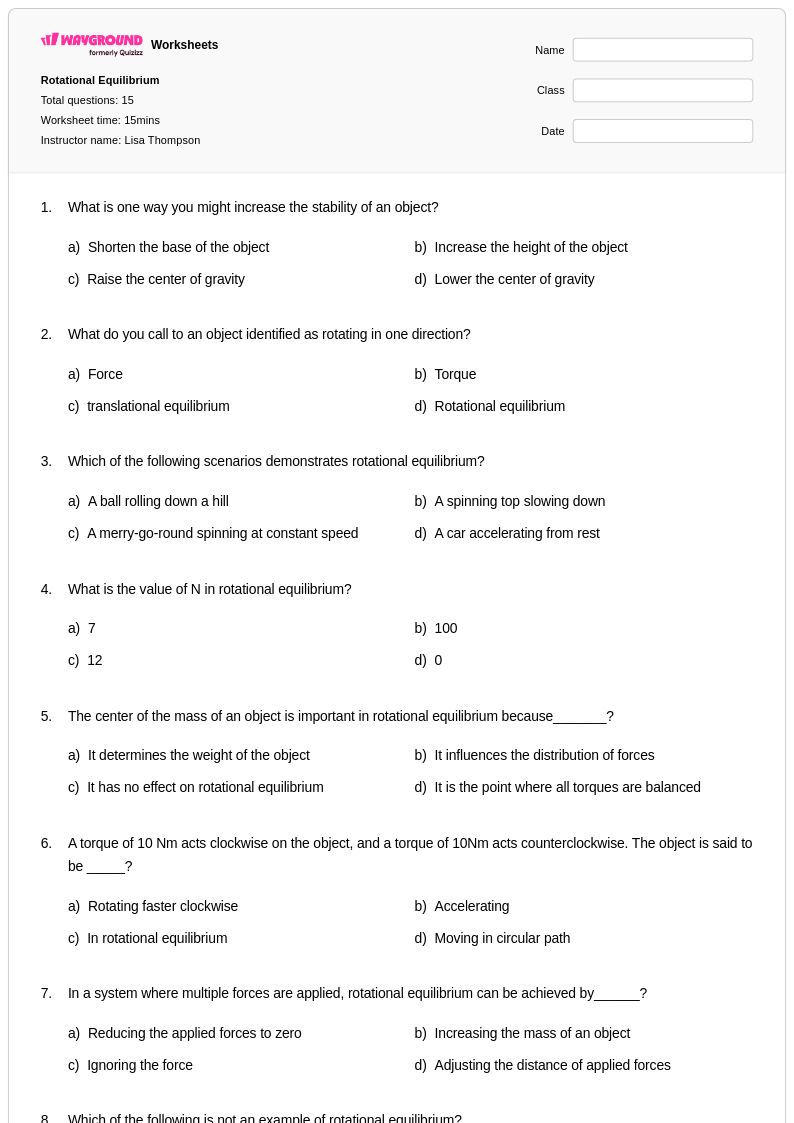
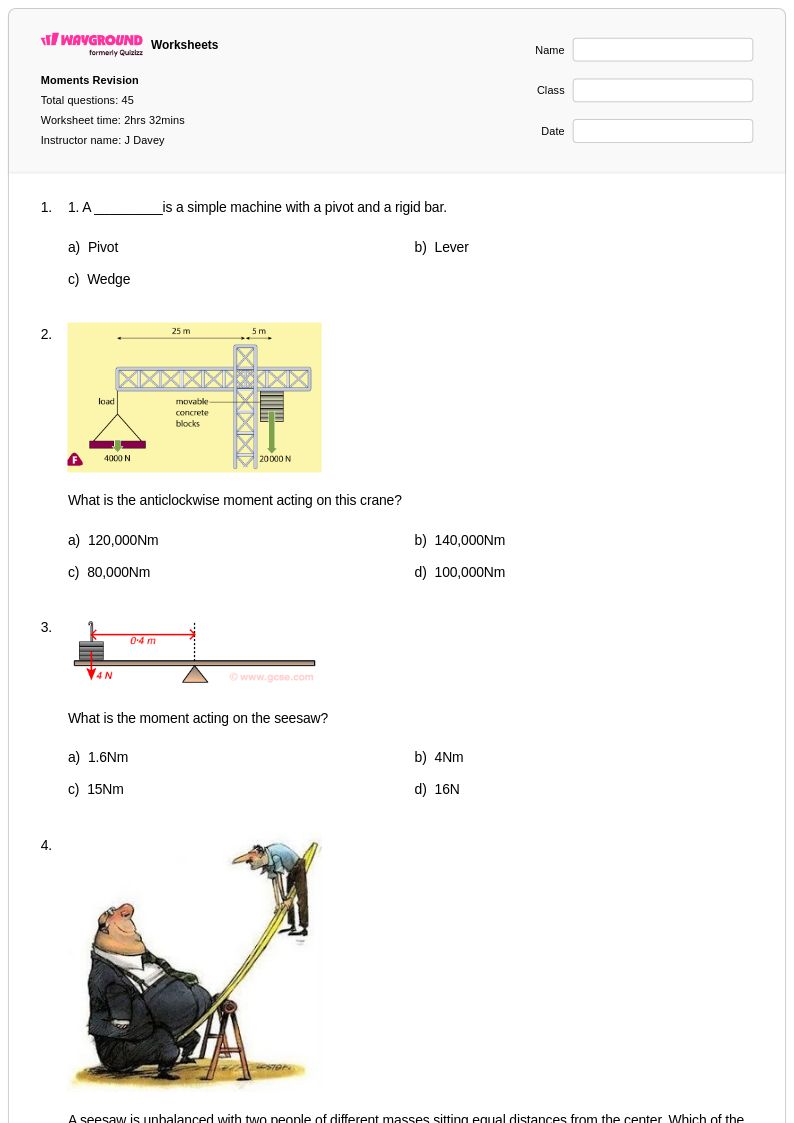
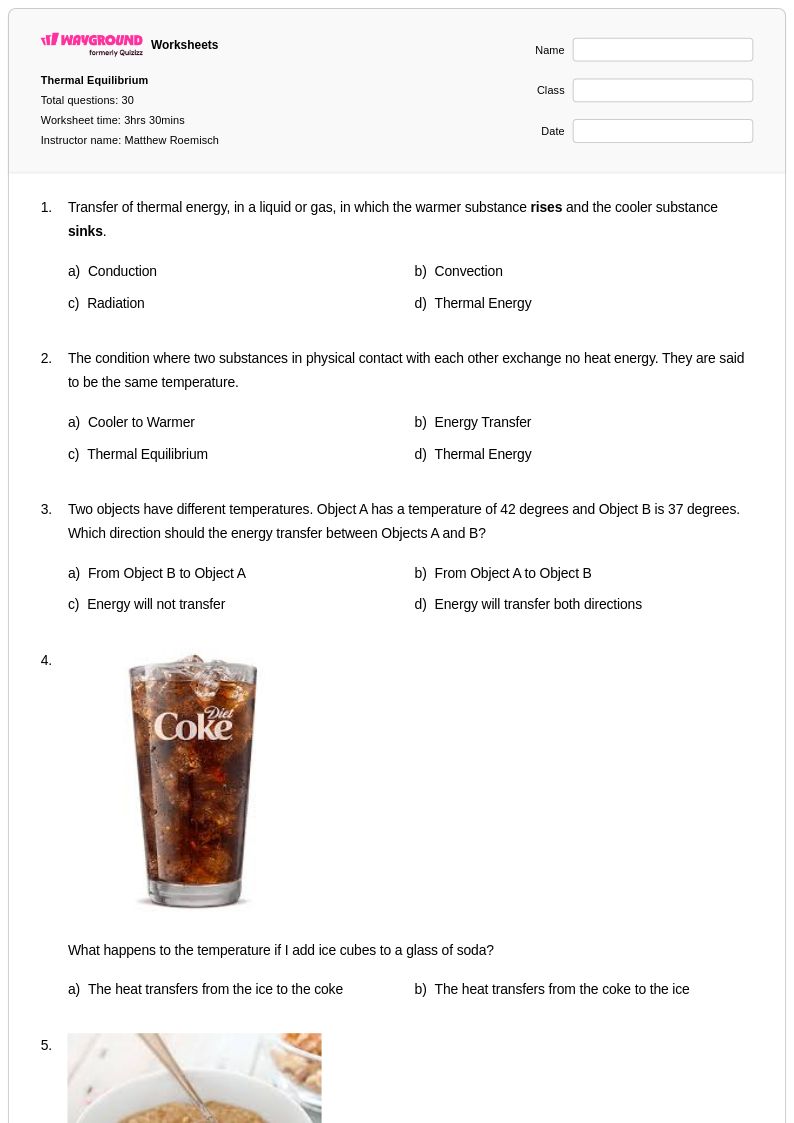
Explore Wayground's comprehensive collection of torque and equilibrium worksheets featuring free printable PDFs with practice problems and answer keys to help students master rotational forces, mechanical equilibrium, and moment calculations in physics.
Explore printable Torque and Equilibrium worksheets
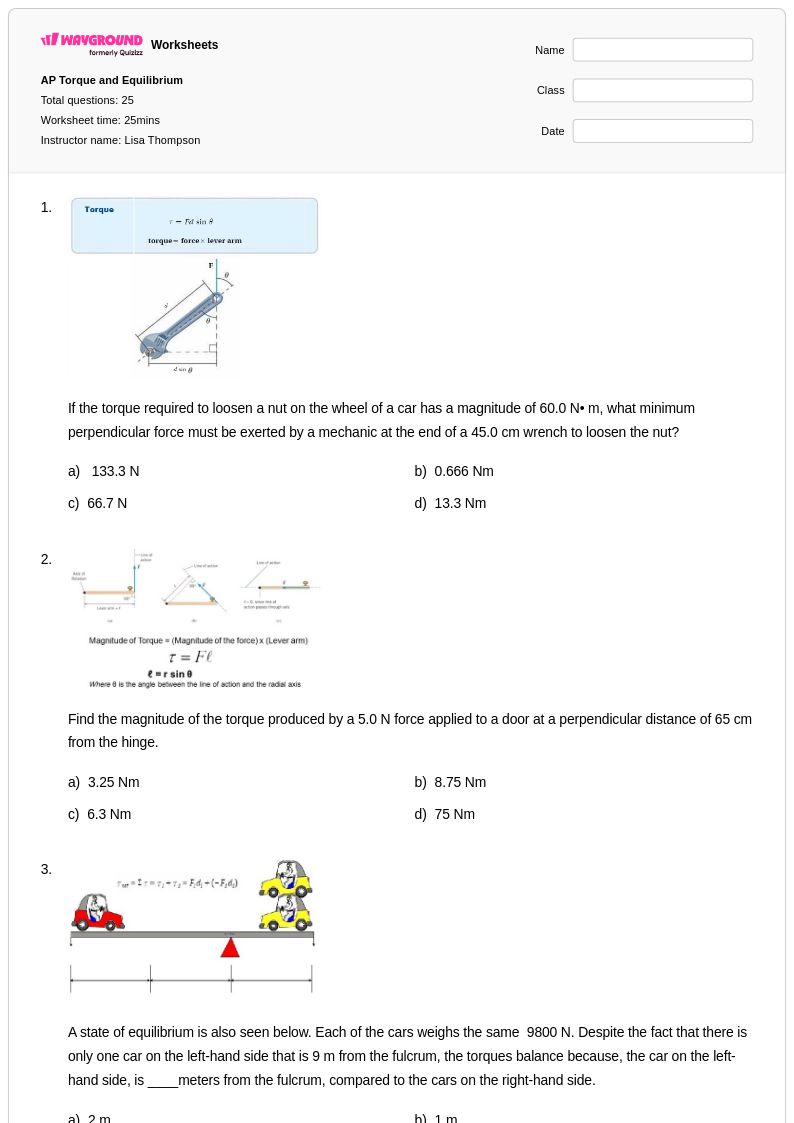
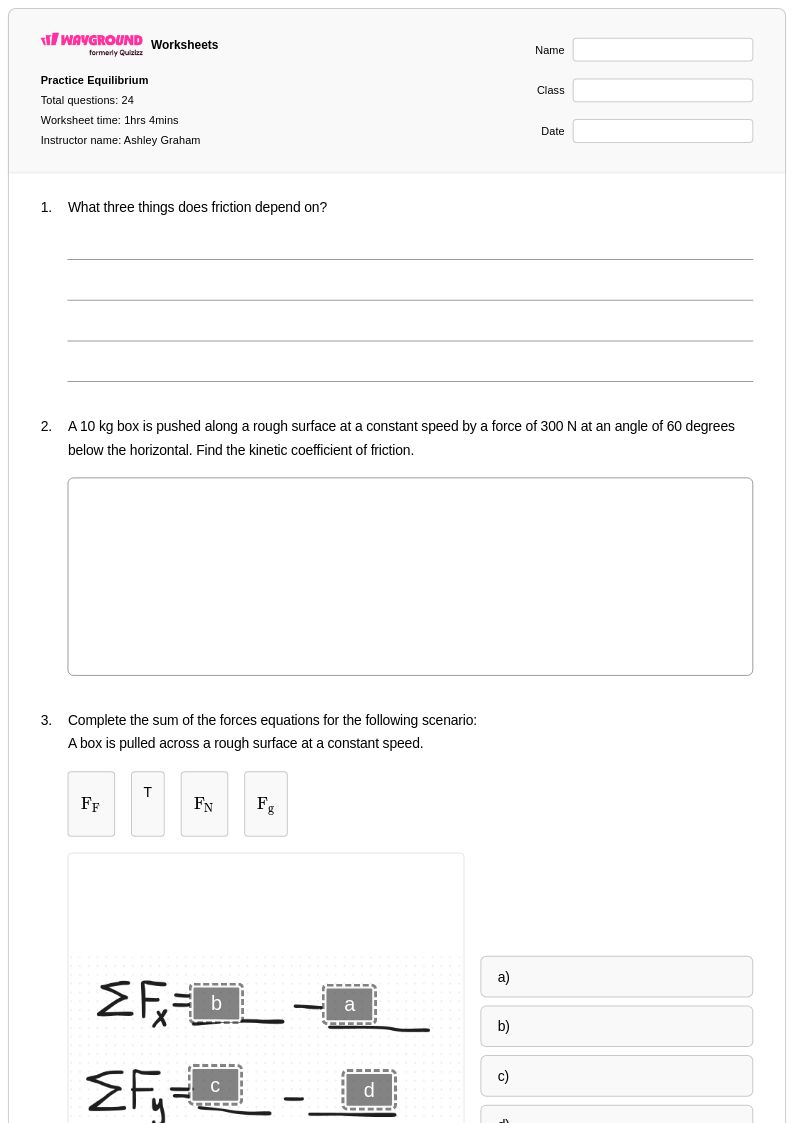
Torque and equilibrium worksheets available through Wayground (formerly Quizizz) provide comprehensive practice in understanding rotational forces and balanced systems, fundamental concepts that bridge introductory mechanics with advanced physics applications. These expertly crafted resources strengthen students' abilities to calculate torque using force and lever arm relationships, analyze static equilibrium conditions, and solve complex problems involving multiple forces acting on rotating objects. The collection includes practice problems that progressively build from basic torque calculations to sophisticated equilibrium scenarios, complete with detailed answer keys that guide students through step-by-step solutions. Each printable pdf worksheet emphasizes conceptual understanding while developing quantitative problem-solving skills essential for mastering rotational dynamics, with free resources covering topics from simple lever systems to multi-force equilibrium analysis.
Wayground's extensive collection draws from millions of teacher-created resources specifically designed to support physics instruction in torque and equilibrium concepts. The platform's robust search and filtering capabilities allow educators to quickly locate materials aligned with specific curriculum standards, whether targeting conceptual introduction or advanced problem-solving applications. Teachers benefit from built-in differentiation tools that enable customization of worksheet difficulty levels, supporting both remediation for struggling students and enrichment opportunities for advanced learners. The flexible format options, including both printable pdf versions and interactive digital worksheets, facilitate seamless integration into diverse classroom environments and instructional approaches. This comprehensive resource system streamlines lesson planning while providing targeted skill practice that helps students develop the analytical thinking required for understanding rotational mechanics and equilibrium principles across various physics contexts.
FAQs
How do I teach torque and equilibrium to physics students?
Start by grounding students in the concept of a lever arm before introducing the torque formula (τ = r × F), since most misconceptions about torque stem from confusion about what distance is being measured. Use physical demonstrations with a meter stick and hanging masses to make rotational force tangible before moving into problem sets. Once students can calculate torque for a single force, progress to static equilibrium by applying the conditions that net force and net torque must both equal zero. Building from concrete examples to multi-force scenarios prevents students from treating equilibrium as a formula to memorize rather than a physical condition to analyze.
What are the most common mistakes students make when solving torque and equilibrium problems?
The most frequent error is students using the full length of a lever arm rather than the perpendicular distance from the pivot to the line of action of the force, which leads to incorrect torque values whenever forces are applied at an angle. Students also commonly forget to assign correct signs to clockwise and counterclockwise torques, causing equilibrium equations to yield nonsensical results. A third persistent mistake is neglecting the weight of the beam or rod itself as a force acting at the object's center of mass when summing torques. Addressing these three error patterns explicitly during instruction prevents them from becoming entrenched habits.
What practice problems best help students master torque calculations?
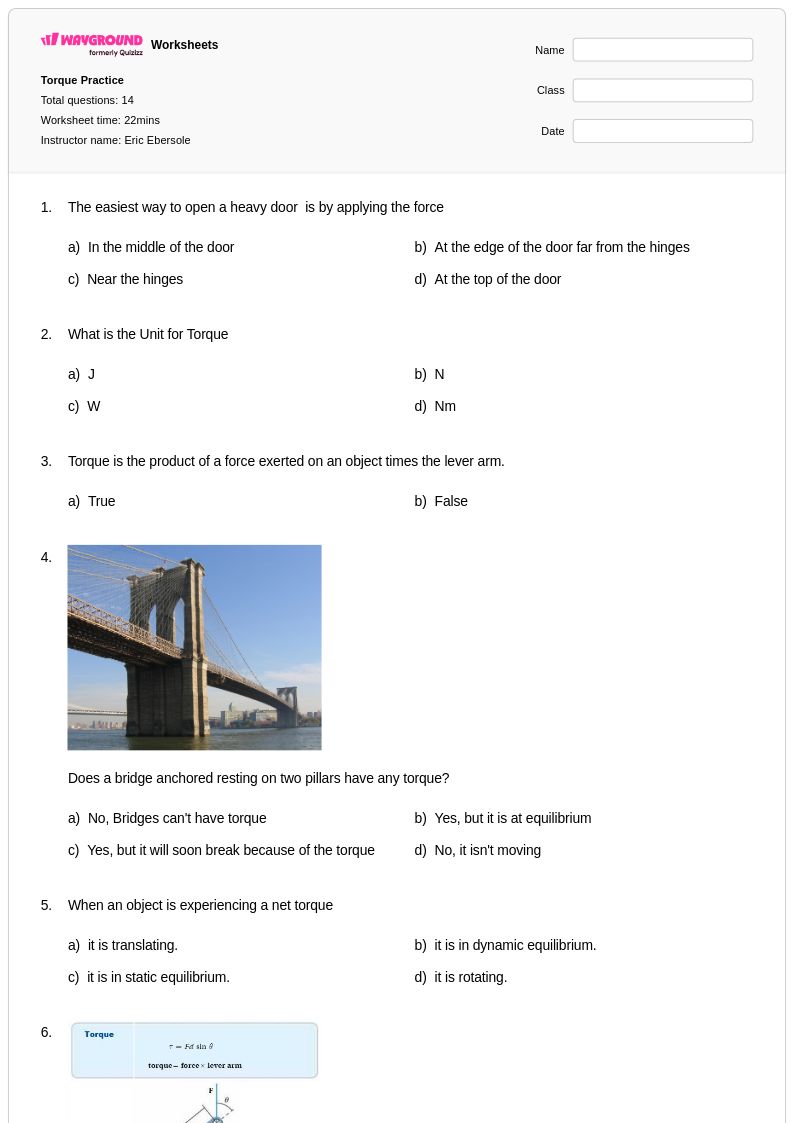
Effective torque practice should follow a progression: begin with single-force problems where the force is perpendicular to the lever arm, then introduce angled forces requiring students to resolve components or use the perpendicular distance. From there, move to two-force balance problems on a uniform beam before advancing to multi-force static equilibrium scenarios that require students to choose a strategic pivot point to simplify their equations. Problems involving seesaws, bridges, and suspended signs are particularly effective because they connect abstract calculations to physically intuitive situations students can reason about qualitatively before solving quantitatively.
How do I differentiate torque and equilibrium instruction for students at different skill levels?
For students still building confidence, restrict initial problems to forces applied perpendicular to the lever arm and provide structured equation templates so cognitive load stays focused on the physics rather than algebraic manipulation. Advanced students benefit from open-ended problems where they must choose their own pivot point, justify that choice, and work with distributed loads or non-uniform beams. On Wayground, teachers can apply accommodations such as reduced answer choices and read-aloud support to individual students without disrupting the rest of the class, and extended time settings can be configured per student directly from the Students or Classes tab.
How can I use Wayground's torque and equilibrium worksheets in my classroom?
Wayground's torque and equilibrium worksheets are available as printable PDFs for traditional classroom use and in digital formats for technology-integrated environments, making them adaptable for in-class practice, homework, or lab follow-up activities. Teachers can also host worksheets as a quiz directly on Wayground, enabling real-time response tracking and immediate feedback for students. All worksheets include complete answer keys, which supports self-paced review and makes it straightforward to use these materials for guided practice, independent work, or test preparation.
How does understanding torque connect to broader physics concepts students will encounter later?
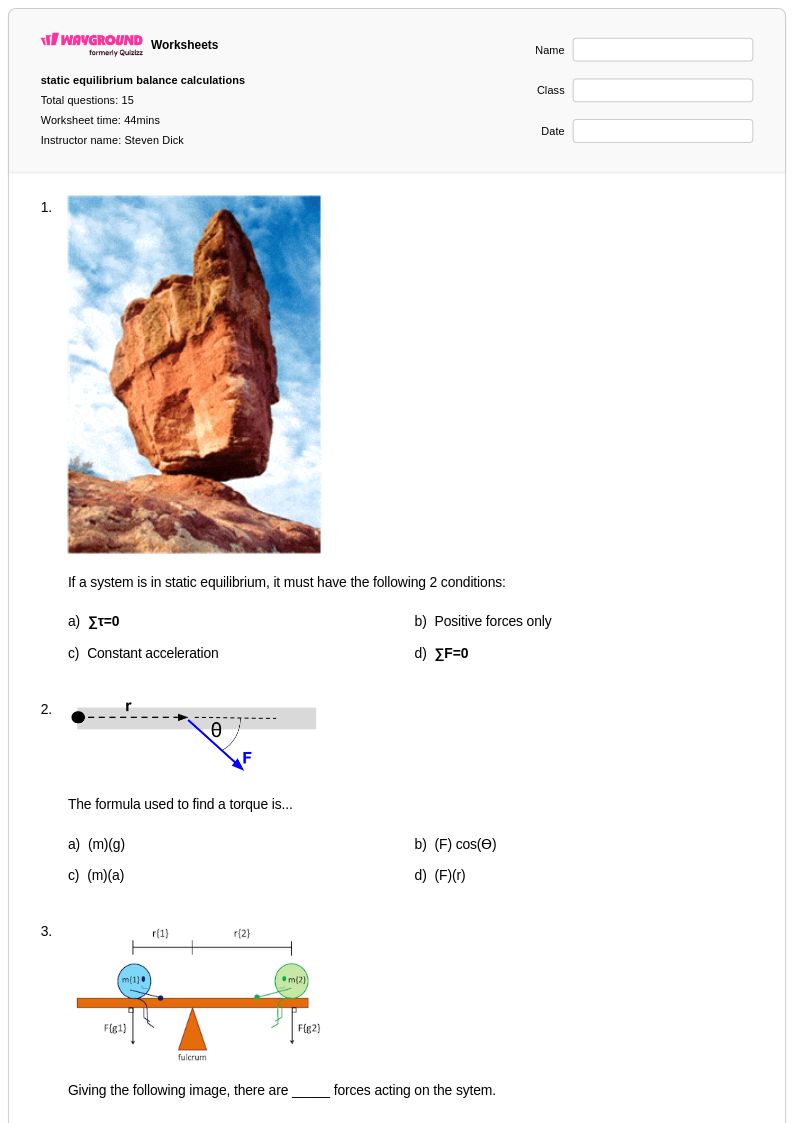
Torque is the rotational analog of force, so mastering it gives students the conceptual framework they need to understand angular momentum, rotational kinetic energy, and moment of inertia in later physics courses. Static equilibrium, built on the conditions that both net force and net torque equal zero, directly underpins structural analysis in engineering and is foundational for understanding how bridges, cranes, and joints in the human body maintain stability under load. Students who genuinely understand torque rather than just memorizing the formula are substantially better prepared for AP Physics and introductory college mechanics courses.