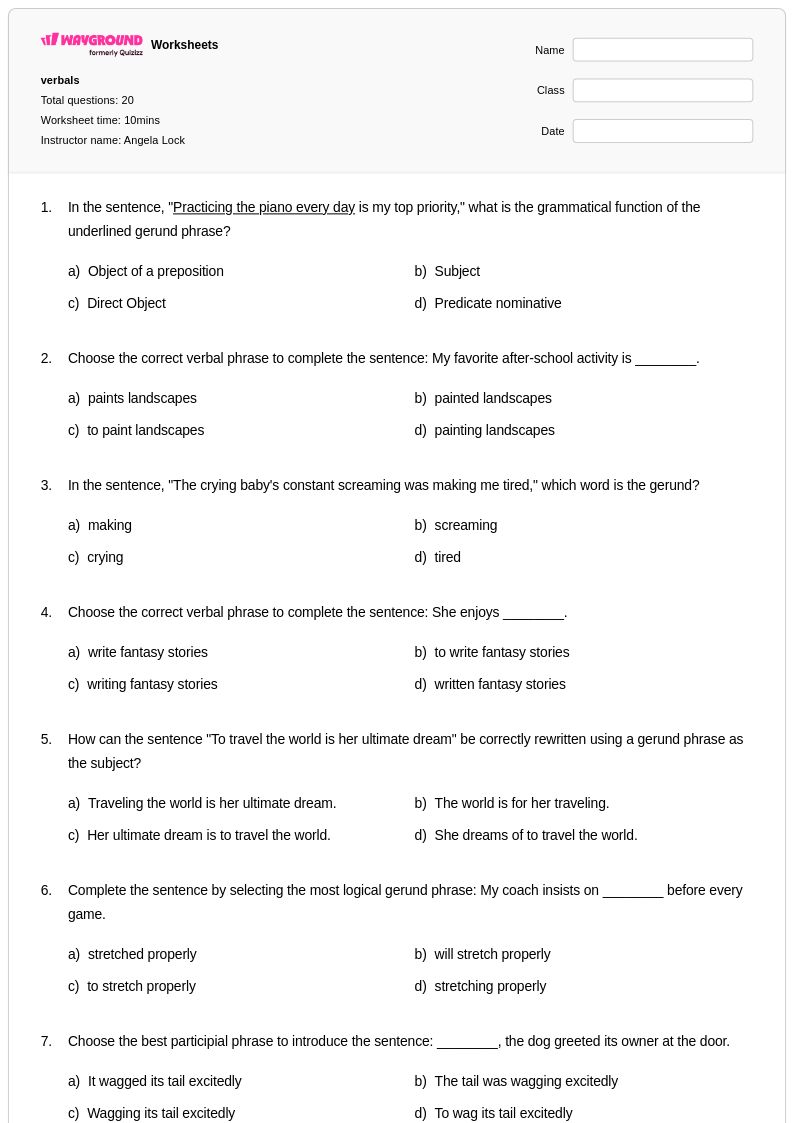
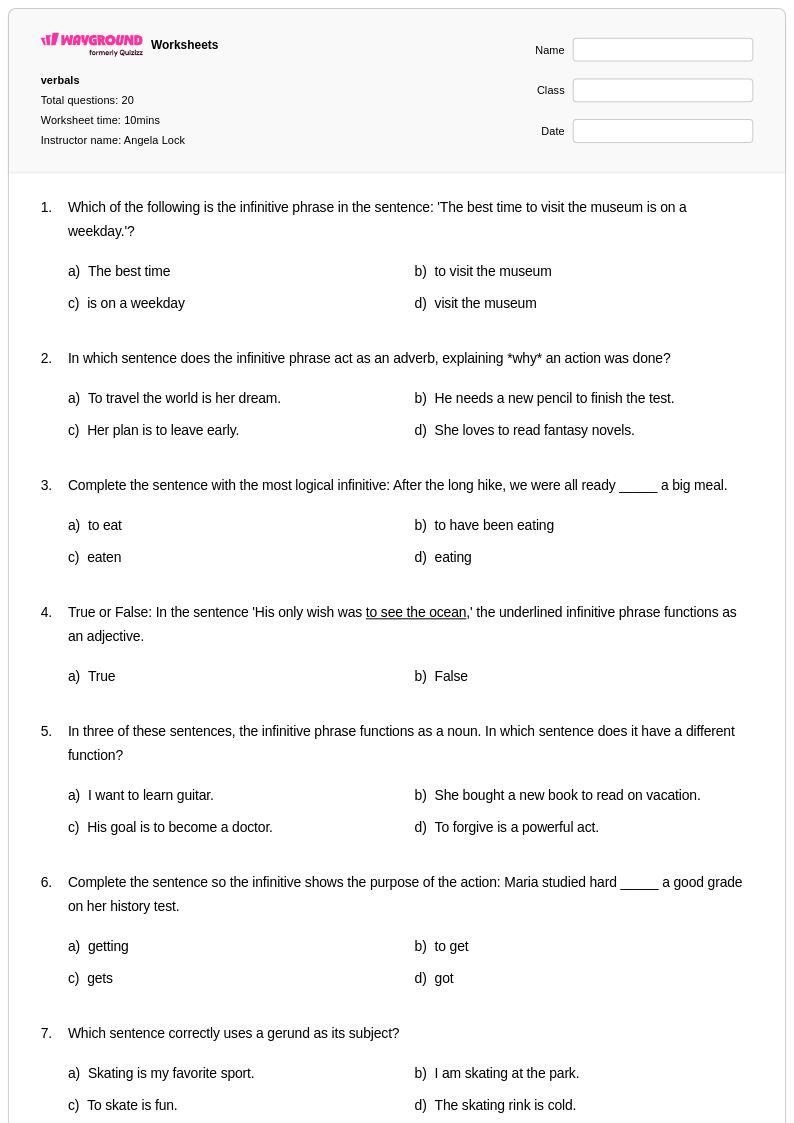
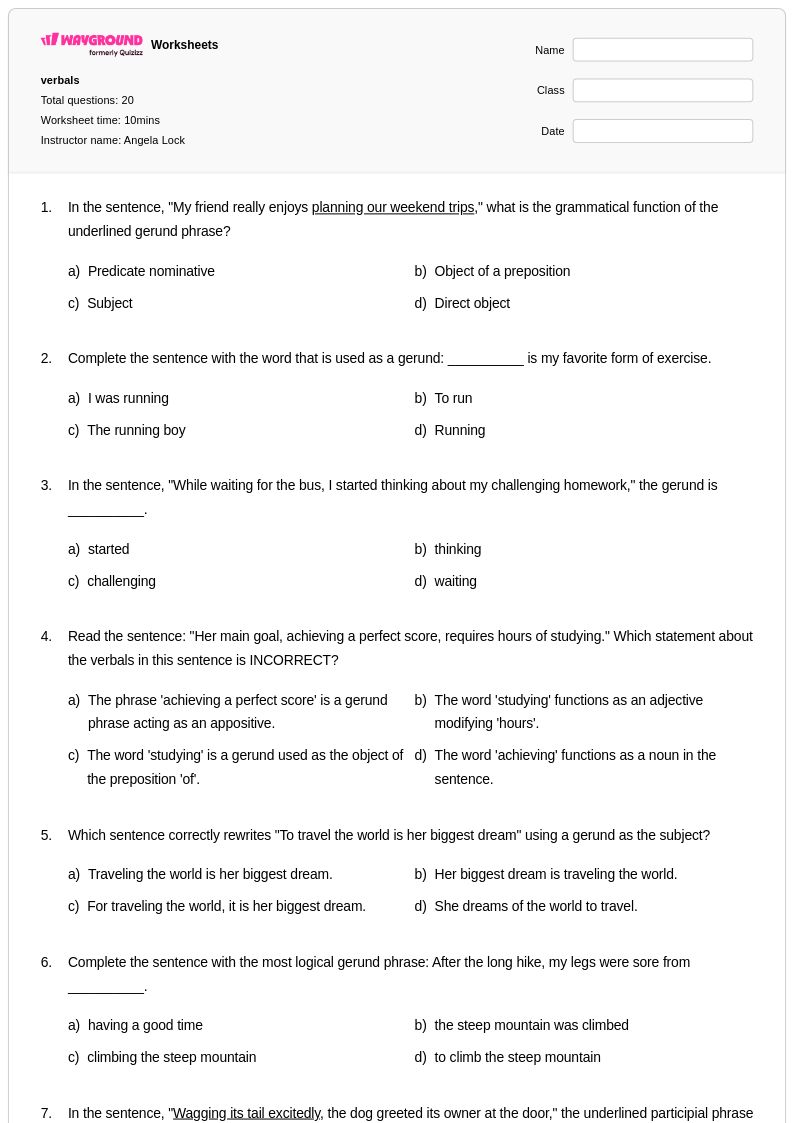
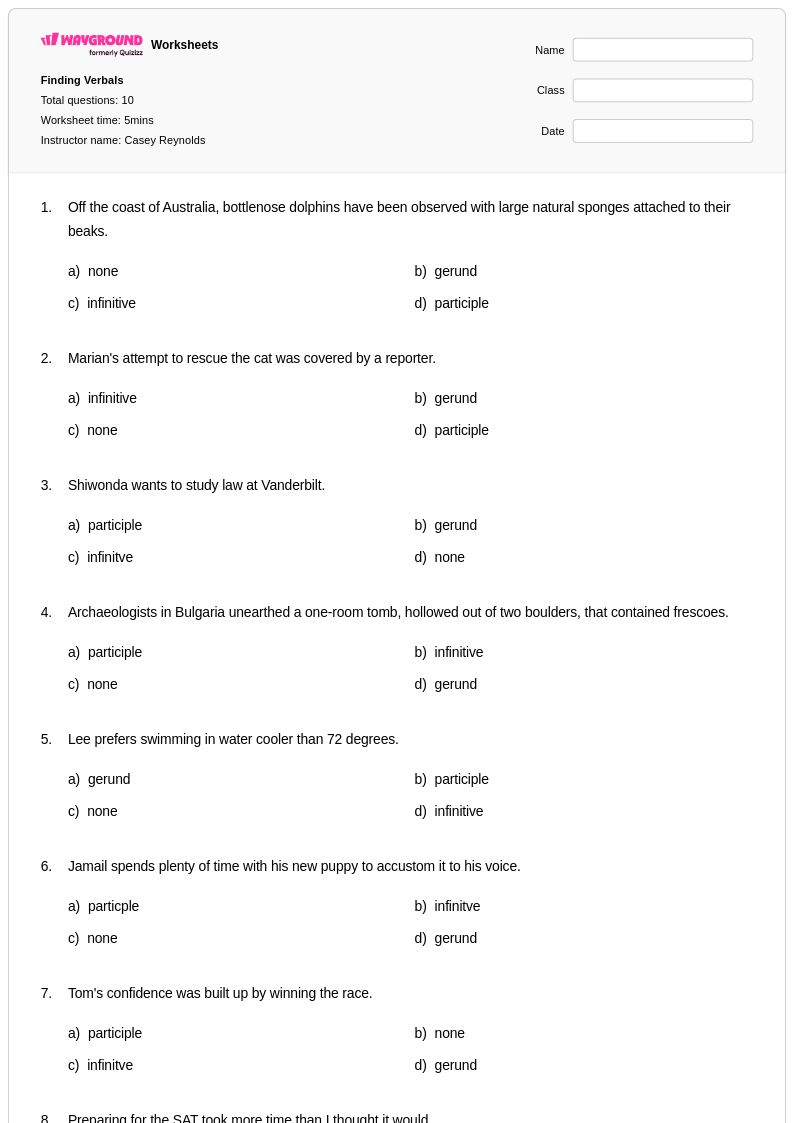
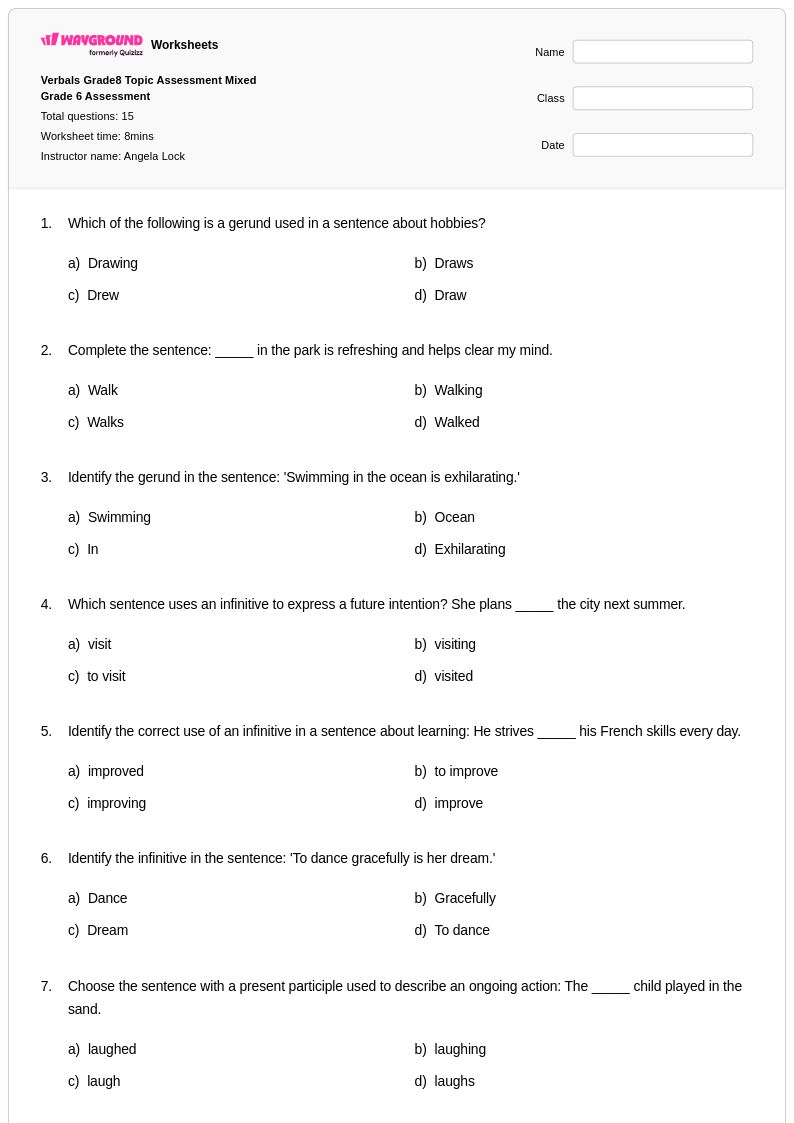
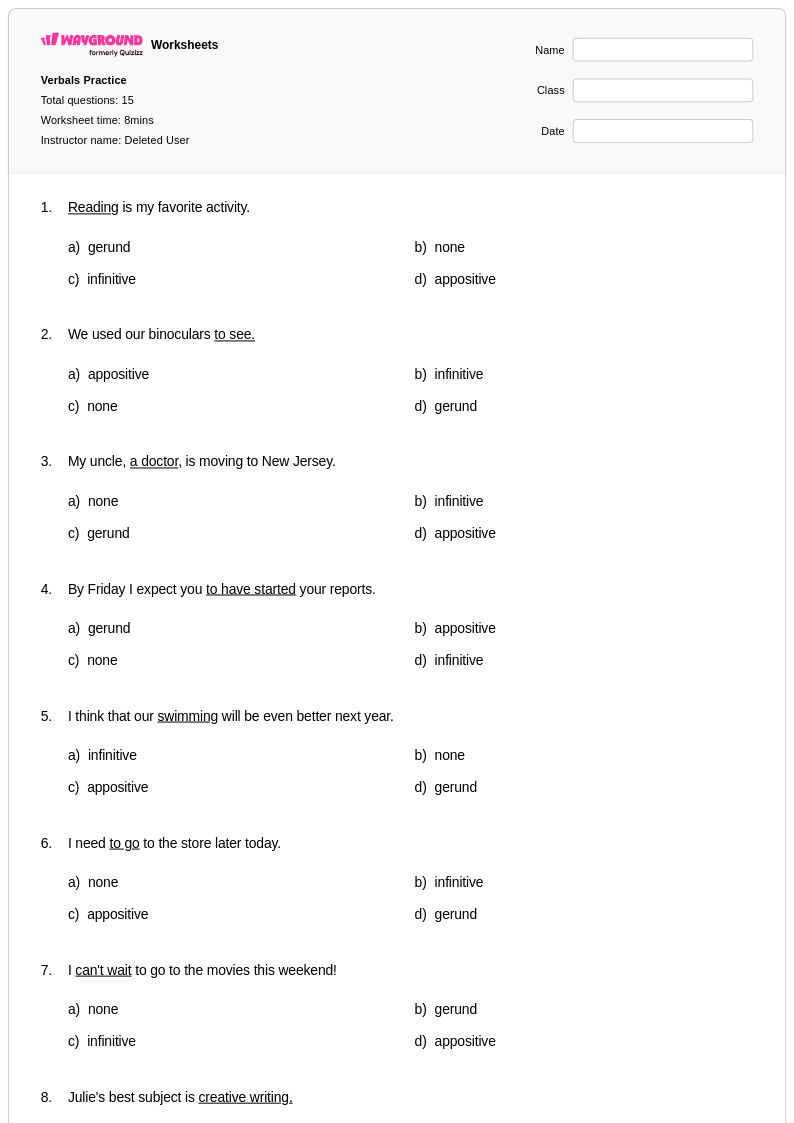
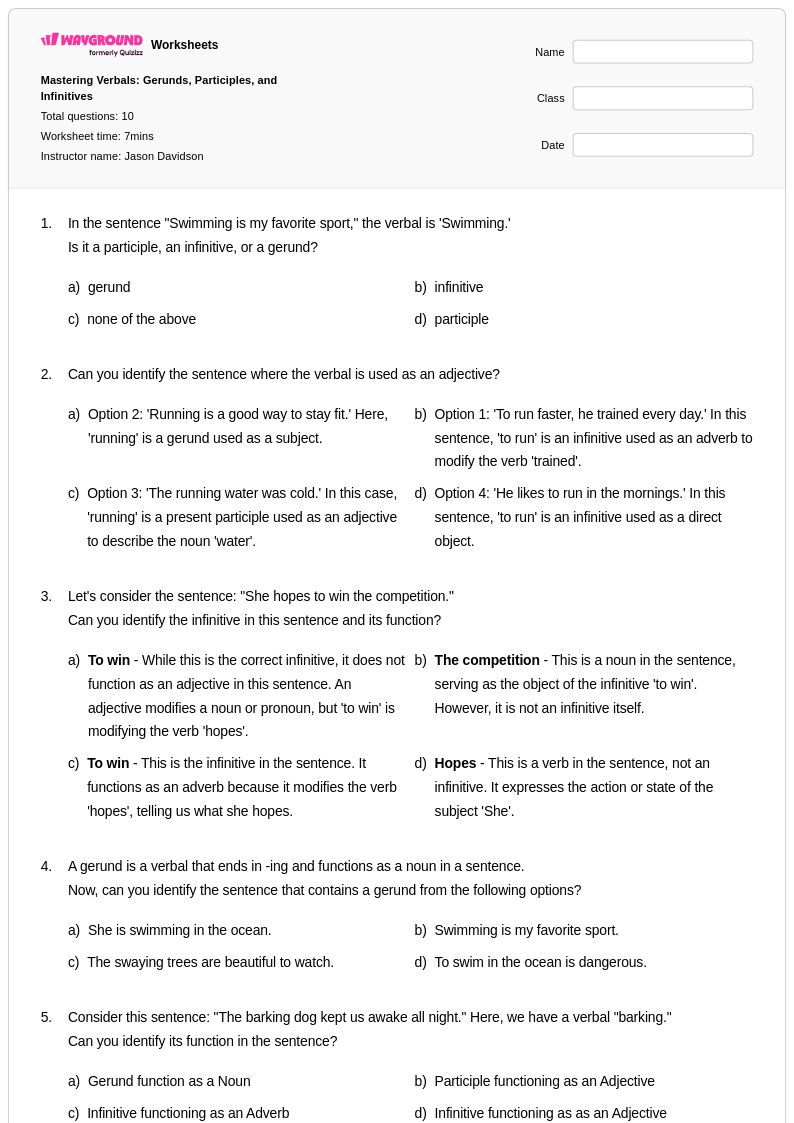
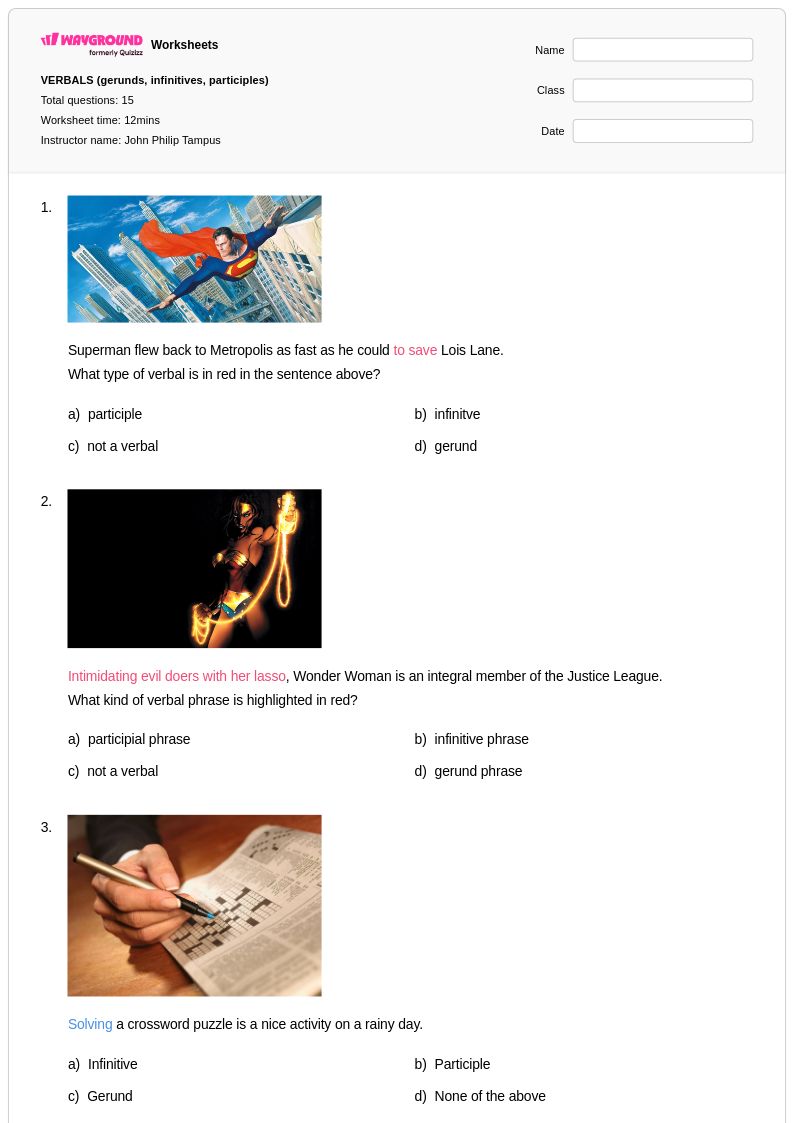
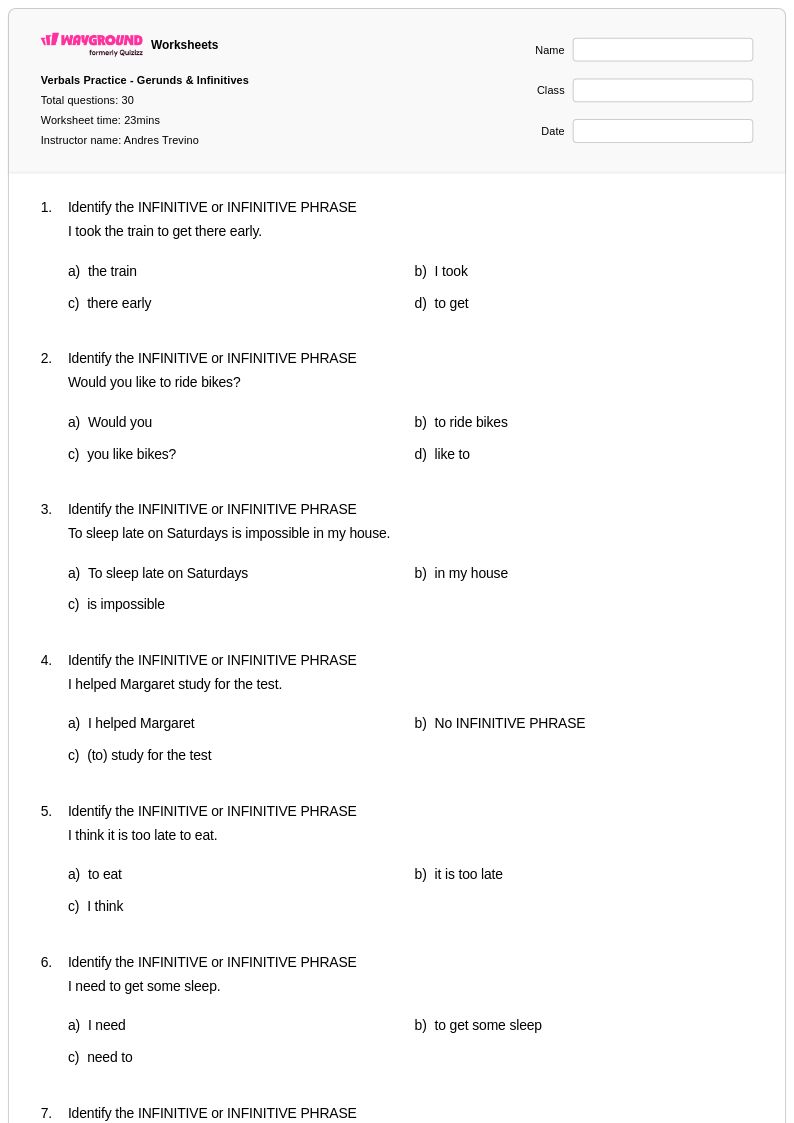
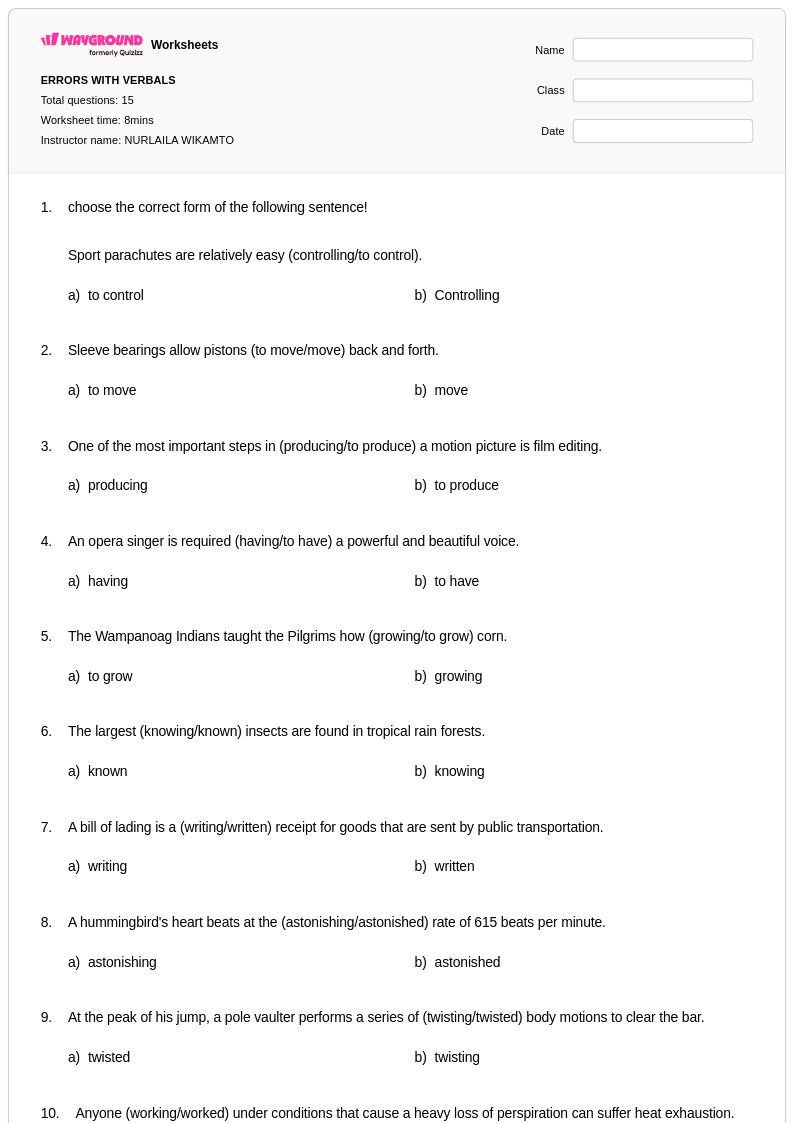
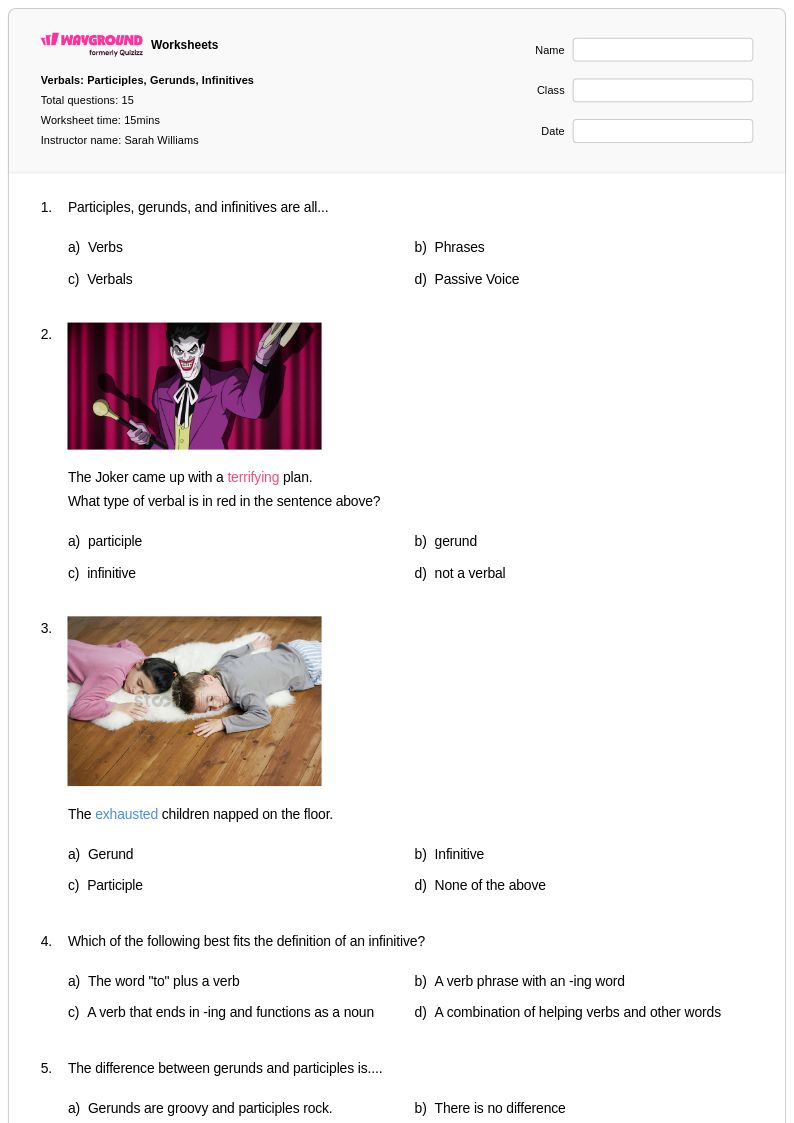
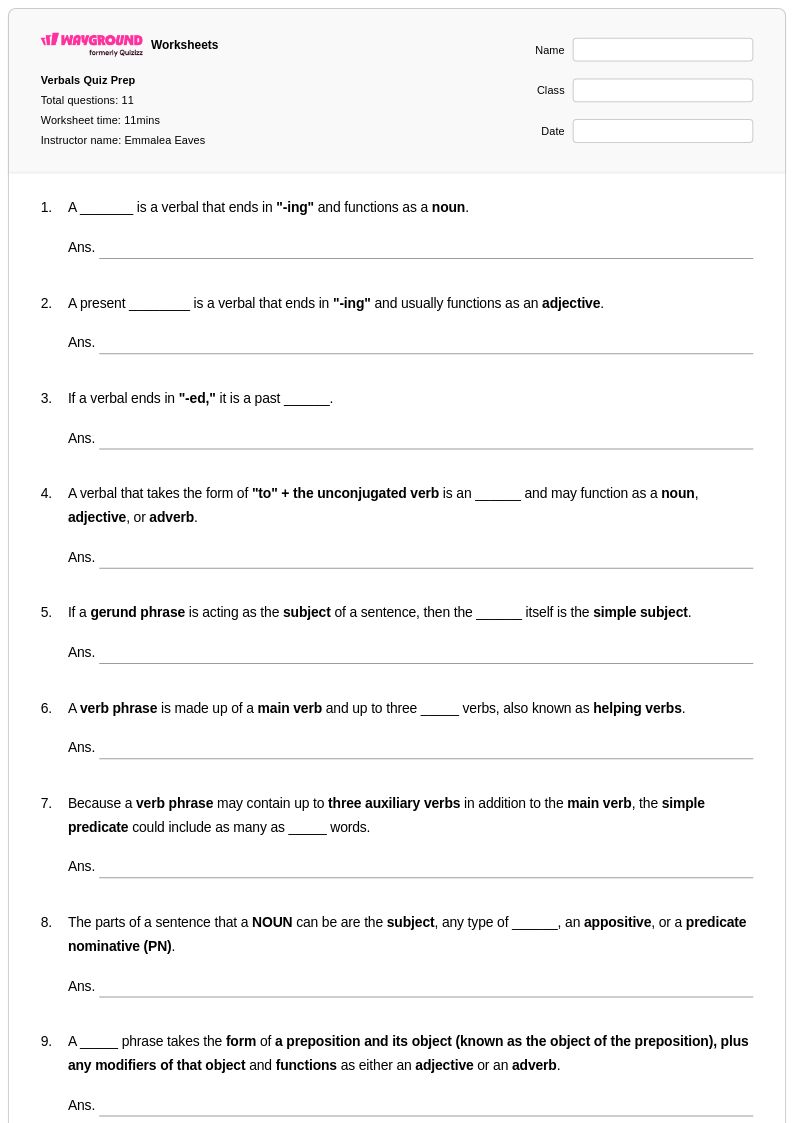
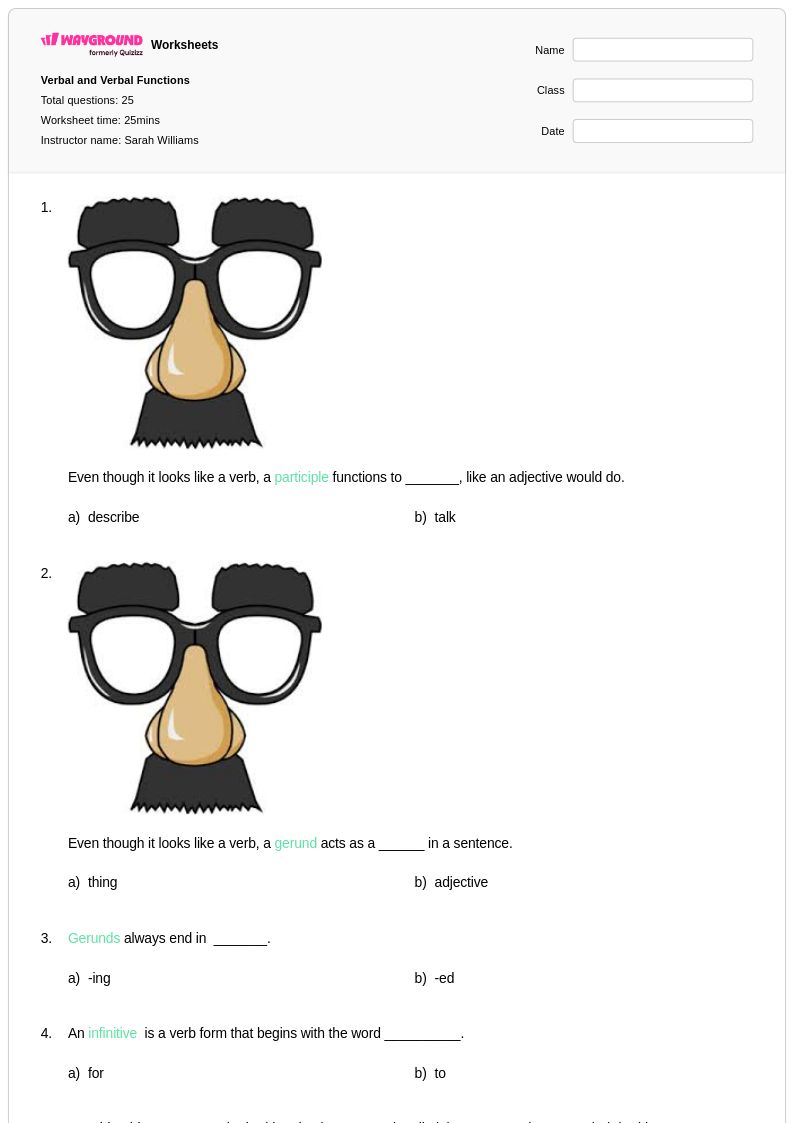
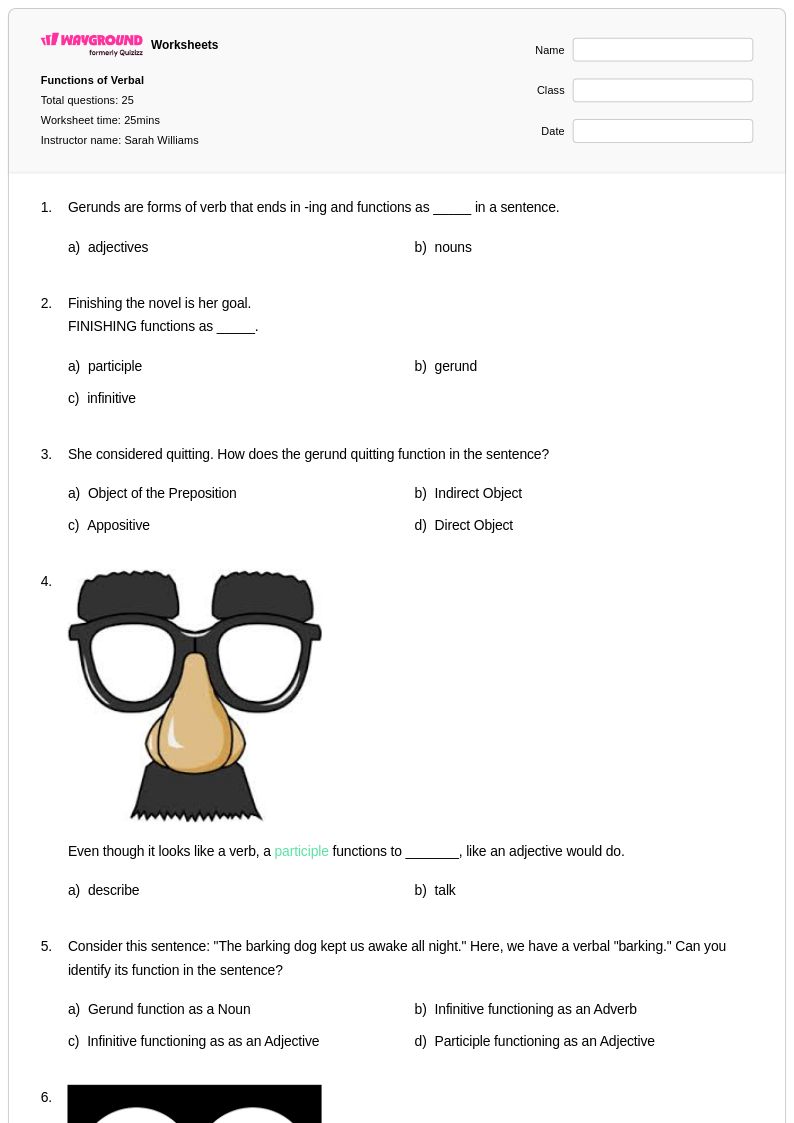
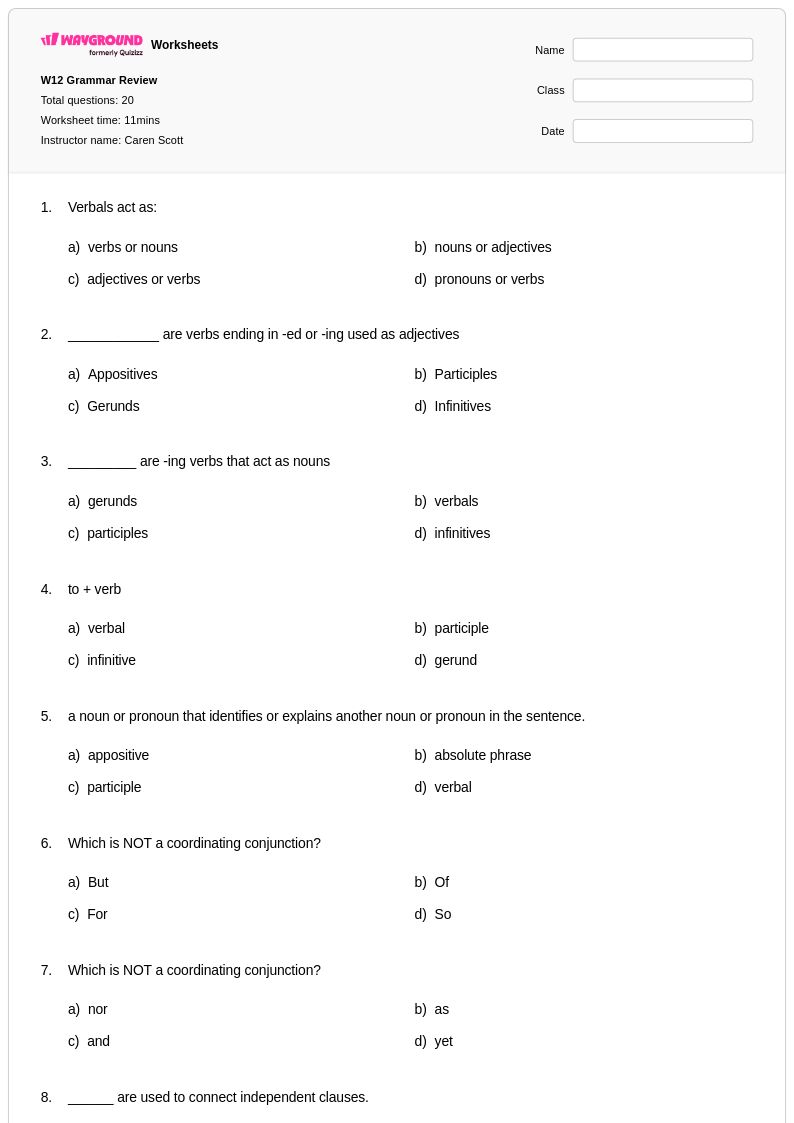
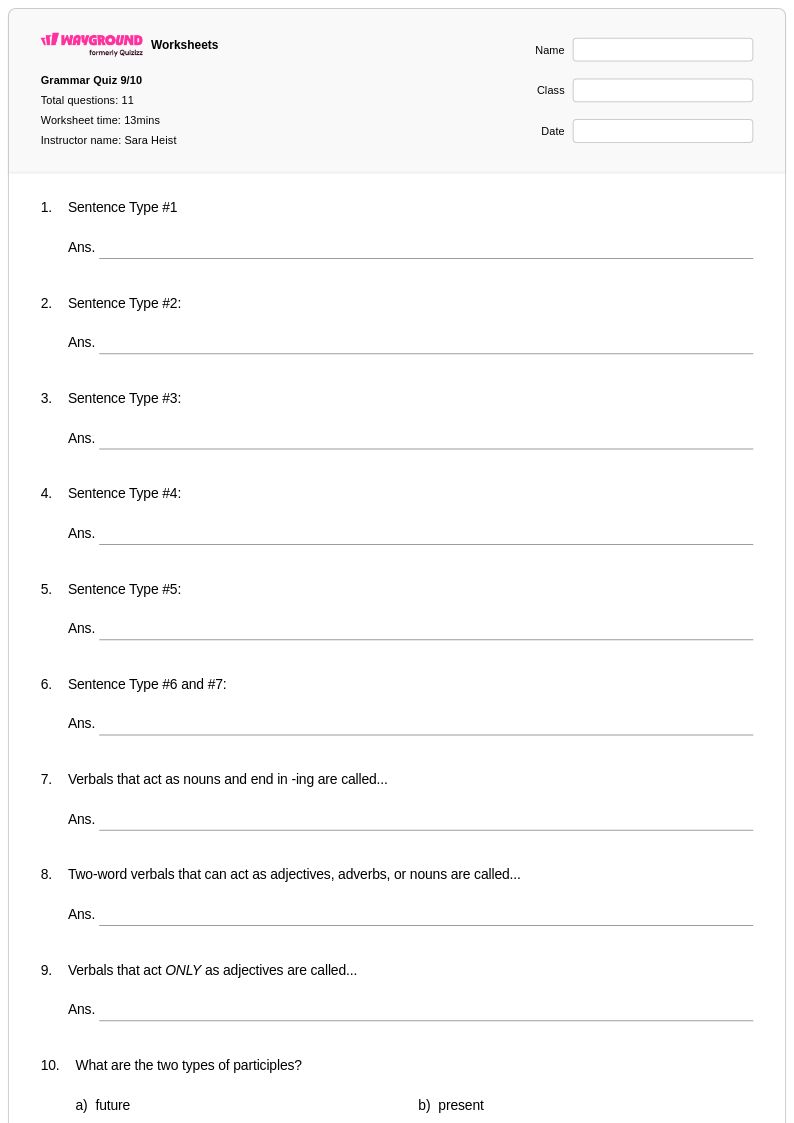
Master Year 12 verbals with Wayground's comprehensive collection of free worksheets and printables, featuring practice problems and answer keys to help students identify and analyze gerunds, participles, and infinitives effectively.
Verbals worksheets for Year 12 students available through Wayground (formerly Quizizz) provide comprehensive practice with these essential hybrid word forms that function as both verbs and other parts of speech. These educational resources focus on the three primary types of verbals: gerunds, participles, and infinitives, helping twelfth-grade students master their identification, proper usage, and grammatical functions within complex sentence structures. The worksheets strengthen critical analytical skills by challenging students to distinguish between verbals and regular verbs, recognize verbal phrases, and understand how these versatile constructions enhance writing sophistication and clarity. Each printable resource includes detailed practice problems with comprehensive answer keys, allowing students to work independently while receiving immediate feedback on their understanding of these advanced grammatical concepts. These free educational materials serve as invaluable tools for reinforcing classroom instruction and preparing students for college-level writing expectations.
Wayground (formerly Quizizz) supports educators with an extensive collection of teacher-created verbals worksheets, drawing from millions of high-quality resources specifically designed for advanced grammar instruction. The platform's robust search and filtering capabilities enable teachers to quickly locate materials aligned with specific curriculum standards and student proficiency levels, while built-in differentiation tools allow for seamless customization based on individual learning needs. These verbals worksheets are available in both digital and printable PDF formats, providing flexibility for various classroom environments and teaching preferences. Teachers can efficiently plan targeted lessons, design remediation activities for struggling students, create enrichment opportunities for advanced learners, and establish consistent skill practice routines that build confidence in identifying and using gerunds, participles, and infinitives effectively in academic writing contexts.
FAQs
How do I teach verbals to middle or high school students?
Start by teaching each verbal type in isolation before combining them. Introduce gerunds first since students already use them naturally in speech (e.g., 'Swimming is fun'), then move to participles as adjectives, and finally infinitives, which can function as nouns, adjectives, or adverbs. Anchor each type with a consistent sentence-level test: gerunds and infinitives pass the noun-slot test, while participles modify nouns and can be swapped for an adjective. Using mentor sentences from literature helps students see verbals in authentic context rather than isolated drills.
What are the three types of verbals and how are they different?
The three types of verbals are gerunds, participles, and infinitives. Gerunds end in -ing and always function as nouns (e.g., 'Running is exhausting'). Participles are verb forms that act as adjectives, appearing as present participles (-ing) or past participles (-ed/-en) modifying nouns (e.g., 'the broken window'). Infinitives are the base form of a verb preceded by 'to' and can function as nouns, adjectives, or adverbs (e.g., 'To succeed takes effort'). The key distinction is grammatical function, not form alone.
What mistakes do students commonly make when identifying verbals?
The most frequent error is confusing a gerund (-ing form used as a noun) with a present participle (-ing form used as an adjective or part of a verb phrase). Students also struggle to distinguish infinitives used as verbs from those functioning as nouns or adjectives. Another common misconception is treating any word ending in -ing as a verbal rather than checking whether it forms part of a progressive verb tense. Teaching students to test grammatical function in the sentence, rather than relying on word form alone, directly addresses these errors.
What exercises help students practice identifying and using verbals?
Effective practice moves from identification to application. Begin with exercises where students label underlined words as gerunds, participles, or infinitives and state their function. Progress to sentence-combining tasks that require students to convert two simple sentences into one using a verbal phrase. Sentence-editing exercises, where students correct dangling or misplaced participle phrases, build both grammar and writing skills simultaneously. Practice that requires students to write original sentences using each verbal type in a specified grammatical role tends to produce the strongest retention.
How do I use Wayground's verbals worksheets in my classroom?
Wayground's verbals worksheets are available as printable PDFs for traditional classroom use and in digital formats for technology-integrated environments, giving you flexibility for in-person, hybrid, or remote instruction. You can also host them as a quiz directly on Wayground, allowing students to complete work online with built-in answer feedback. Each worksheet includes a comprehensive answer key, which supports self-paced review, small-group correction, or whole-class discussion. The collection covers gerunds, participles, and infinitives through structured exercises that range from basic identification to sentence construction, making it straightforward to sequence practice across a unit.
How can I differentiate verbals instruction for students at different skill levels?
For students who are still building foundational grammar knowledge, focus first on gerunds using high-frequency verbs and short sentences before introducing participial phrases or infinitive clauses. More advanced students benefit from analyzing verbals in complex literary sentences and writing tasks that require deliberate use of all three types. On Wayground, teachers can apply individual accommodations such as reduced answer choices to lower cognitive load for struggling learners, or enable Read Aloud support for students who need audio access to questions, while other students work with default settings.