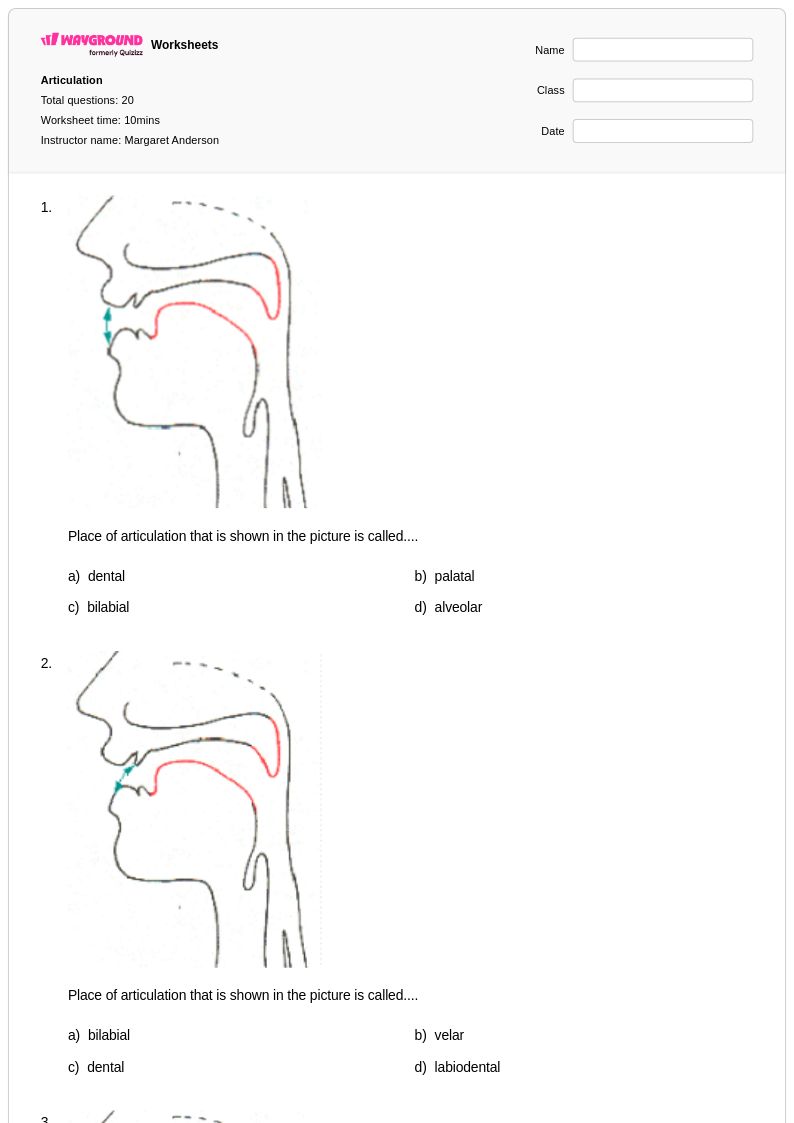
Enhance students' speech clarity and pronunciation skills with Wayground's comprehensive collection of articulation worksheets, featuring free printables, practice problems, and answer keys to support phonics development.
Articulation worksheets available through Wayground (formerly Quizizz) provide comprehensive practice opportunities for students to develop precise speech sound production and phonemic awareness skills. These expertly designed resources target the fundamental mechanics of how sounds are formed using the articulators - the tongue, lips, teeth, and vocal cords - while building essential phonics foundations. Students engage with systematic practice problems that progress from isolated sound production to contextual application, strengthening their ability to distinguish between similar sounds and develop clear, accurate pronunciation patterns. Each worksheet collection includes detailed answer keys and free printable pdf formats, making it simple for educators to implement structured articulation practice that supports both remedial intervention and skill reinforcement across diverse learning environments.
Wayground's extensive collection draws from millions of teacher-created resources specifically designed to address articulation challenges within phonics instruction, offering robust search and filtering capabilities that allow educators to locate materials perfectly matched to their students' developmental needs. The platform's differentiation tools enable teachers to customize worksheets for various skill levels, while standards alignment ensures that articulation practice connects meaningfully to broader literacy objectives. Available in both printable and digital pdf formats, these resources support flexible implementation whether used for whole-class instruction, small group intervention, or individual practice sessions. Teachers can efficiently plan targeted remediation for students struggling with specific sounds, provide enrichment opportunities for advanced learners, and maintain consistent skill practice that builds the phonological processing abilities essential for reading and spelling success.
FAQs
How do I teach articulation skills in the classroom?
Effective articulation instruction begins with isolating individual speech sounds before progressing to blends, words, and connected speech. Teachers typically model correct tongue, lip, and teeth placement for each target sound, then guide students through repetitive practice in a structured sequence. Incorporating visual cues, mirrors for self-monitoring, and minimal pair exercises helps students distinguish between similar sounds and internalize accurate pronunciation patterns.
What exercises help students practice articulation?
Articulation practice is most effective when it moves systematically from isolated sound production to syllables, then words, phrases, and sentences. Minimal pair drills, sound sorting activities, and repetition exercises targeting specific phonemes build the muscle memory and phonemic awareness students need for clear speech. Worksheets that scaffold this progression give students structured, repeatable practice they can work through independently or with teacher guidance.
What mistakes do students commonly make when learning articulation?
One of the most common errors is substituting an easier sound for a harder one, such as replacing /r/ with /w/ or /th/ with /f/ or /d/. Students also frequently omit sounds in blends or final positions of words, which can persist as habitual patterns if not corrected early. Misidentifying where sounds are formed in the mouth is another frequent issue, making explicit instruction on articulator placement essential for remediation.
How can I differentiate articulation practice for students at different skill levels?
Differentiation in articulation instruction means targeting specific sounds for students who need remedial support while providing more complex phonemic tasks for students who are ready to advance. On Wayground, teachers can apply accommodations such as Read Aloud support and reduced answer choices for students who need additional scaffolding, while other students receive standard practice without any changes being visible to them. These settings can be configured per student and reused across future sessions, making it practical to maintain individualized practice routines within a whole-class structure.
How do I use Wayground's articulation worksheets in my classroom?
Wayground's articulation worksheets are available as printable PDFs for traditional classroom and intervention settings, as well as in digital formats for technology-integrated learning environments, including the option to host them as a quiz directly on Wayground. Teachers can use them for whole-class phonics instruction, small group pull-out sessions, or individual remediation targeting a student's specific error sounds. Each worksheet includes an answer key, so scoring and feedback can be handled efficiently without additional preparation.
How do articulation worksheets support phonics and reading development?
Articulation and phonics are closely linked because accurate speech sound production supports a student's ability to segment, blend, and map sounds to letters in reading and spelling. When students can reliably produce and distinguish phonemes, phonological processing tasks such as decoding and encoding become more accessible. Structured articulation practice reinforces the sound-symbol connections that underpin early literacy, making it a meaningful complement to broader reading instruction.