
Free Printable Collision Theory Worksheets for Class 12
Enhance Class 12 students' understanding of collision theory with Wayground's comprehensive collection of free chemistry worksheets, featuring printable PDFs, practice problems, and detailed answer keys to master molecular interactions and reaction rates.
Keep exploring
Explore printable Collision Theory worksheets for Class 12
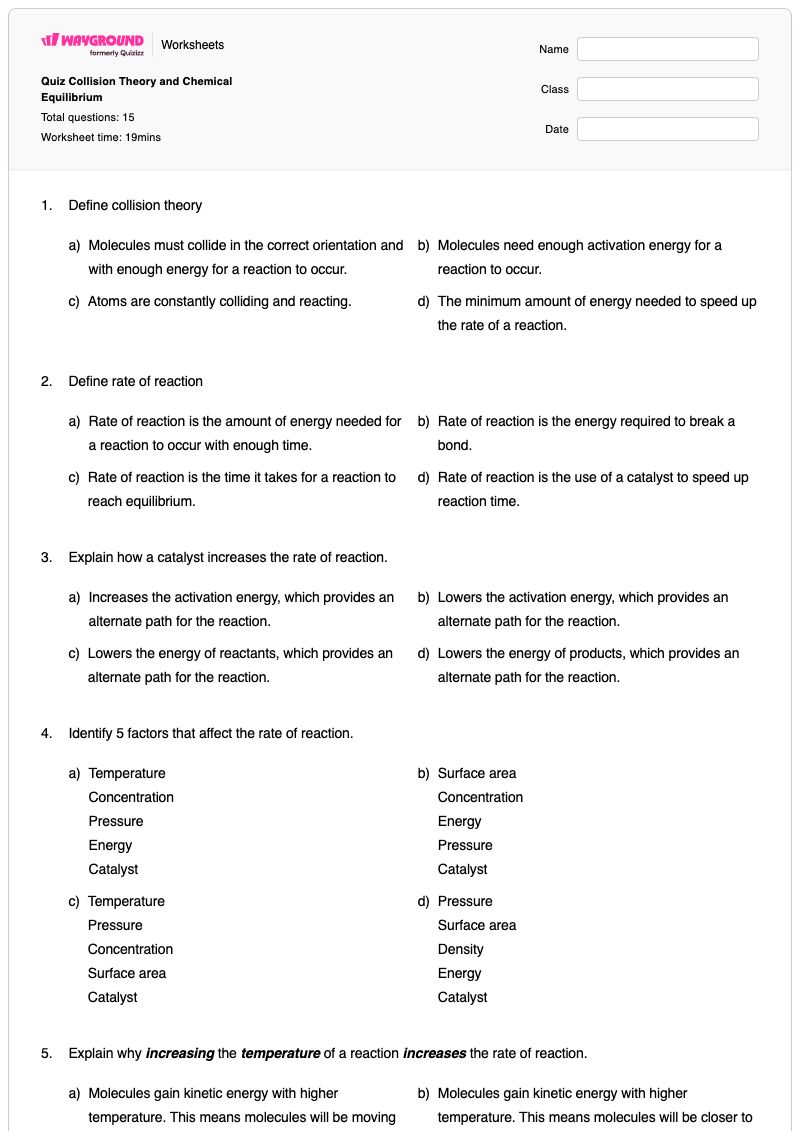
Collision theory worksheets for Class 12 chemistry students available through Wayground (formerly Quizizz) provide comprehensive coverage of this fundamental kinetic concept that explains how and why chemical reactions occur. These expertly designed worksheets strengthen students' understanding of molecular collisions, activation energy requirements, and the factors that influence reaction rates, including temperature, concentration, and catalytic effects. Students engage with practice problems that require them to analyze collision frequency, calculate activation energies, and interpret energy diagrams while developing critical thinking skills essential for advanced chemistry coursework. Each worksheet includes detailed answer keys and is available as free printable pdf resources, allowing educators to seamlessly integrate collision theory concepts into their curriculum while providing students with structured opportunities to master this complex topic.
Wayground (formerly Quizizz) supports chemistry educators with an extensive collection of millions of teacher-created collision theory resources that can be easily discovered through robust search and filtering capabilities aligned with educational standards. Teachers benefit from differentiation tools that allow them to customize worksheets based on individual student needs, whether for remediation of foundational concepts or enrichment activities for advanced learners. The platform's flexible format options include both printable pdf versions for traditional classroom use and digital formats for interactive learning environments, enabling educators to efficiently plan lessons that address diverse learning styles and classroom configurations. These comprehensive worksheet collections facilitate targeted skill practice in collision theory applications, helping teachers provide focused instruction on reaction mechanisms, rate laws, and the molecular basis of chemical kinetics while ensuring students develop the analytical skills necessary for success in advanced chemistry studies.
Explore Other Subject Worksheets for class 12
Frequently asked questions
Teaching collision theory effectively starts with grounding students in the two conditions required for a successful reaction: sufficient collision energy (at or above activation energy) and correct molecular orientation. From there, build outward to factors that influence collision frequency and effectiveness, including temperature, concentration, surface area, and catalysts. Visual models showing molecular orientation and energy diagrams help students connect abstract particle behavior to observable reaction rate changes. Scaffolding practice problems that increase in complexity allows students to transfer conceptual understanding into analytical reasoning.