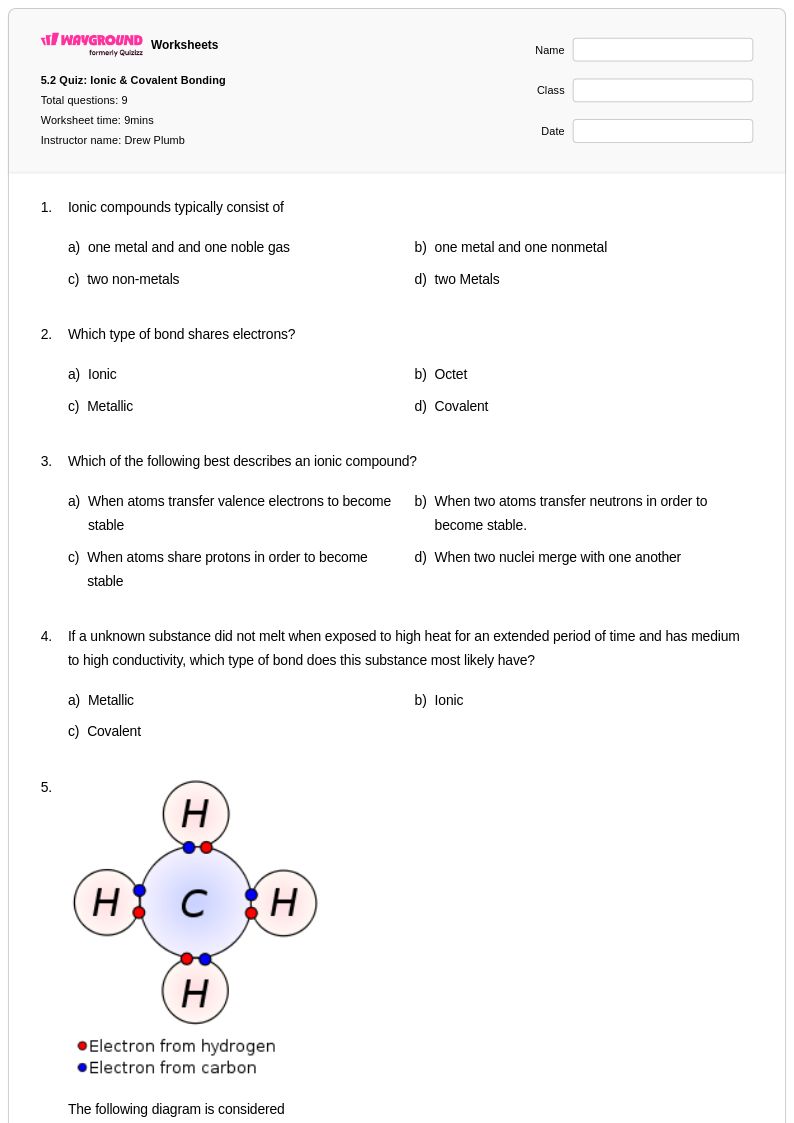
Master covalent bonding concepts with Wayground's comprehensive collection of free chemistry worksheets, featuring printable PDFs with practice problems and detailed answer keys to strengthen molecular understanding.
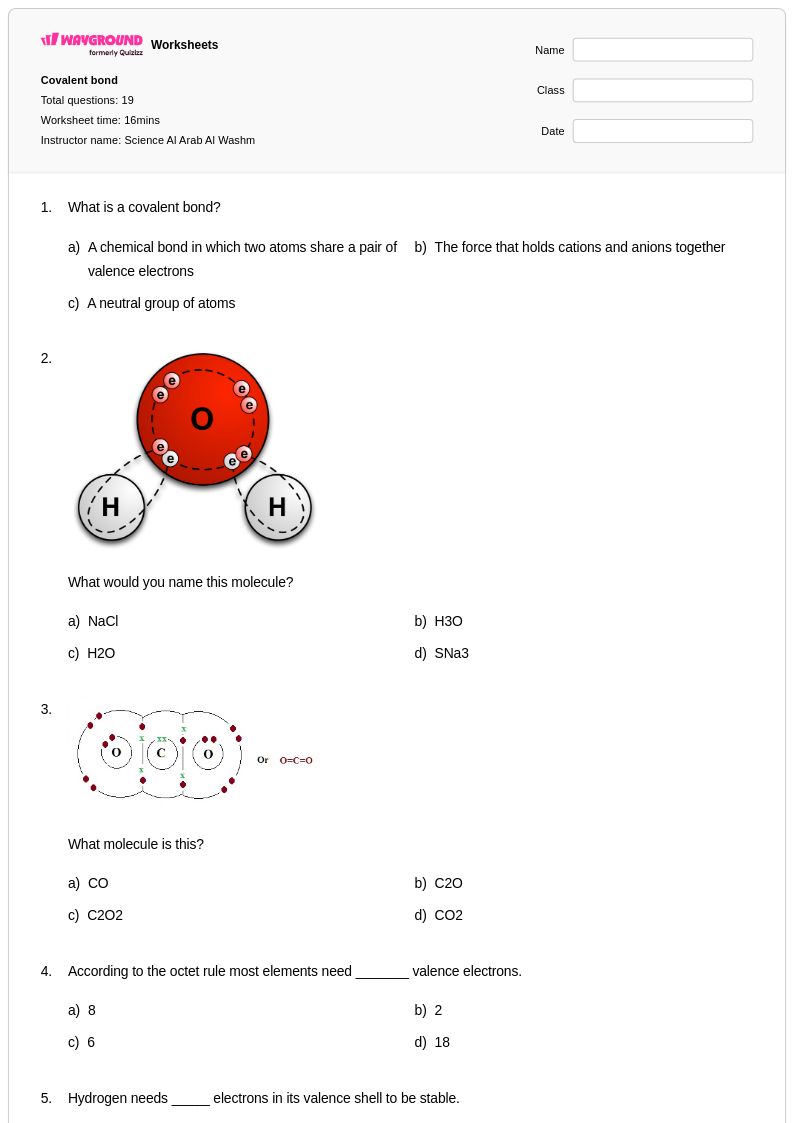
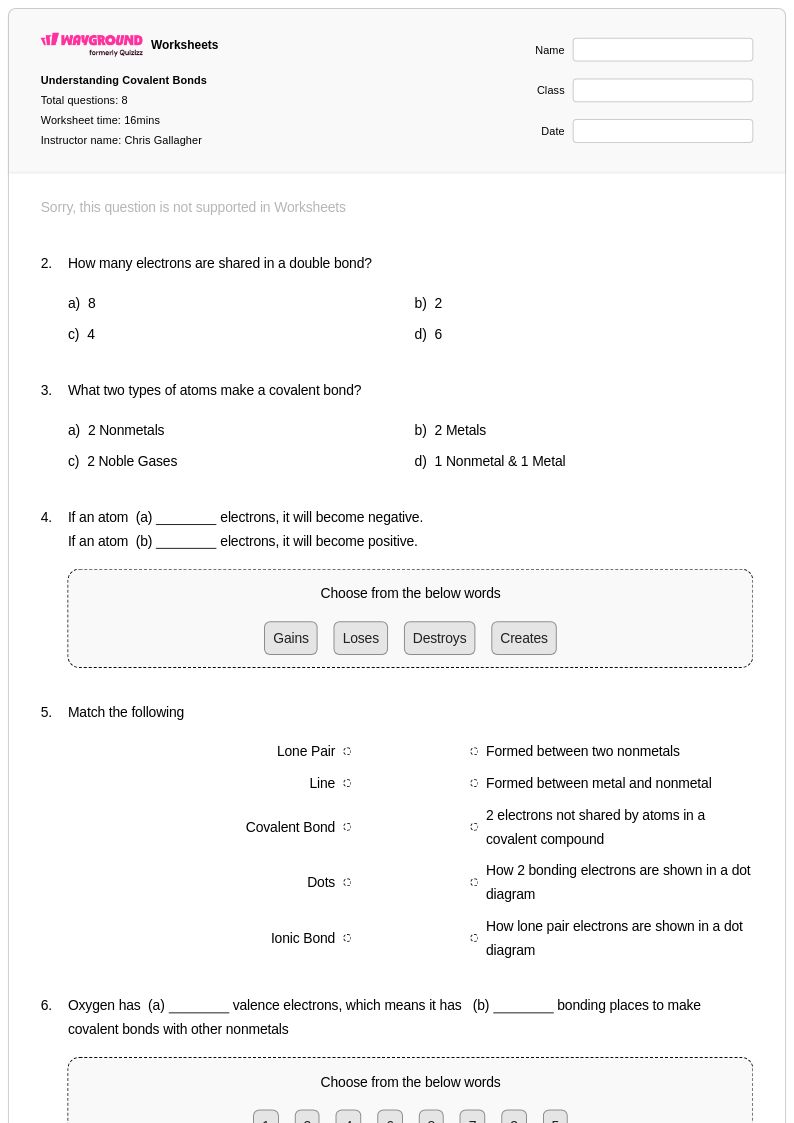
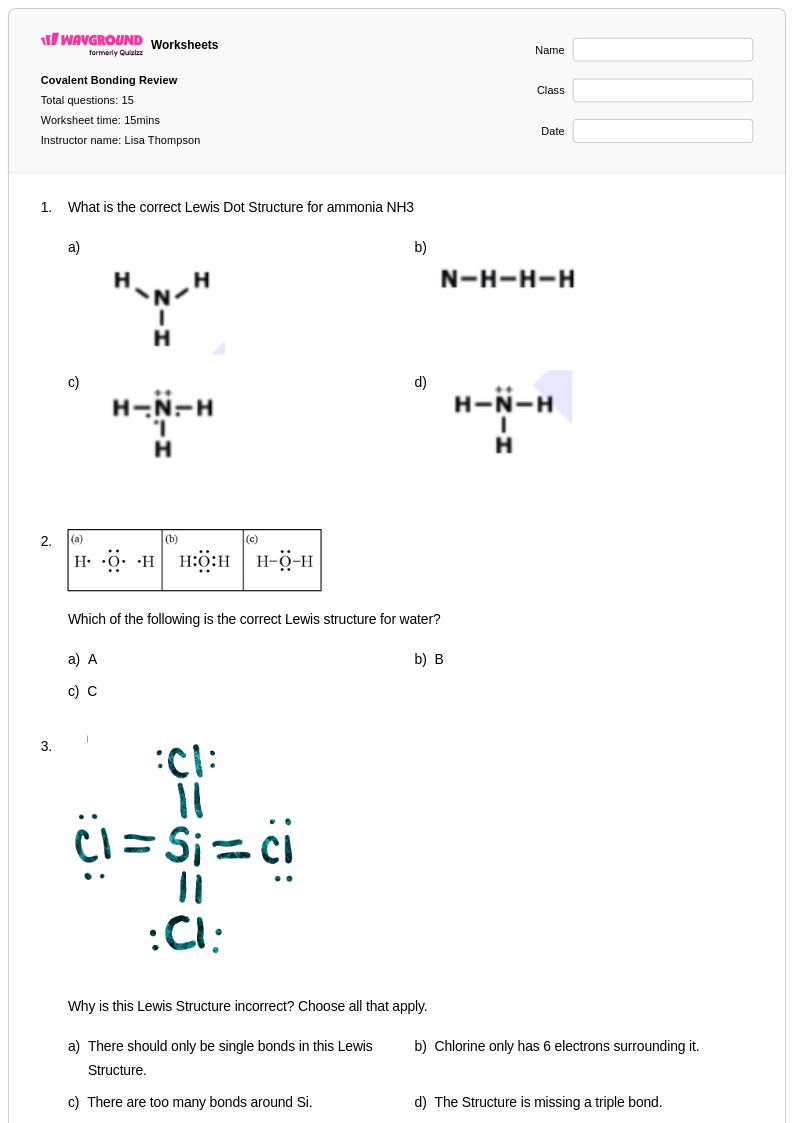
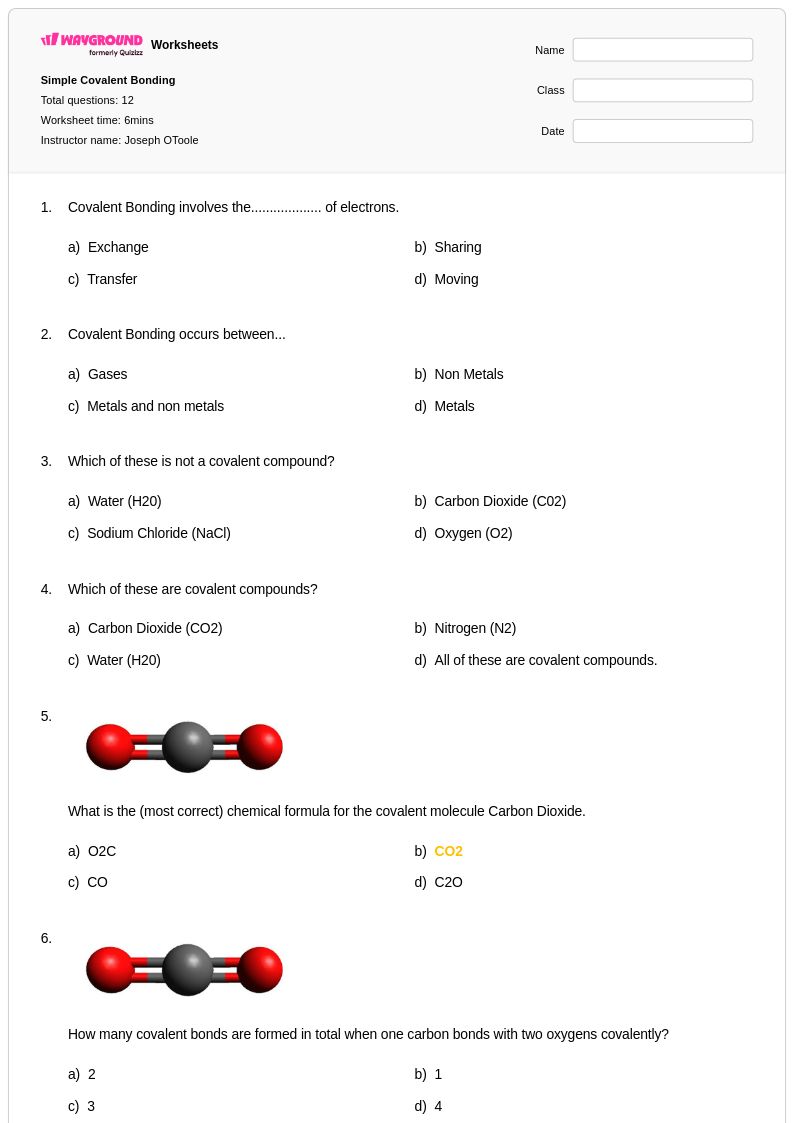
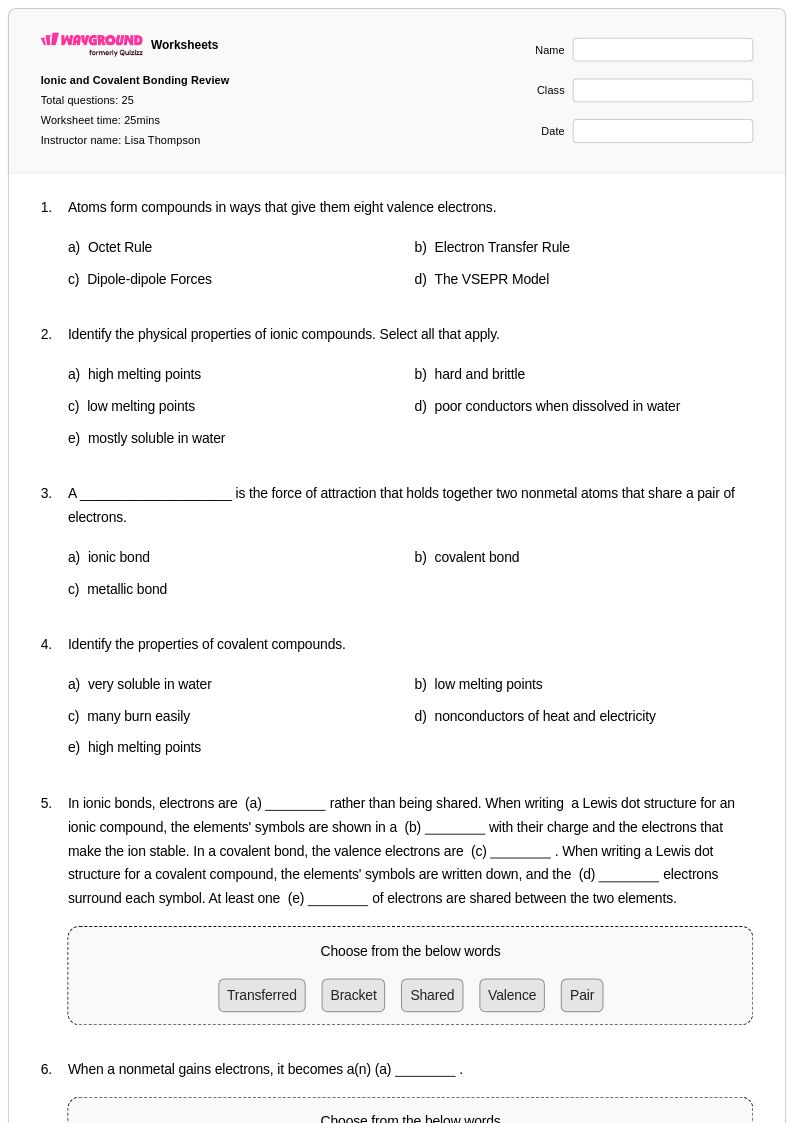
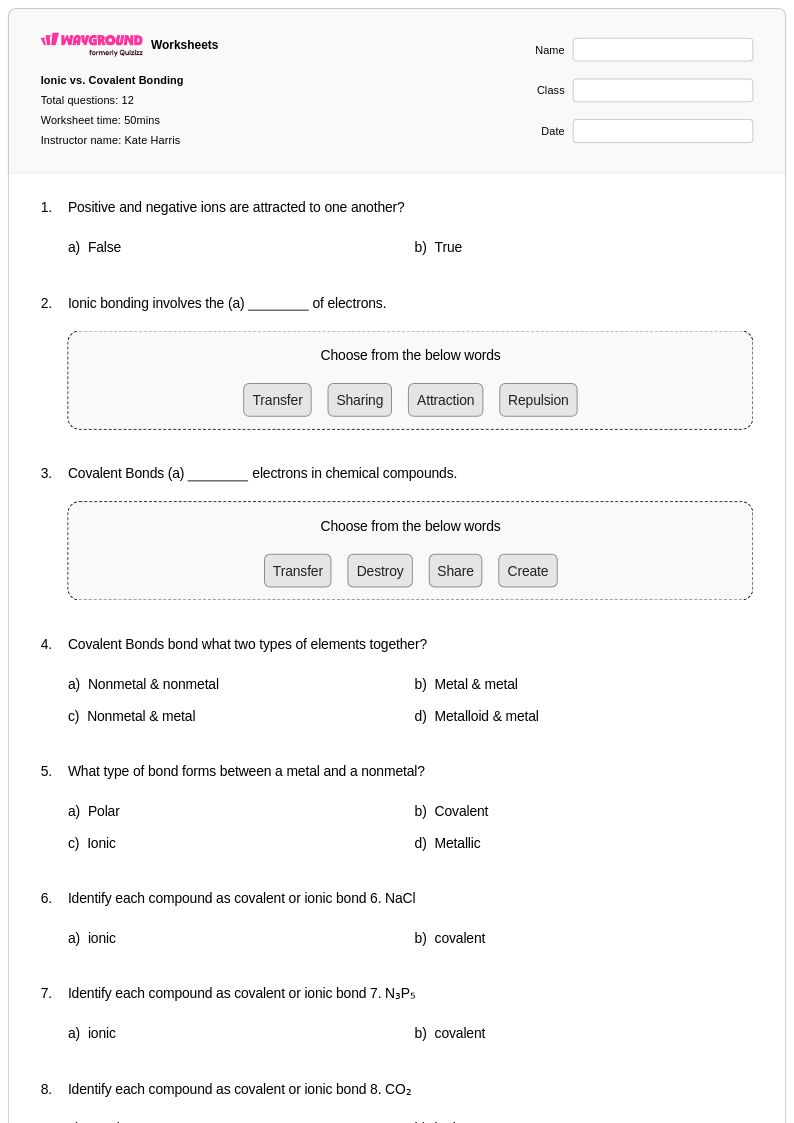
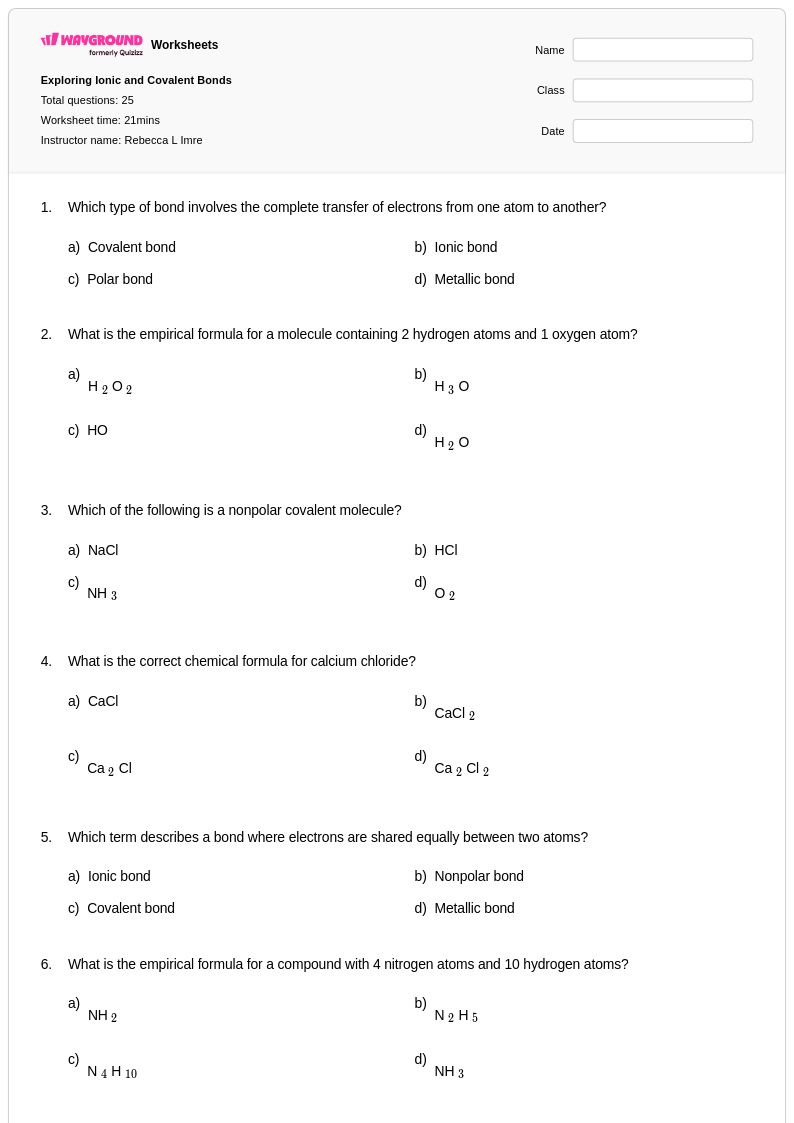
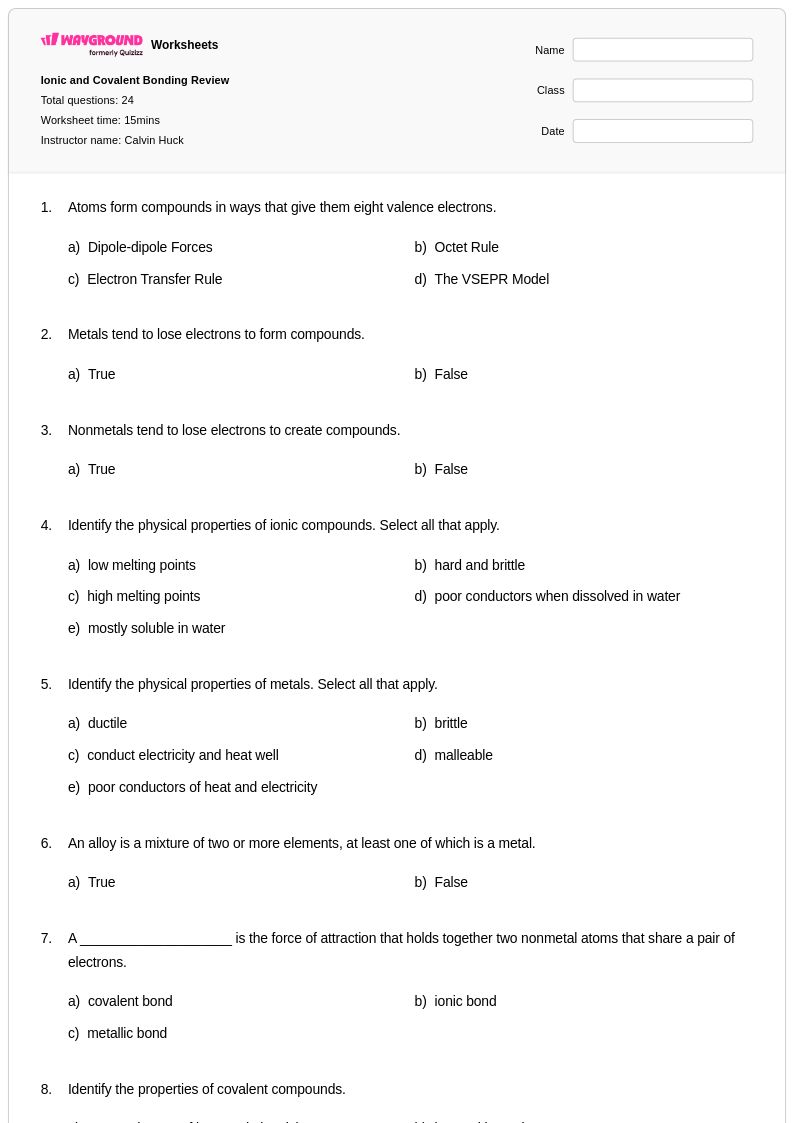
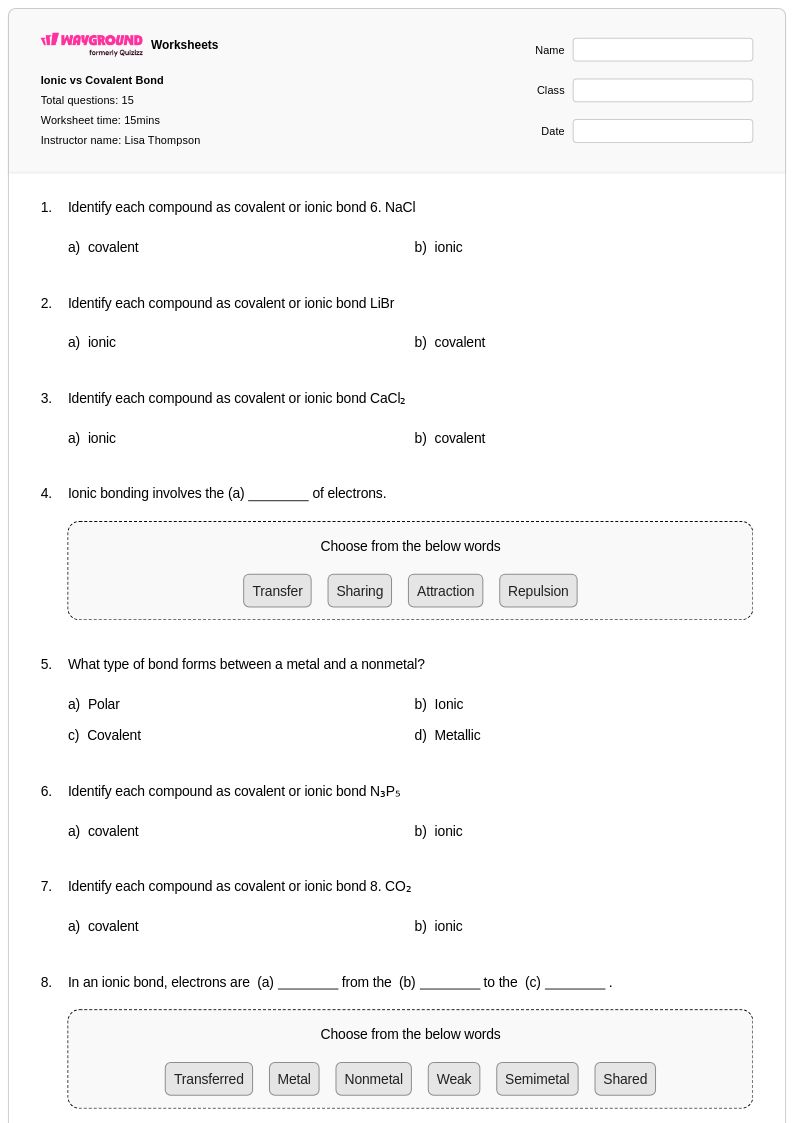
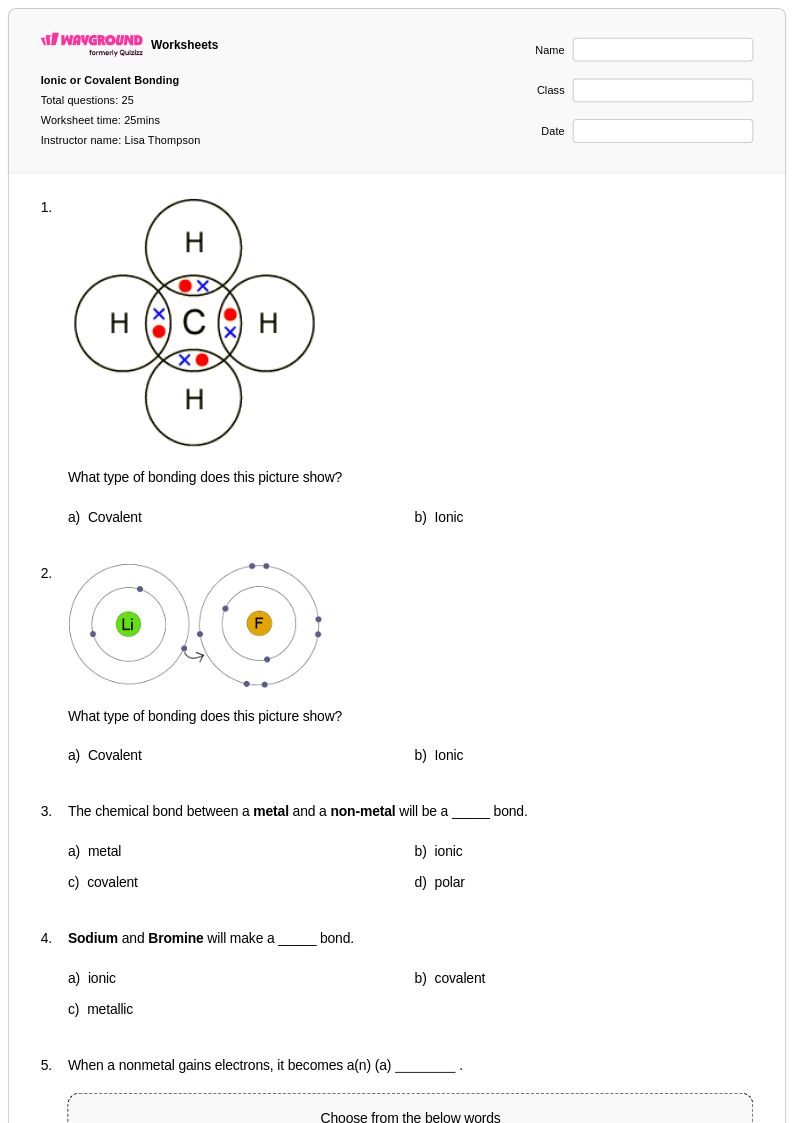
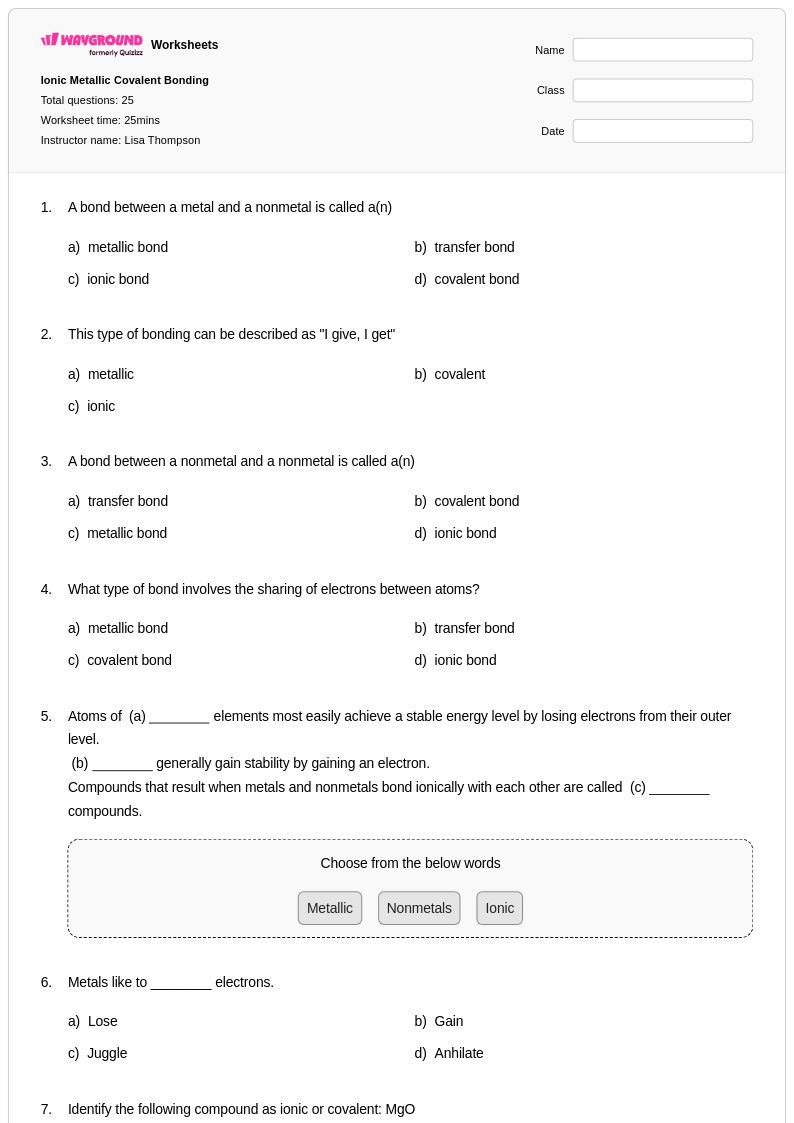
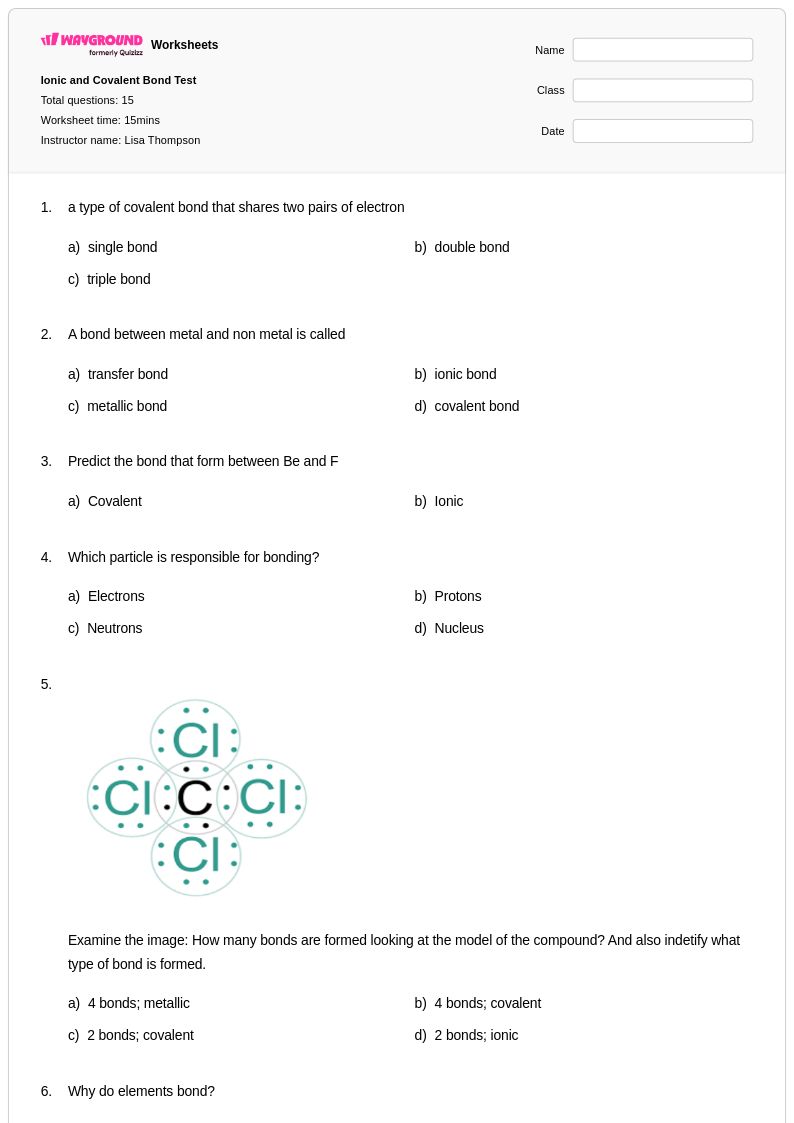
Covalent bond worksheets available through Wayground (formerly Quizizz) provide comprehensive practice materials that help students master one of chemistry's most fundamental concepts. These expertly designed worksheets guide learners through the intricacies of electron sharing between atoms, covering essential topics such as Lewis dot structures, molecular geometry, bond polarity, and the distinction between polar and nonpolar covalent compounds. Students engage with practice problems that reinforce their understanding of how atoms achieve stable electron configurations through covalent bonding, while teachers benefit from ready-to-use materials that include detailed answer keys and are available as free printables in convenient pdf format. The worksheets systematically build conceptual understanding by progressing from simple diatomic molecules to complex organic compounds, ensuring students develop the analytical skills necessary to predict molecular behavior and chemical properties.
Wayground (formerly Quizizz) empowers educators with access to millions of teacher-created covalent bond resources, supported by robust search and filtering capabilities that allow instructors to quickly locate materials aligned with specific curriculum standards and learning objectives. The platform's sophisticated differentiation tools enable teachers to customize worksheets for diverse learning needs, whether providing additional scaffolding for struggling students or enrichment activities for advanced learners. These flexible resources are available in both printable and digital formats, including downloadable pdf versions, making them ideal for classroom instruction, homework assignments, laboratory preparation, and targeted remediation sessions. Teachers can efficiently plan comprehensive chemistry units by leveraging the platform's extensive collection to address varying skill levels, support conceptual reinforcement, and provide ongoing practice opportunities that strengthen students' mastery of covalent bonding principles throughout their chemistry education.
FAQs
How do I teach covalent bonding to high school chemistry students?
Start by grounding students in the concept of electron sharing as atoms' strategy for achieving a stable octet configuration, contrasting it clearly with ionic bonding. Build from simple diatomic molecules like H₂ and O₂ before introducing Lewis dot structures, then progress to molecular geometry using VSEPR theory. Connecting bond polarity to electronegativity differences early gives students a framework they can apply to more complex organic compounds later.
What exercises help students practice drawing Lewis dot structures for covalent compounds?
Practice exercises that follow a step-by-step process work best: count total valence electrons, place the least electronegative atom at the center, distribute electrons to satisfy octets, and convert lone pairs to bonding pairs where needed. Sequencing problems from simple molecules like CH₄ to polyatomic ions and organic structures builds procedural fluency. Worksheets that include both straightforward examples and edge cases like expanded octets and resonance structures ensure students are prepared for exam-level complexity.
What mistakes do students commonly make when identifying polar vs. nonpolar covalent bonds?
The most frequent error is confusing bond polarity with molecular polarity. Students often label a molecule like CO₂ as polar because it contains polar bonds, failing to account for how symmetrical geometry cancels the dipole moments. Another common misconception is treating any bond between different elements as ionic rather than covalent when the electronegativity difference is below 1.7. Targeted practice with molecular geometry alongside polarity problems helps students connect these two concepts correctly.
How can I use covalent bond worksheets to address different skill levels in my chemistry class?
Differentiated worksheets allow teachers to assign scaffolded problems to students who are still building foundational skills while giving advanced learners problems involving resonance structures, formal charges, or bond energy calculations. On Wayground, teachers can apply individual accommodations such as read aloud support or reduced answer choices for students who need additional assistance, while the rest of the class works with default settings. These accommodations are saved per student and apply automatically in future sessions, reducing setup time across a chemistry unit.
How do I use Wayground's covalent bond worksheets in my classroom?
Wayground's covalent bond worksheets are available as printable PDFs for traditional classroom use and in digital formats for technology-integrated or hybrid learning environments. Teachers can also host worksheets directly as a quiz on Wayground, making it easy to assign practice, collect responses, and review results in one place. All worksheets include detailed answer keys, so they work equally well for in-class instruction, independent practice, homework, or targeted remediation.
How do covalent bond worksheets build toward understanding organic chemistry?
Covalent bonding is the structural foundation of organic chemistry, where carbon's four valence electrons allow it to form single, double, and triple bonds with other nonmetals. Worksheets that progress from simple diatomic molecules to hydrocarbons and functional groups help students recognize bonding patterns they will encounter throughout organic chemistry. Building fluency with Lewis structures, molecular geometry, and polarity at the covalent bond level makes organic reaction mechanisms significantly more accessible later.