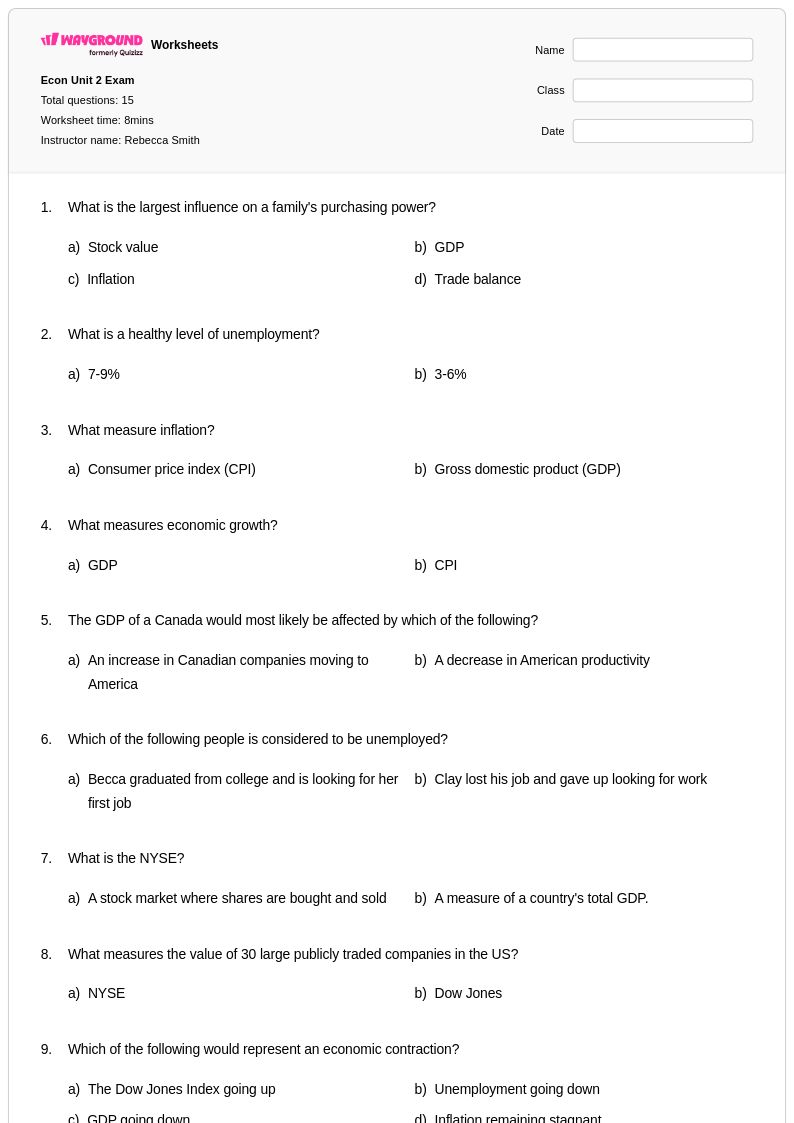
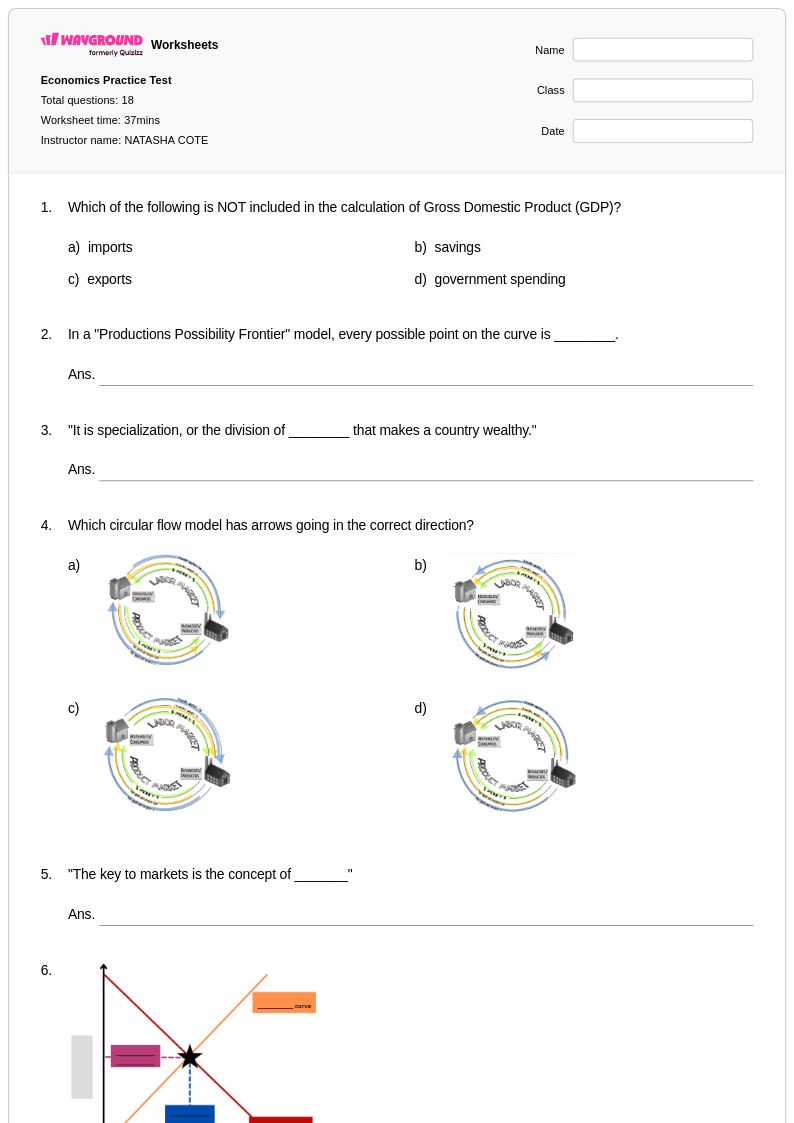
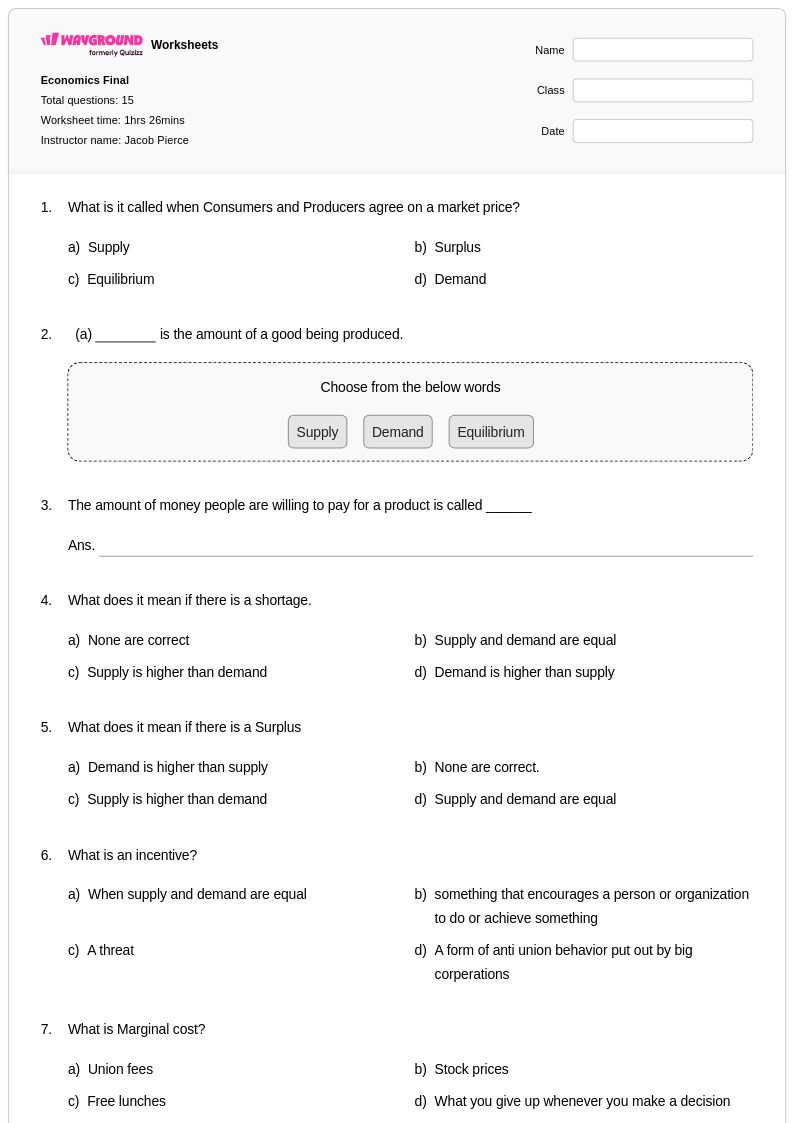
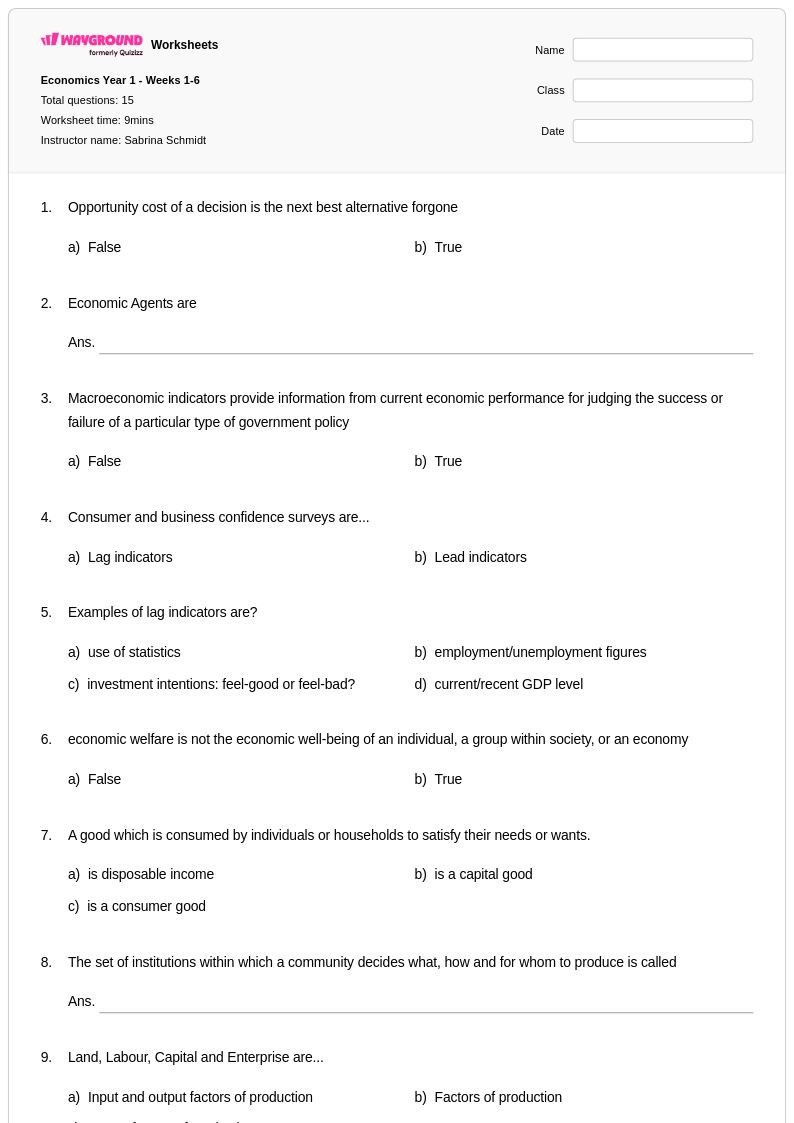
Explore Wayground's free economic indicators worksheets and printables that help students master key metrics like GDP, inflation, and unemployment through engaging practice problems with comprehensive answer keys.
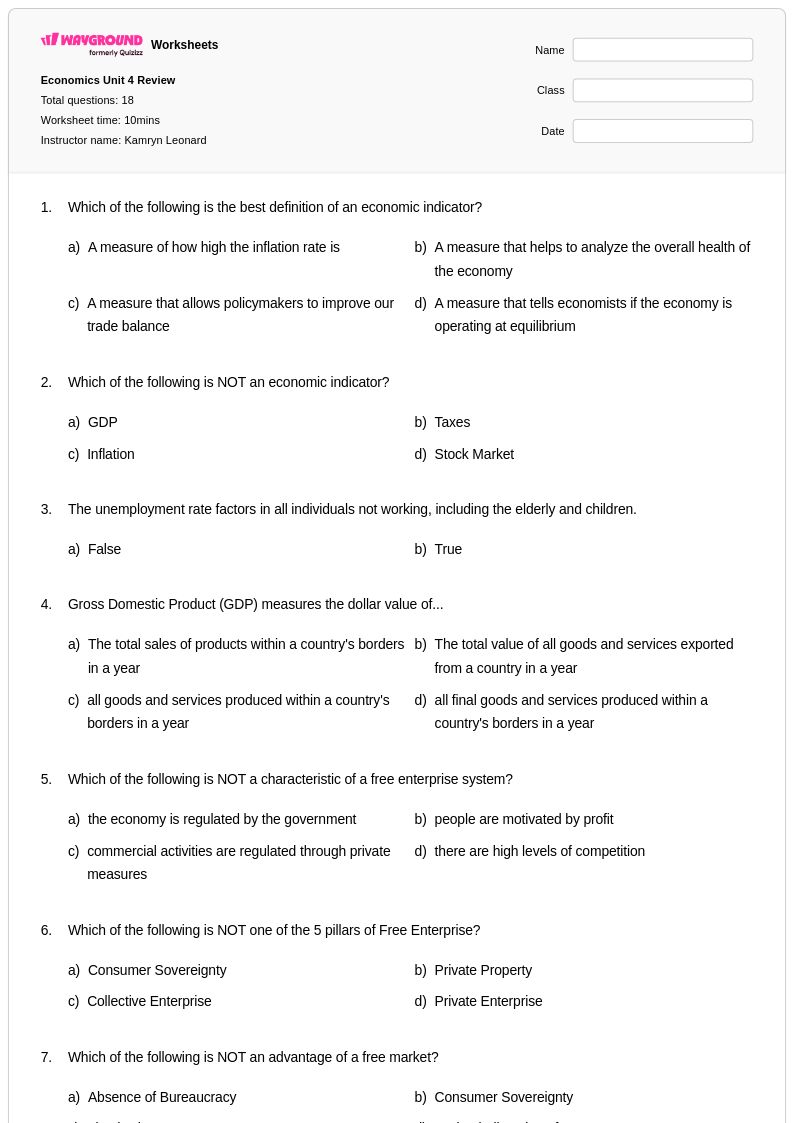
Economic indicators worksheets available through Wayground (formerly Quizizz) provide comprehensive practice materials that help students understand and analyze the key metrics economists use to measure economic health and performance. These expertly crafted worksheets focus on essential indicators such as GDP, unemployment rates, inflation measures, consumer price index, and leading economic indicators that signal future economic trends. Students develop critical analytical skills by interpreting real-world economic data, creating graphs from statistical information, and drawing connections between different economic measurements and their implications for businesses, consumers, and government policy. The collection includes detailed answer keys that facilitate self-assessment and teacher grading, while free printable pdf formats ensure accessibility for both classroom instruction and independent study, allowing students to engage with practice problems that mirror the complexity of actual economic analysis.
Wayground (formerly Quizizz) empowers educators with millions of teacher-created economic indicators resources that streamline lesson planning and enhance student comprehension through powerful search and filtering capabilities. Teachers can easily locate materials aligned with specific curriculum standards while utilizing differentiation tools that accommodate diverse learning needs and skill levels within their classrooms. The platform's flexible customization options allow instructors to modify existing worksheets or create targeted practice sets for remediation of struggling students or enrichment activities for advanced learners. Available in both printable and comprehensive digital formats including downloadable pdfs, these resources support varied teaching approaches from traditional paper-based assignments to interactive digital lessons, ensuring that educators have the tools necessary to help students master the complex concepts underlying economic measurement and analysis.
FAQs
How do I teach economic indicators to high school students?
Start by grounding students in the three categories of economic indicators: leading (which predict future trends), lagging (which confirm patterns after the fact), and coincident (which reflect current conditions). Use real datasets from sources like the Bureau of Labor Statistics or the Federal Reserve to make abstract metrics like GDP growth rates and CPI changes tangible. Connecting each indicator to a concrete scenario, such as how rising unemployment affects consumer spending, helps students build analytical reasoning rather than just memorizing definitions.
What exercises help students practice interpreting economic indicators?
Effective practice exercises include having students interpret time-series graphs of GDP and unemployment data, calculate inflation rates using CPI figures, and identify whether a given indicator is leading, lagging, or coincident. Scenario-based problems that ask students to evaluate economic health based on a set of mixed indicators build the kind of multi-metric reasoning that mirrors real economic analysis. Economic indicators worksheets on Wayground include practice problems that develop these skills through structured, data-driven tasks with comprehensive answer keys.
What mistakes do students commonly make when working with GDP and inflation data?
A common error is confusing nominal GDP with real GDP, leading students to misinterpret economic growth that is actually driven by inflation rather than increased output. Students also frequently conflate the Consumer Price Index with the inflation rate itself, not recognizing that CPI is a measurement tool used to calculate inflation. Another persistent misconception is treating all economic indicators as equally current, without understanding that leading indicators signal future conditions while lagging indicators only confirm trends that have already occurred.
How do I use economic indicators worksheets in my classroom?
Economic indicators worksheets on Wayground are available as printable PDFs for traditional classroom instruction and in digital formats for technology-integrated learning environments, making them adaptable to both in-person and remote settings. Teachers can host the worksheets as a quiz directly on Wayground, which adds interactivity and allows for streamlined grading. The included answer keys support both teacher-led correction and independent student self-assessment, saving preparation time while maintaining rigor.
How can I differentiate economic indicators instruction for students at different skill levels?
For struggling students, begin with single-indicator analysis before asking them to compare multiple metrics simultaneously, and use simplified datasets with fewer variables. Advanced learners can be challenged with open-ended tasks that require them to synthesize GDP, unemployment, and CPI data to make an argument about the state of the economy. On Wayground, teachers can apply accommodations such as reduced answer choices or extended time to individual students, ensuring that differentiation happens at the student level without disrupting the rest of the class.
How does understanding economic indicators connect to broader economics standards?
Economic indicators are a core component of macroeconomics standards at the high school level, connecting directly to concepts like the business cycle, fiscal policy, and monetary policy. When students can read and interpret GDP trends, unemployment rates, and inflation measures, they are better equipped to evaluate policy decisions and understand news about the economy. This analytical foundation supports standards in both economics and social studies that require students to apply economic reasoning to real-world situations.