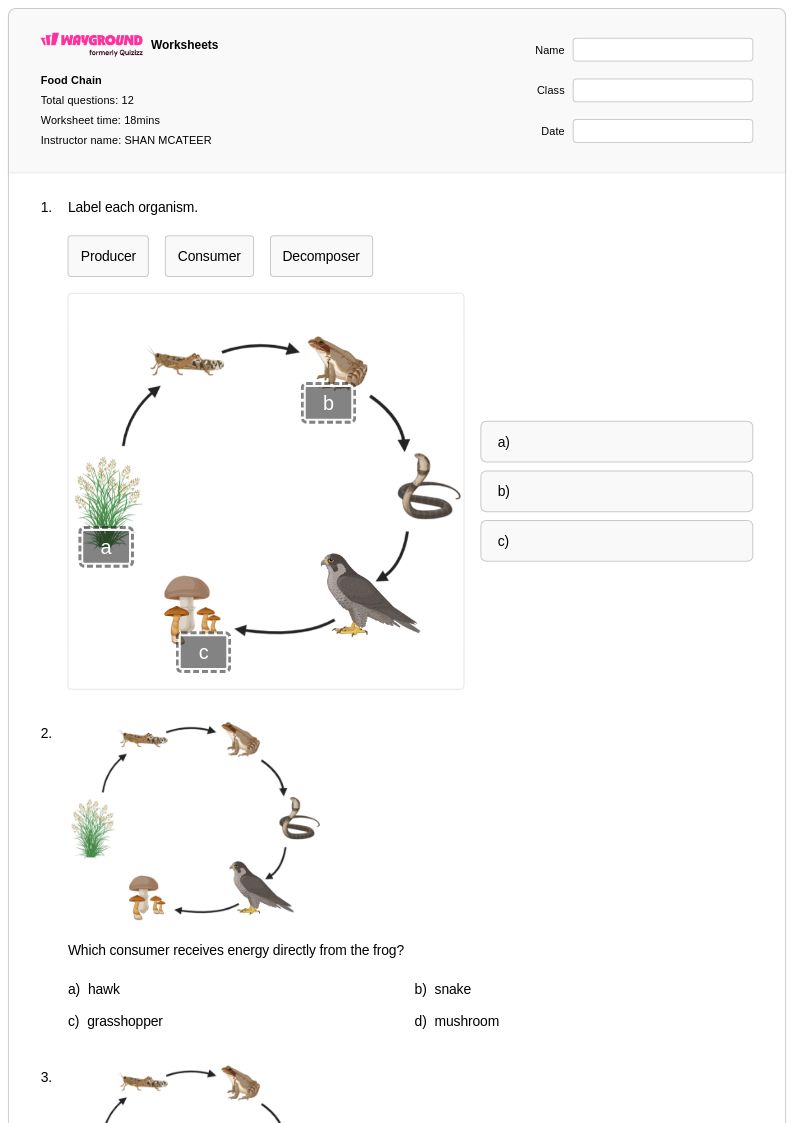
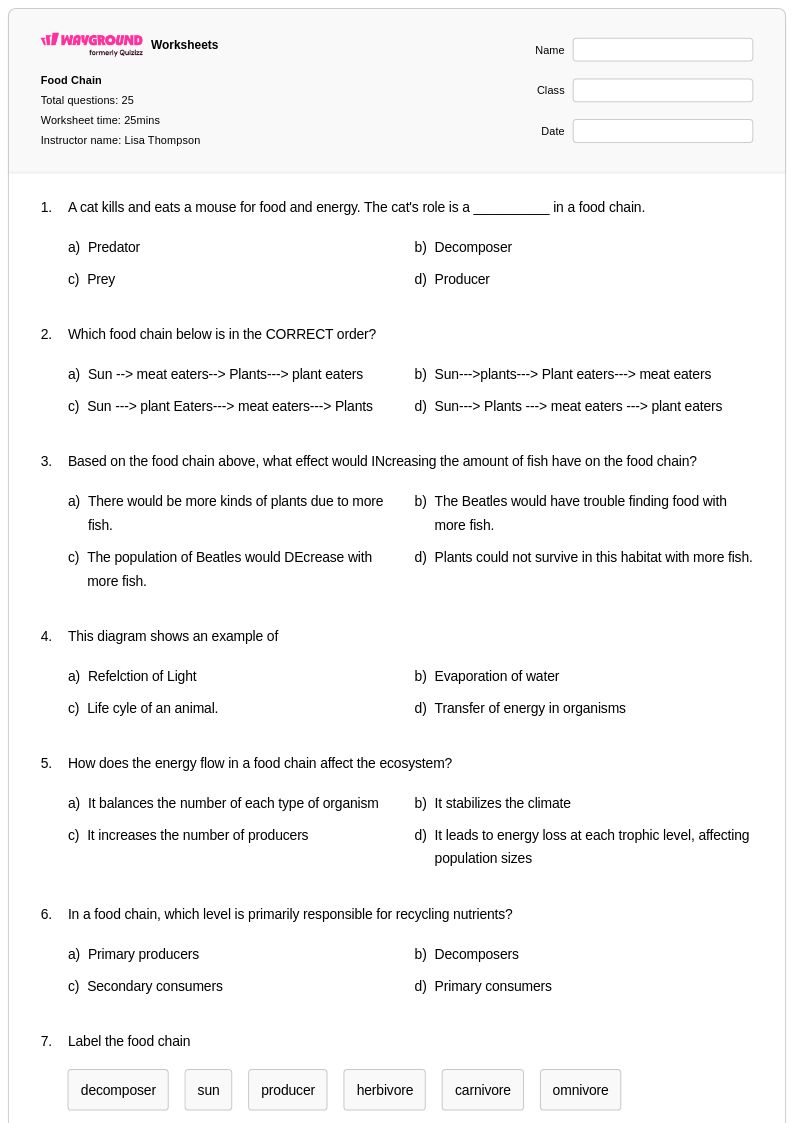
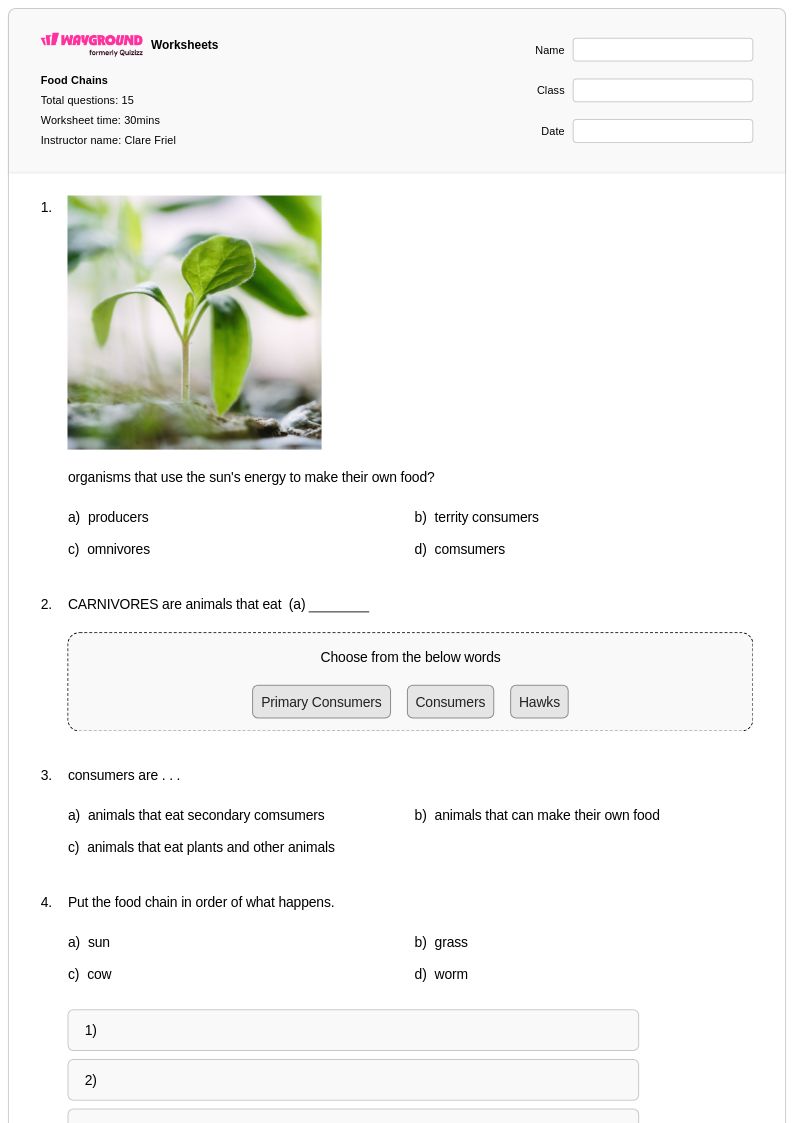
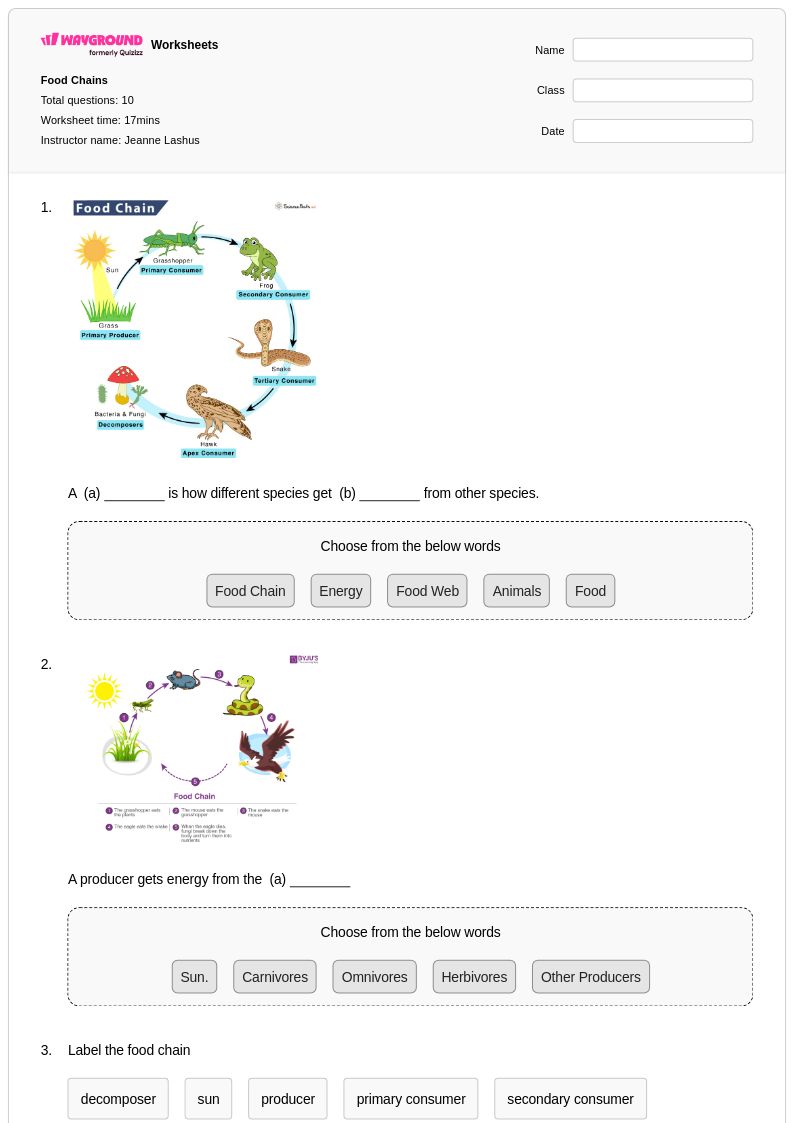
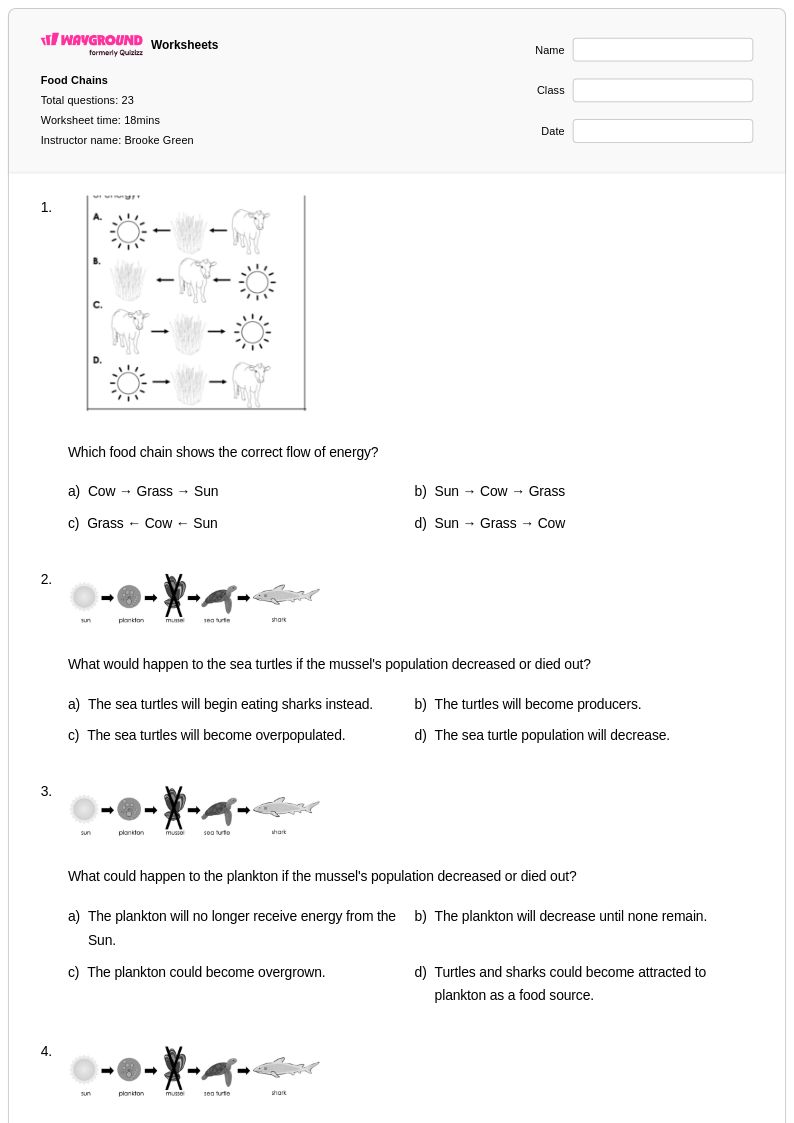
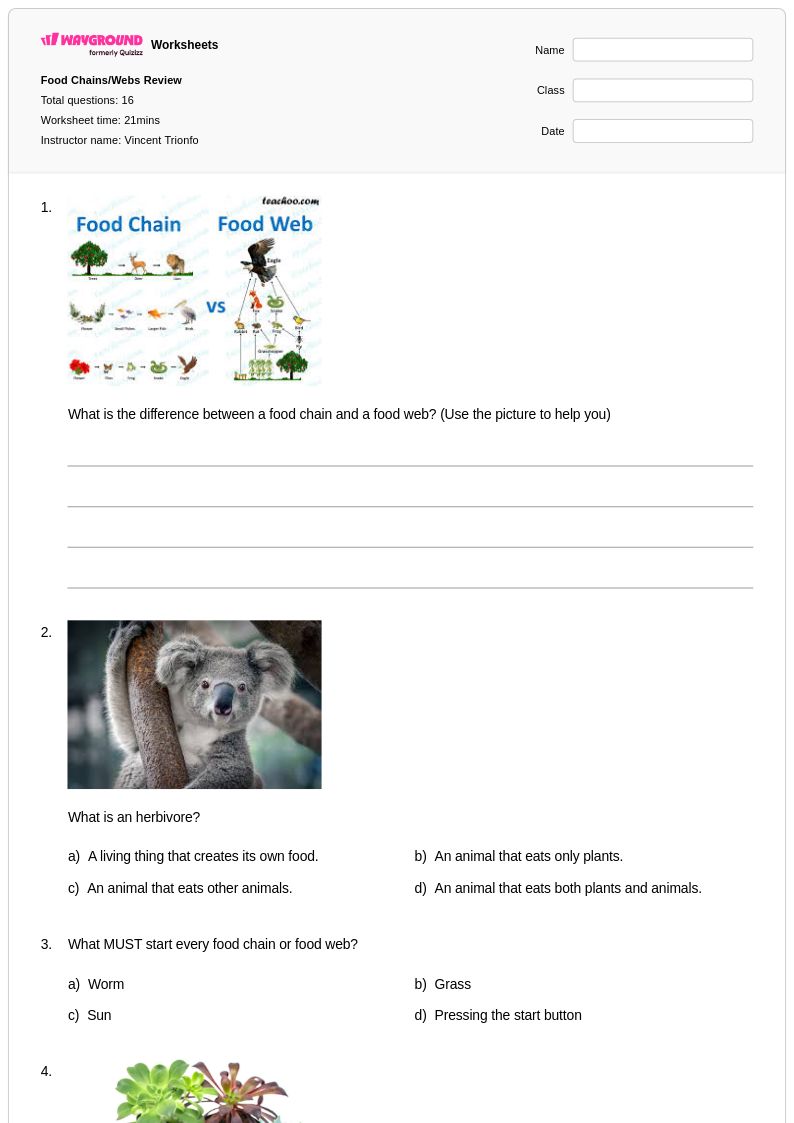
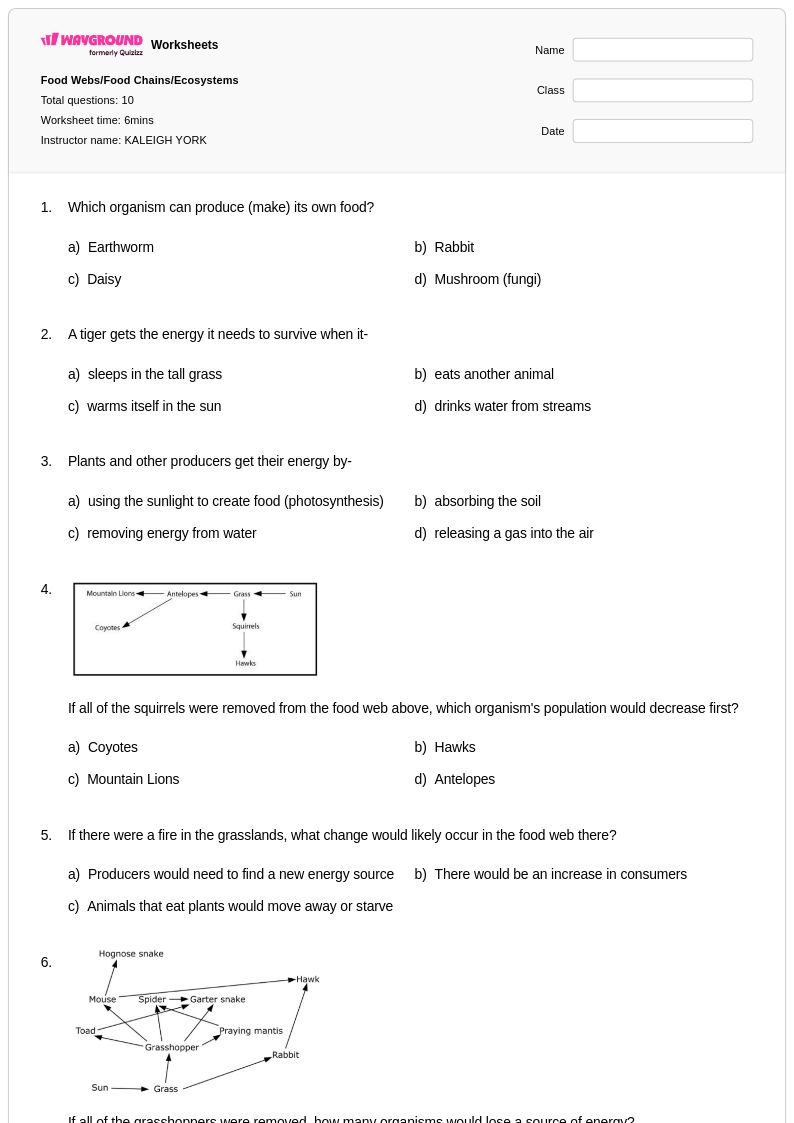
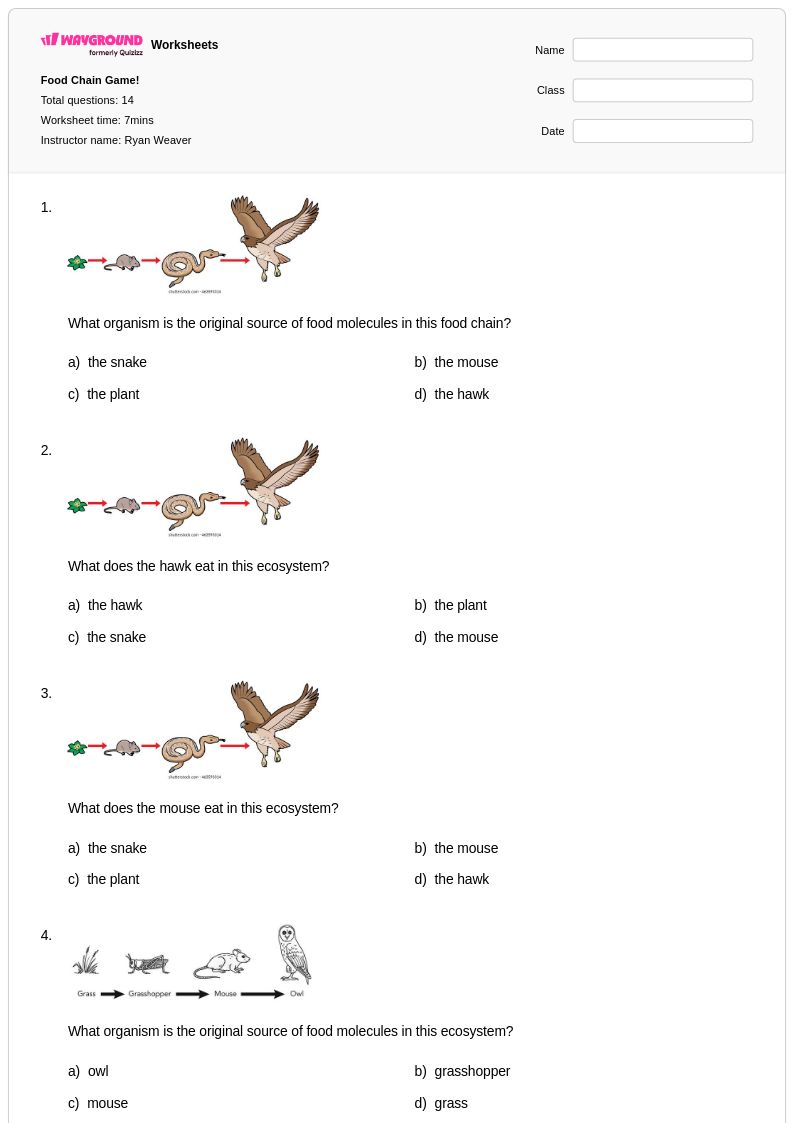
Explore our comprehensive Class 5 food chain worksheets and printables that help students understand energy flow through ecosystems with engaging practice problems, free PDF downloads, and complete answer keys.
Explore printable Food Chain worksheets for Class 5
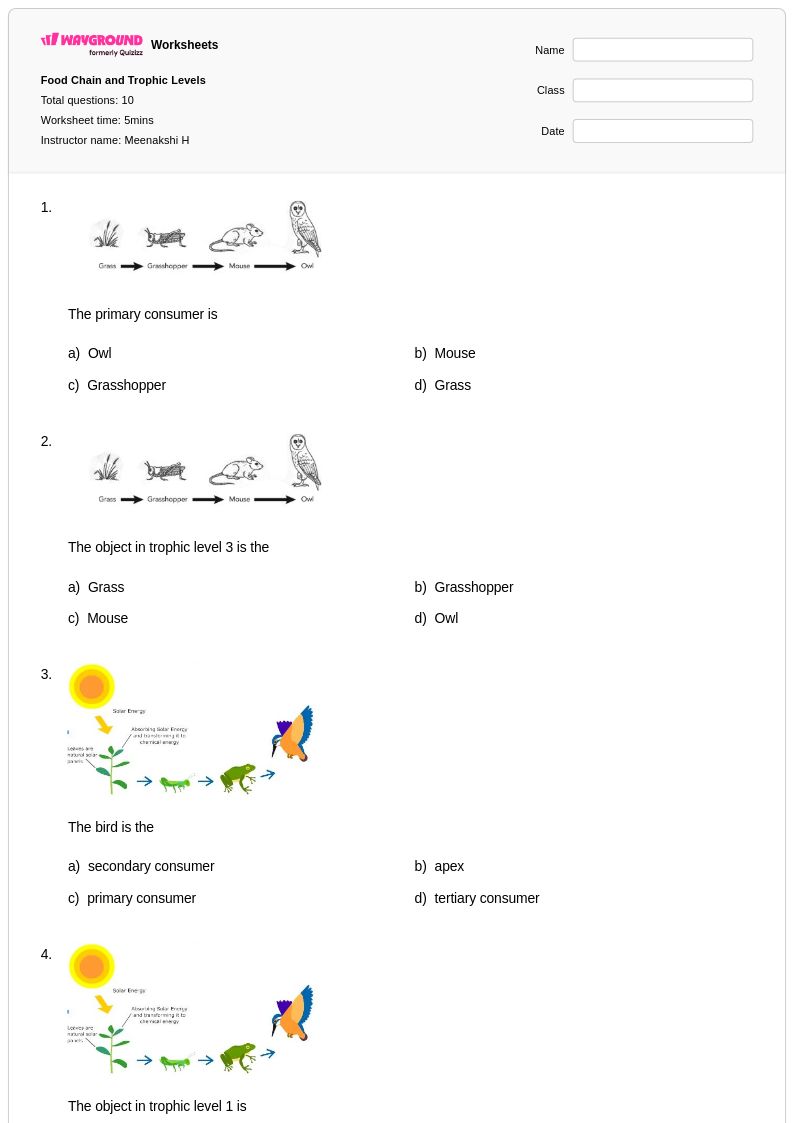
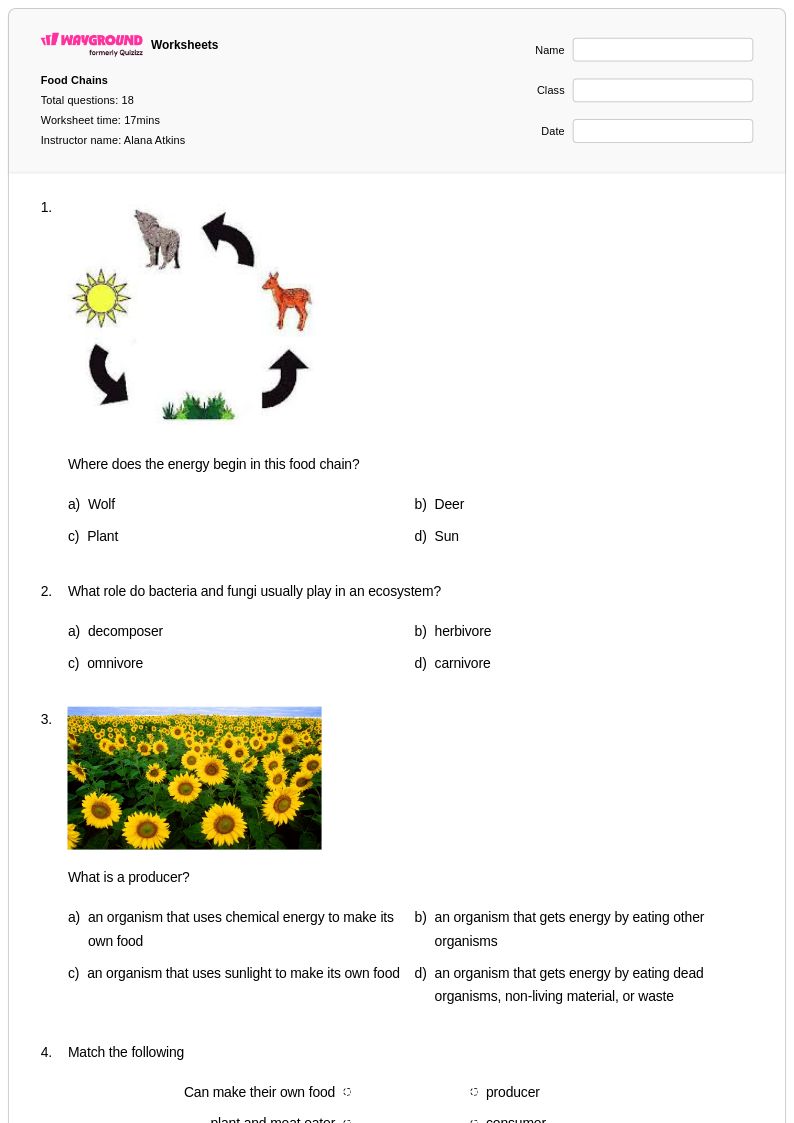
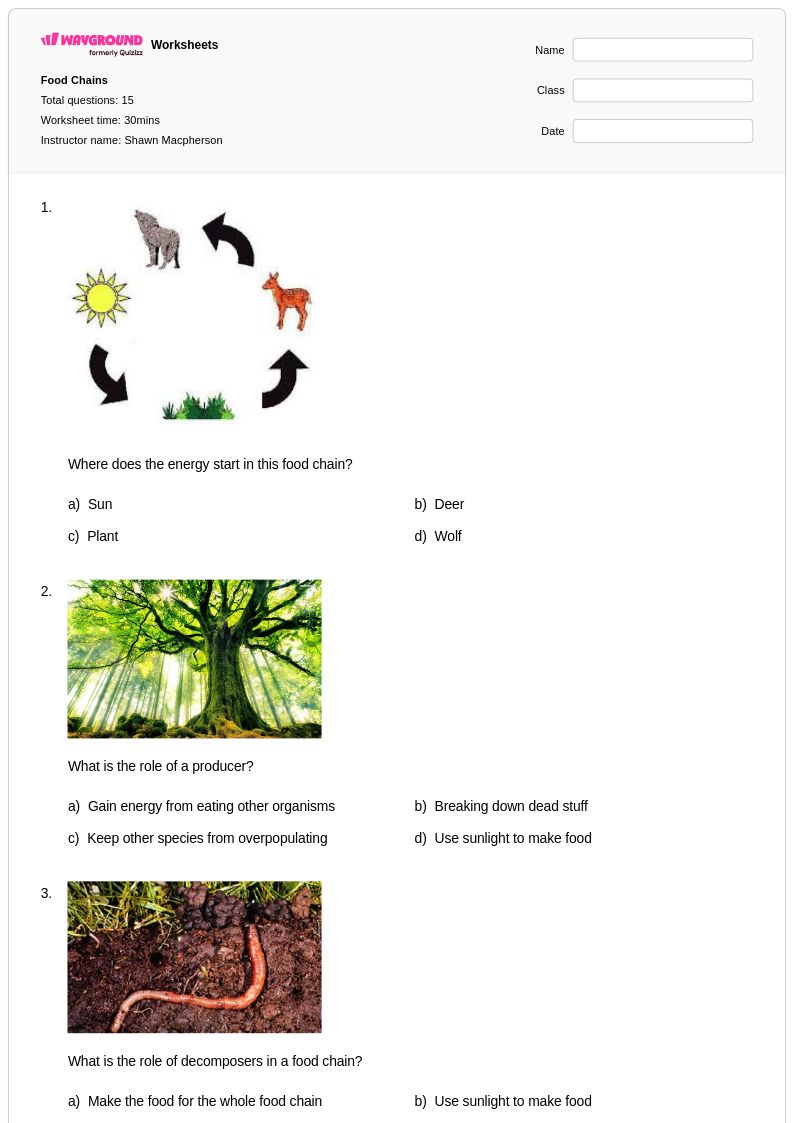
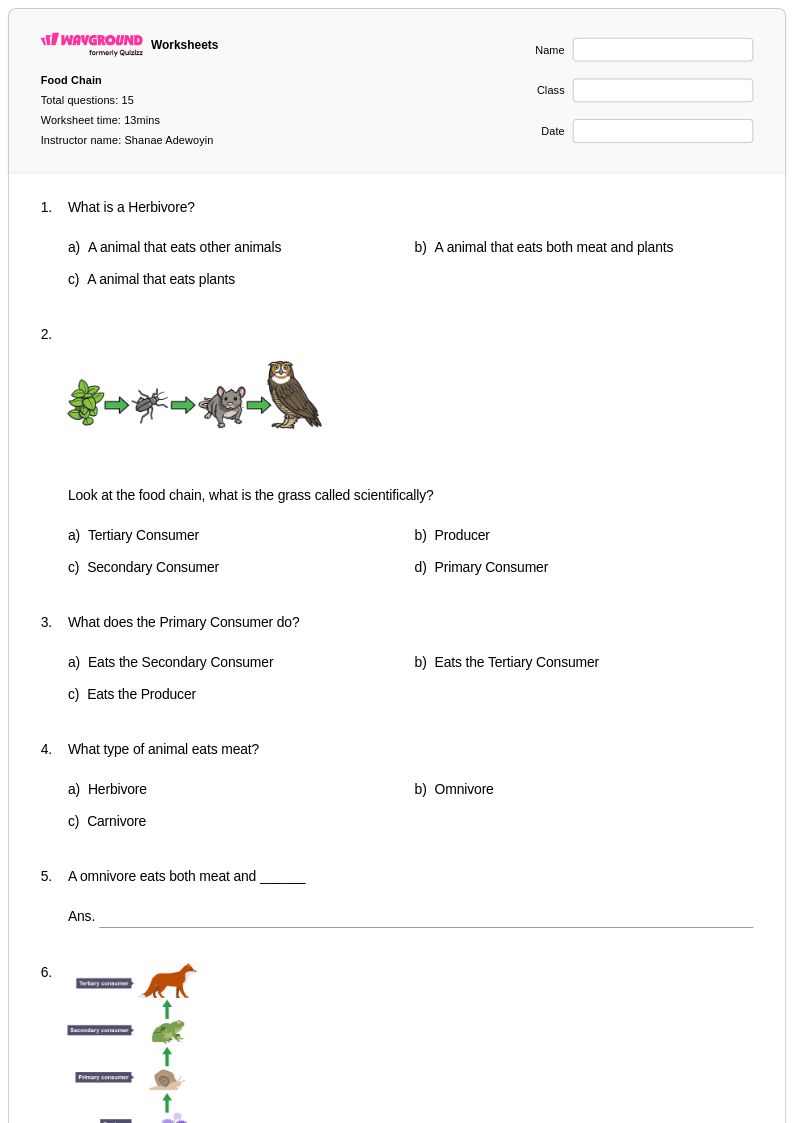
Food chain worksheets for Class 5 students available through Wayground provide comprehensive exploration of how energy flows through ecosystems and the interconnected relationships between producers, consumers, and decomposers. These educational resources strengthen students' understanding of ecological concepts by guiding them through the identification of organisms at different trophic levels, tracing energy transfer from plants to herbivores to carnivores, and analyzing the critical role each organism plays in maintaining ecosystem balance. The collection includes practice problems that challenge students to construct their own food chains, interpret food webs, and predict the consequences of removing specific organisms from an ecosystem. Each worksheet comes with a complete answer key and is available as free printables in pdf format, making them accessible for both classroom instruction and independent study.
Wayground's extensive library draws from millions of teacher-created resources specifically designed to support Class 5 biology instruction on food chain concepts. Teachers benefit from robust search and filtering capabilities that allow them to locate worksheets aligned with specific learning standards and differentiate instruction based on student readiness levels. The platform's flexible customization tools enable educators to modify existing worksheets or combine multiple resources to create comprehensive lesson packets that address diverse learning needs. Available in both printable and digital formats including downloadable pdfs, these resources facilitate seamless integration into lesson planning while supporting targeted remediation for struggling learners and enrichment opportunities for advanced students. The standardized answer keys and consistent formatting across the collection streamline grading and assessment processes, allowing teachers to focus more time on analyzing student understanding of ecological relationships and energy flow patterns.
FAQs
How do I teach food chains to elementary and middle school students?
Start by introducing the three core roles — producer, consumer, and decomposer — using familiar local ecosystems so students can connect abstract concepts to real organisms. Once students can correctly label organisms by role, move to tracing energy flow directionally along a chain, emphasizing that arrows represent energy transfer, not who eats whom. Hands-on activities like constructing food chains from organism cards before progressing to food webs help build schema in a logical sequence.
What exercises help students practice food chain concepts?
Effective practice exercises include labeling diagrams to identify producers, primary consumers, and secondary consumers, as well as constructing food webs from a given list of organisms. Scenario-based problems — such as predicting what happens to a population when a top predator is removed — push students beyond memorization into ecological reasoning. Classifying organisms by feeding habit (herbivore, carnivore, omnivore, decomposer) and tracing nutrient flow from one trophic level to the next are also high-value practice formats.
What mistakes do students commonly make when learning about food chains?
The most common error is reversing the direction of arrows in a food chain or food web, drawing them to point toward the predator rather than in the direction of energy flow. Students also frequently confuse food chains with food webs, treating them as interchangeable rather than understanding that food webs represent the full network of feeding relationships in an ecosystem. A third misconception is assuming that removing one species has no broader effect, which makes species-removal scenario problems a particularly useful diagnostic tool.
How do I help struggling students understand trophic levels and energy transfer?
Students who struggle with trophic levels often benefit from visual anchor charts that pair each level with a concrete example from a single ecosystem. Breaking energy transfer into a step-by-step trace — starting from the sun through producers to each consumer level — reduces cognitive load before introducing the 10% energy rule. On Wayground, teachers can apply accommodations such as Read Aloud support and reduced answer choices for individual students, which helps lower barriers on food chain worksheets without altering the core content for the rest of the class.
How do I use Wayground's food chain worksheets in my classroom?
Wayground's food chain worksheets are available as printable PDFs for traditional classroom distribution and in digital formats for technology-integrated learning environments, making them suitable for in-class work, homework, or hybrid settings. Teachers can also host worksheet content as a live or self-paced quiz directly on Wayground, allowing for real-time student response data. Each worksheet includes a complete answer key, so the materials support both teacher-led instruction and independent student practice.
How do food chain worksheets connect to broader ecology standards?
Food chain worksheets directly support science standards related to ecosystems, energy flow, and interdependence of organisms — concepts that appear across NGSS and state-level frameworks from grades 3 through 8. Well-designed worksheets move students from identifying producers and consumers to analyzing trophic levels, constructing food webs, and evaluating ecological consequences of population changes, covering a wide band of standard-aligned skills within a single topic. This makes food chain materials useful not just for a single lesson but as a recurring touchpoint across an entire ecology unit.