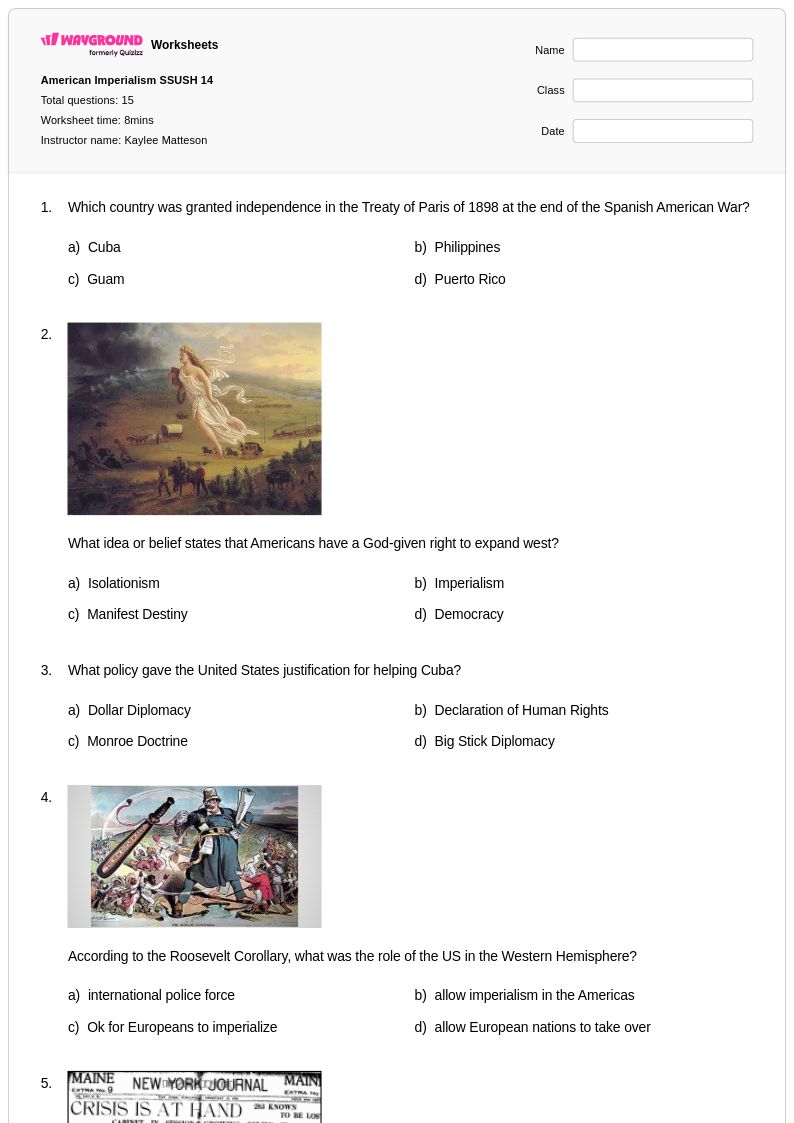
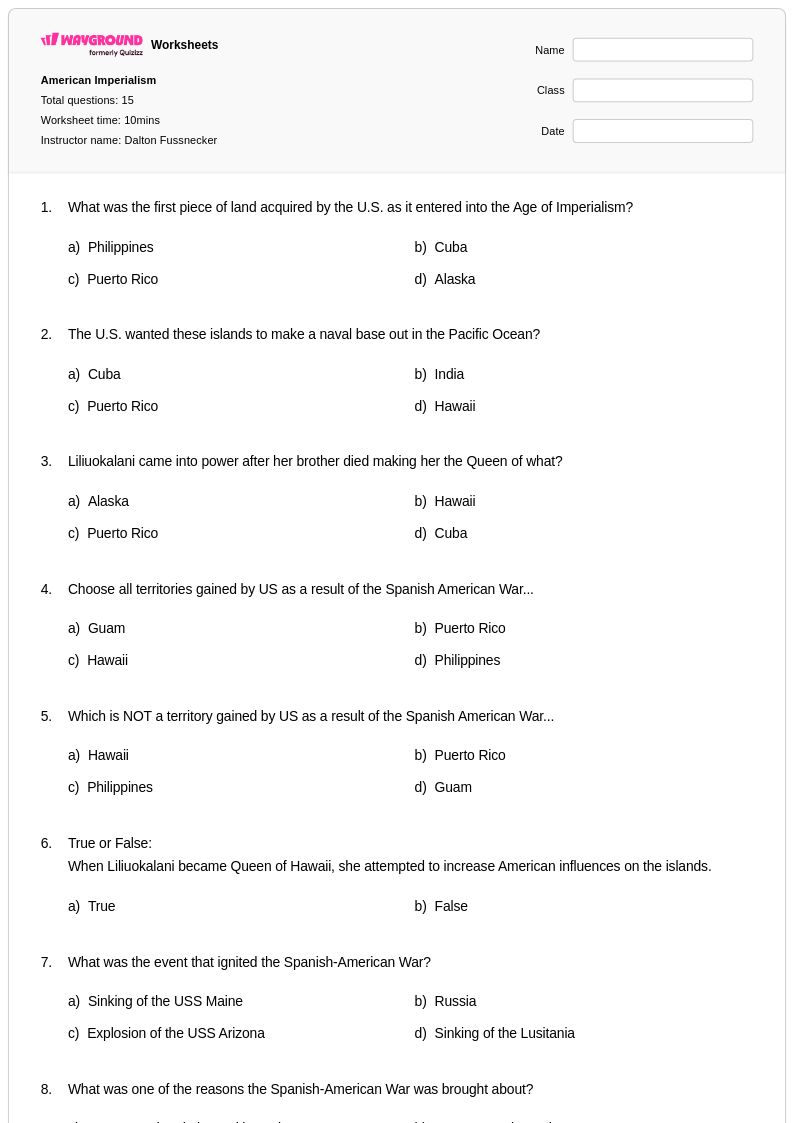
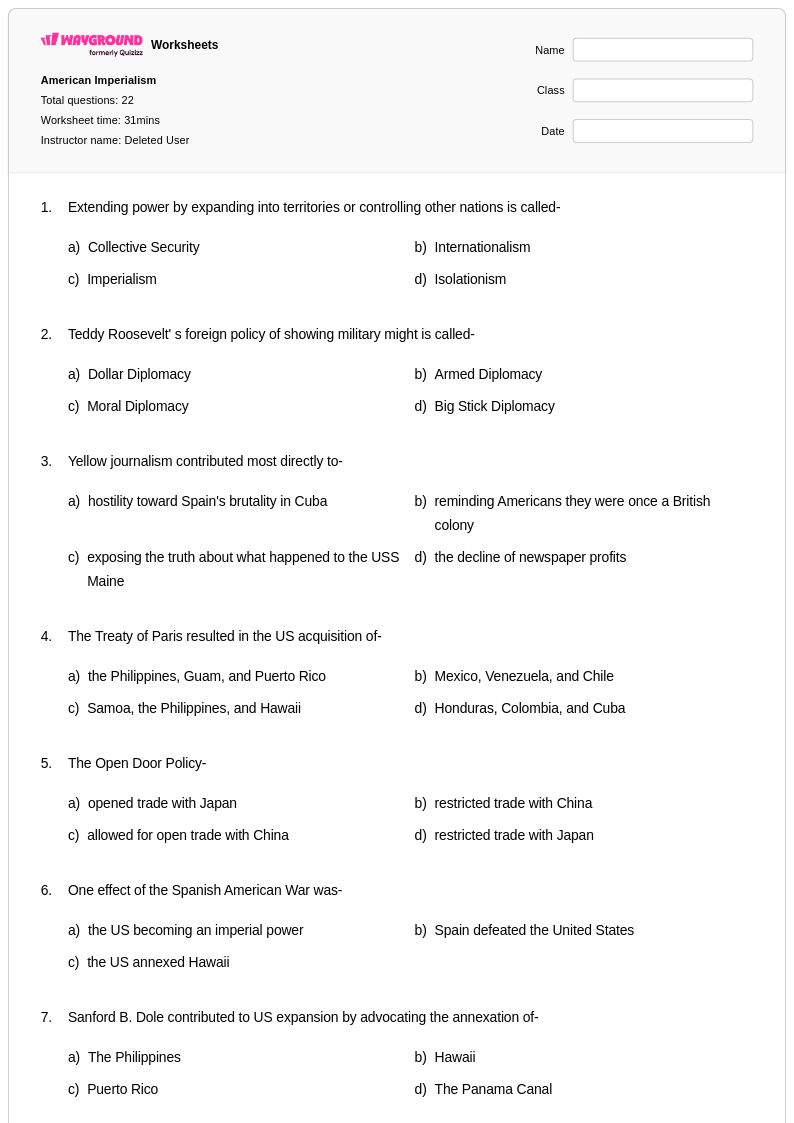
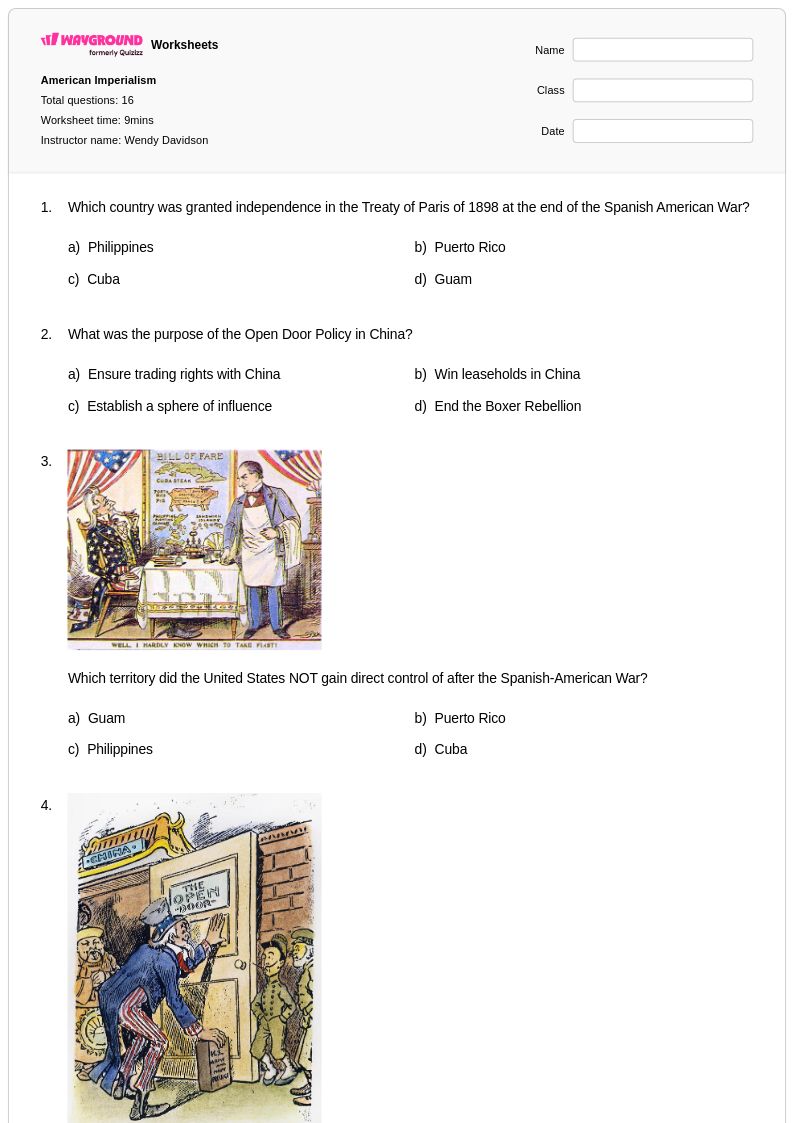
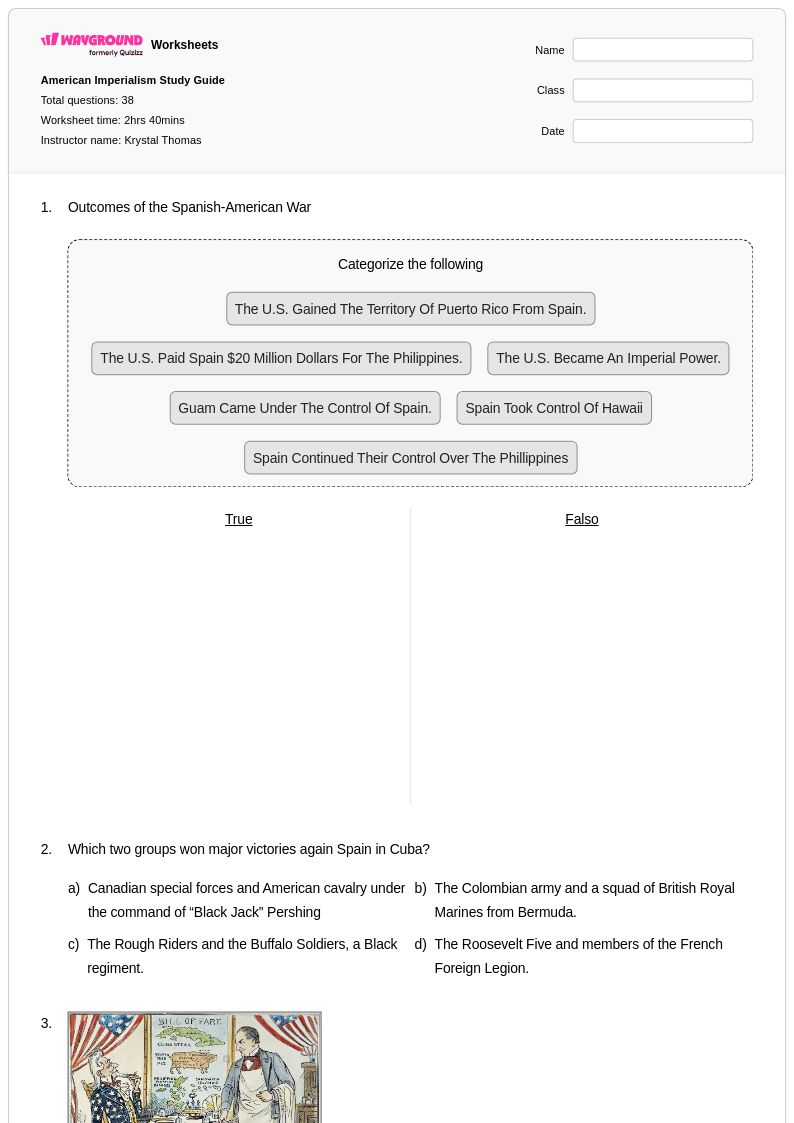
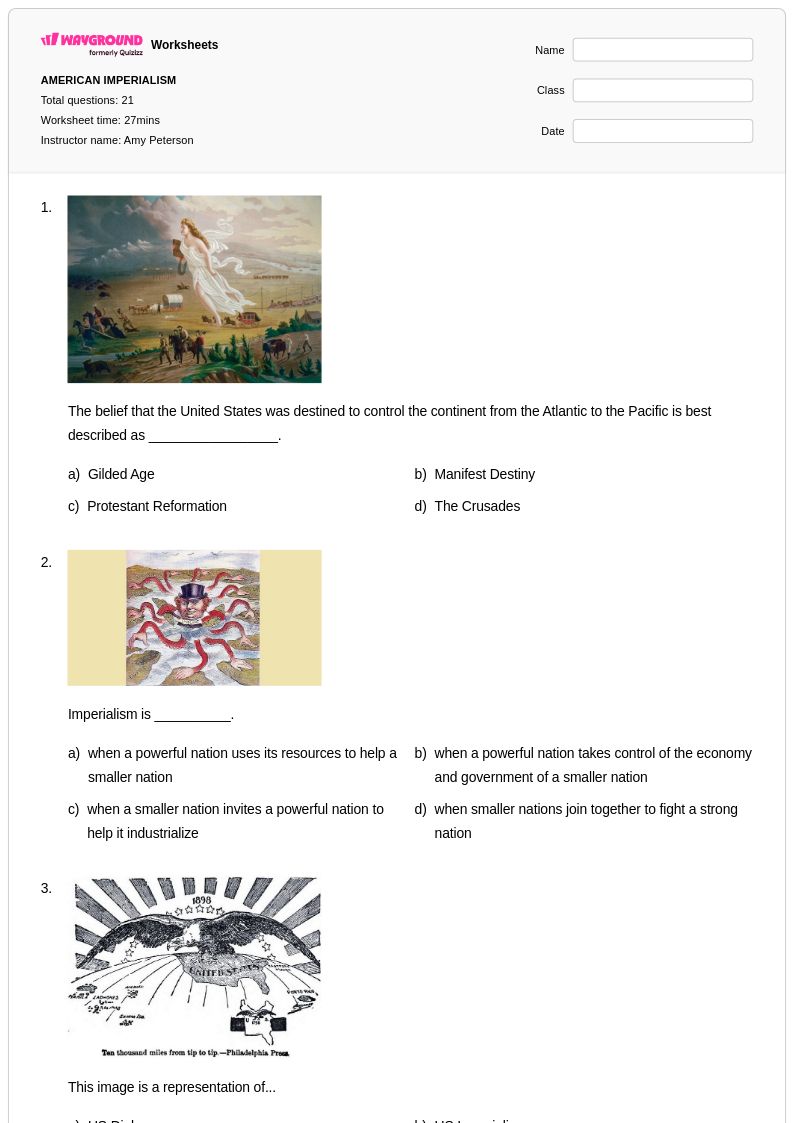
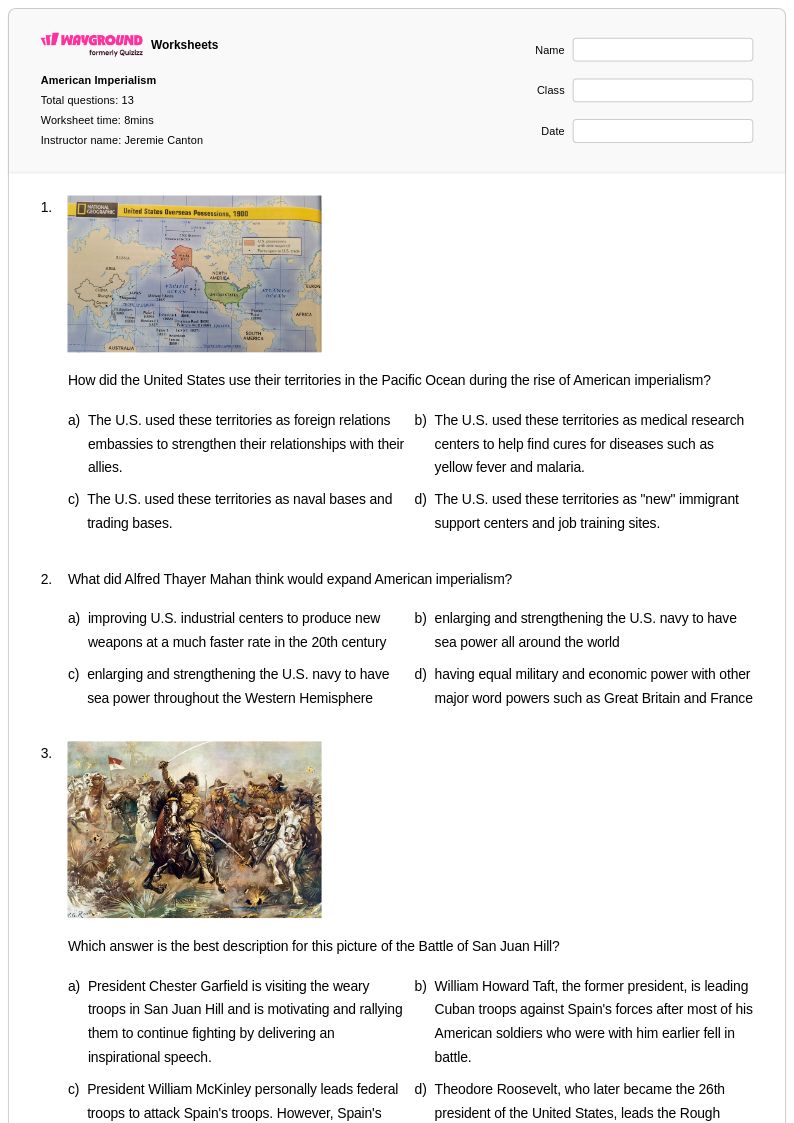
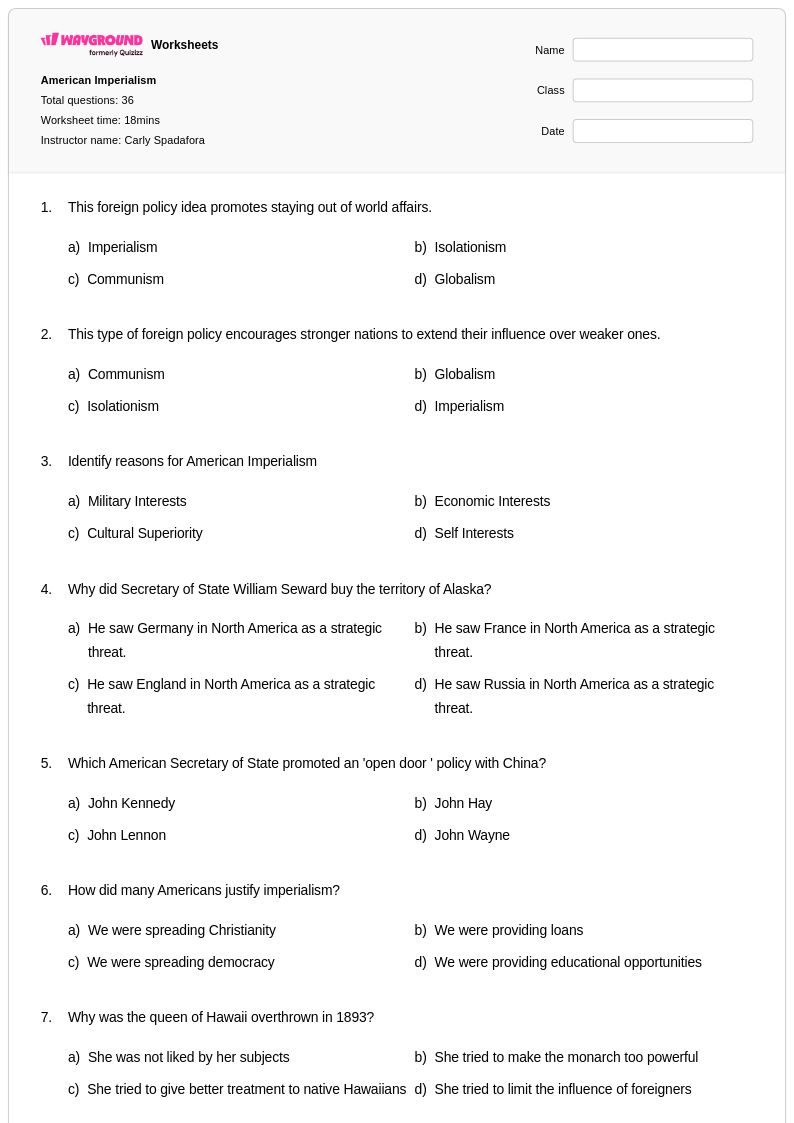
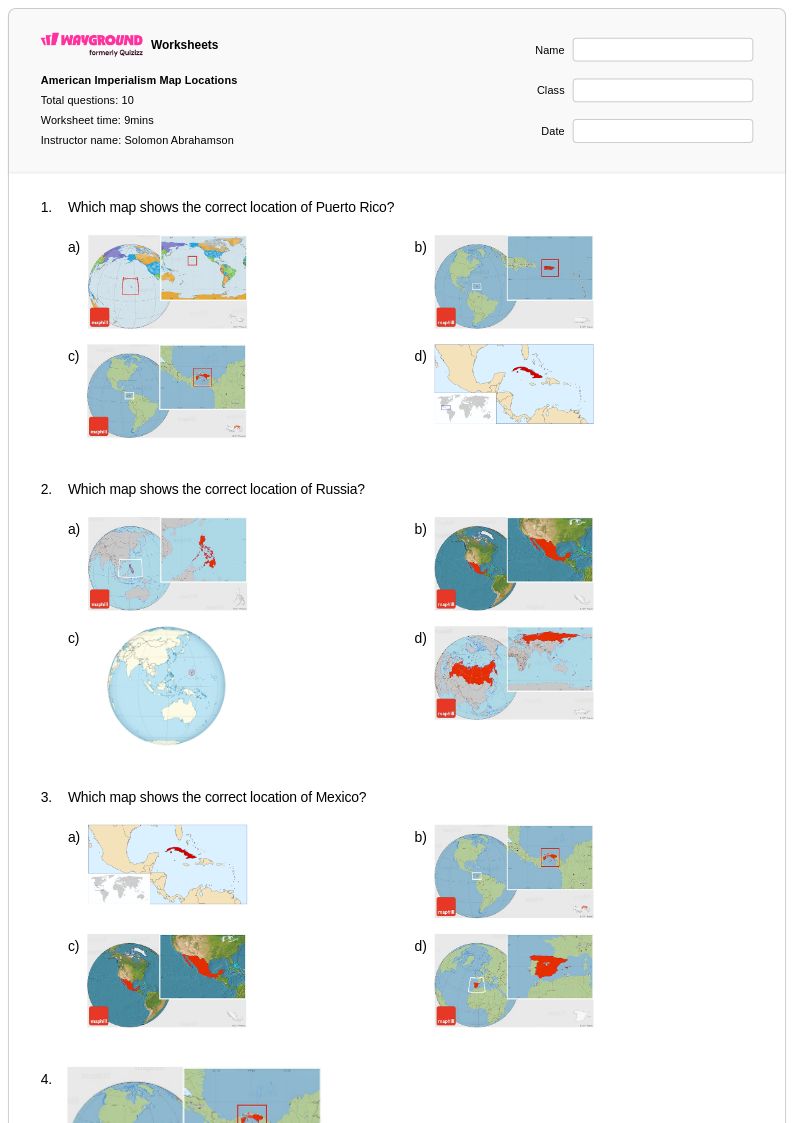
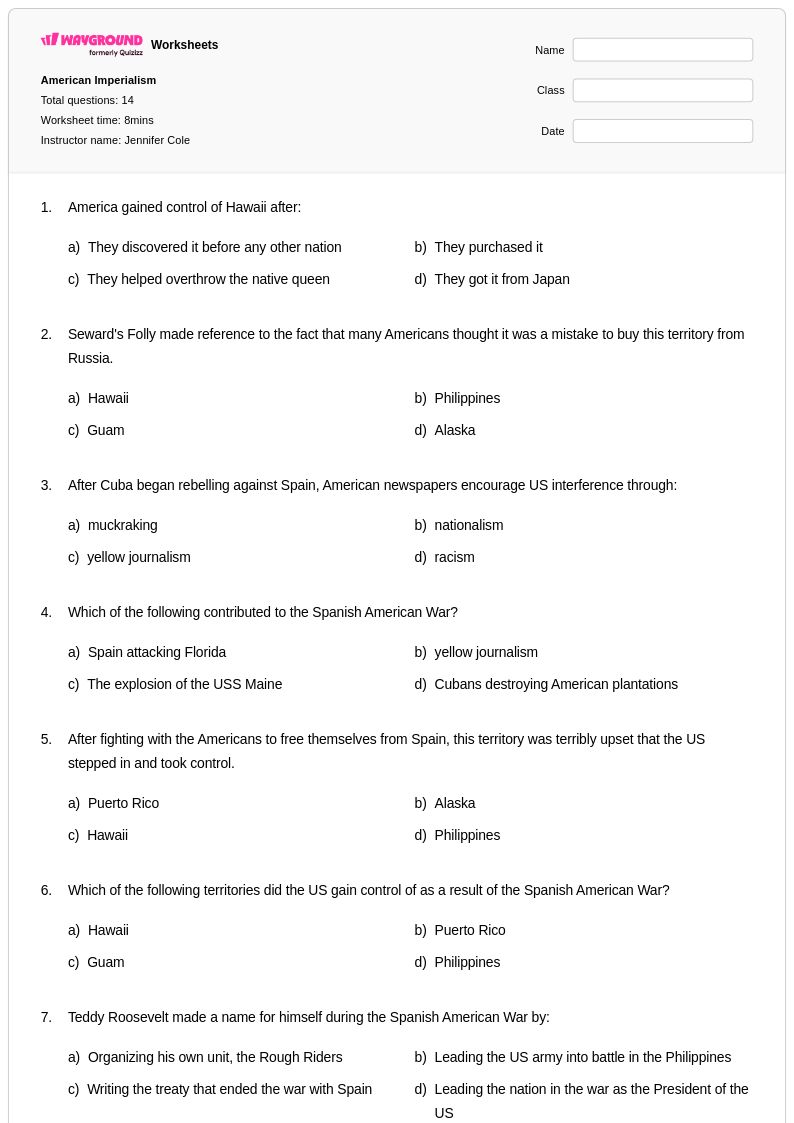
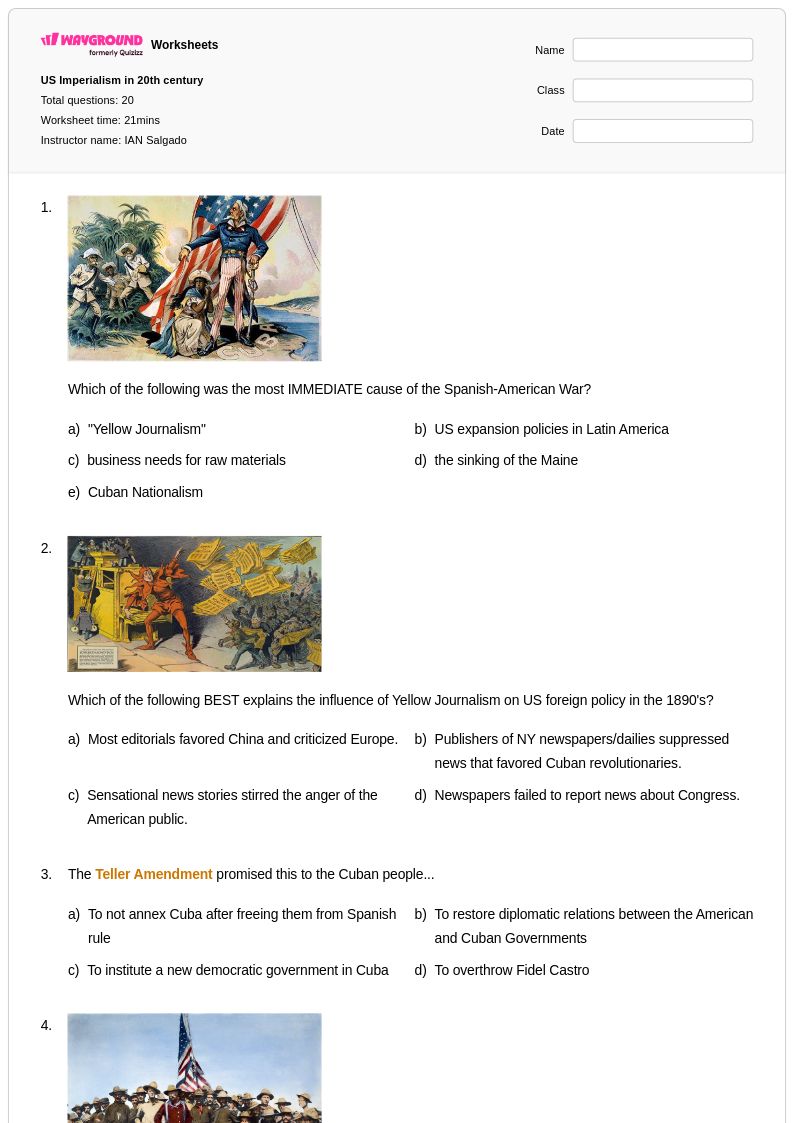
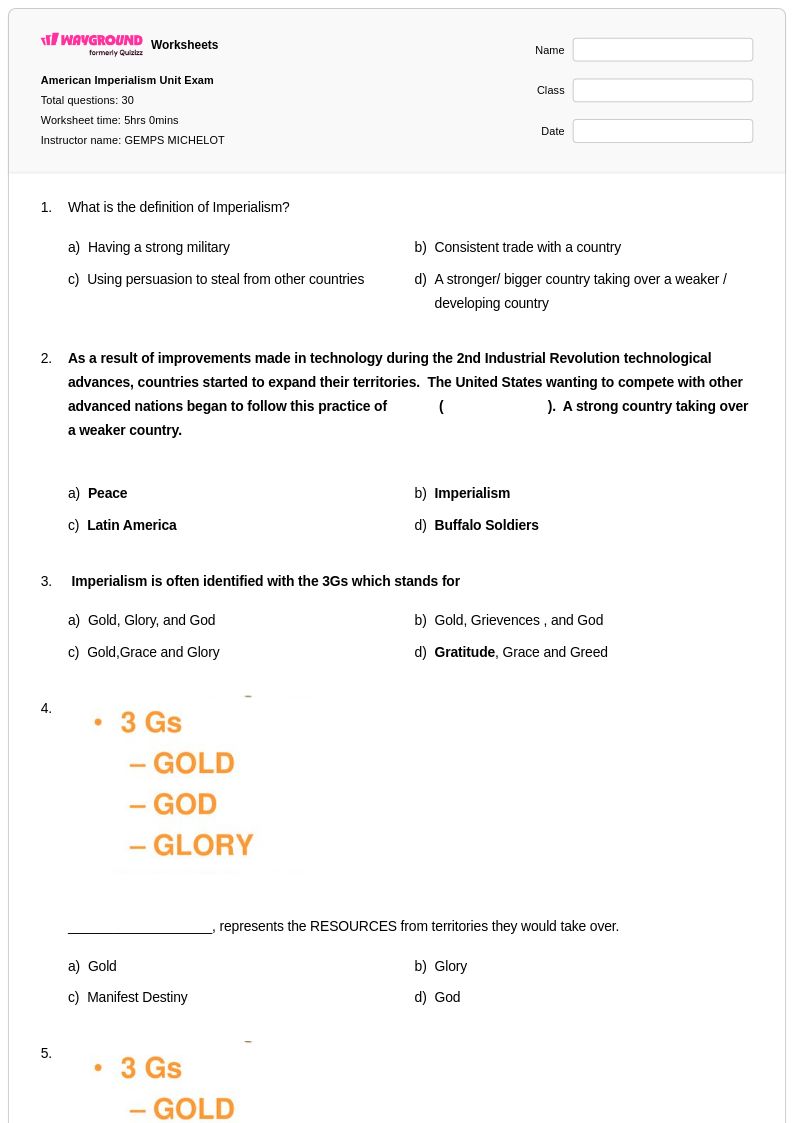
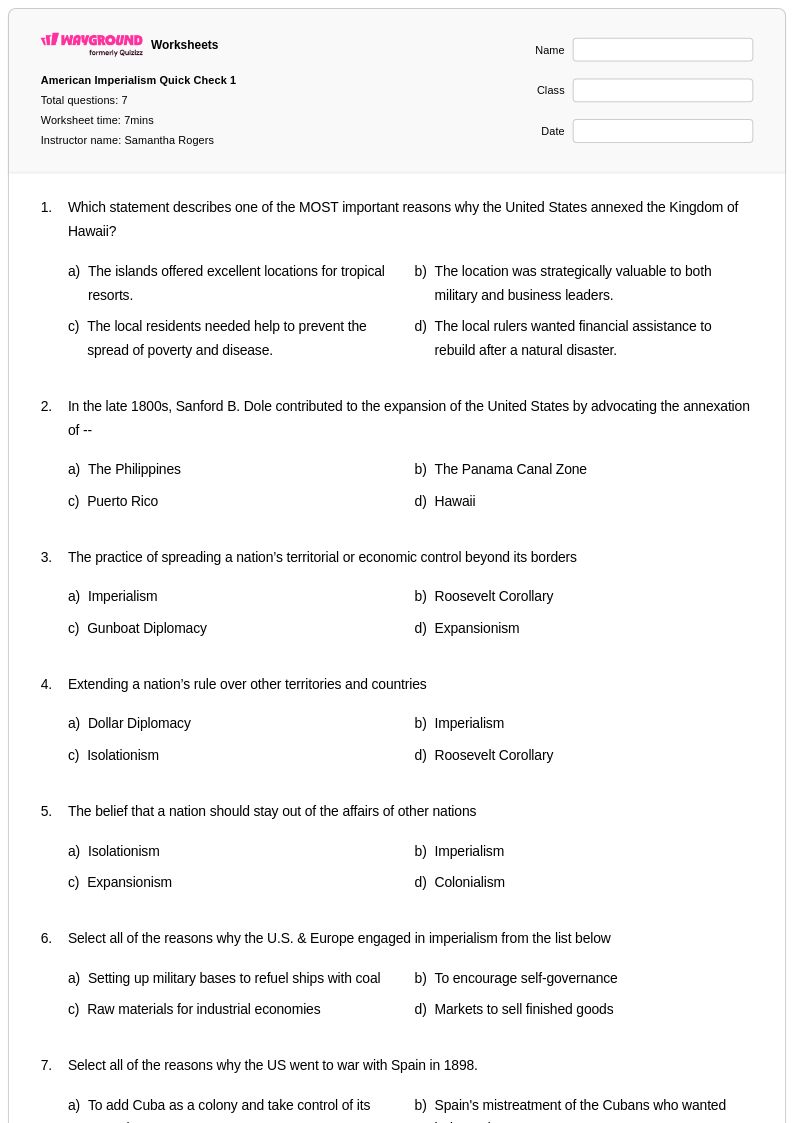
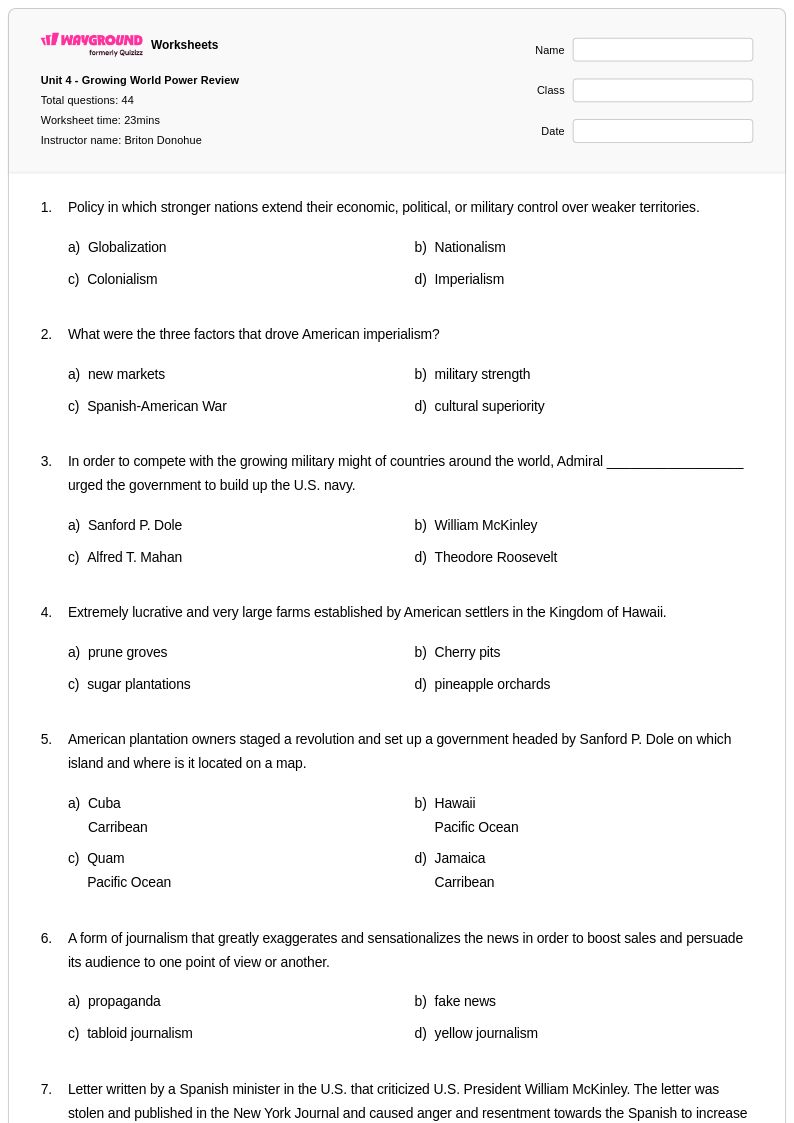
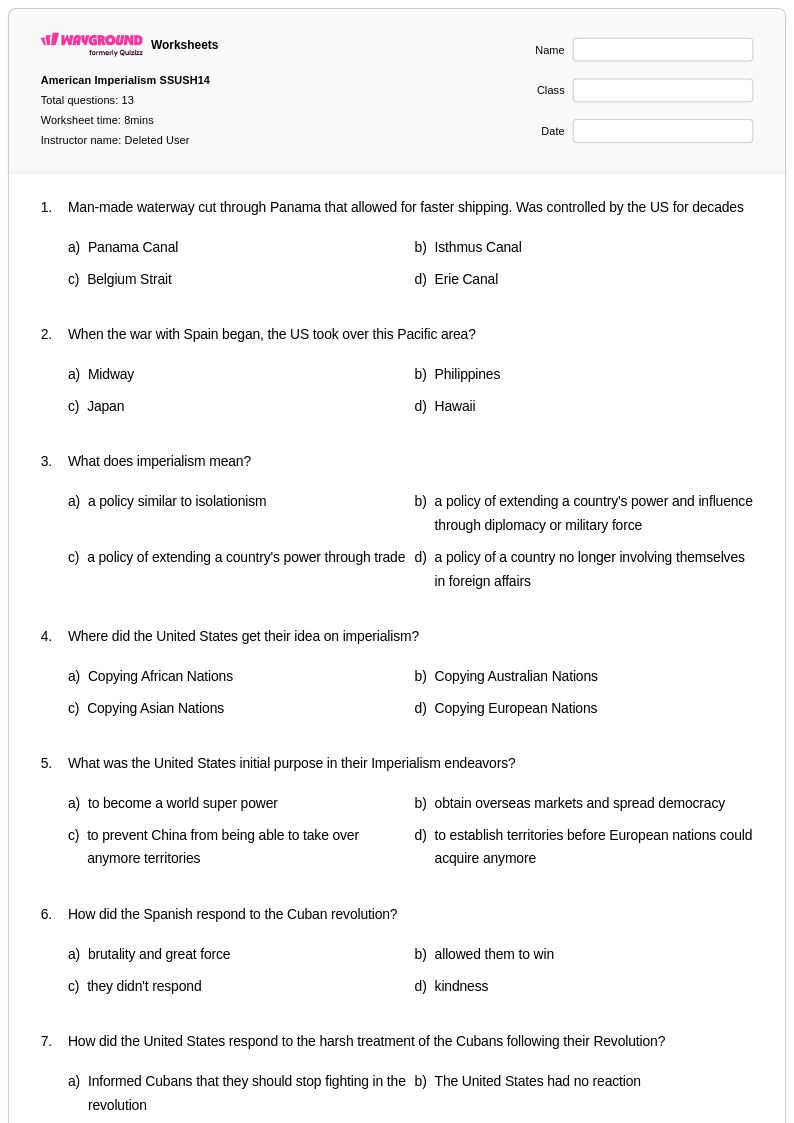
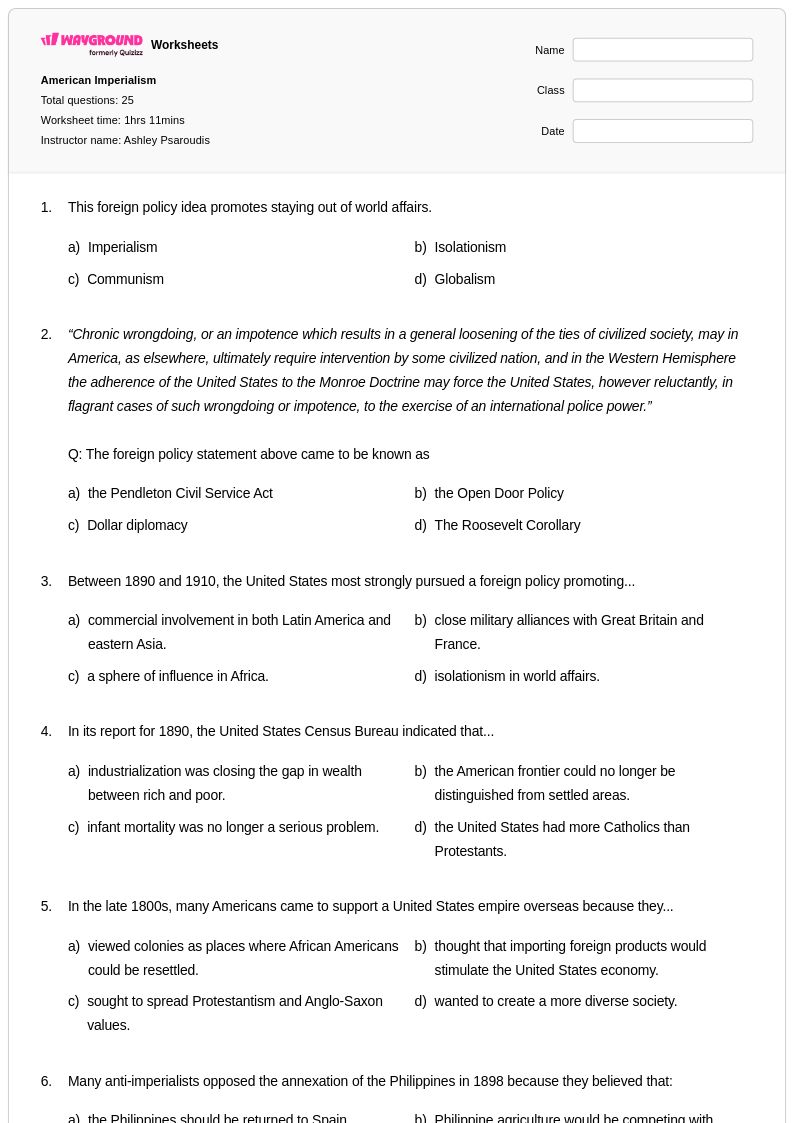
Explore Wayground's free American Imperialism worksheets and printables that help students analyze U.S. expansionist policies, practice with primary sources, and master key historical concepts through engaging PDF activities with comprehensive answer keys.
American Imperialism worksheets available through Wayground (formerly Quizizz) provide comprehensive coverage of this pivotal period in U.S. History when the nation emerged as a global power in the late 19th and early 20th centuries. These educational resources strengthen students' analytical skills by examining the causes, methods, and consequences of American expansion beyond continental borders, including the Spanish-American War, acquisition of territories like Puerto Rico and the Philippines, and the development of policies such as the Roosevelt Corollary to the Monroe Doctrine. Each worksheet includes carefully crafted practice problems that challenge students to evaluate primary sources, analyze political cartoons, and assess the economic and political motivations behind imperialist policies. Teachers can access free printables with comprehensive answer keys that facilitate efficient grading and provide clear explanations for complex historical concepts, while pdf formats ensure consistent formatting across different devices and printing systems.
Wayground's extensive collection draws from millions of teacher-created resources, offering educators unparalleled access to diverse American Imperialism materials that align with national and state social studies standards. The platform's robust search and filtering capabilities allow teachers to quickly locate worksheets that match specific learning objectives, whether focusing on the Anti-Imperialist League's arguments, the impact of the Open Door Policy in China, or the cultural and social effects of territorial expansion. Differentiation tools enable educators to customize content difficulty levels and modify assignments to meet diverse student needs, while the availability of both printable and digital formats provides flexibility for various classroom environments and remote learning situations. These comprehensive resources support effective lesson planning by offering ready-to-use materials for skill practice, targeted remediation for struggling students, and enrichment opportunities for advanced learners exploring the complex legacy of American imperialism in shaping modern foreign policy.
FAQs
How do I teach American Imperialism in a U.S. History class?
Teaching American Imperialism effectively means grounding students in the economic, political, and ideological motivations that drove U.S. expansion in the late 19th and early 20th centuries. Start with the causes — Manifest Destiny's extension overseas, Alfred Thayer Mahan's naval power arguments, and the economic demand for new markets — before moving into specific events like the Spanish-American War and the acquisition of Puerto Rico, Guam, and the Philippines. Incorporating primary sources and political cartoons helps students engage critically with how imperialism was both promoted and contested domestically, including through the Anti-Imperialist League.
What are good activities for practicing American Imperialism concepts?
Primary source analysis and political cartoon interpretation are among the most effective practice activities for American Imperialism because they require students to evaluate perspective, bias, and historical context simultaneously. Document-based questions (DBQs) focused on the Roosevelt Corollary, the Open Door Policy, or the debate over Philippine annexation push students to construct evidence-based arguments. Comparing the economic and strategic motivations behind different territorial acquisitions also reinforces the broader patterns of U.S. expansionist policy during this period.
What mistakes do students commonly make when studying American Imperialism?
A common misconception is that American Imperialism began and ended with the Spanish-American War of 1898 — students often underestimate the longer arc of U.S. expansionism that included Hawaii, Samoa, and interventions across Latin America and Asia. Students also frequently confuse the territories acquired after 1898, conflating the political status of Puerto Rico, Guam, and the Philippines rather than recognizing their distinct legal and colonial relationships with the United States. Another recurring error is treating imperialism as purely military when economic motivations, such as access to Asian markets via the Open Door Policy, were equally central to U.S. foreign policy decisions.
How can I assess whether students understand the causes and consequences of American Imperialism?
Strong assessments for American Imperialism ask students to do more than recall events — they should require students to analyze causation and evaluate consequences across political, economic, and social dimensions. Effective assessment tasks include comparing arguments made by imperialists and anti-imperialists, analyzing how the Roosevelt Corollary extended the Monroe Doctrine, or evaluating the long-term impact of U.S. territorial expansion on colonized populations. Short constructed-response questions tied to primary sources are particularly useful for gauging whether students can apply historical thinking skills, not just memorize dates and names.
How do I use American Imperialism worksheets from Wayground in my classroom?
Wayground's American Imperialism worksheets are available as printable PDFs for traditional classroom use and in digital formats for technology-integrated or remote learning environments, and can also be hosted as a quiz directly on the Wayground platform. Each worksheet includes a comprehensive answer key, which streamlines grading and gives teachers clear explanations for complex historical concepts. For teachers working with diverse learners, Wayground supports accommodations such as read aloud, extended time, and reduced answer choices, which can be assigned to individual students without disrupting the rest of the class.
How do I differentiate American Imperialism instruction for students at different skill levels?
For students who are still building foundational knowledge, scaffold instruction by focusing first on the Spanish-American War as a concrete entry point before introducing broader policy frameworks like the Monroe Doctrine and Roosevelt Corollary. Advanced students can be challenged with deeper analysis of the Anti-Imperialist League's arguments or comparative study of how U.S. imperialism paralleled and differed from European colonial practices. On Wayground, teachers can apply individual accommodations — including reduced answer choices and read aloud — to specific students, so differentiation happens at the assignment level without requiring the creation of entirely separate materials.