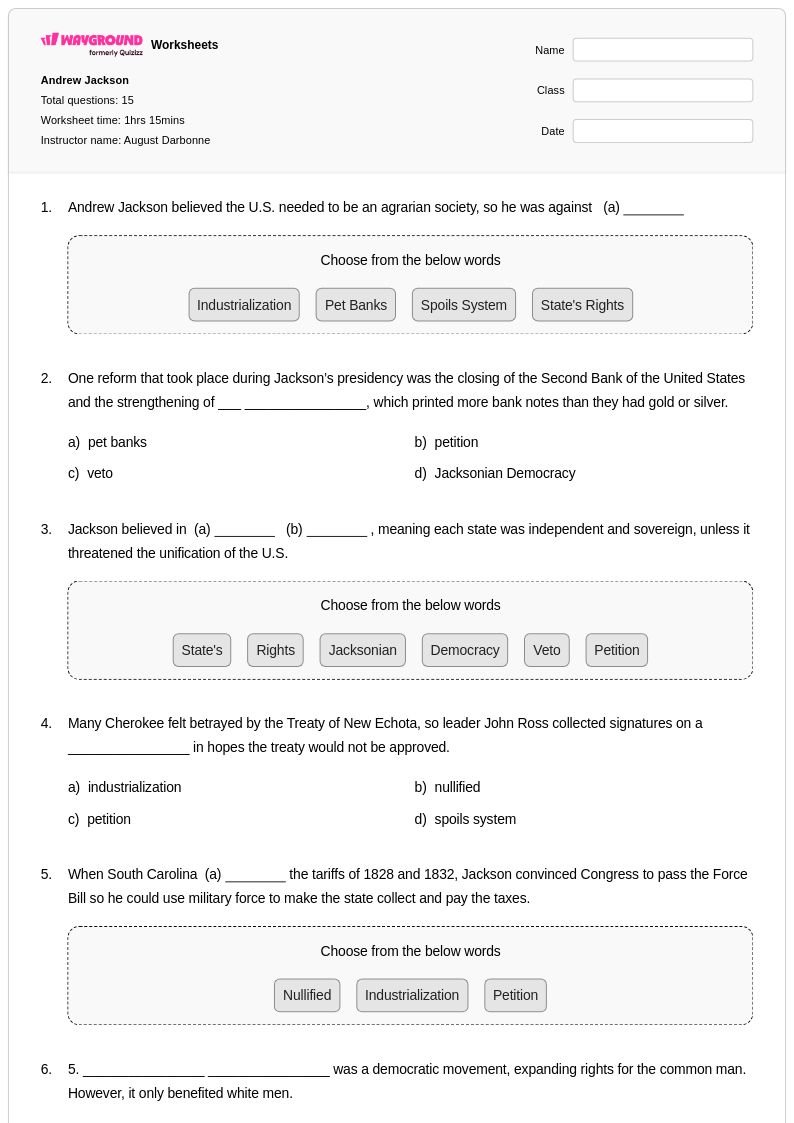
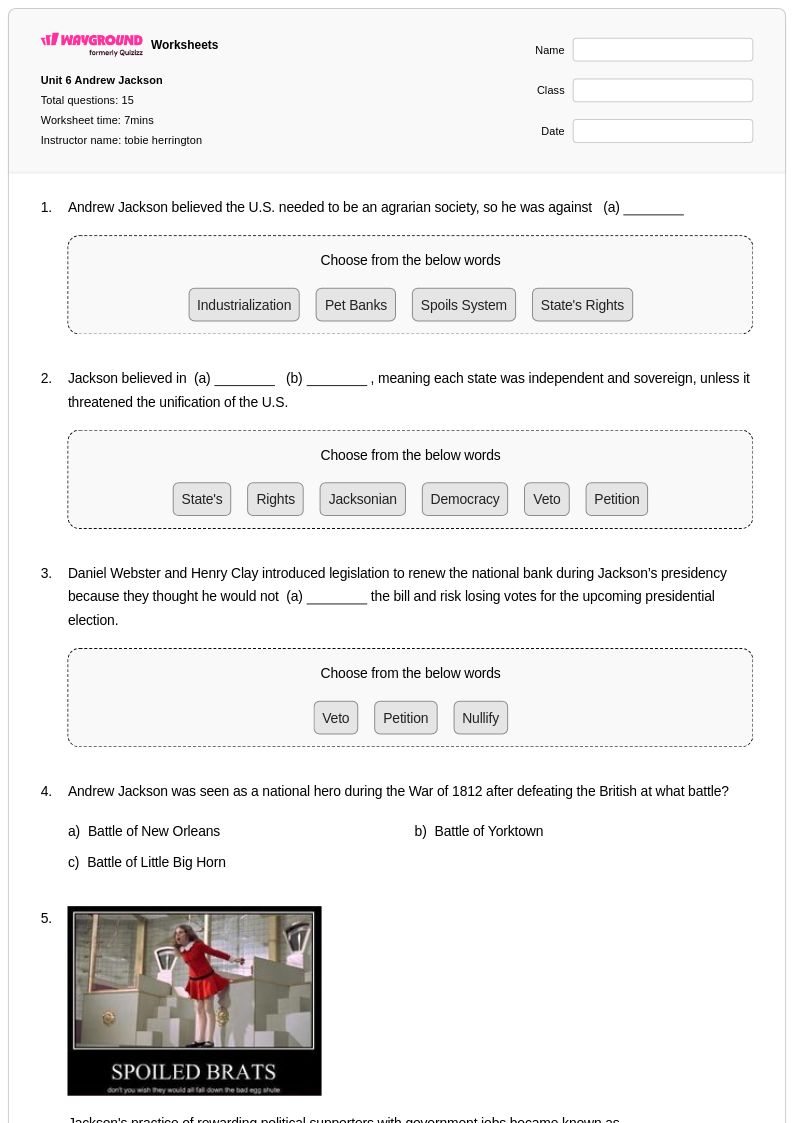
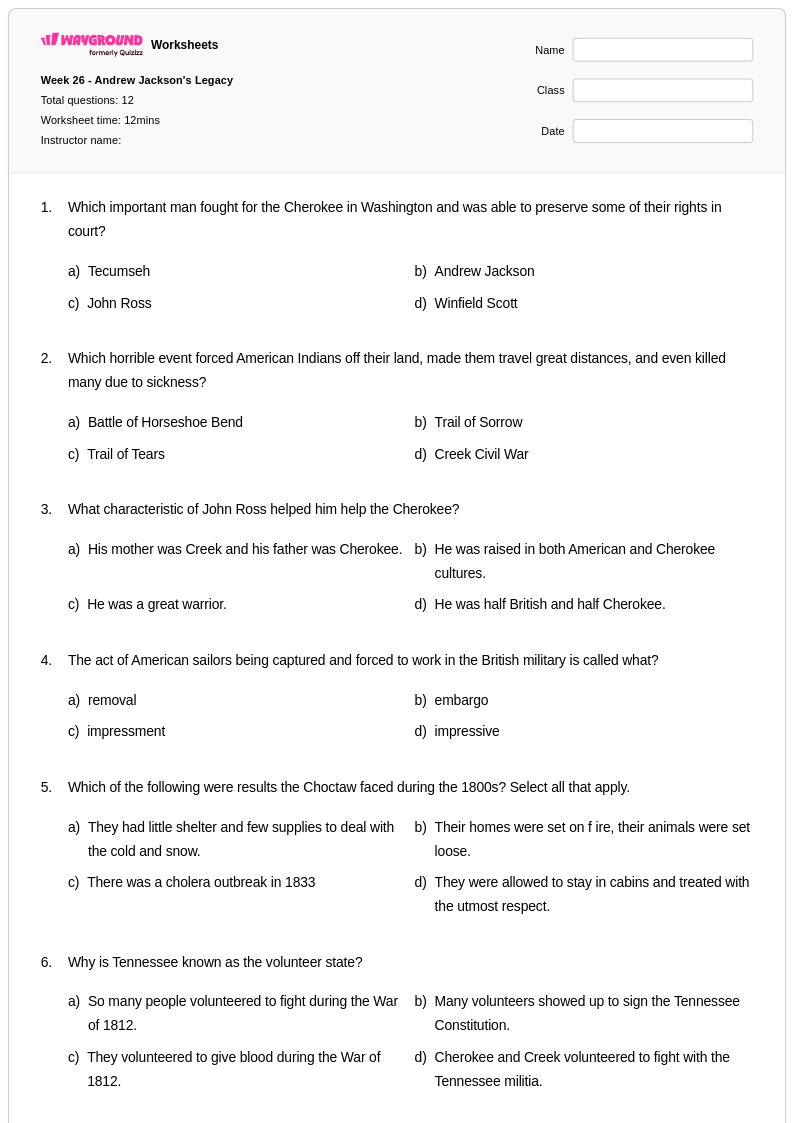
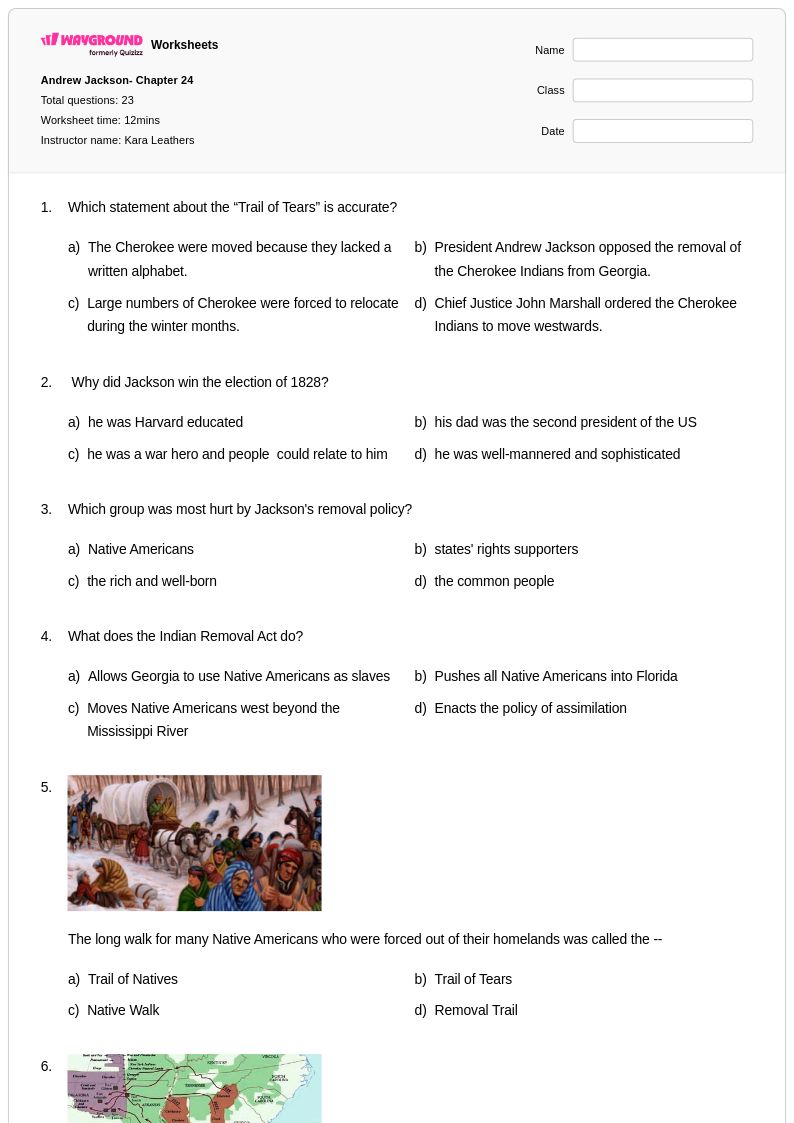
Explore Wayground's comprehensive collection of free Andrew Jackson worksheets and printables that help students analyze the seventh president's policies, presidency, and historical impact through engaging practice problems with answer keys.
Andrew Jackson worksheets available through Wayground (formerly Quizizz) provide comprehensive coverage of one of America's most controversial and influential presidents, offering students detailed exploration of his presidency, policies, and lasting impact on American democracy. These expertly crafted resources examine Jackson's rise from frontier origins to the White House, his implementation of the spoils system, the Indian Removal Act and Trail of Tears, his battle against the National Bank, and his role in expanding democratic participation while simultaneously concentrating executive power. Each worksheet includes structured practice problems that guide students through primary source analysis, cause-and-effect relationships, and critical evaluation of Jackson's complex legacy, with complete answer keys provided to support both independent study and classroom instruction. These free printables strengthen essential historical thinking skills including chronological reasoning, crafting historical arguments, and analyzing the tension between democratic ideals and their implementation in early 19th-century America.
Wayground (formerly Quizizz) empowers educators with millions of teacher-created Andrew Jackson resources that streamline lesson planning and accommodate diverse learning needs in the social studies classroom. The platform's robust search and filtering capabilities allow teachers to quickly locate materials aligned with state standards and specific curriculum requirements, whether focusing on Jackson's military career, his presidency's democratic reforms, or the humanitarian consequences of his Indian policies. Advanced differentiation tools enable seamless customization of content difficulty and format, supporting both remediation for struggling learners and enrichment opportunities for advanced students, while flexible delivery options include printable pdf worksheets for traditional classroom use and digital formats for interactive learning environments. These comprehensive features facilitate targeted skill practice in historical analysis, support varied instructional approaches from direct teaching to collaborative inquiry, and provide the adaptability necessary for effective differentiated instruction in studying this pivotal figure in American political development.
FAQs
How do I teach Andrew Jackson's presidency to middle or high school students?
Teaching Andrew Jackson effectively means presenting him as a figure of genuine contradiction: a champion of expanded democracy for white male citizens who simultaneously authorized the forced removal of Native American nations. Start with his frontier origins and Battle of New Orleans to establish his public image, then move into the spoils system, the Bank War, and the Indian Removal Act so students can trace how his ideology played out in policy. Primary source analysis, such as reading excerpts from his veto message or Cherokee petitions, helps students evaluate his presidency rather than simply memorize it.
What exercises help students practice analyzing Andrew Jackson's policies?
Cause-and-effect graphic organizers work well for connecting Jackson's political beliefs to specific policy outcomes, such as linking his distrust of federal institutions to his veto of the National Bank recharter. Primary source comparison exercises, where students read both pro-Jackson and anti-Jackson perspectives, build the critical evaluation skills central to historical thinking. Worksheets that ask students to assess Jackson's legacy across multiple stakeholder groups, including white settlers, Native Americans, and wealthy elites, are especially effective for developing nuanced historical arguments.
What common mistakes do students make when learning about Andrew Jackson?
The most frequent misconception is treating Jackson as simply either a democratic hero or a villain, rather than analyzing the tension between those two realities. Students often conflate "Jacksonian Democracy" with universal democracy, failing to recognize that expanded political participation was largely limited to white men. Another common error is treating the Trail of Tears as an isolated event rather than a direct consequence of the Indian Removal Act and Jackson's broader policy of dispossessing Native nations east of the Mississippi.
How do I help students understand the Trail of Tears in the context of Jackson's presidency?
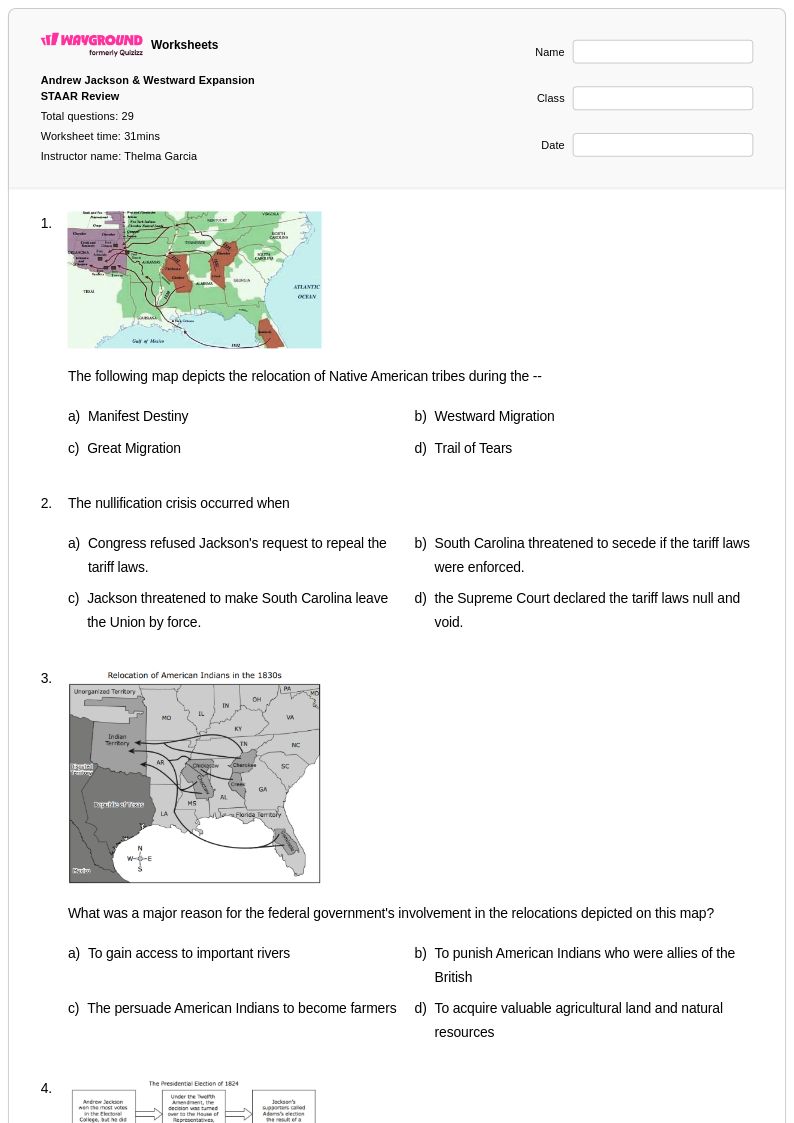
Students need to first understand the Indian Removal Act of 1830 as deliberate federal policy before they can grasp the Trail of Tears as its human outcome. Mapping exercises that show the geographic scope of removal and timeline activities connecting congressional passage of the Act to the forced marches of the late 1830s help students see cause and consequence clearly. Pairing Cherokee primary sources with Jackson's own statements gives students the tools to evaluate accountability rather than simply record events.
How can I use Andrew Jackson worksheets in my classroom?
Andrew Jackson worksheets on Wayground are available as printable PDFs for traditional classroom use and in digital formats for technology-integrated or hybrid learning environments, including the option to host them as a quiz on Wayground. Printable versions work well for structured note-taking, in-class analysis activities, or assessment. Digital formats allow for self-paced independent study or formative checks during a unit on Jacksonian America. For students who need additional support, Wayground's accommodation tools, such as read aloud and extended time, can be applied individually without disrupting the rest of the class.
How do I differentiate Andrew Jackson instruction for students at different levels?
For struggling learners, scaffolded worksheets that break Jackson's presidency into discrete chronological events, such as the Nullification Crisis, the Bank War, and Indian Removal, help build a manageable framework before asking for synthesis. Advanced students benefit from tasks that require them to craft a historical argument about Jackson's legacy using primary and secondary sources. On Wayground, teachers can apply individual accommodations such as reduced answer choices or read aloud to specific students, while the rest of the class works with standard settings, making differentiation seamless and discreet.