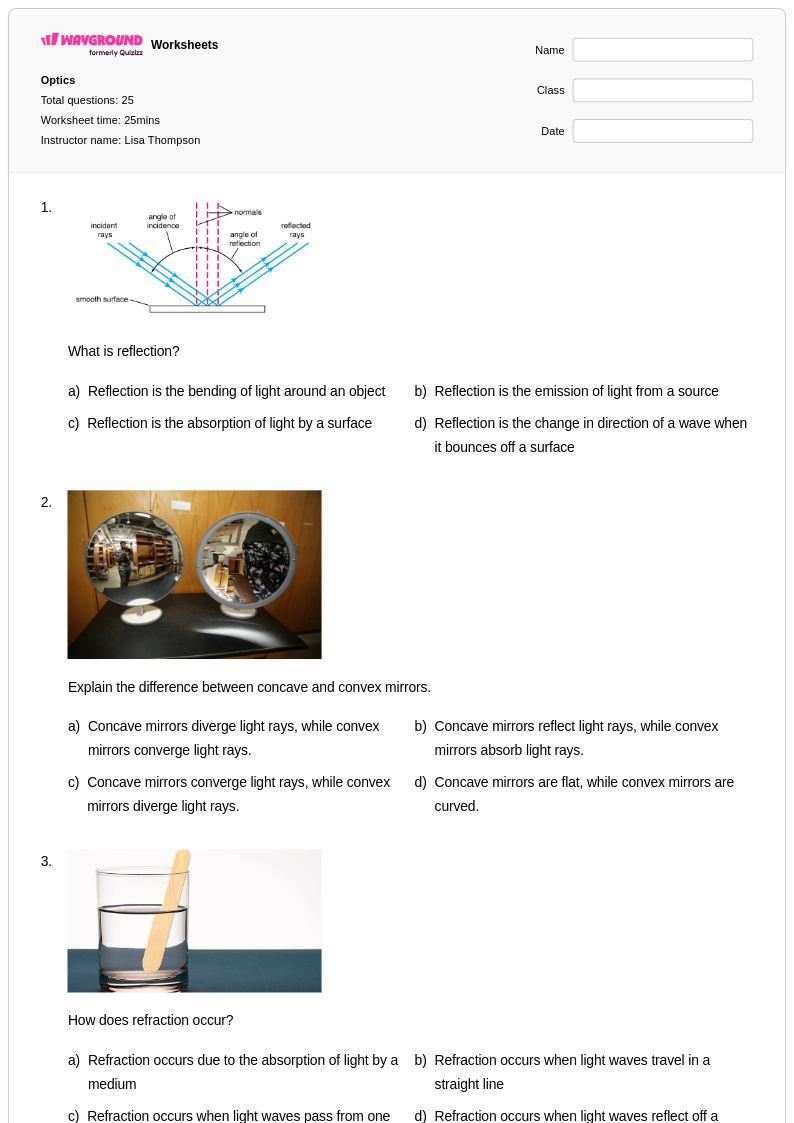
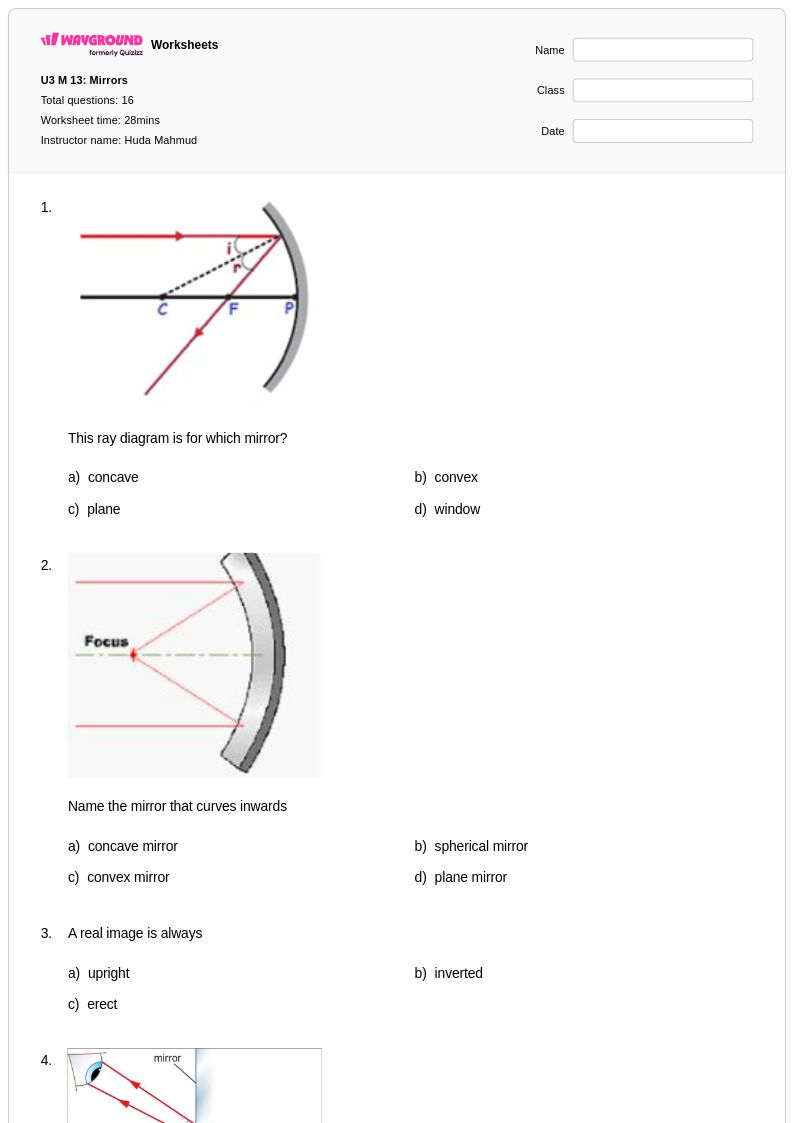
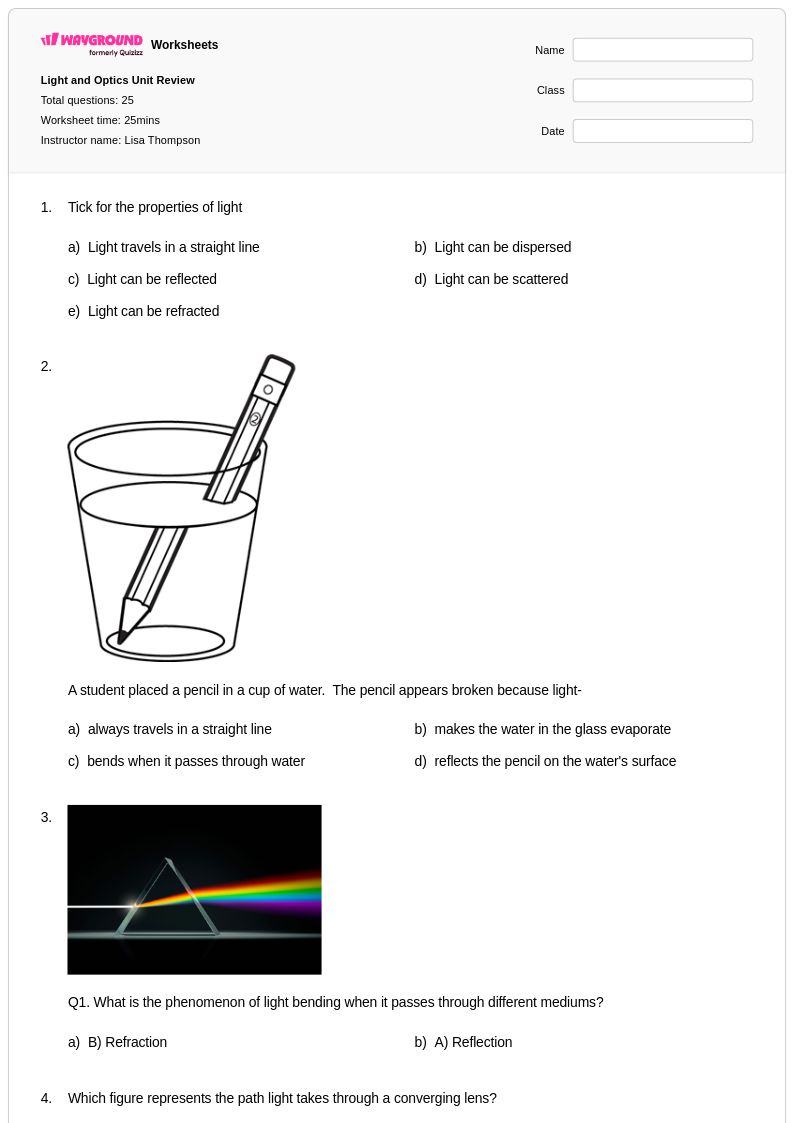
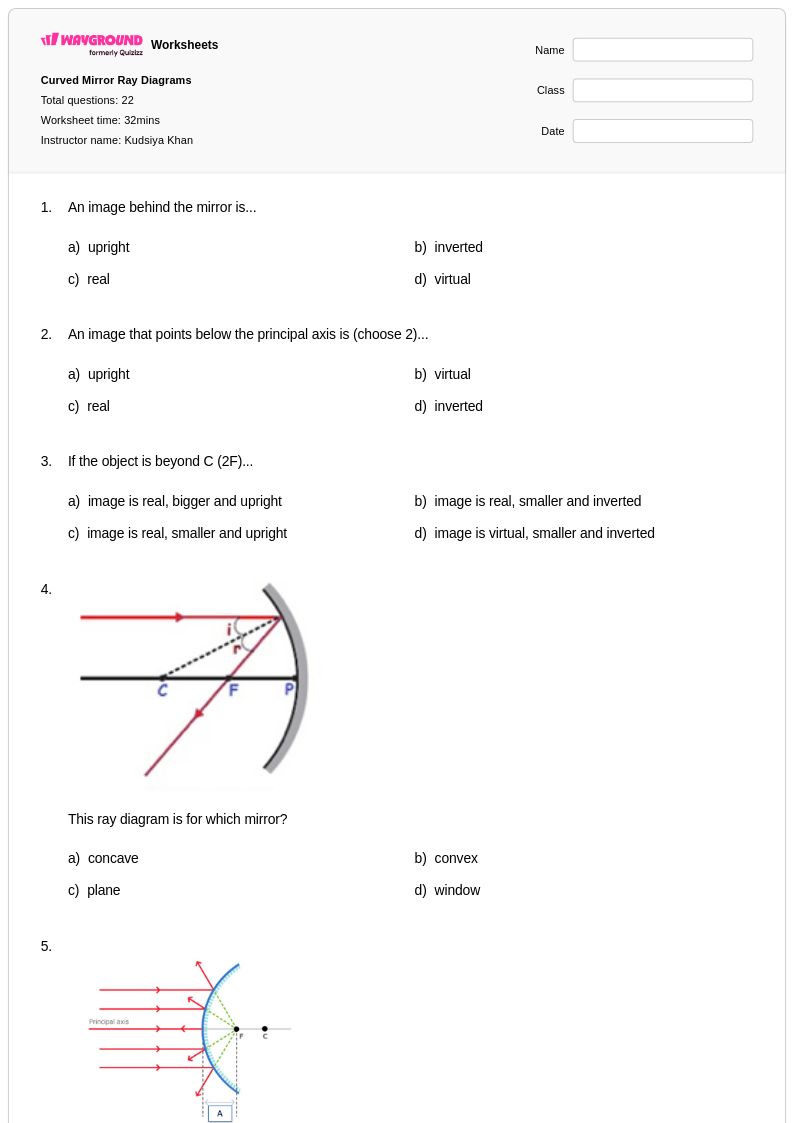
Free Printable Convex Mirrors Worksheets for Grade 9
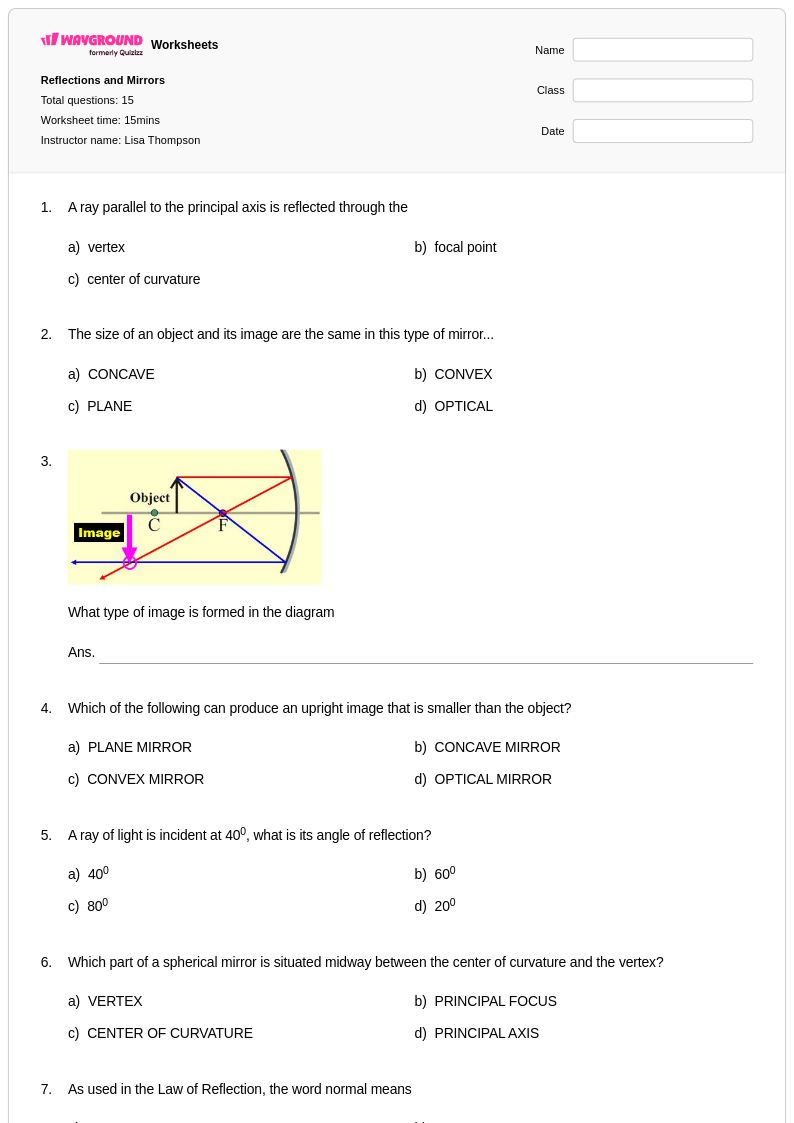
Explore Grade 9 convex mirrors worksheets and printables that help students master curved mirror properties, image formation, and ray diagrams through engaging practice problems with complete answer keys.
Explore printable Convex Mirrors worksheets for Grade 9
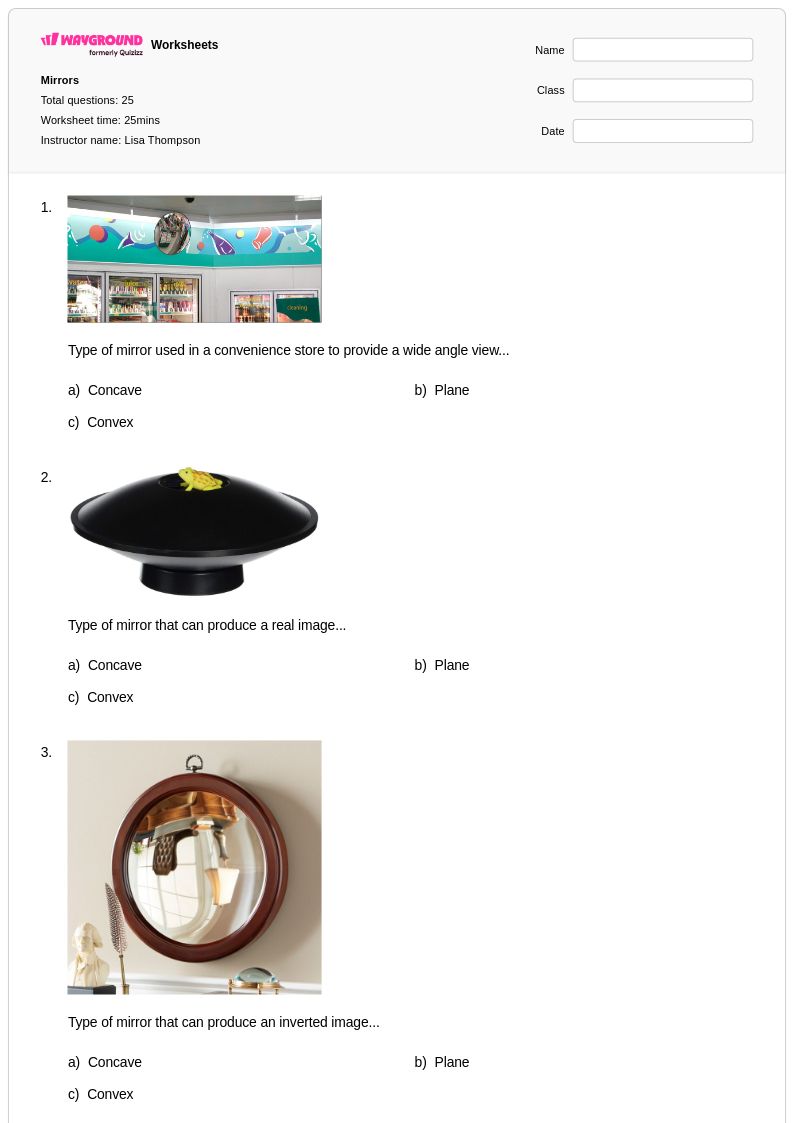
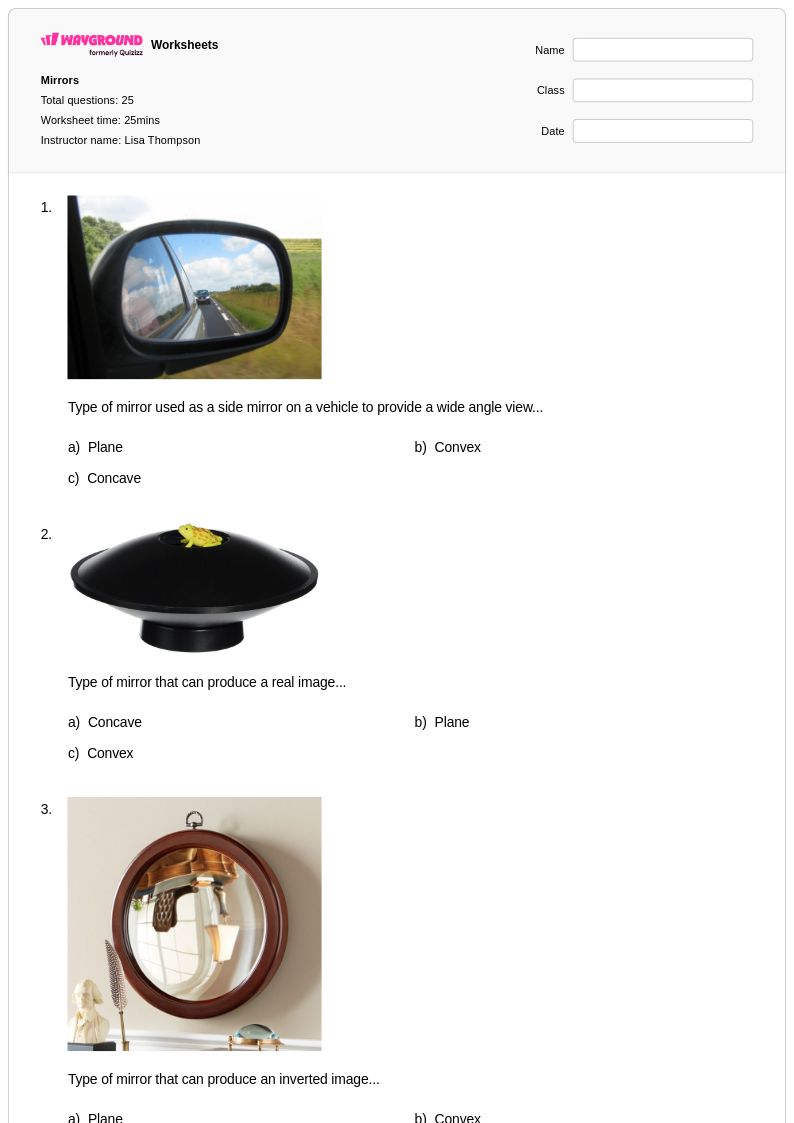
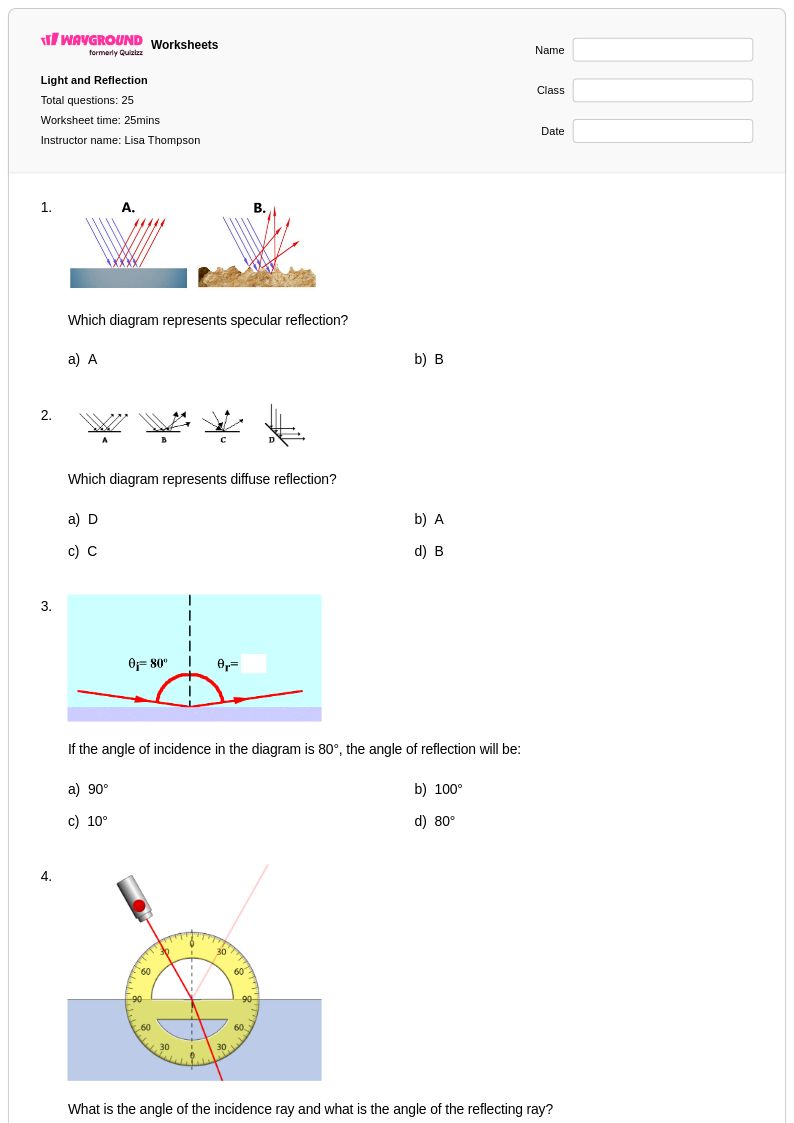
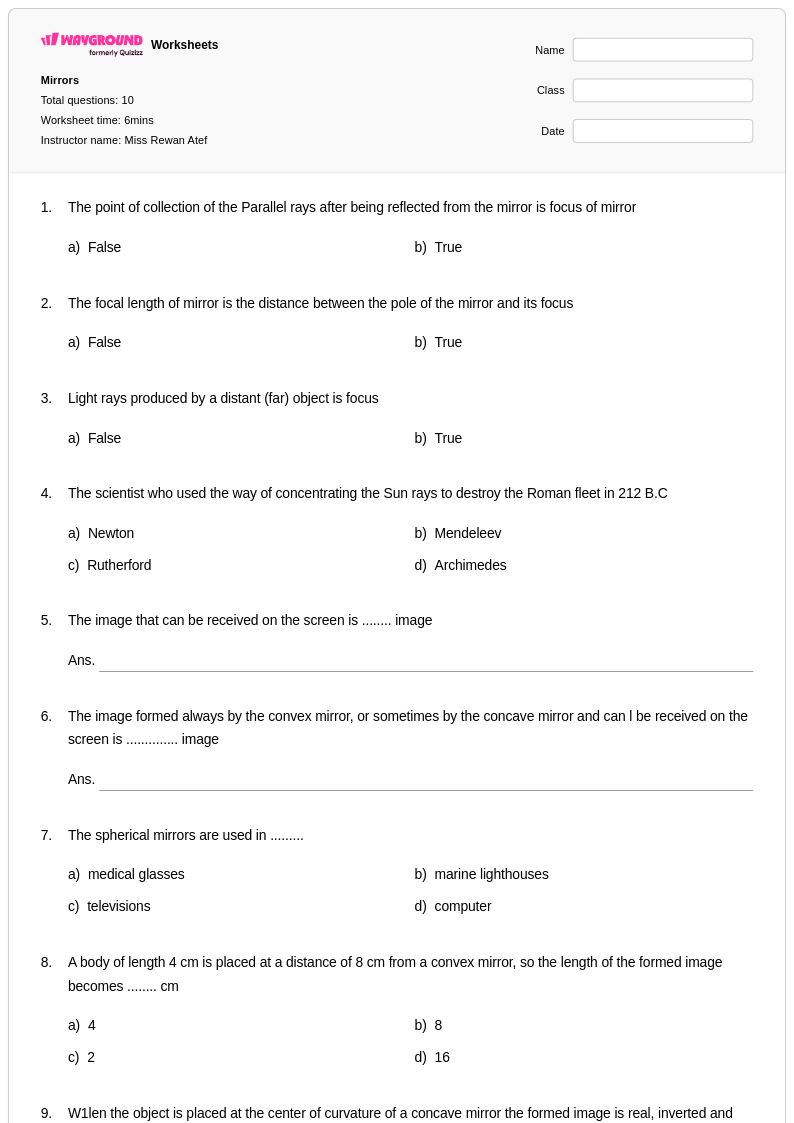
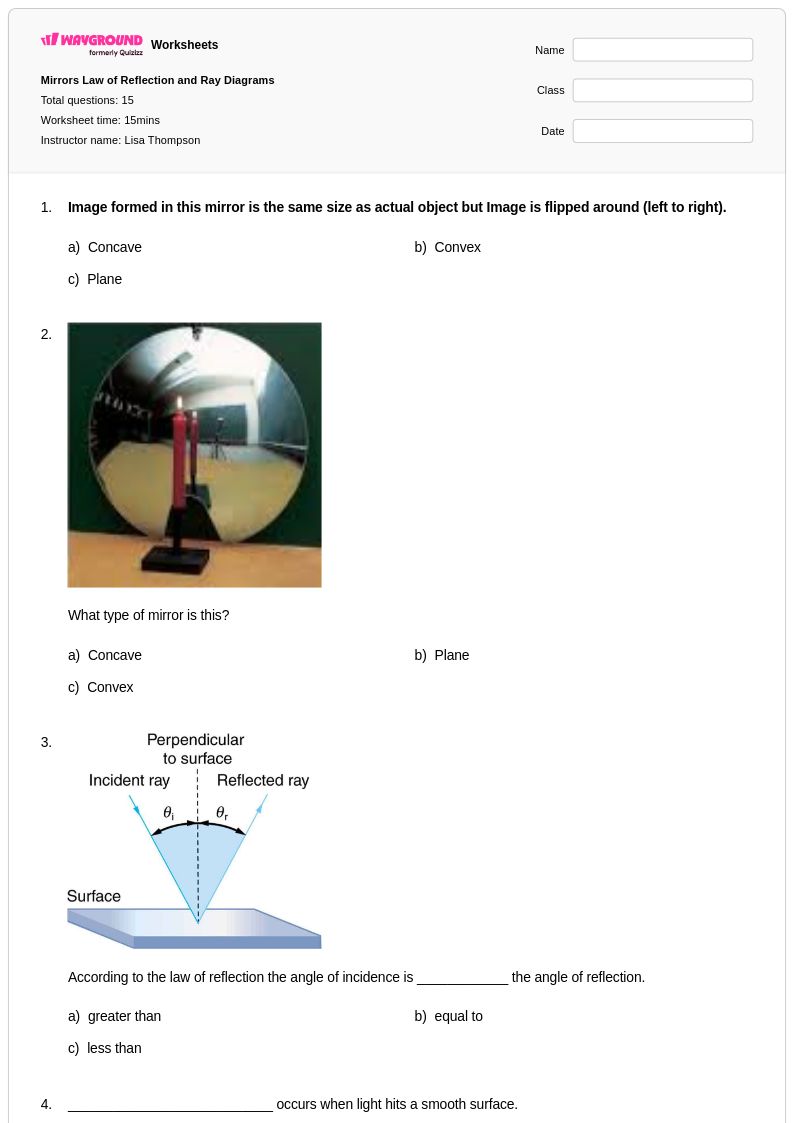
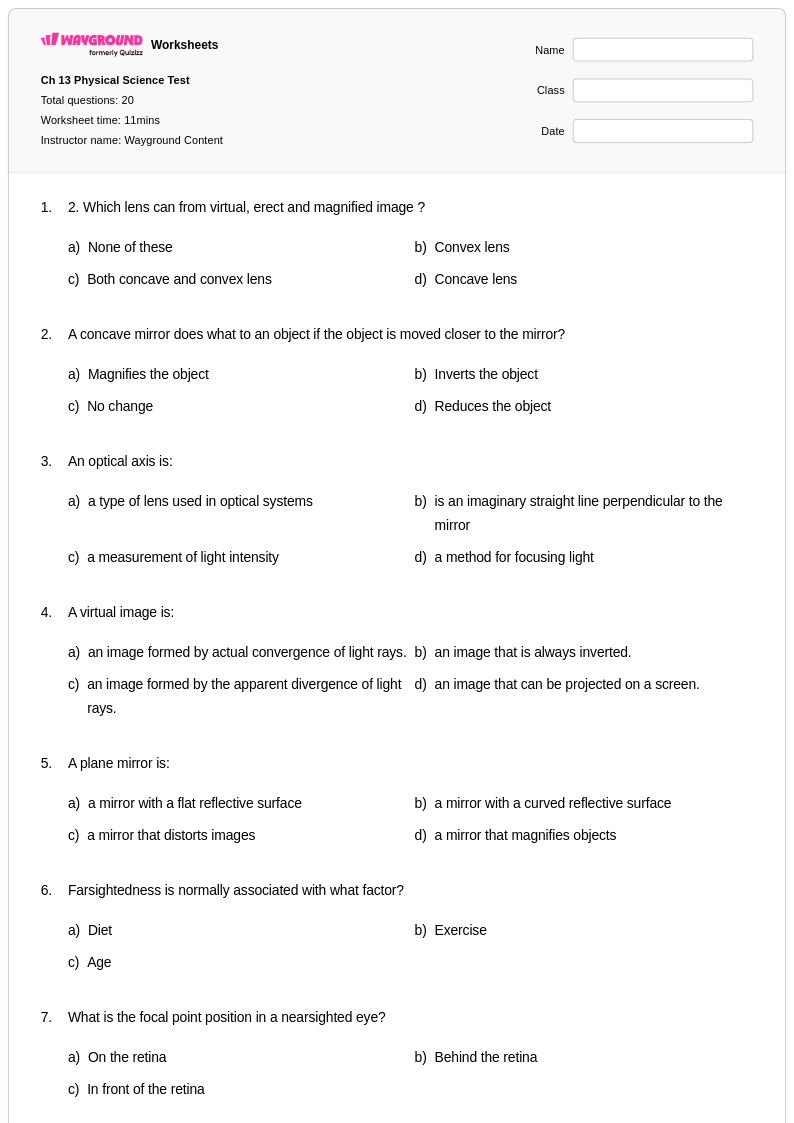
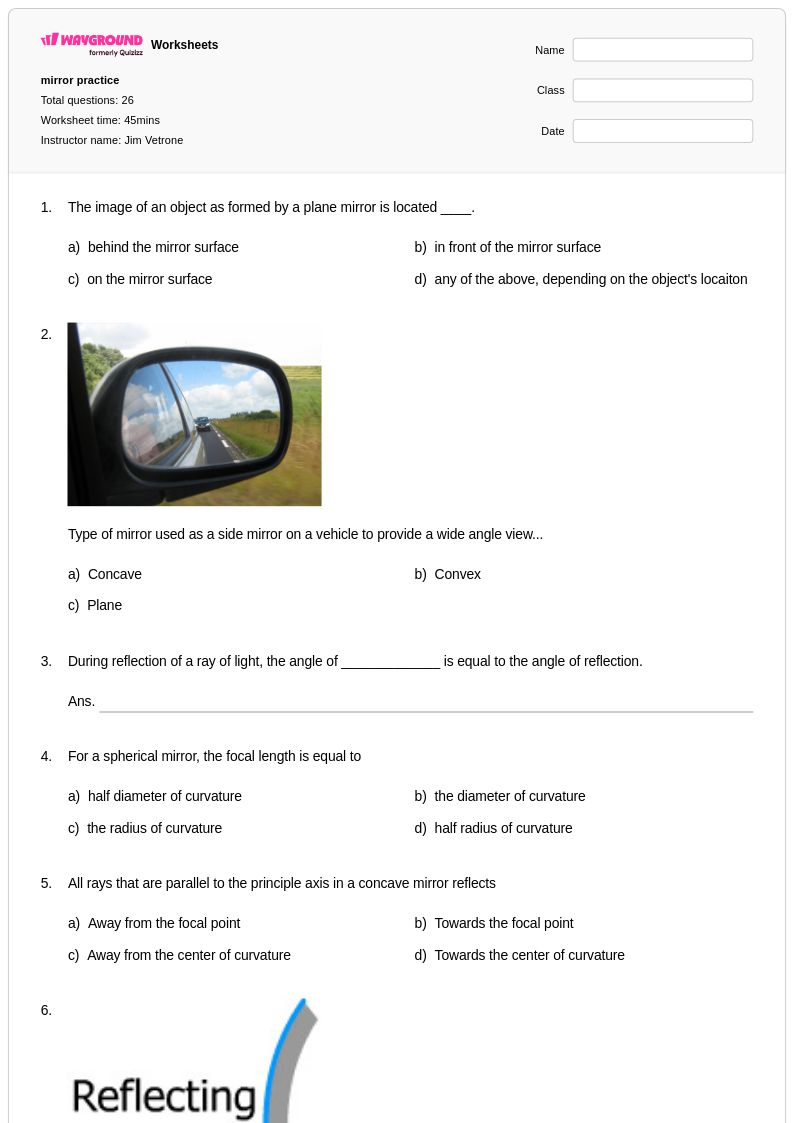
Convex mirrors present unique optical properties that Grade 9 physics students must master to understand how curved surfaces affect light reflection and image formation. Wayground's comprehensive collection of convex mirror worksheets provides targeted practice problems that guide students through essential concepts including focal length calculations, image characteristics, and real-world applications of these diverging mirrors. These carefully crafted printables strengthen critical thinking skills as students analyze how convex mirrors always produce virtual, upright, and diminished images regardless of object distance. Each worksheet includes detailed answer keys that support independent learning and self-assessment, while the free pdf format ensures accessibility for both classroom instruction and home study sessions.
Wayground's extensive library draws from millions of teacher-created resources specifically designed to support physics educators in delivering effective convex mirror instruction for Grade 9 students. The platform's advanced search and filtering capabilities enable teachers to quickly locate worksheets that align with specific learning standards and match their students' skill levels, facilitating seamless lesson planning and targeted remediation. Differentiation tools allow educators to customize these convex mirror practice materials for diverse learning needs, while the dual availability in printable and digital pdf formats provides maximum flexibility for various teaching environments. Whether used for initial skill development, enrichment activities, or assessment preparation, these thoughtfully curated worksheet collections empower teachers to address individual student needs while maintaining rigorous academic standards in physics education.
FAQs
How do I teach convex mirrors to physics students?
Start by contrasting convex mirrors with concave mirrors so students understand that the reflecting surface curves outward, placing the focal point behind the mirror. Use ray diagrams early and often — drawing the three principal rays (parallel to axis, through the focal point, and through the center of curvature) helps students visualize why convex mirrors always produce virtual, upright, and diminished images. Once students grasp the geometric reasoning, introduce the mirror equation (1/f = 1/do + 1/di) and magnification formula with the sign conventions specific to convex mirrors, where focal length is always negative.
What are good practice exercises for convex mirror problems?
Effective practice should move from qualitative to quantitative: begin with ray diagram construction for various object distances, then progress to mirror equation calculations solving for image distance, focal length, and magnification. Students benefit from problems that require them to interpret the sign of the image distance — confirming that di is always negative for convex mirrors — and connect the math back to the physical meaning of a virtual, upright, diminished image. Including real-world application problems, such as calculating the field of view for a security mirror, builds engagement and contextual understanding.
What mistakes do students commonly make when solving convex mirror problems?
The most frequent error is sign convention confusion: students often assign a positive focal length to a convex mirror, which leads to incorrect image distance values and the wrong image type. A related mistake is assuming convex mirrors can produce real images under some conditions, when in fact they always produce virtual images. Students also frequently misread magnification results, interpreting a value between 0 and 1 as an error rather than correctly identifying it as a diminished image.
How do I help struggling students understand ray diagrams for convex mirrors?
Struggling students often benefit from a side-by-side comparison of concave and convex ray diagrams so the differences are made explicit rather than assumed. On Wayground, teachers can enable the Read Aloud feature so written problem instructions are read to students who process auditory information more effectively, and the reduced answer choices accommodation can lower cognitive load for students who become overwhelmed by complex multi-step optics problems. Building from single-ray tracing exercises before requiring full three-ray diagrams also scaffolds the skill more effectively.
How can I use Wayground's convex mirrors worksheets in my classroom?
Wayground's convex mirrors worksheets are available as printable PDFs for traditional classroom use and in digital formats for technology-integrated learning environments, including the option to host them as a quiz directly on Wayground. The printable format works well for in-class practice or homework, while the digital format allows teachers to assign problems remotely, track student responses, and apply individual accommodations such as extended time or read aloud for students who need them. Each worksheet includes a complete answer key, supporting independent student review and efficient teacher grading.
How do convex mirrors differ from concave mirrors in terms of image formation?
Convex mirrors always produce virtual, upright, and diminished images regardless of where the object is placed, because the focal point lies behind the reflective surface and reflected rays diverge rather than converge. Concave mirrors, by contrast, can produce real or virtual images that may be enlarged or diminished depending on object distance relative to the focal point. This predictable behavior makes convex mirrors ideal for wide-field applications like vehicle side mirrors and security mirrors, and it is a key distinction students are expected to articulate in physics assessments.
How do I assess student understanding of convex mirrors beyond a formula plug-and-chug test?
Meaningful assessment of convex mirror understanding should require students to construct accurate ray diagrams, predict image characteristics before calculating, and explain why the mirror equation yields a negative image distance for this mirror type. Including a short-answer component asking students to connect their numerical answer to a physical description — such as 'the image is virtual and located 5 cm behind the mirror' — reveals whether they understand the concept or are simply manipulating numbers. Error-analysis problems, where students identify and correct a worked solution with a sign convention mistake, are also highly effective for assessing deeper understanding.