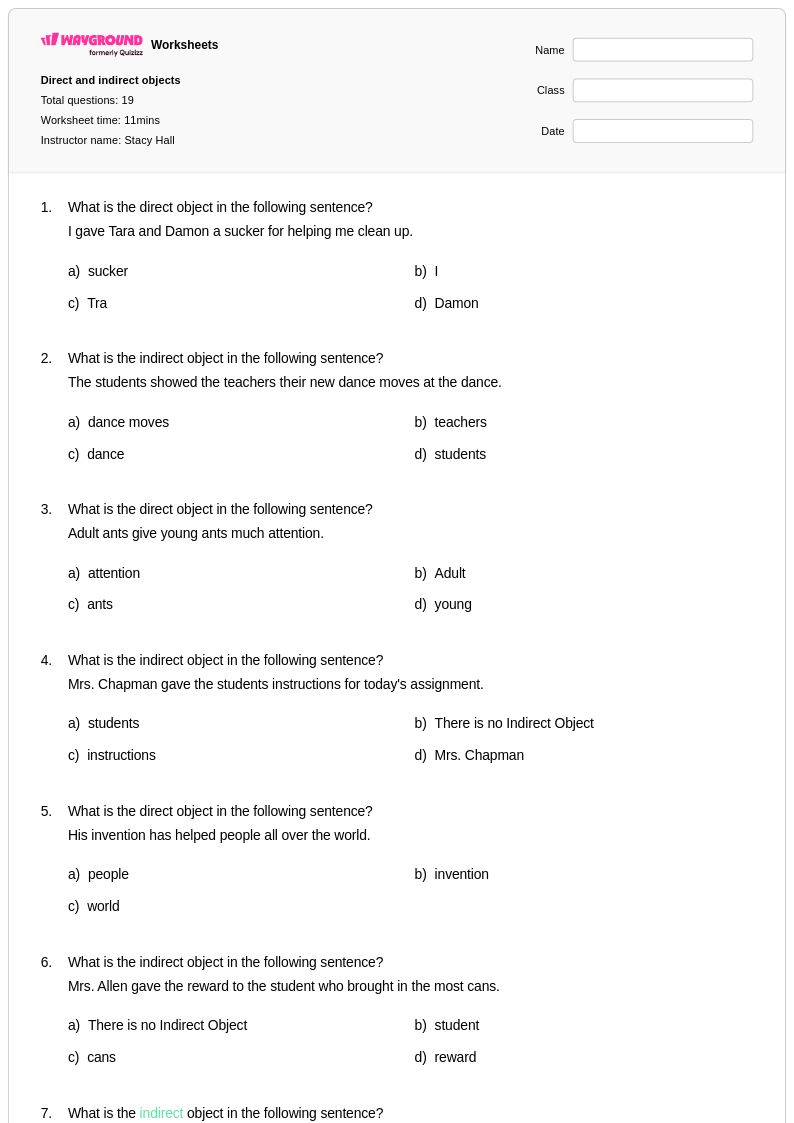
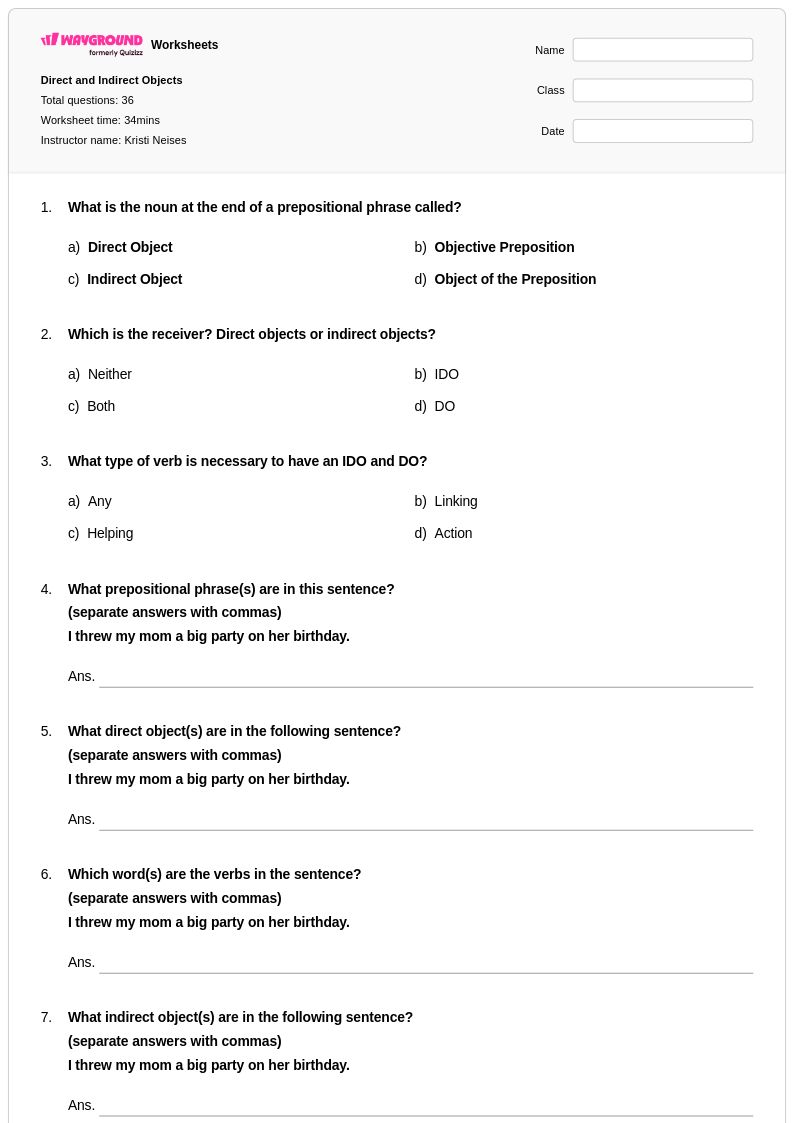
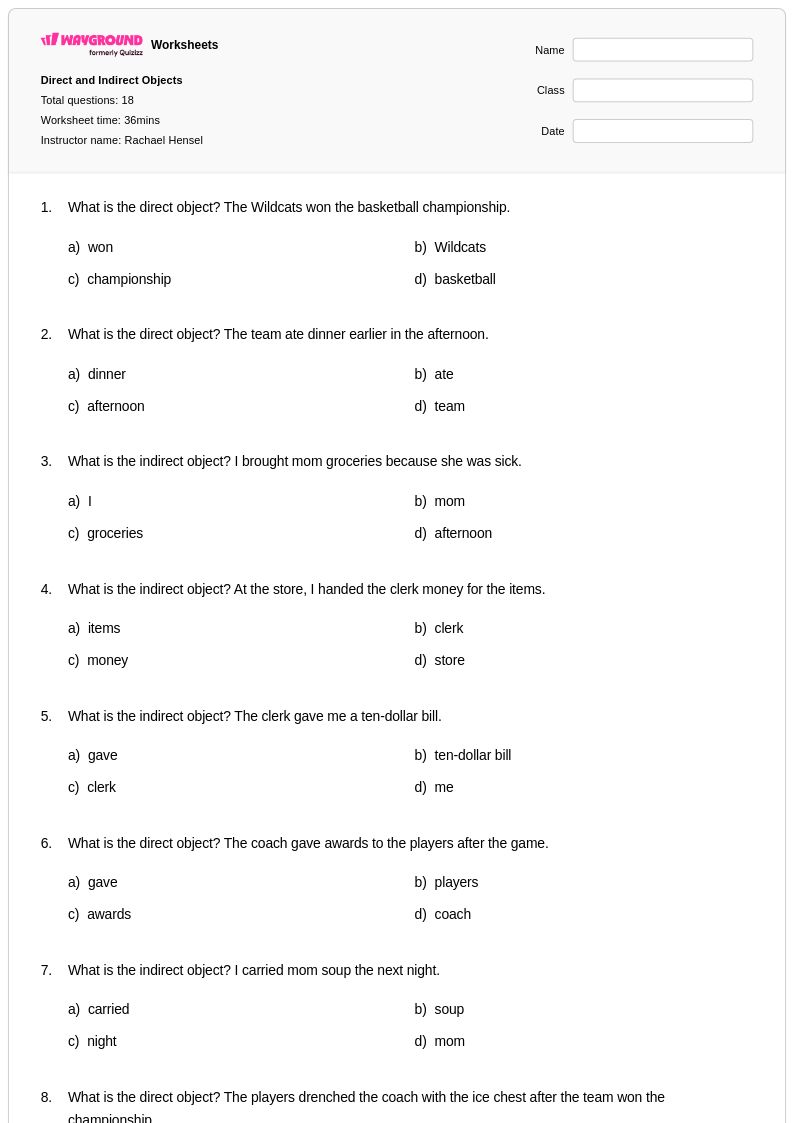
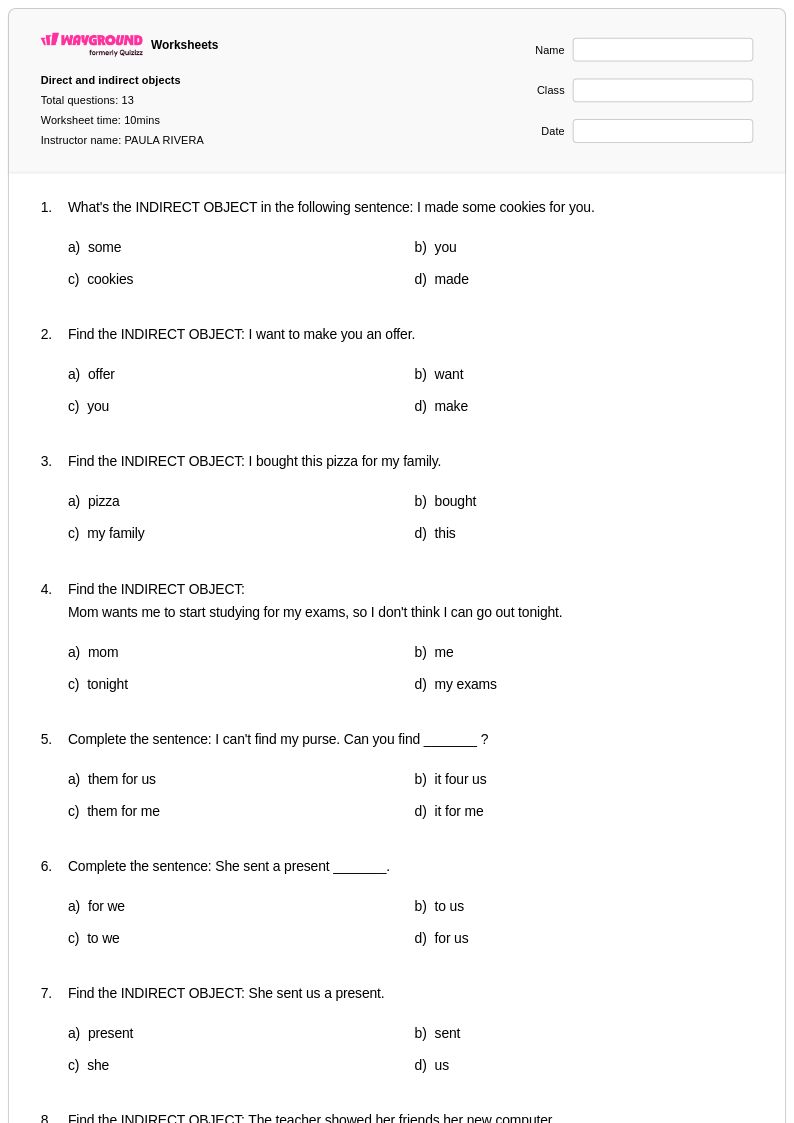
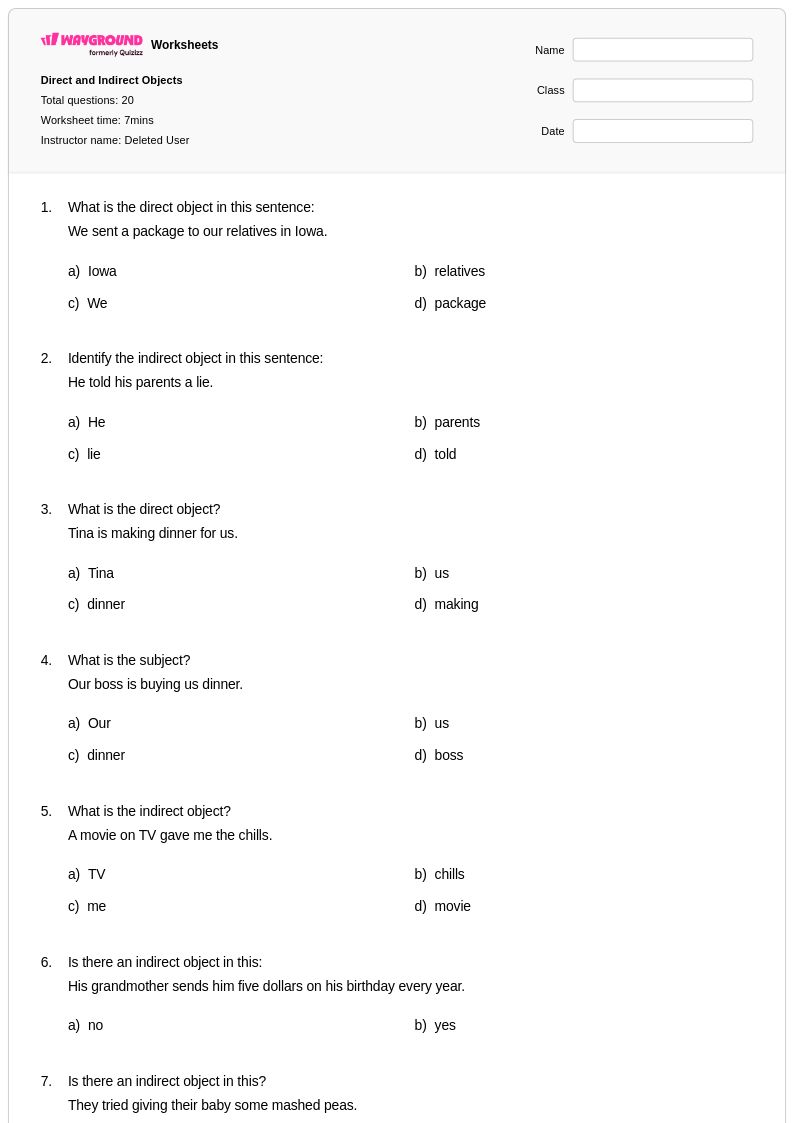
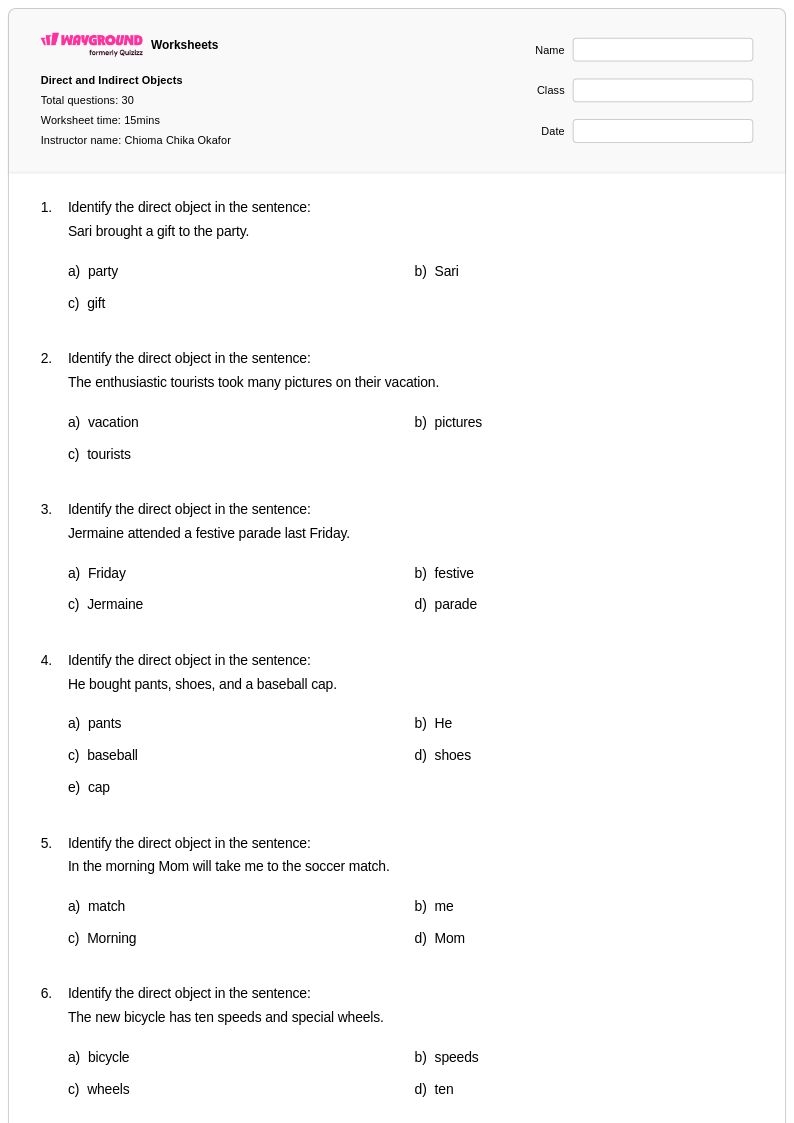
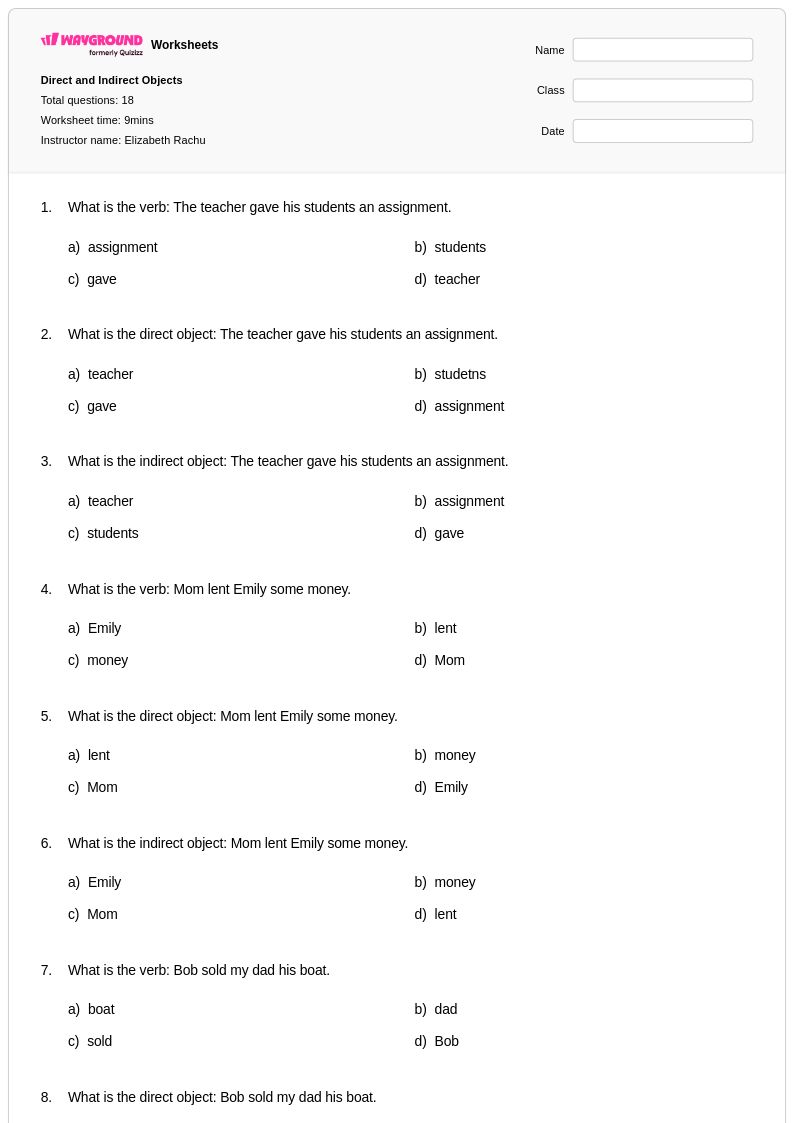
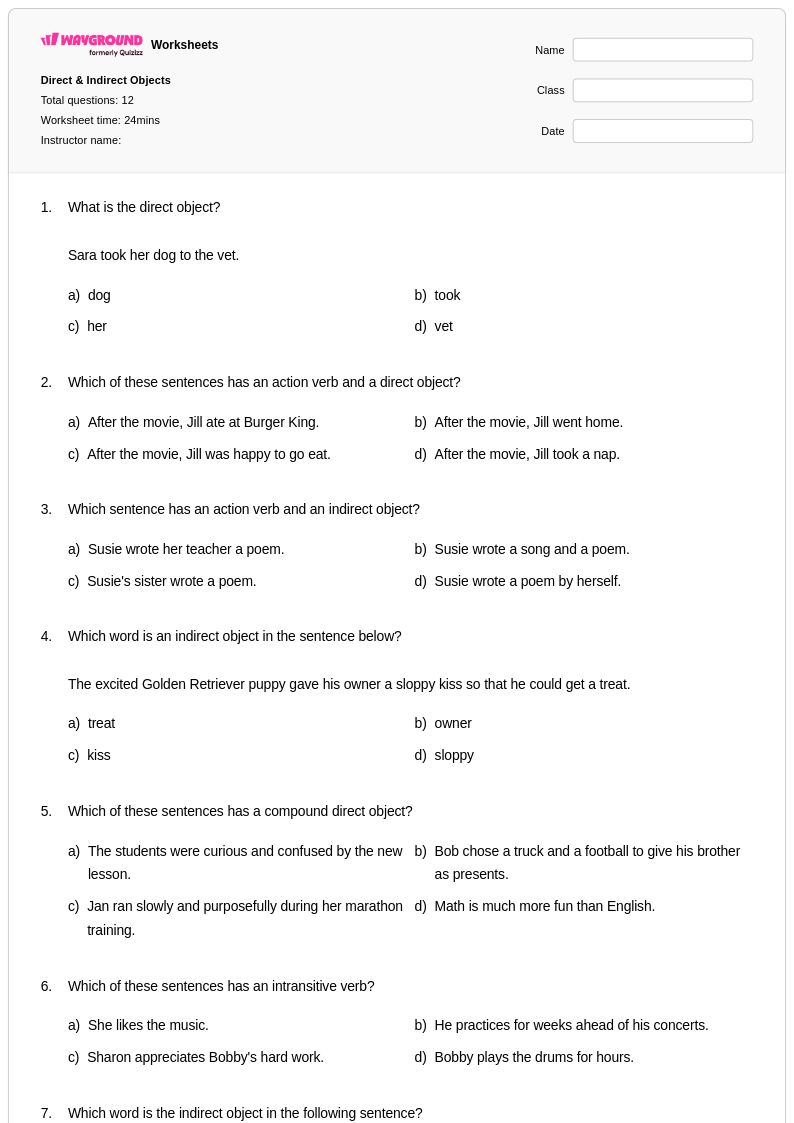
Free Printable Direct and Indirect Objects Worksheets for Grade 6
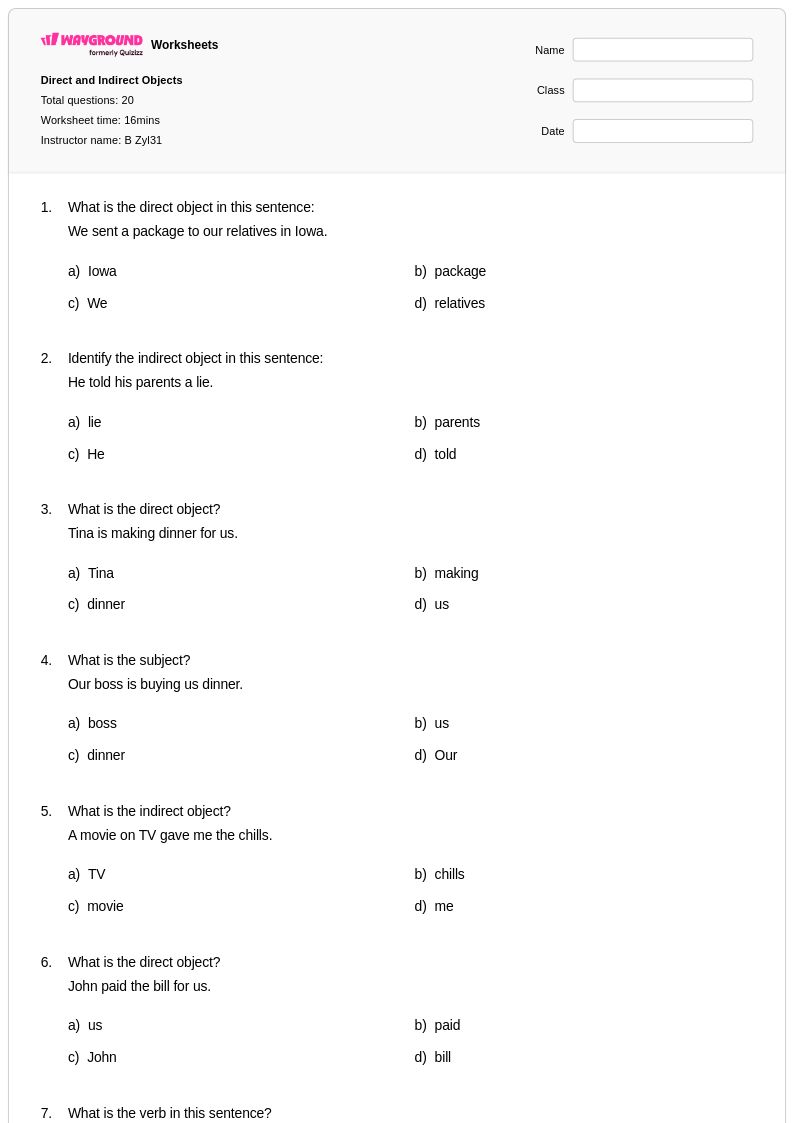
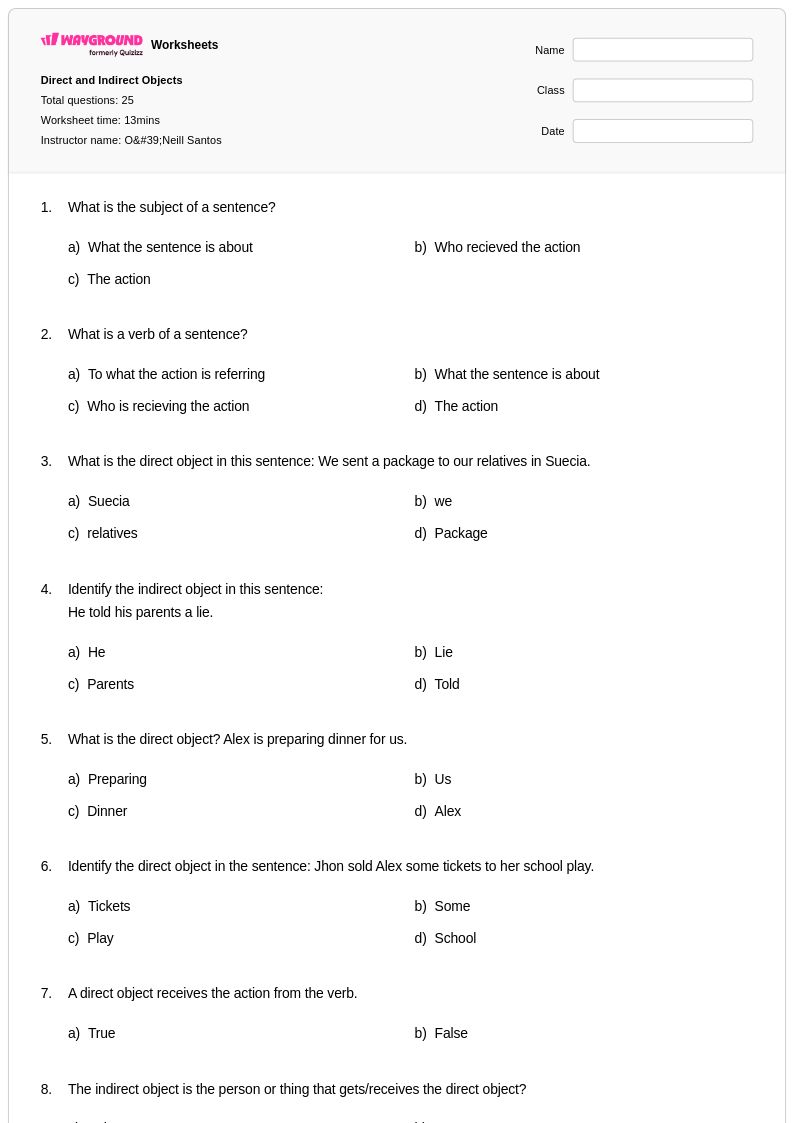
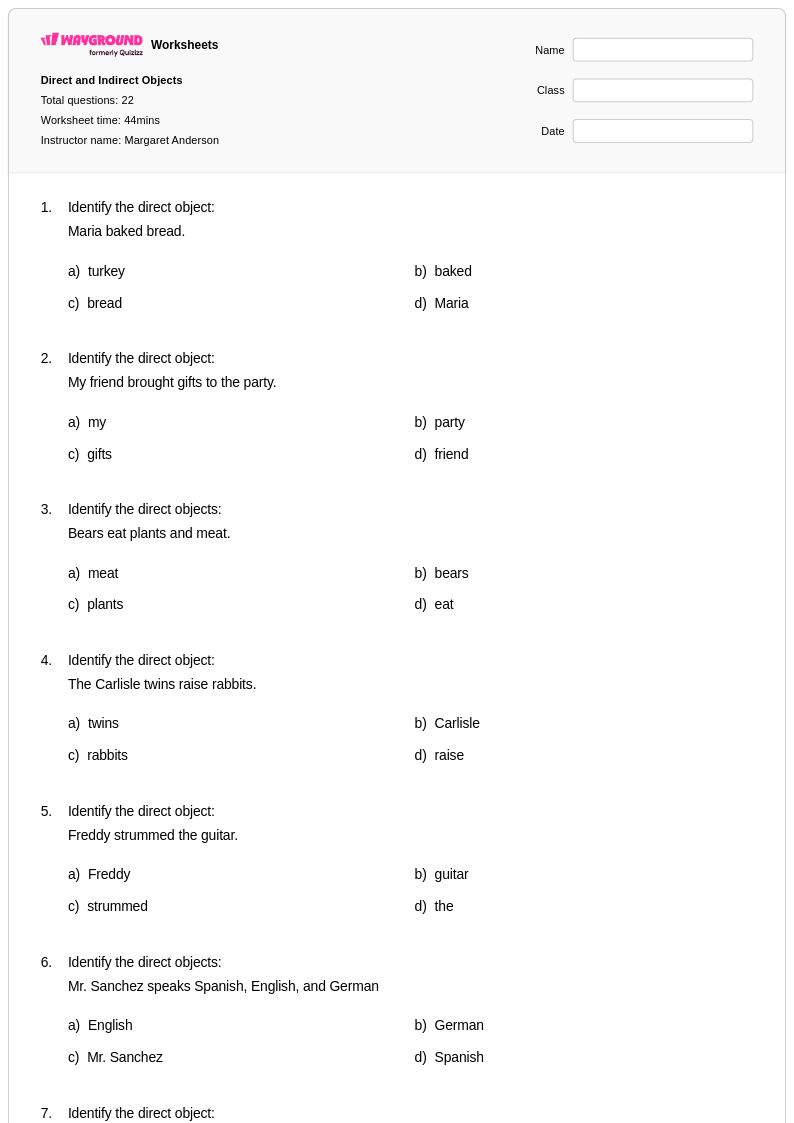
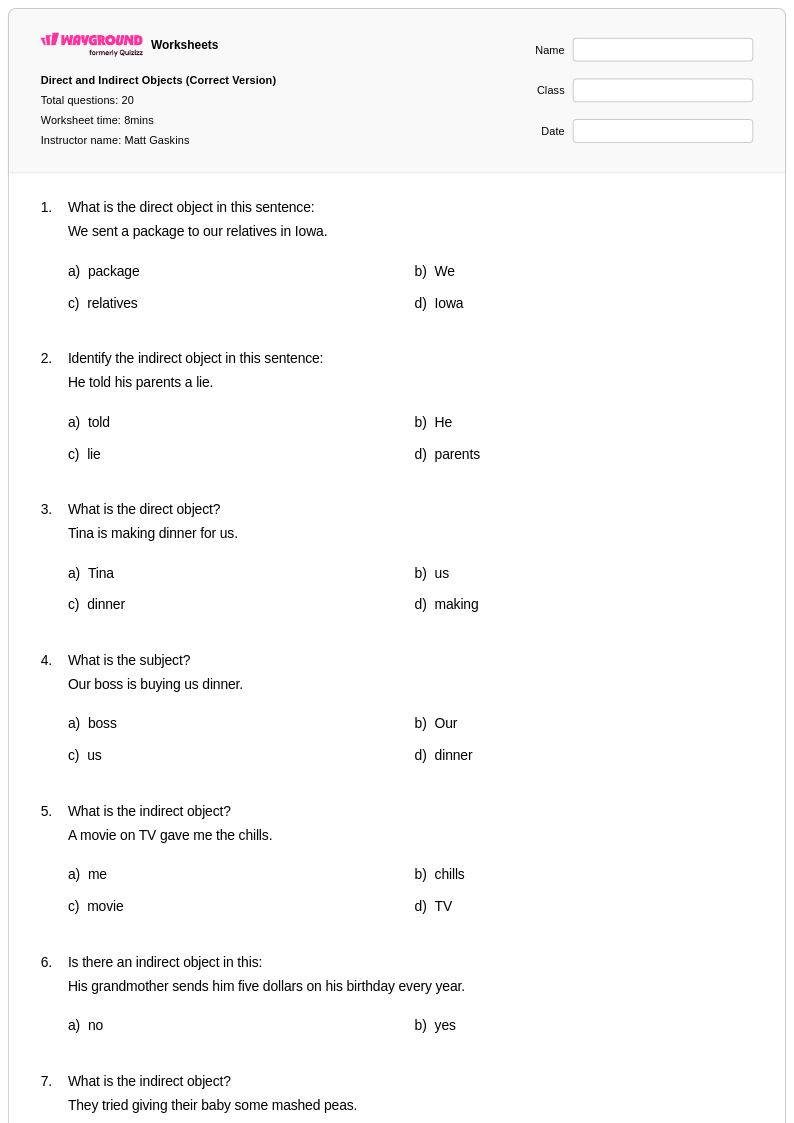
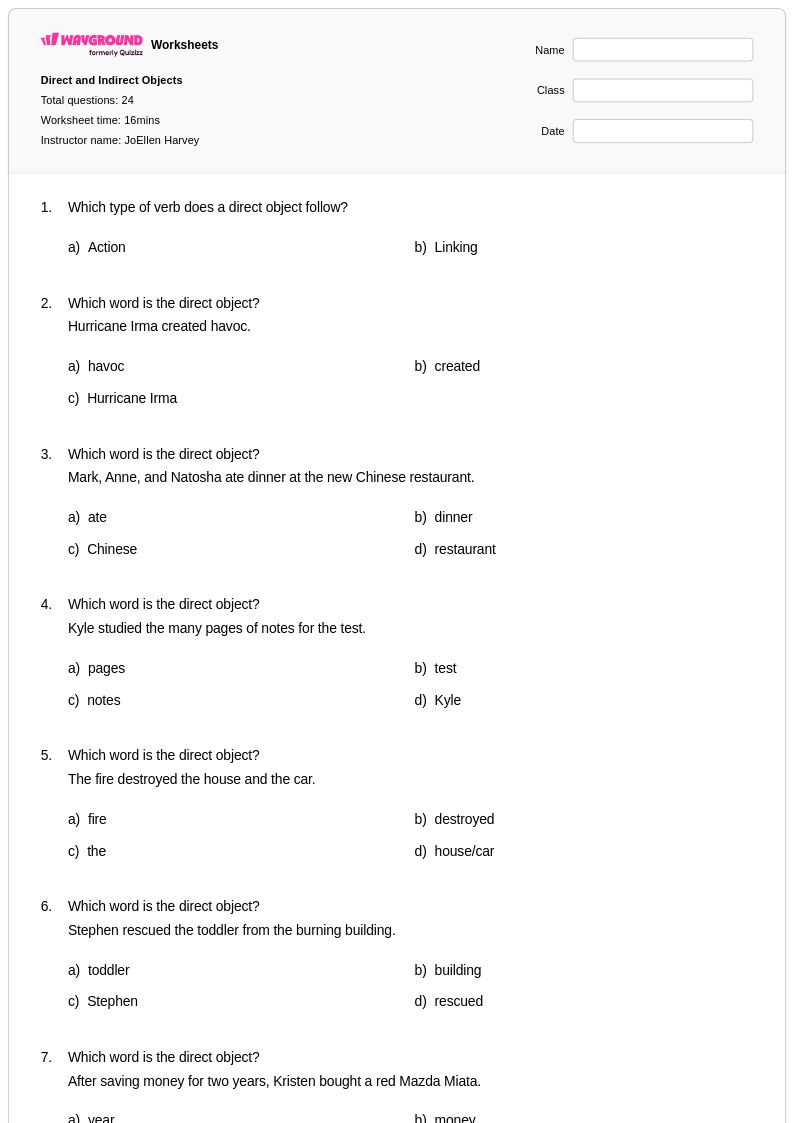
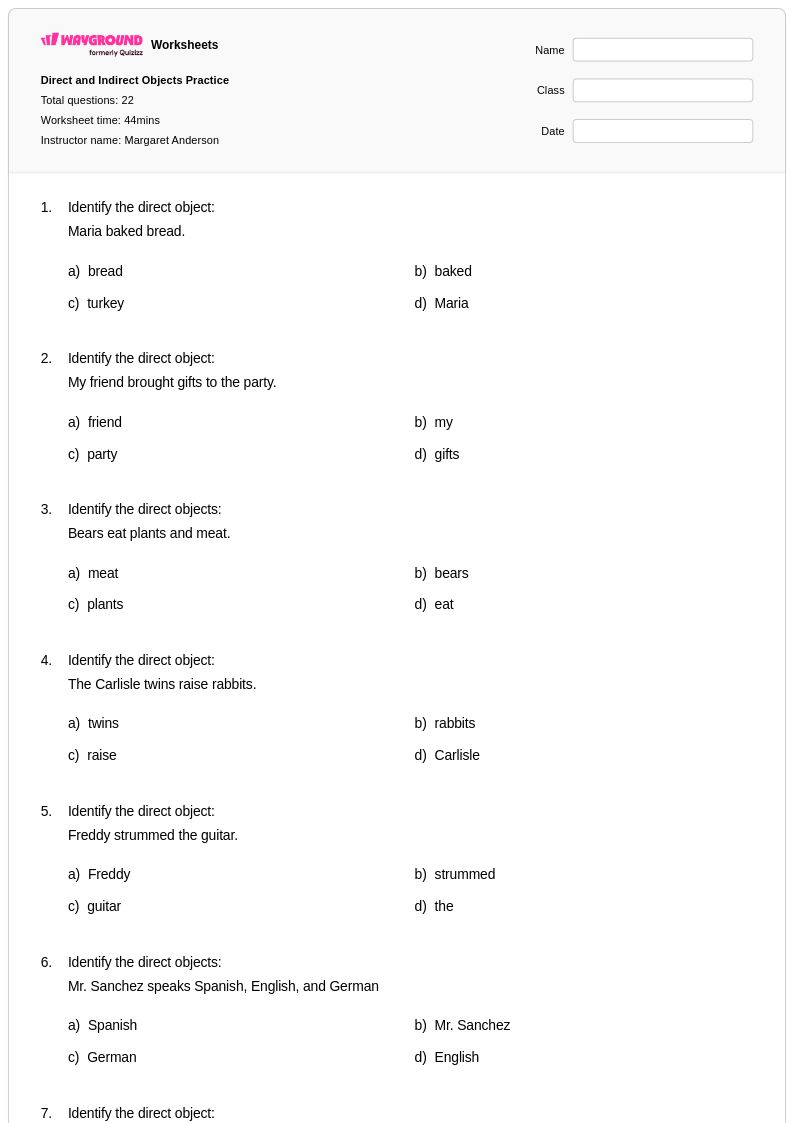
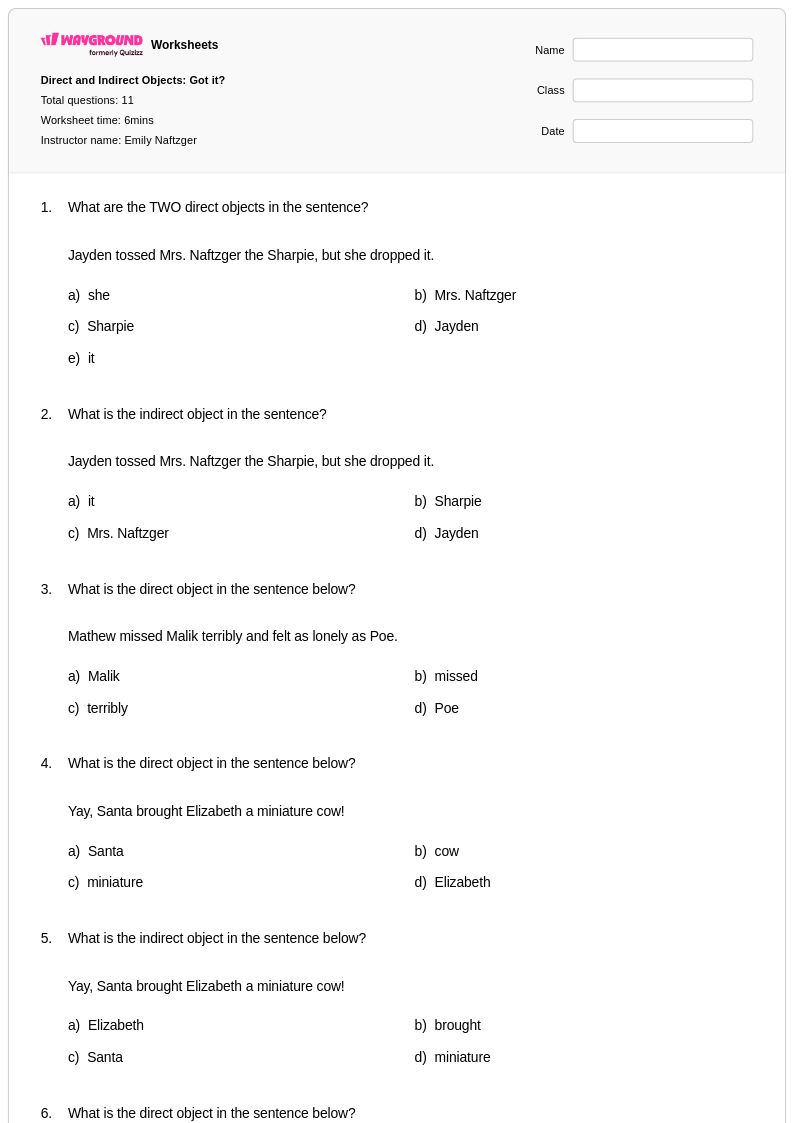
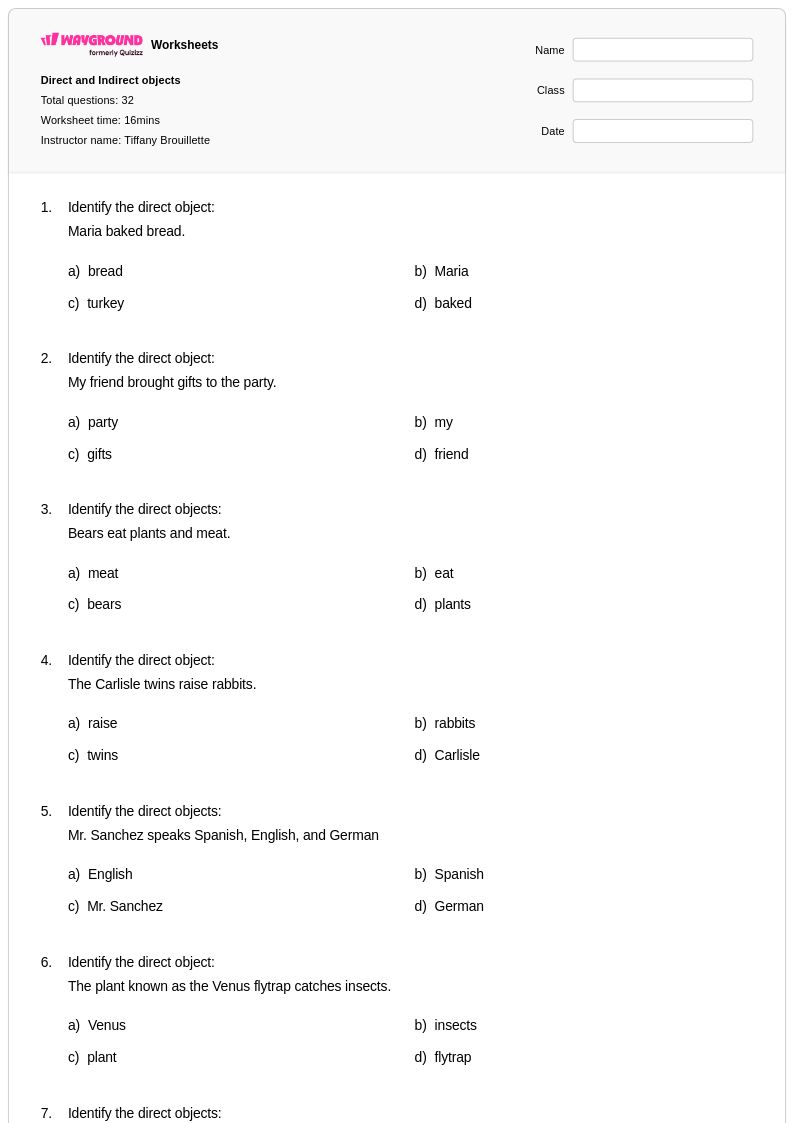
Grade 6 direct and indirect objects worksheets from Wayground help students master grammar fundamentals through engaging printables, practice problems, and comprehensive answer keys for effective learning.
Explore printable Direct and Indirect Objects worksheets for Grade 6
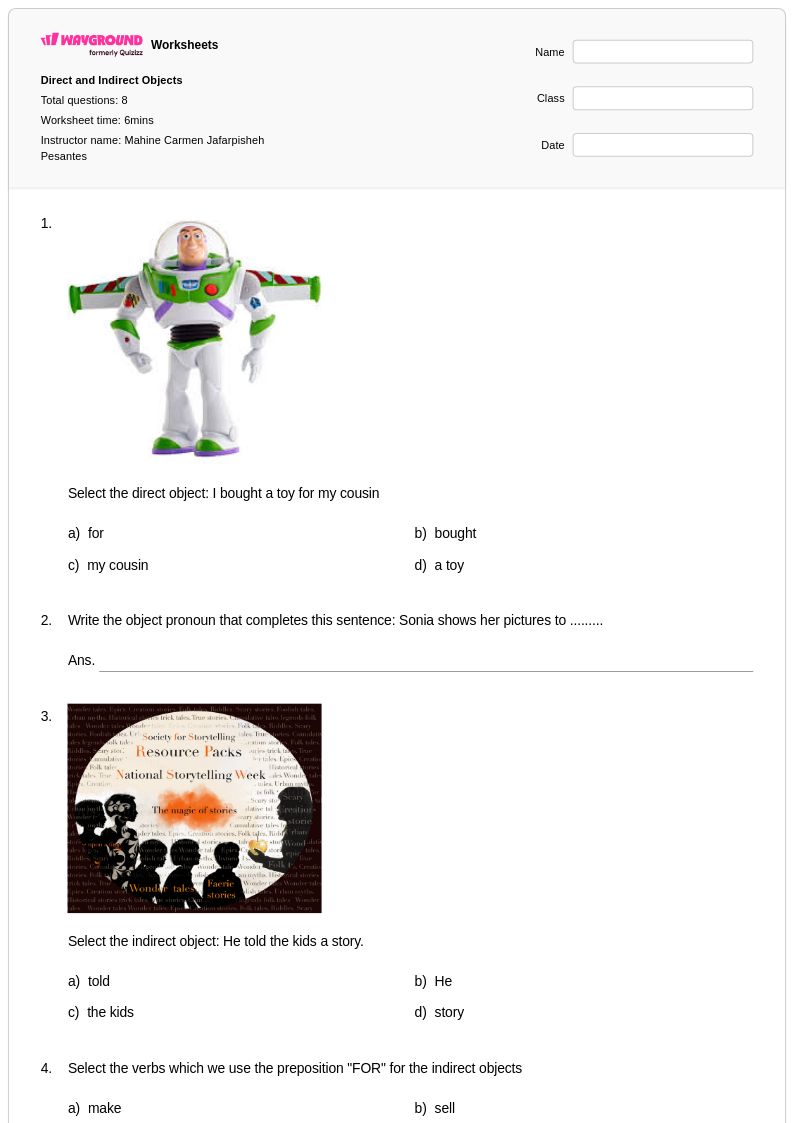
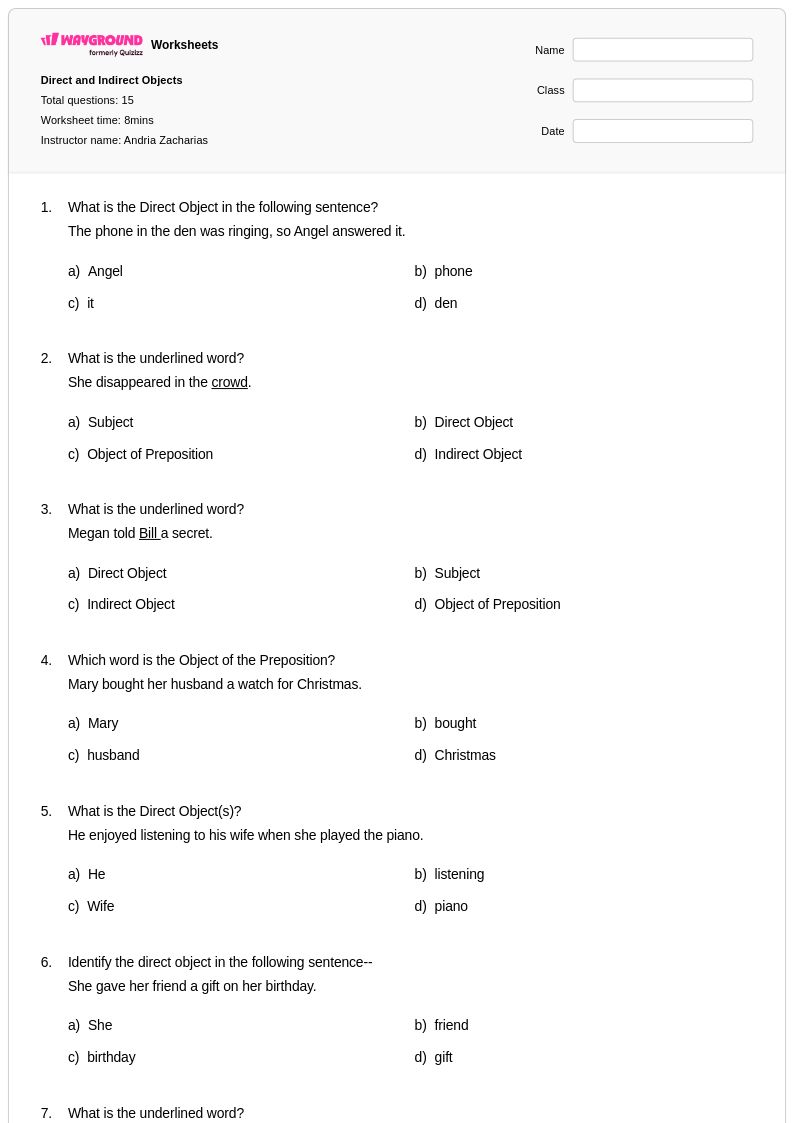
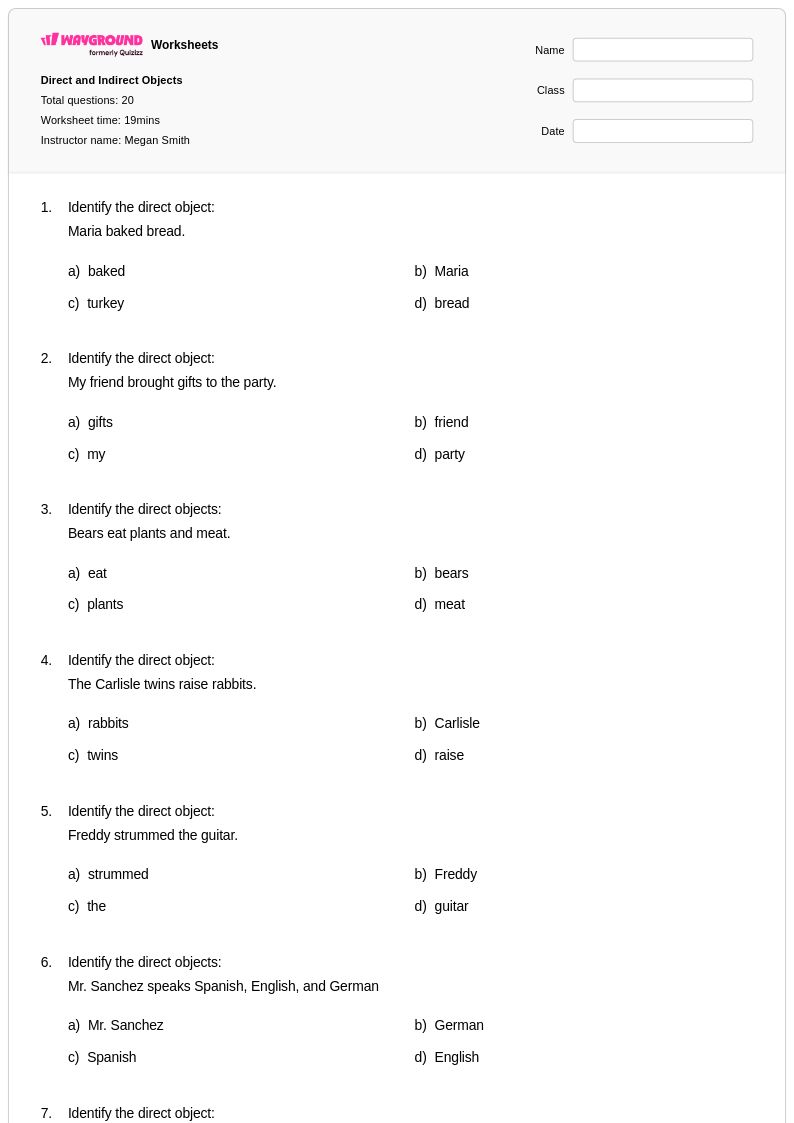
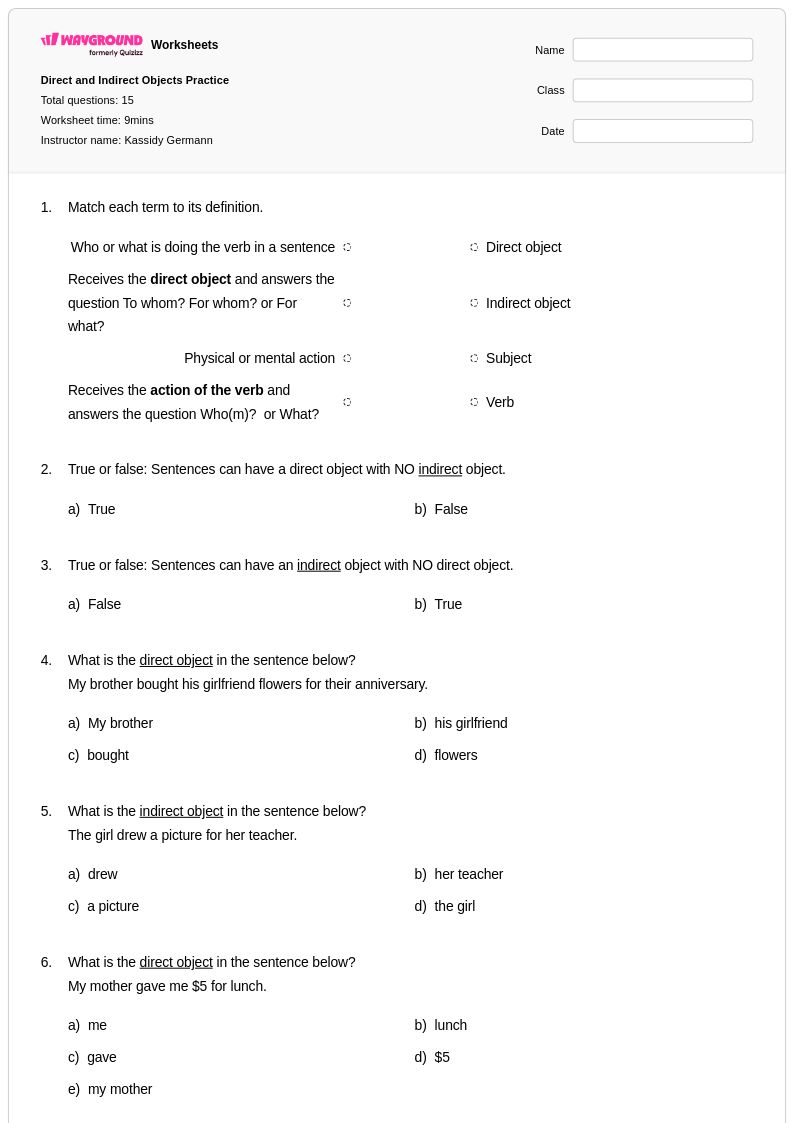
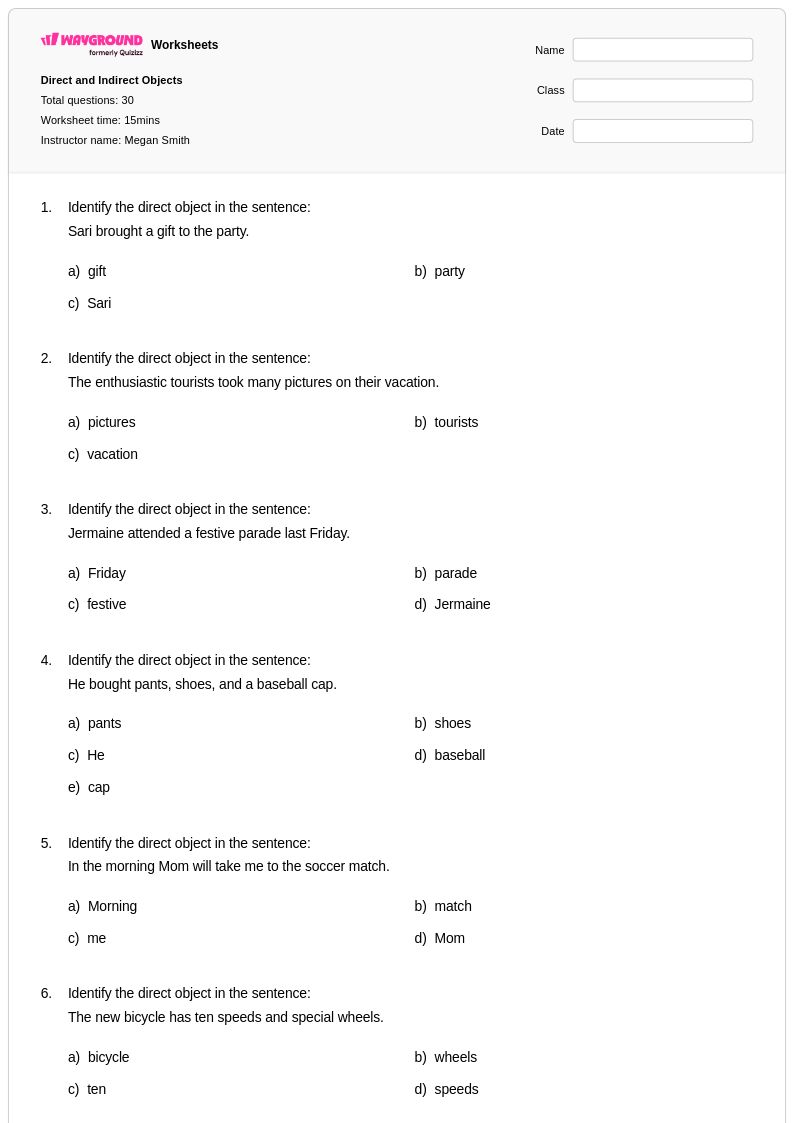
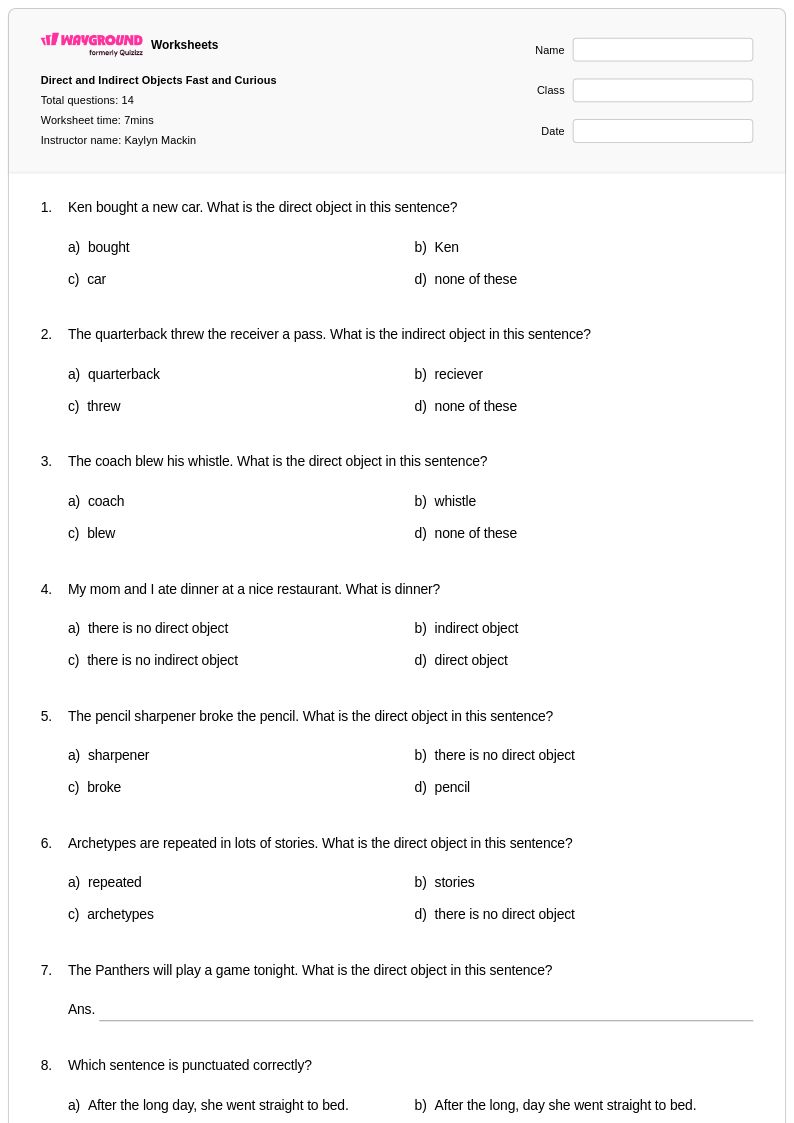
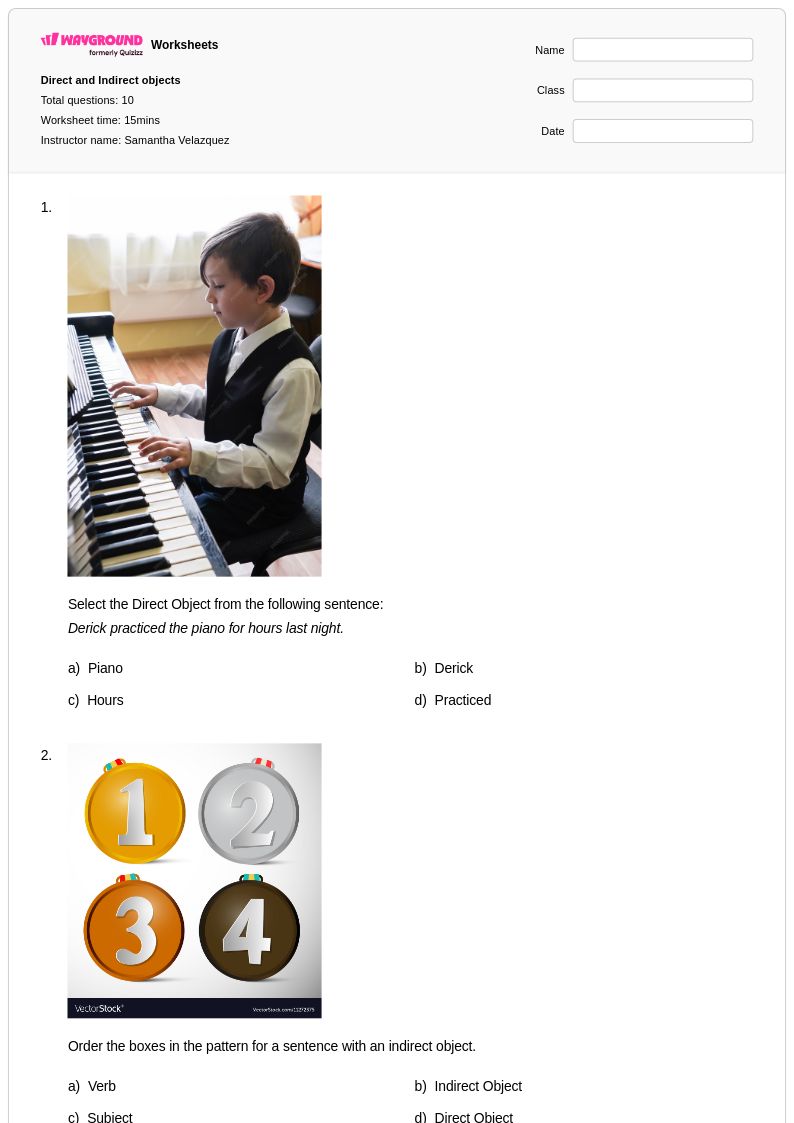
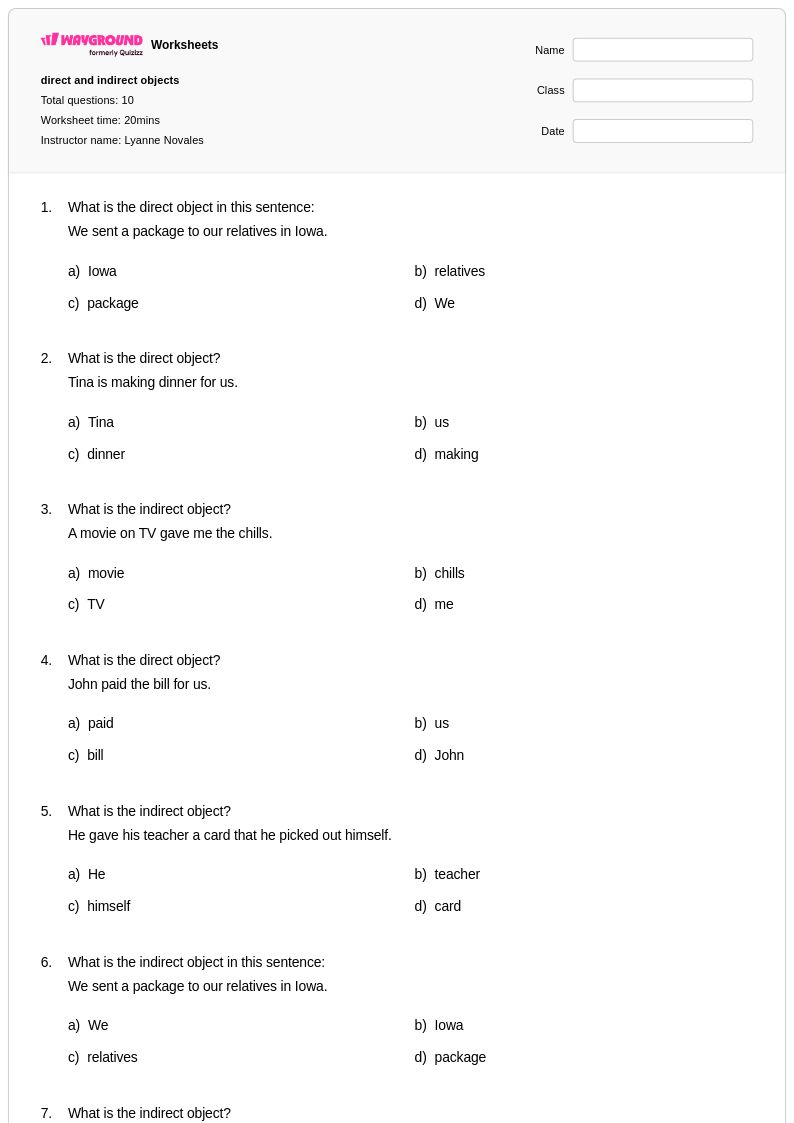
Direct and indirect objects form a crucial foundation in Grade 6 grammar instruction, helping students understand how different sentence elements work together to create clear, complete thoughts. Wayground's comprehensive collection of direct and indirect objects worksheets provides students with systematic practice in identifying these essential sentence components, distinguishing between objects that receive the action directly versus those that receive the action indirectly. These educational resources strengthen students' analytical skills as they learn to recognize patterns in sentence structure, parse complex sentences, and understand the relationships between verbs and their objects. Each worksheet includes detailed practice problems that guide students through progressively challenging exercises, complete with answer keys that enable independent learning and self-assessment. The free printable format ensures accessibility for all classrooms, while the pdf structure maintains consistent formatting across different devices and printing scenarios.
Wayground's extensive library, built from millions of teacher-created resources, offers educators powerful tools for delivering effective direct and indirect objects instruction to Grade 6 students. The platform's robust search and filtering capabilities allow teachers to quickly locate worksheets that align with specific curriculum standards and match their students' varied skill levels, supporting both remediation for struggling learners and enrichment for advanced students. Customization features enable educators to modify existing materials or combine multiple resources to create targeted practice sessions that address specific learning gaps or reinforce particular grammatical concepts. Available in both printable and digital formats, these worksheets seamlessly integrate into diverse classroom environments and instructional approaches, whether teachers need immediate pdf downloads for homework assignments or interactive digital versions for classroom collaboration. This flexibility streamlines lesson planning while providing the differentiated practice opportunities essential for helping all students master the complexities of direct and indirect object identification.
FAQs
How do I teach direct and indirect objects to students who are new to the concept?
Start by teaching direct objects in isolation before introducing indirect objects, since students need to reliably identify what receives the action before they can distinguish who receives it. Use simple, familiar sentences (e.g., 'She threw the ball to Marcus') and have students ask 'what?' or 'whom?' after the verb to locate the direct object, then ask 'to whom?' or 'for whom?' to find the indirect object. Color-coding each grammatical role in practice sentences helps students visually separate the two elements before working with them analytically.
What exercises help students practice identifying direct and indirect objects?
Sentence-labeling exercises where students underline and annotate objects in varied sentence types are the most effective entry-level practice. Progressing to sentence construction tasks, where students must write original sentences using both a direct and indirect object, reinforces understanding at a deeper level. Varied exercise formats, from identification drills to sentence rewriting, help students internalize the distinction across different contexts rather than pattern-matching on a single sentence type.
What mistakes do students commonly make when identifying direct and indirect objects?
The most common error is confusing the indirect object with a prepositional phrase, particularly when the indirect object is expressed as 'to [person]' rather than placed before the direct object (e.g., 'She gave Marcus the book' vs. 'She gave the book to Marcus'). Students also frequently mislabel the indirect object as the direct object when both are present, usually because they stop searching after finding the first noun following the verb. Teaching students to always locate the direct object first and apply the 'to whom/for whom?' test afterward corrects both errors.
How do I use direct and indirect object worksheets effectively in my classroom?
These worksheets are available as printable PDFs for traditional classroom use and in digital formats for technology-integrated environments, which means you can assign them as independent practice, homework, or station work without reformatting. Start with identification-focused sheets to build foundational recognition, then move to construction tasks as students gain confidence. Wayground also allows you to host worksheets as a quiz directly on the platform, giving you built-in assessment data alongside the practice materials.
How do I differentiate direct and indirect object instruction for students at different ability levels?
For struggling students, reduce sentence complexity and focus exclusively on direct objects before introducing indirect objects, and consider using read-aloud support so that decoding difficulty does not interfere with grammar practice. Advanced learners benefit from sentence transformation tasks, such as converting sentences with prepositional phrases into those with indirect objects in canonical position, and vice versa. Wayground's accommodation tools allow teachers to assign reduced answer choices or extended time to individual students without alerting the rest of the class, making differentiation seamless within a shared assignment.
What is the difference between a direct object and an indirect object?
A direct object receives the action of a transitive verb directly and answers the question 'what?' or 'whom?' after the verb (e.g., 'She baked a cake'). An indirect object identifies to whom or for whom the action is performed and always appears in a sentence that also contains a direct object (e.g., 'She baked her sister a cake'). The indirect object can typically be rewritten as a prepositional phrase using 'to' or 'for' without changing the sentence's meaning, which is a reliable test students can apply.