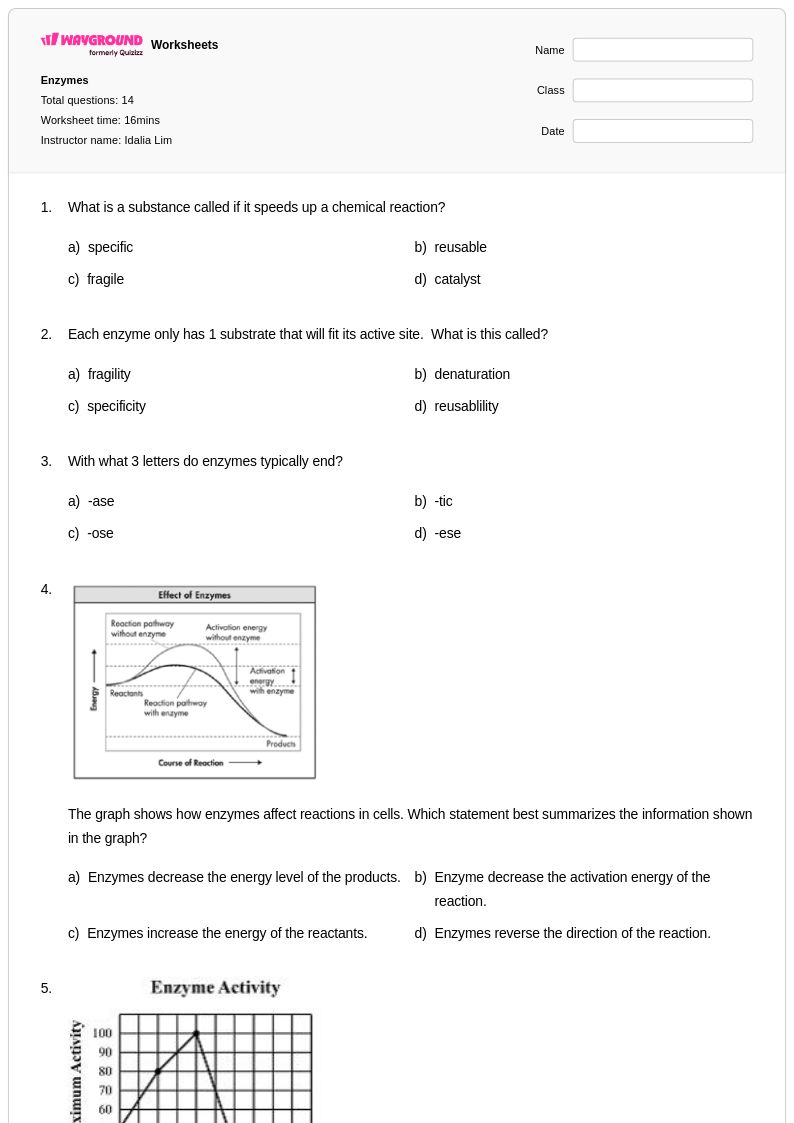
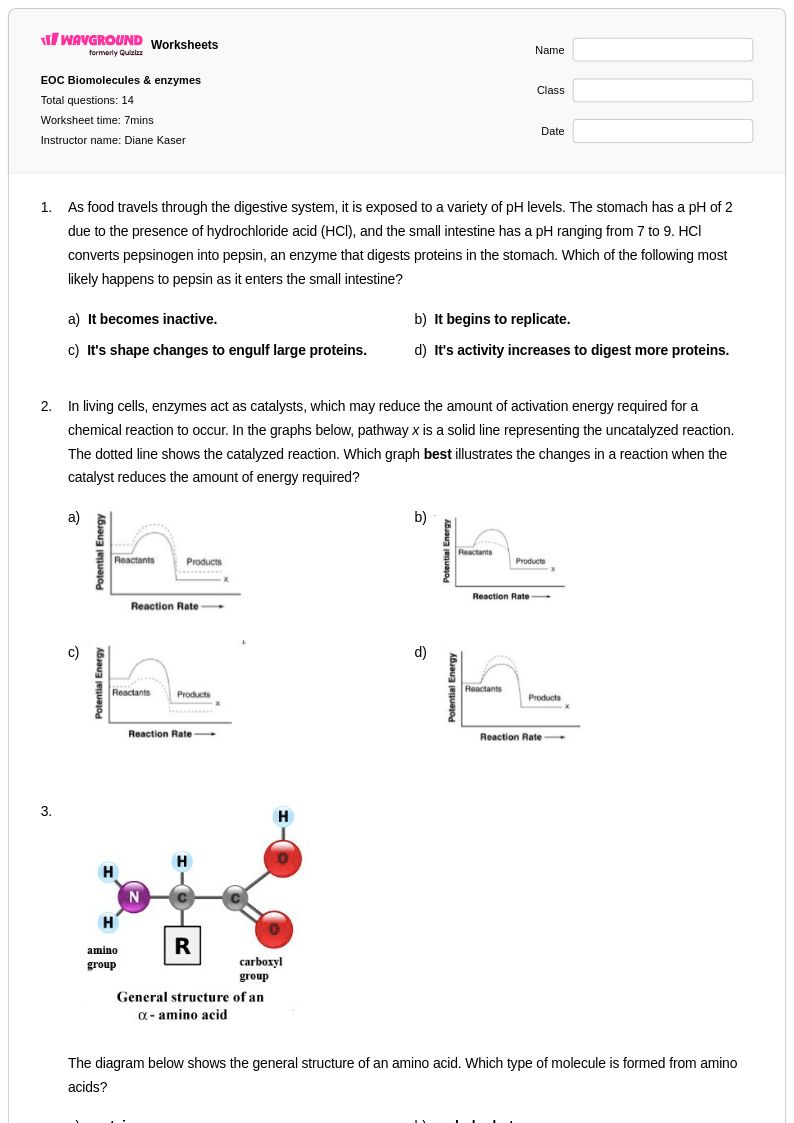
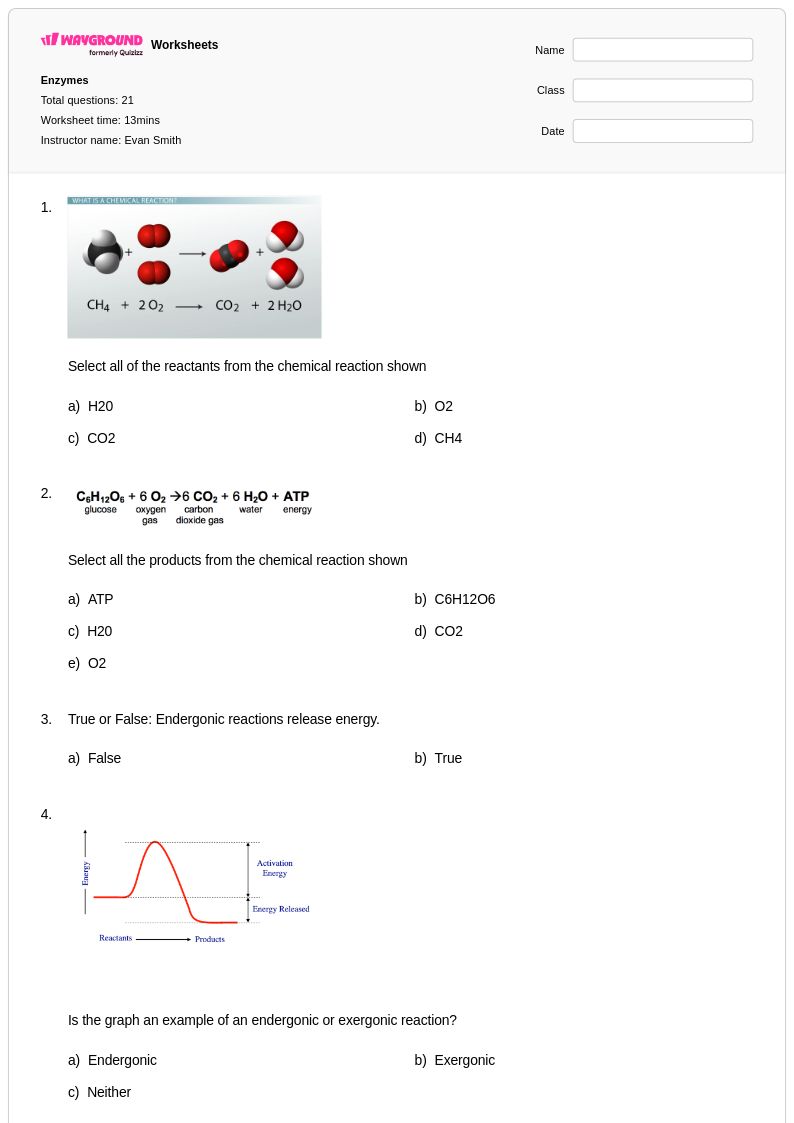
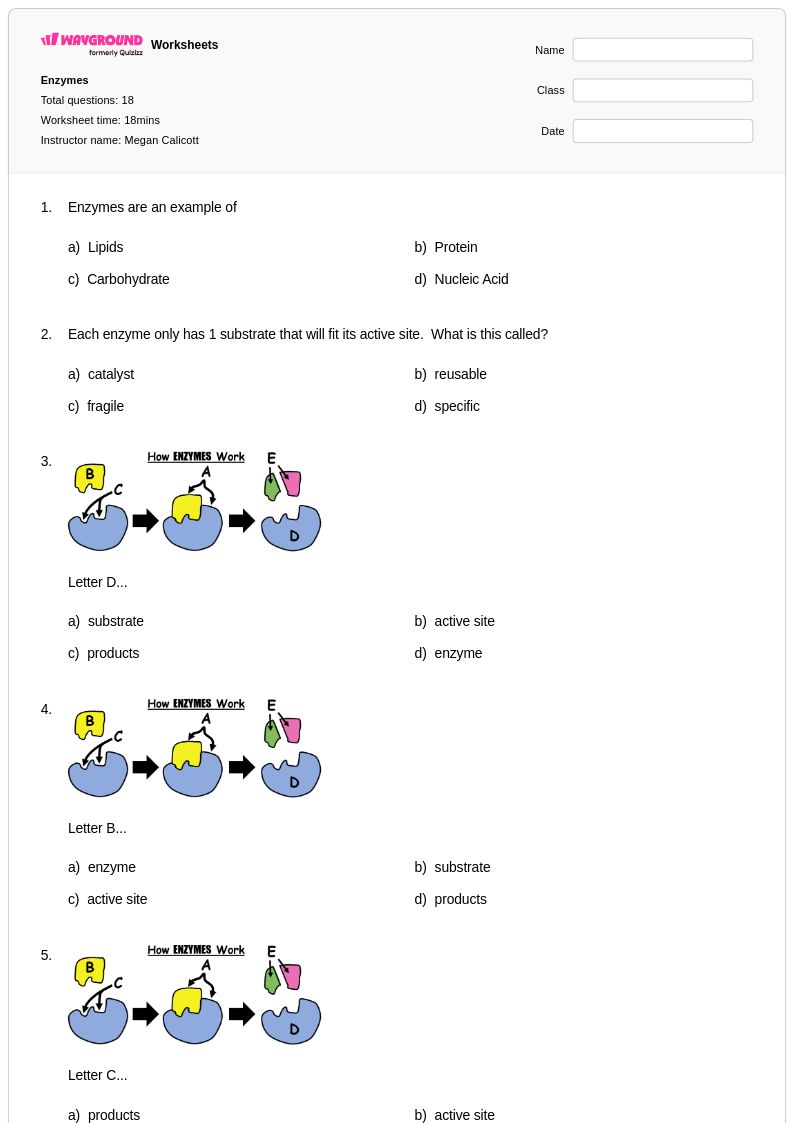
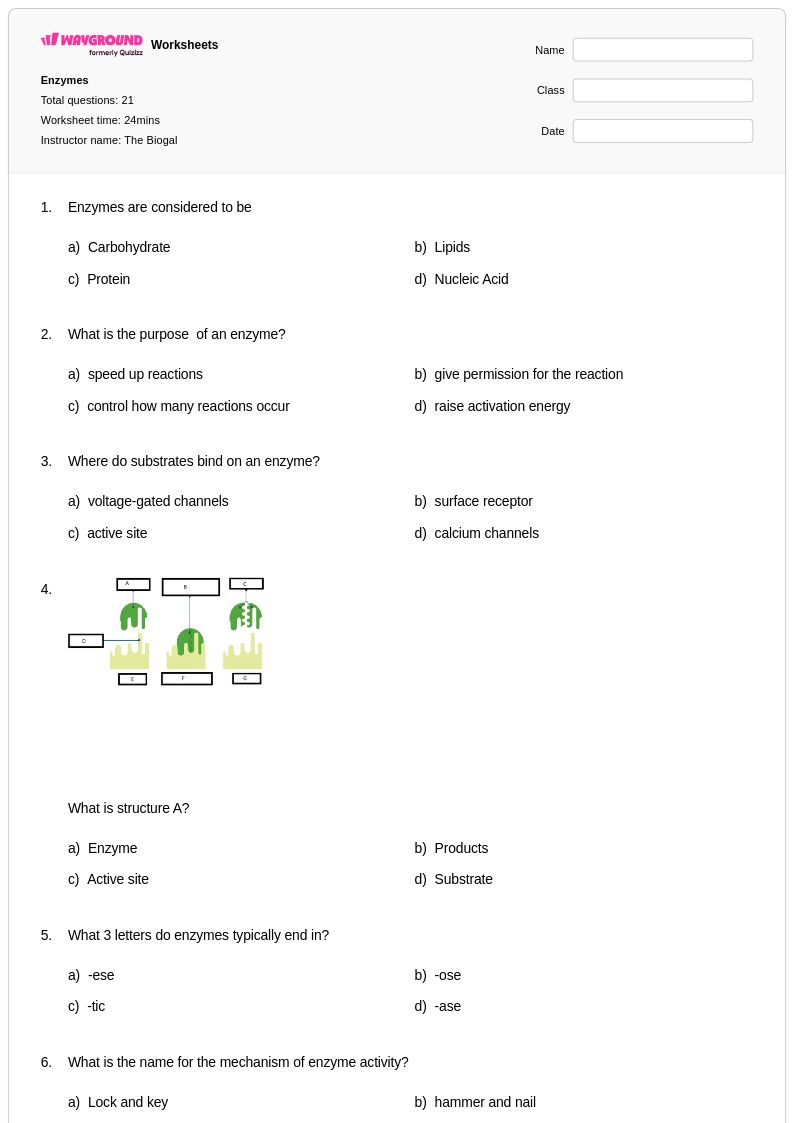
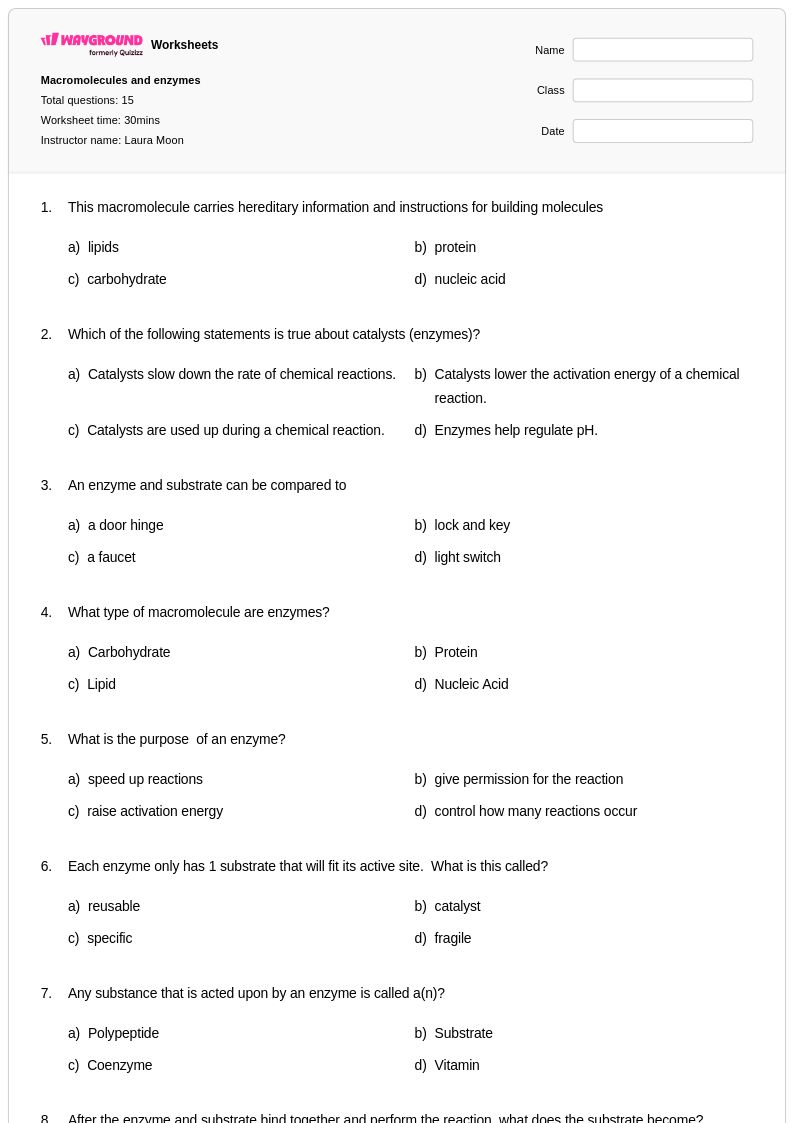
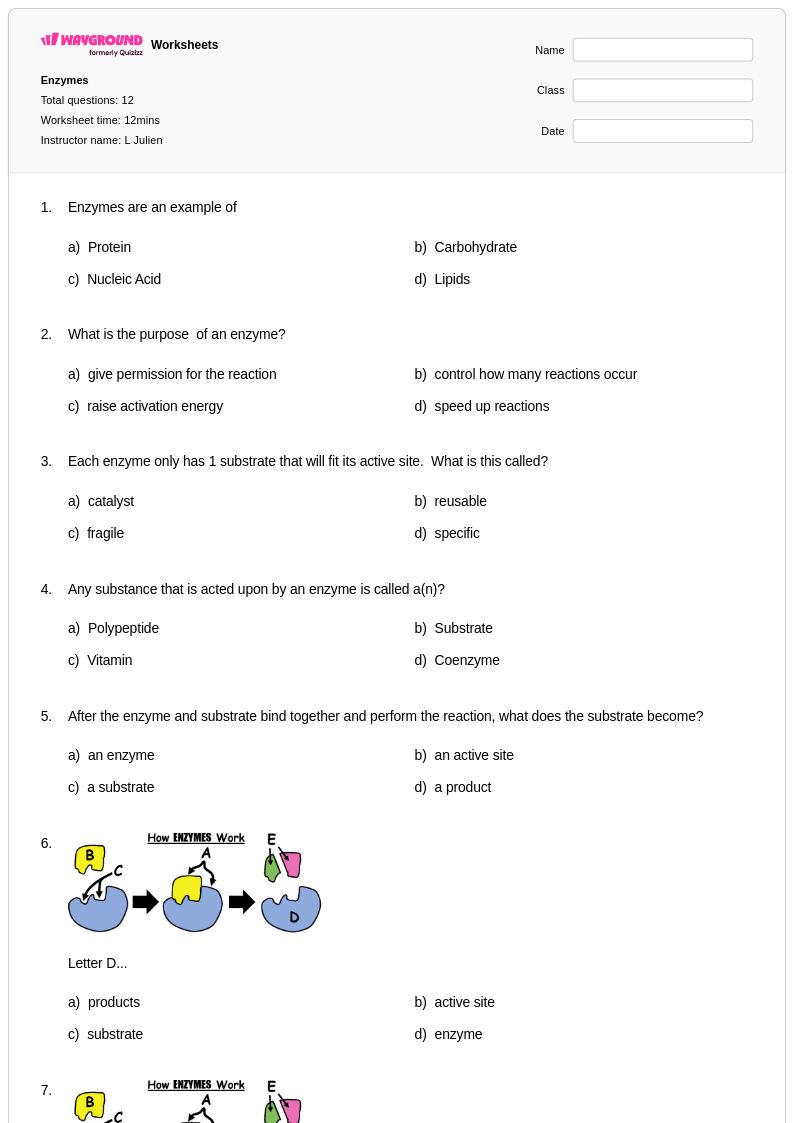
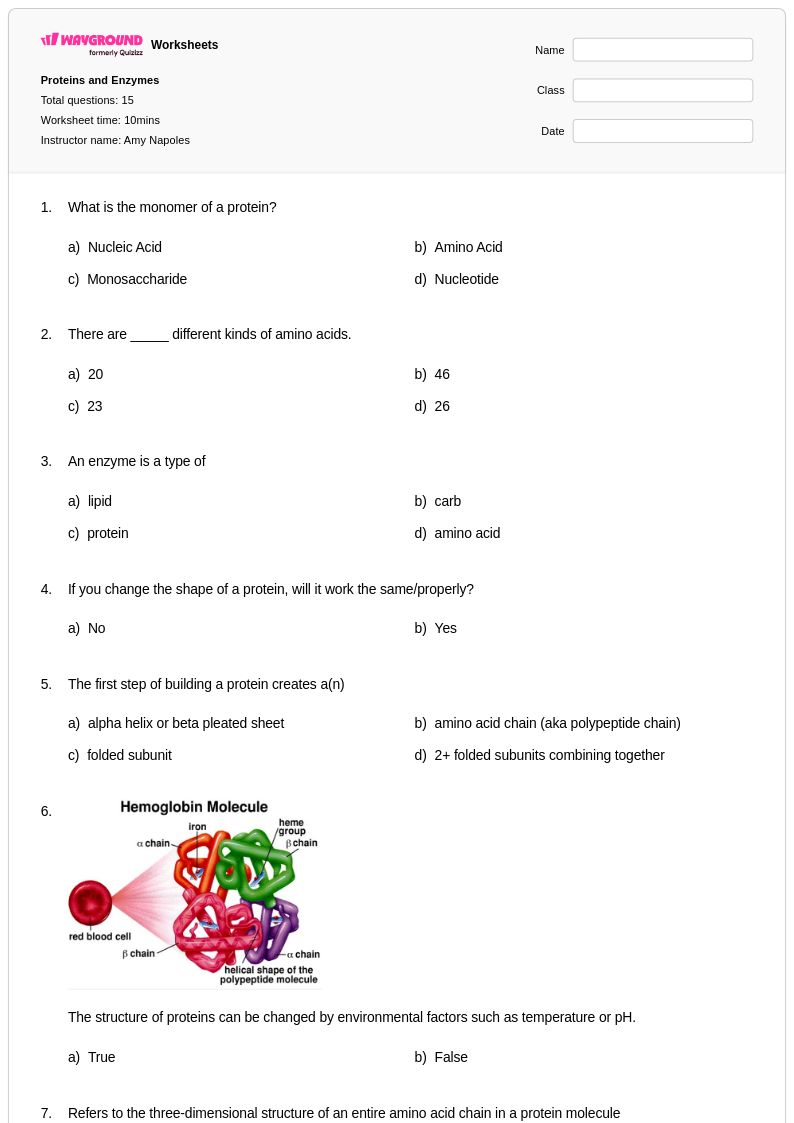
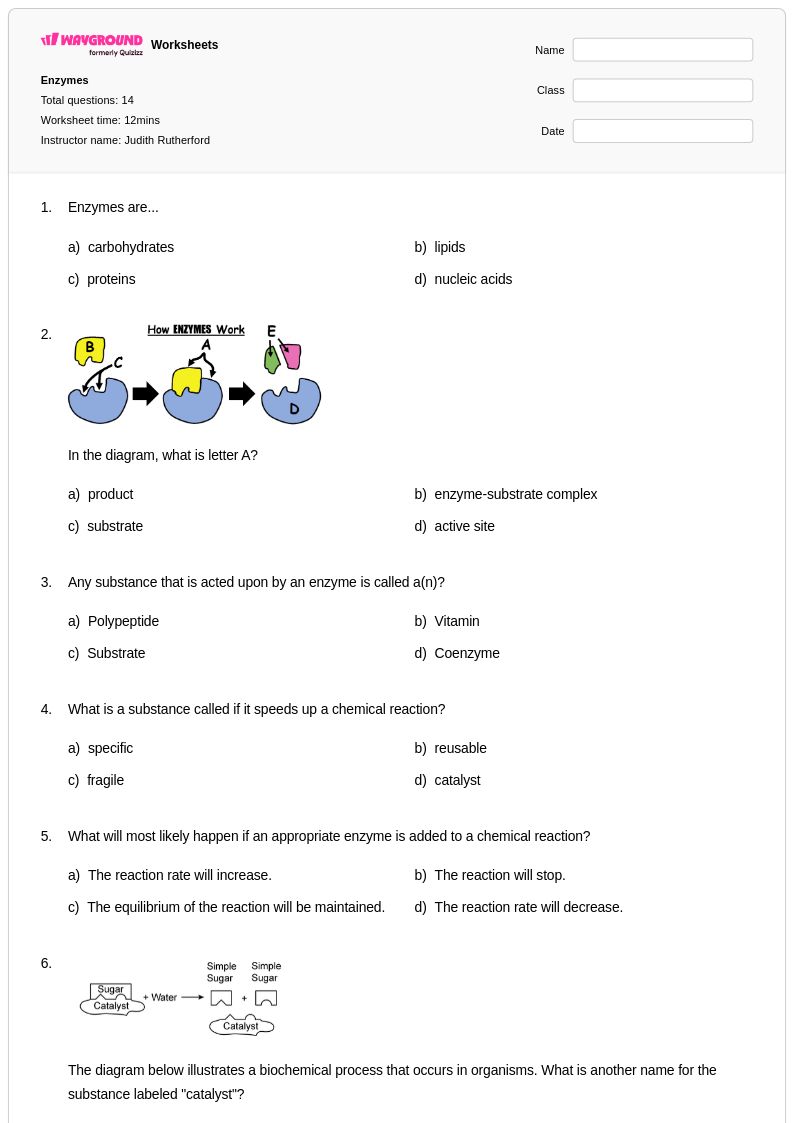
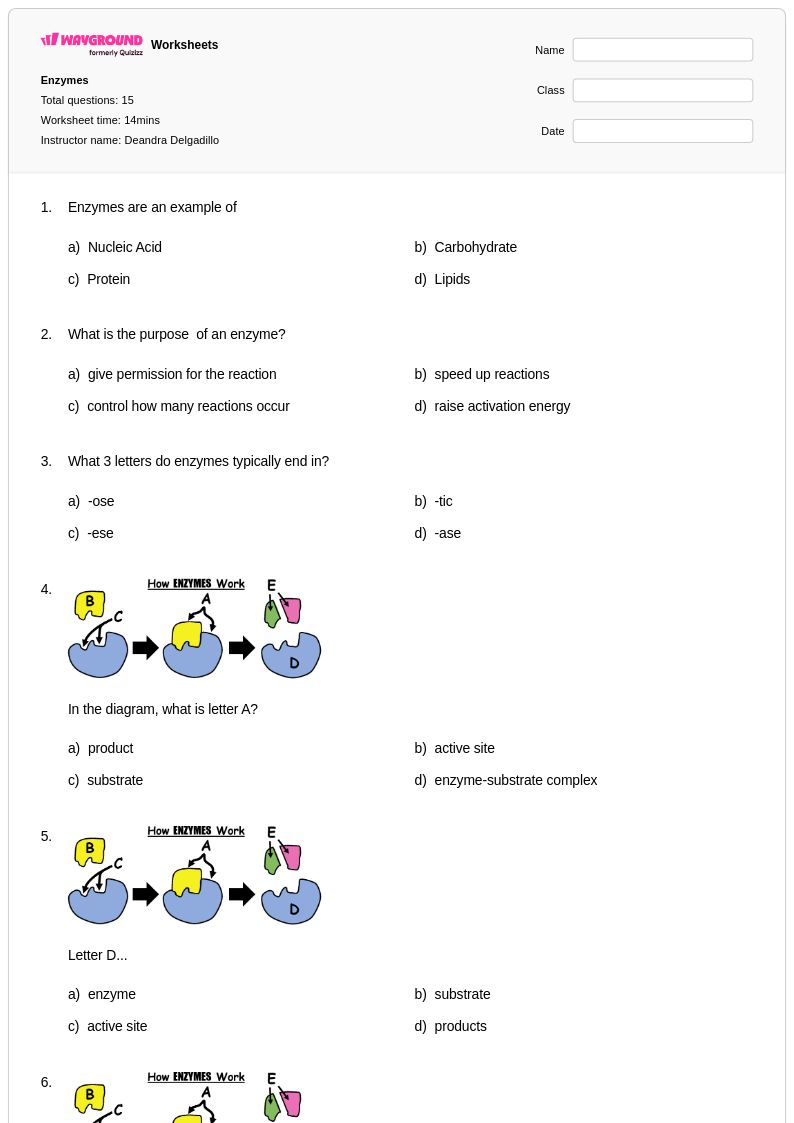
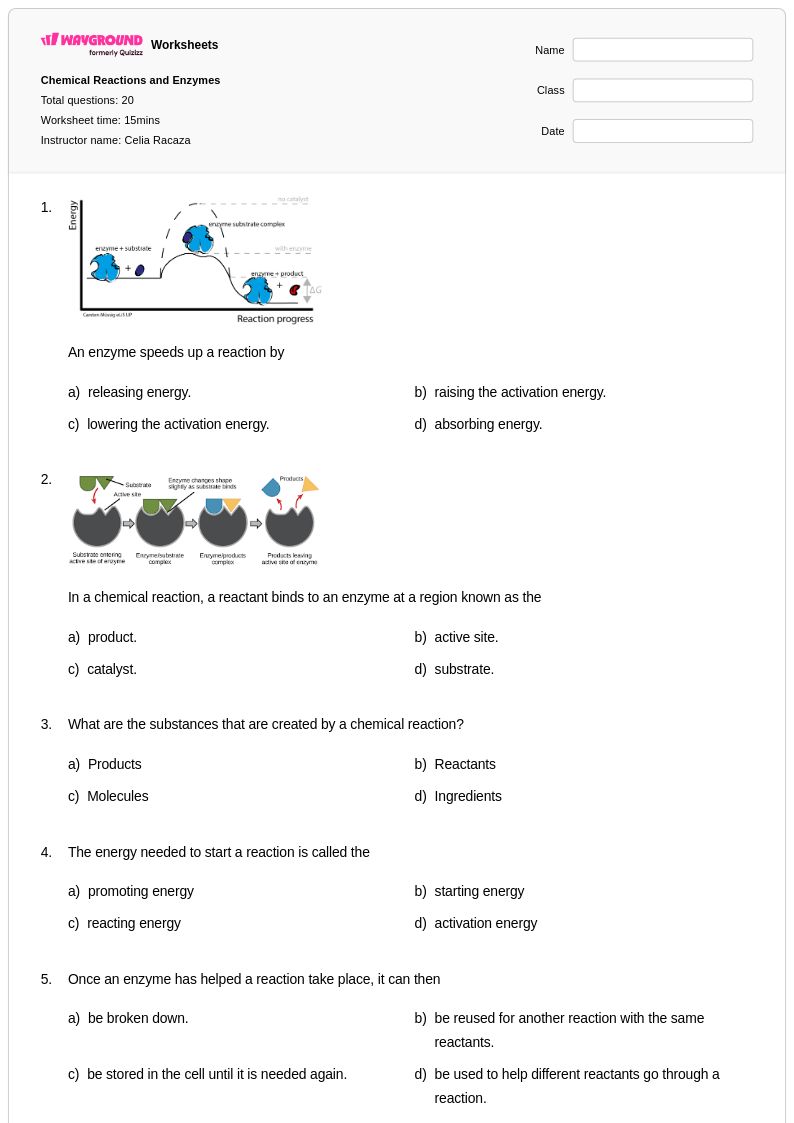
Explore Wayground's comprehensive collection of Grade 9 enzyme worksheets featuring printable PDFs, practice problems, and answer keys to help students master enzyme structure, function, and biochemical reactions through engaging free worksheets.
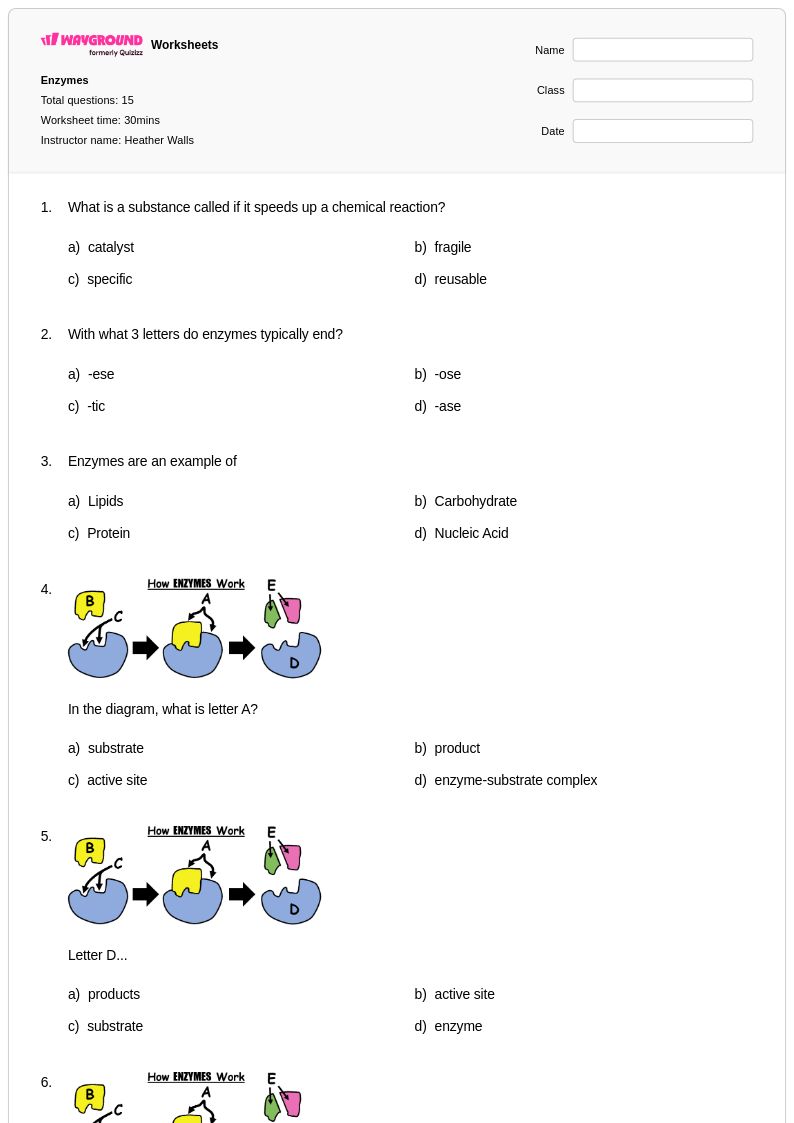
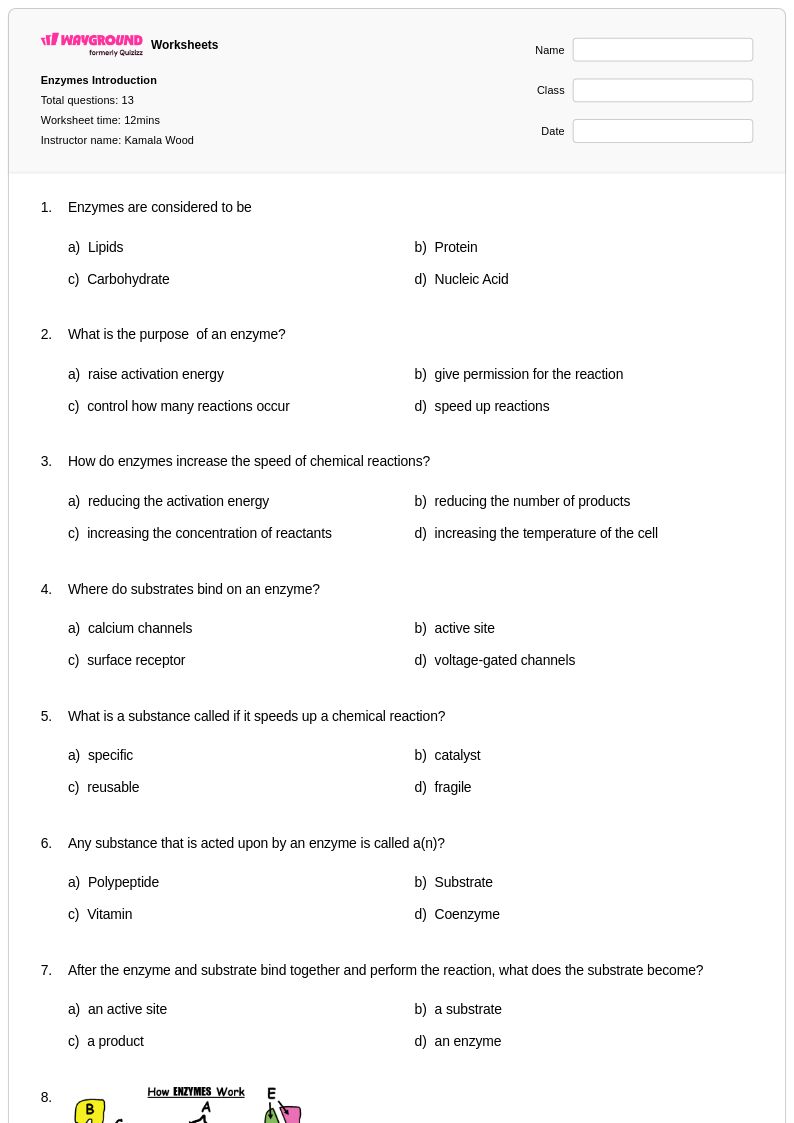
Enzymes worksheets for Grade 9 biology students available through Wayground (formerly Quizizz) provide comprehensive coverage of these essential biological catalysts and their critical role in cellular processes. These expertly designed worksheets strengthen students' understanding of enzyme structure, function, and kinetics while developing analytical skills through detailed practice problems that explore enzyme-substrate interactions, factors affecting enzyme activity, and inhibition mechanisms. Each worksheet collection includes complete answer keys and is available as free printable resources in convenient PDF format, allowing students to master complex concepts such as activation energy, enzyme specificity, and the lock-and-key model through systematic practice and reinforcement.
Wayground (formerly Quizizz) supports biology educators with millions of teacher-created enzyme worksheets that feature robust search and filtering capabilities, enabling quick access to grade-appropriate content aligned with science education standards. The platform's differentiation tools allow teachers to customize worksheets for varying skill levels, while flexible formatting options provide both printable PDF versions and interactive digital formats to accommodate diverse classroom needs. These comprehensive enzyme worksheet collections facilitate effective lesson planning by offering ready-to-use materials for introducing new concepts, providing targeted remediation for struggling students, and delivering enrichment activities that challenge advanced learners to deepen their understanding of enzymatic processes and biochemical pathways.
FAQs
How do I teach enzymes to high school biology students?
Start by grounding students in the lock-and-key and induced-fit models before moving to more abstract concepts like enzyme kinetics and inhibition. Use visual aids such as diagrams of active sites and substrate binding to make the structural concepts tangible. From there, introduce real-world examples like digestive enzymes or DNA polymerase to connect biochemistry to systems students already know. Building from structure to function to regulation gives students a conceptual scaffold that supports deeper understanding.
What activities help students practice understanding enzyme function?
Practice problems that ask students to interpret graphs of enzyme activity at varying pH levels and temperatures are especially effective because they require students to apply conceptual understanding rather than recall. Worksheets that present data on reaction rates with and without inhibitors build analytical thinking around competitive versus noncompetitive inhibition. Including questions on metabolic pathways helps students see how enzymes function within larger biological systems rather than in isolation.
What common mistakes do students make when learning about enzymes?
A frequent misconception is that enzymes are consumed during reactions, when in fact they are regenerated and can catalyze the same reaction repeatedly. Students also commonly confuse the terms 'substrate' and 'product,' which leads to errors when interpreting reaction diagrams. Another persistent error is assuming that higher temperature always increases enzyme activity, without accounting for denaturation above optimal thresholds. Targeted practice on these specific points helps students self-correct before these misconceptions solidify.
How do I help struggling students understand factors that affect enzyme activity?
Students who struggle with this concept often benefit from graphical representations that show enzyme activity curves across a range of pH and temperature values, rather than purely text-based explanations. Pairing these visuals with guided worksheet questions that ask students to identify optimal conditions, describe what happens at extremes, and explain the role of denaturation can scaffold comprehension effectively. On Wayground, teachers can enable the Read Aloud accommodation for students who need auditory support, and can reduce answer choices for selected students to lower cognitive load while they build foundational understanding.
How can I use Wayground's enzyme worksheets in my classroom?
Wayground's enzyme worksheets are available as printable PDFs, making them straightforward to distribute for in-class work or homework, and in digital formats suited to technology-integrated classrooms. Teachers can also host enzyme worksheets directly as a quiz on Wayground, enabling real-time student responses and instant feedback. The platform includes complete answer keys with each worksheet, supporting both teacher-led review and independent student self-assessment.
How do I differentiate enzyme instruction for advanced learners?
Advanced students benefit from moving beyond basic enzyme-substrate interactions into enzyme kinetics concepts such as Michaelis-Menten kinetics, Vmax, and Km values. Worksheets that require students to interpret Lineweaver-Burk plots or design hypothetical experiments around enzyme inhibition push higher-order thinking. Connecting enzyme regulation to metabolic control, such as feedback inhibition in biosynthetic pathways, extends learning into systems-level biology that prepares students for AP or college coursework.