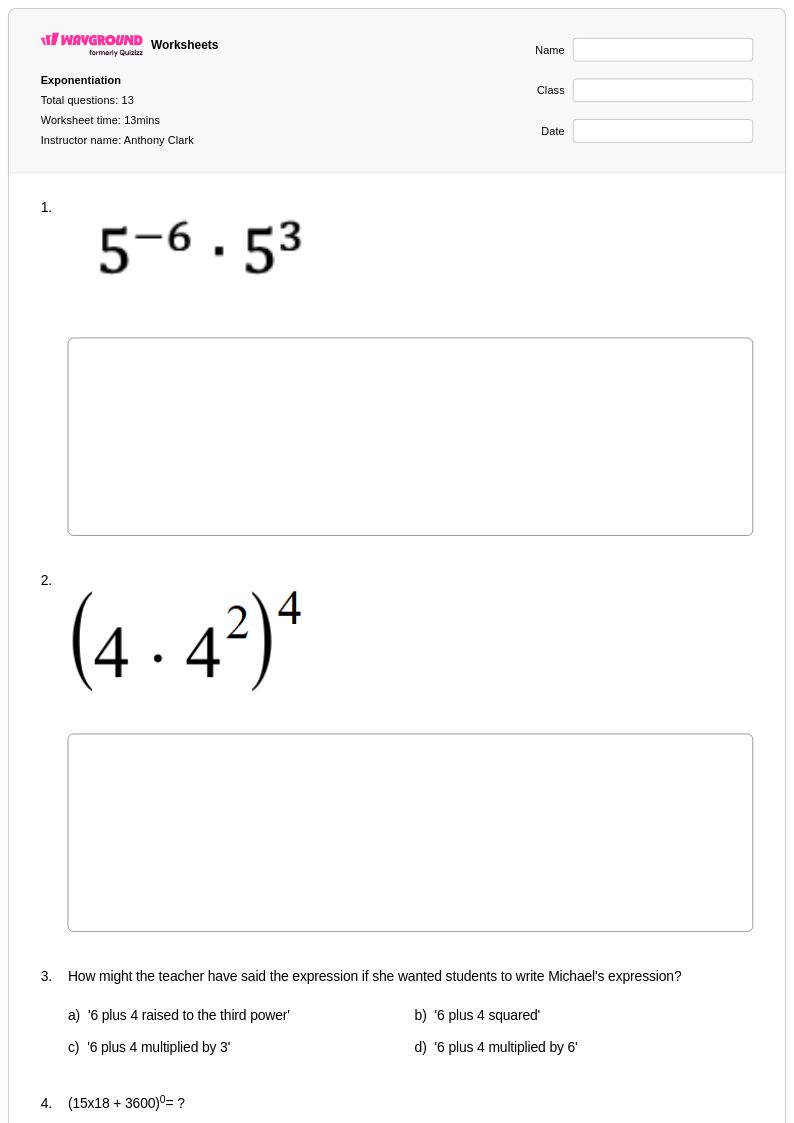
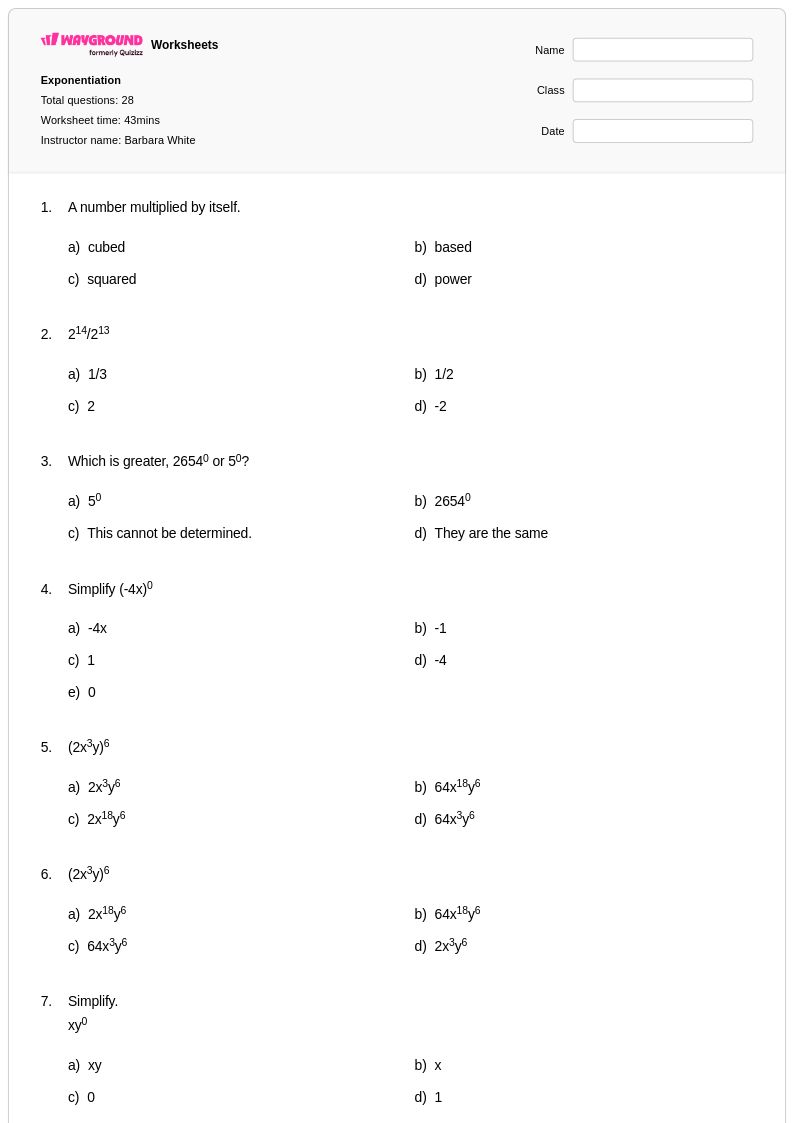
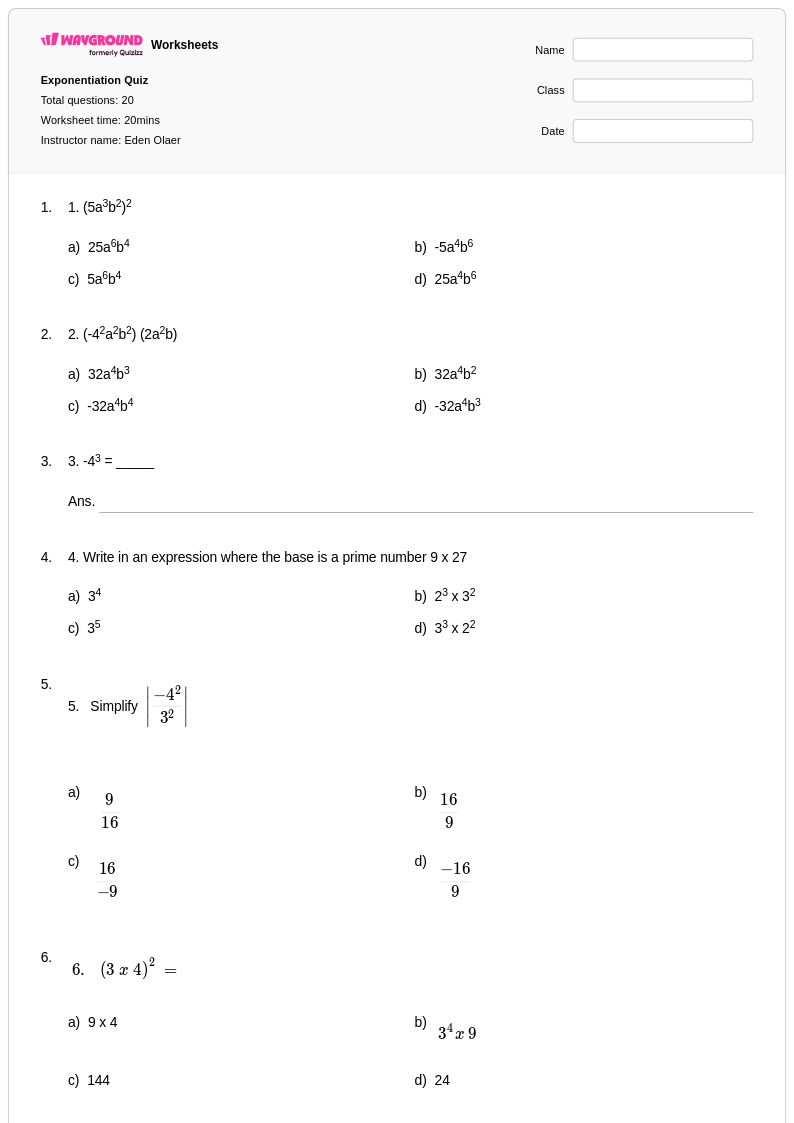
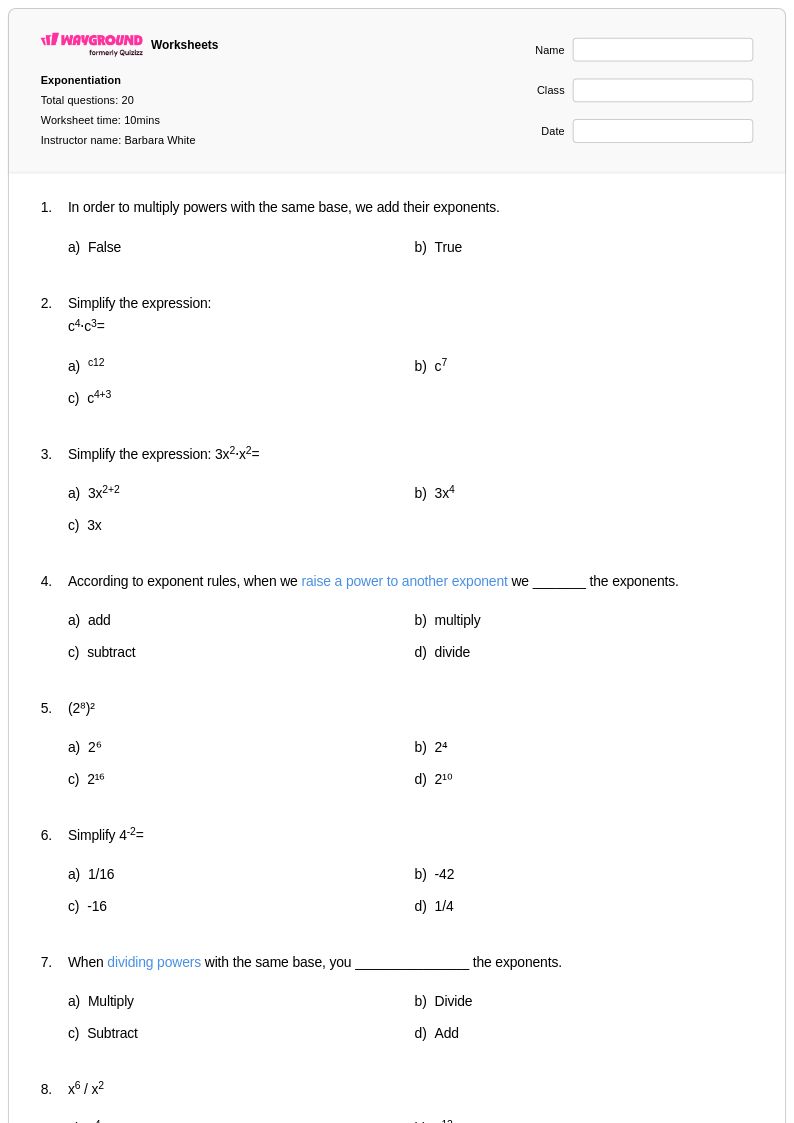
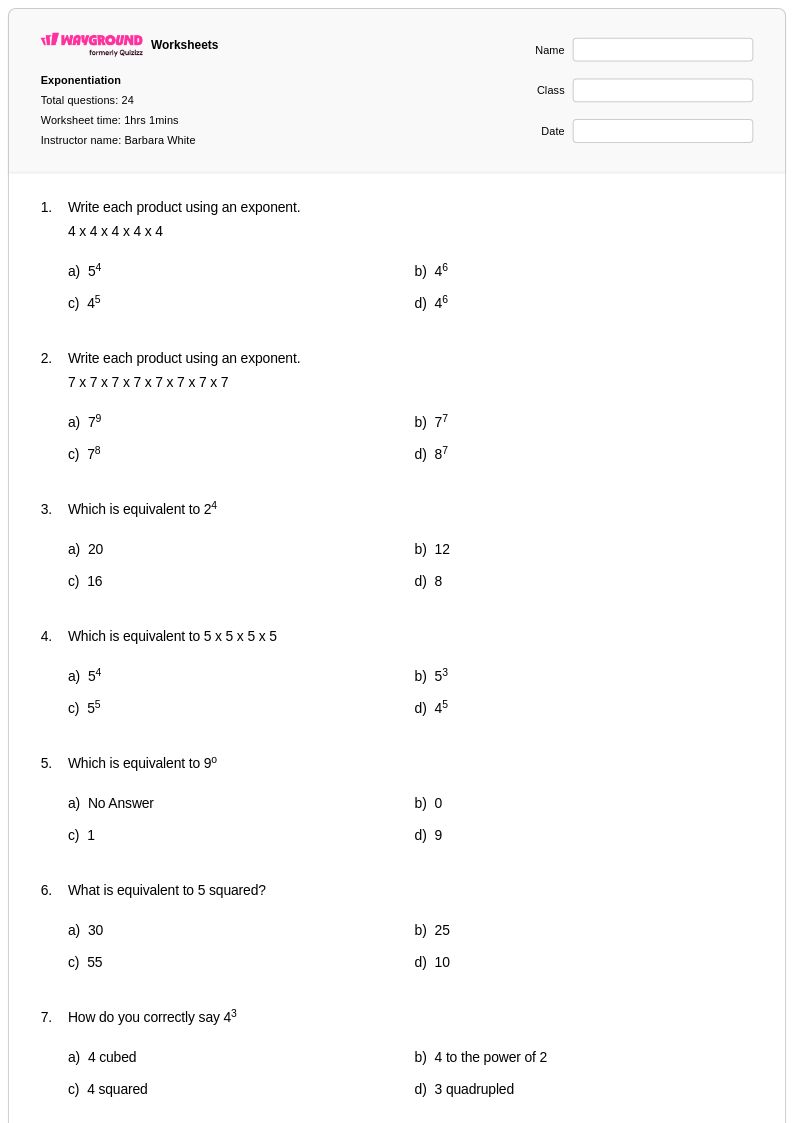
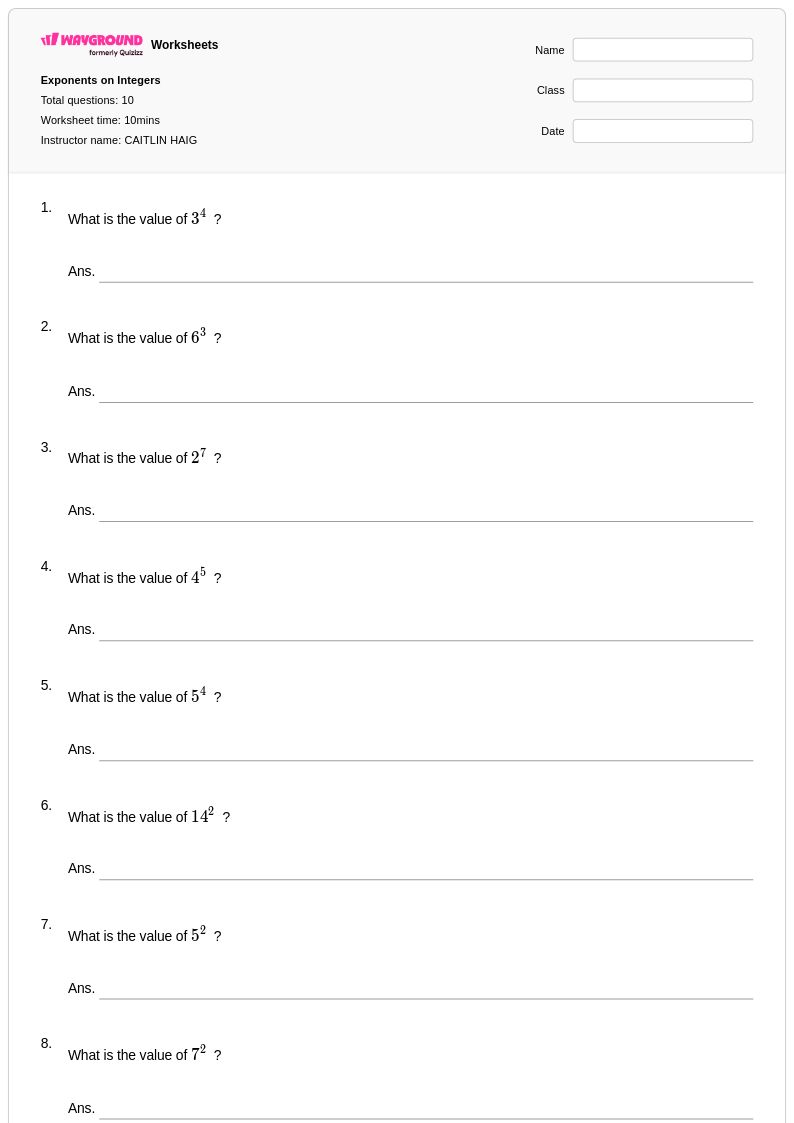
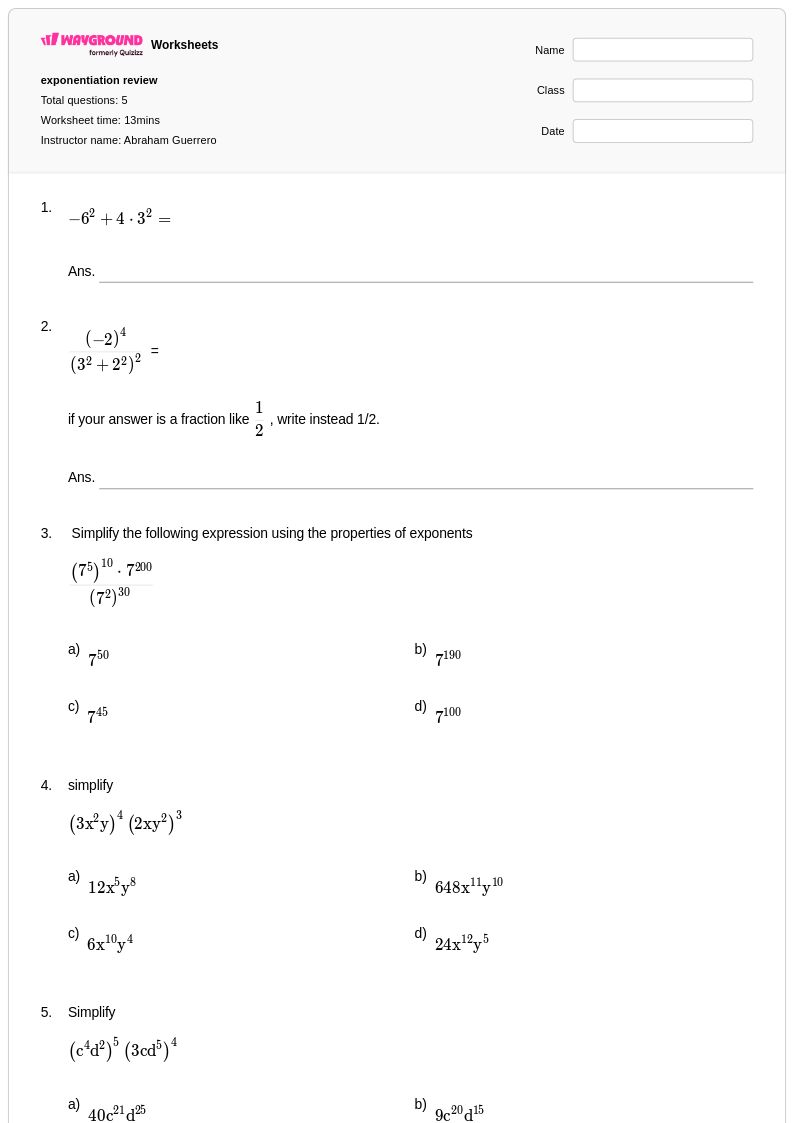
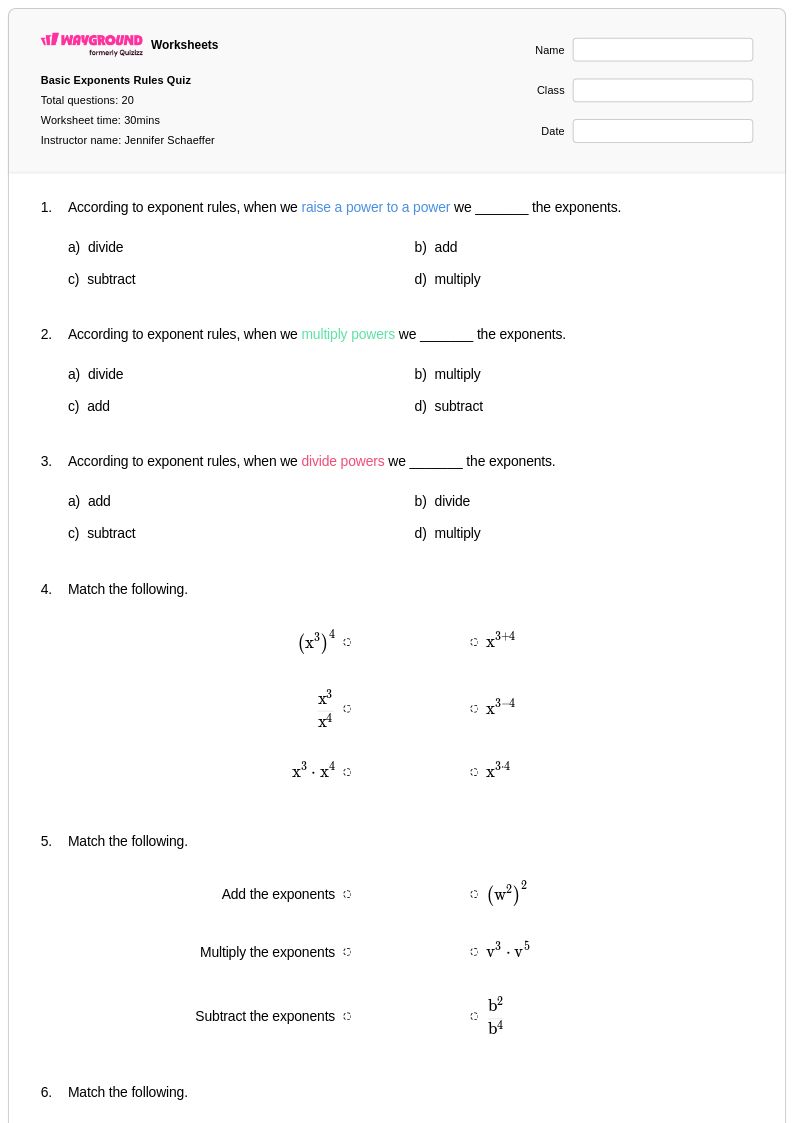
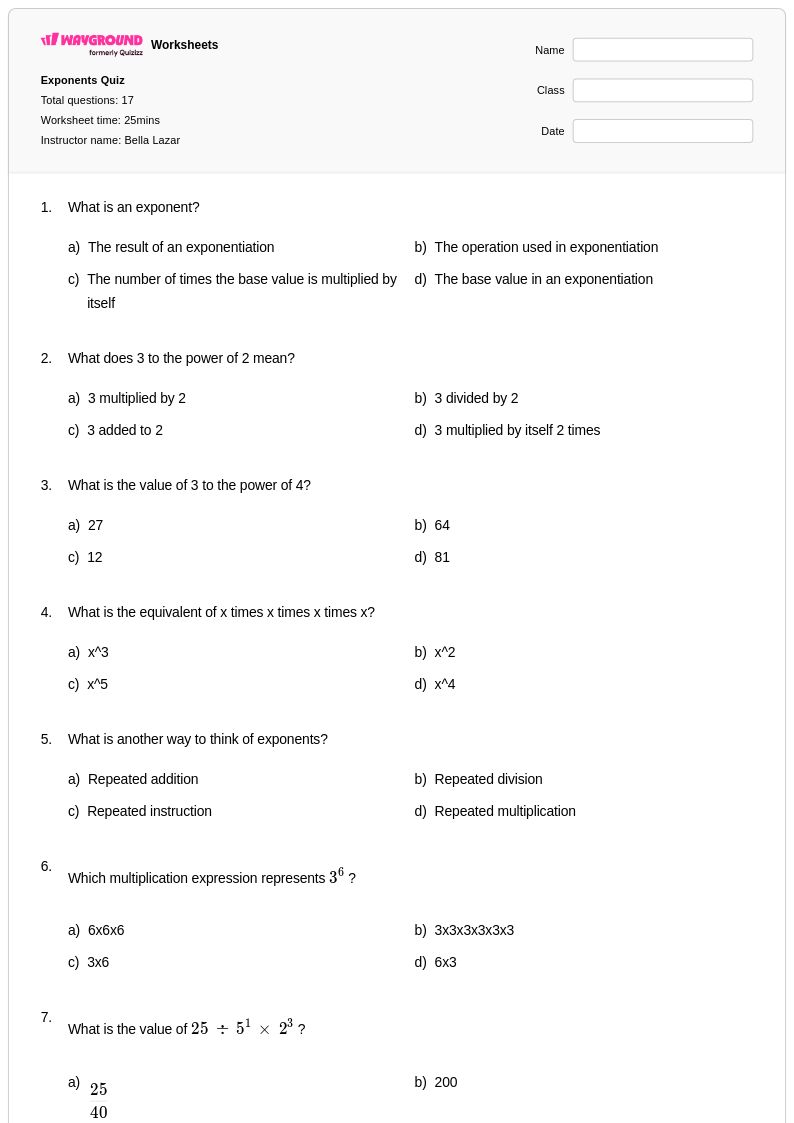
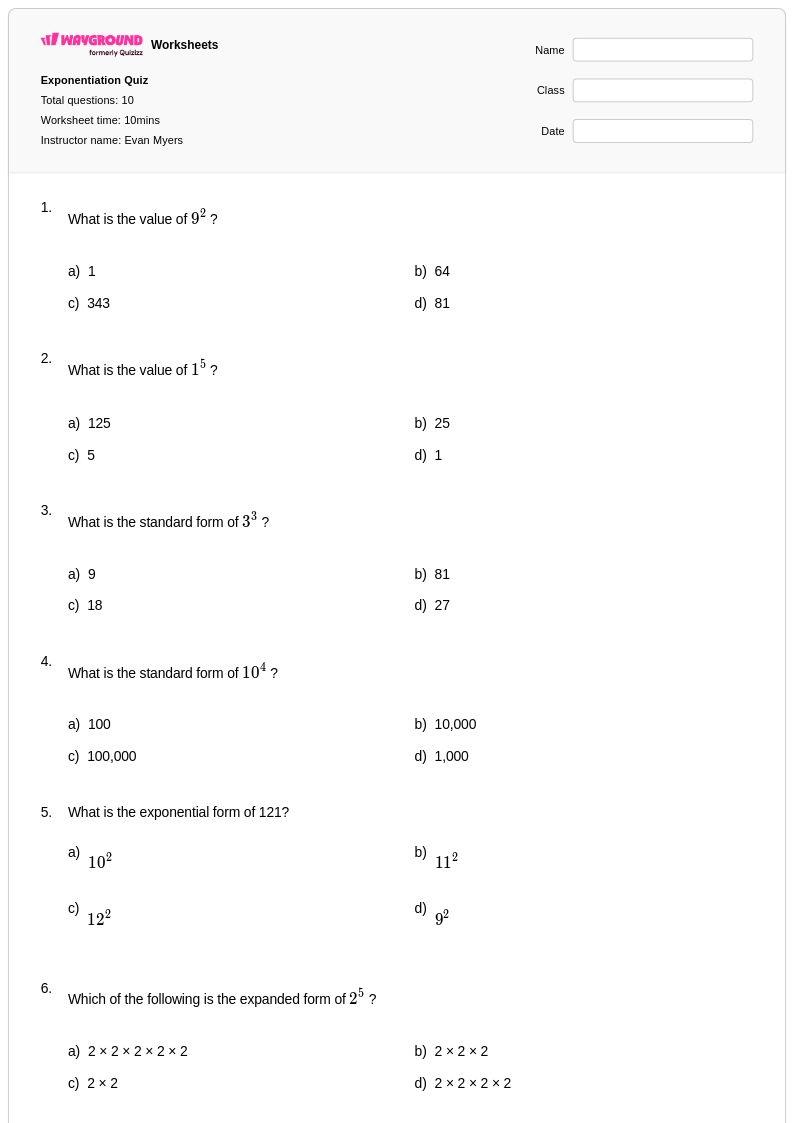
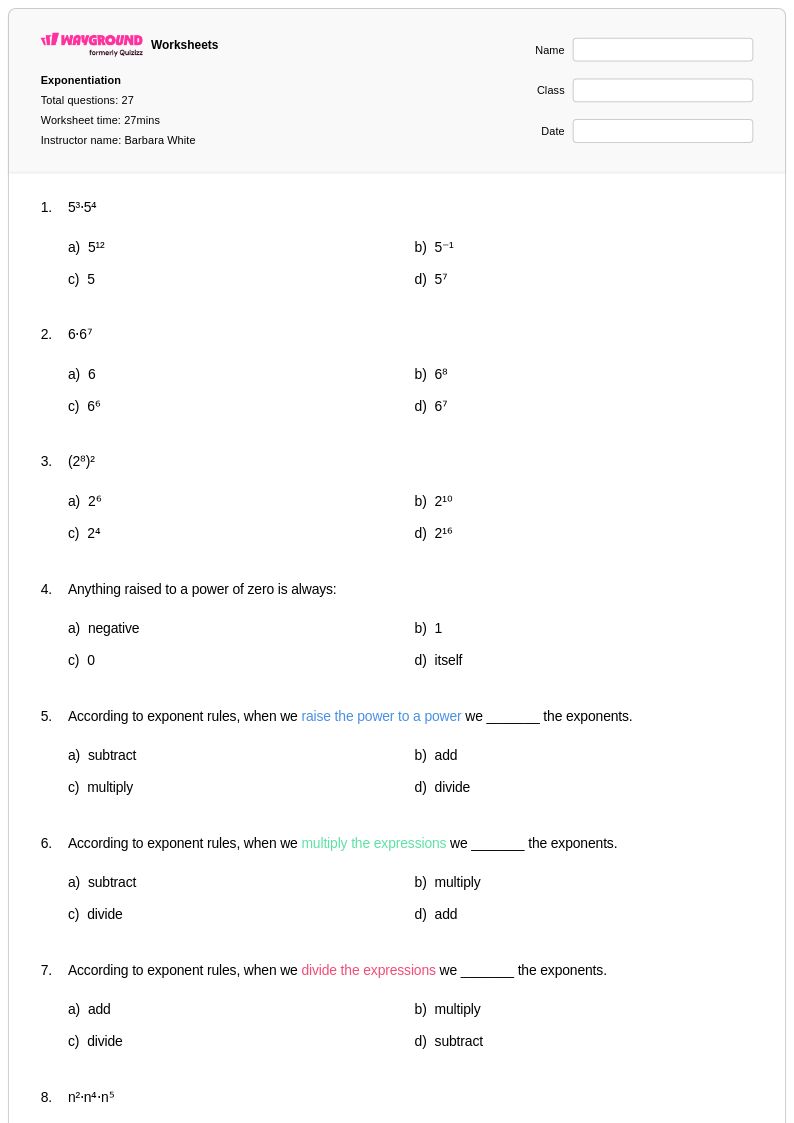
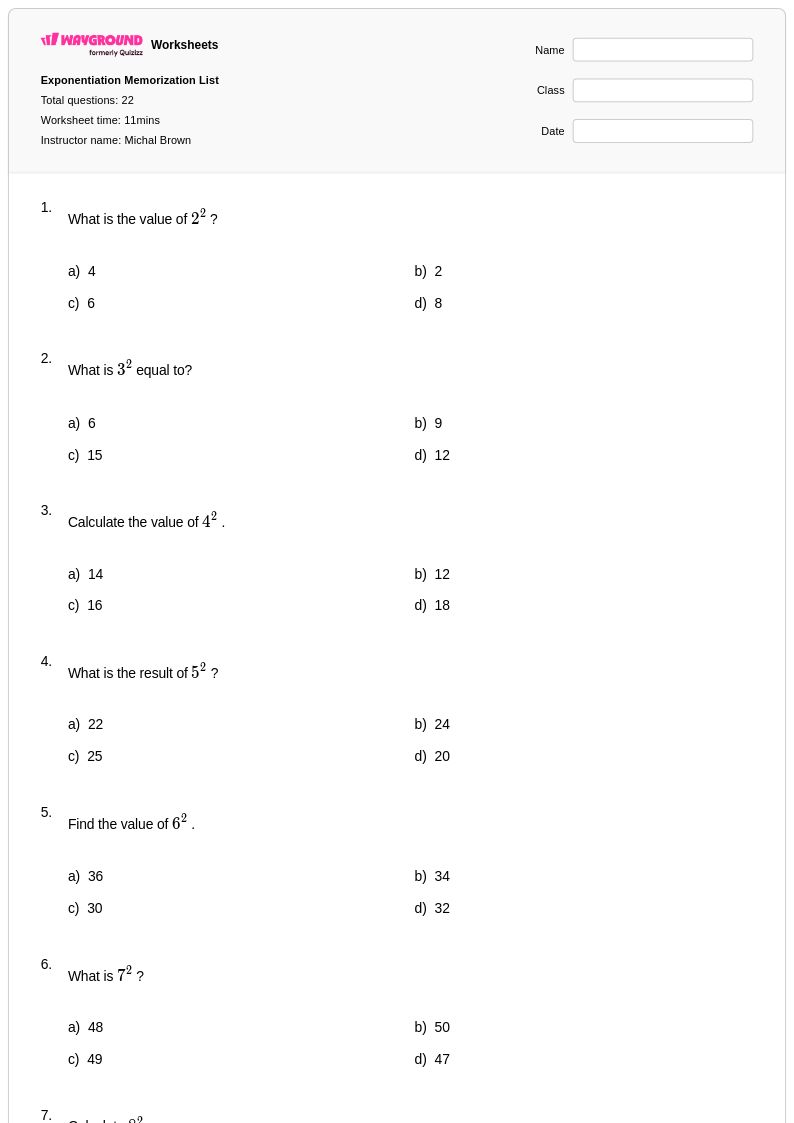
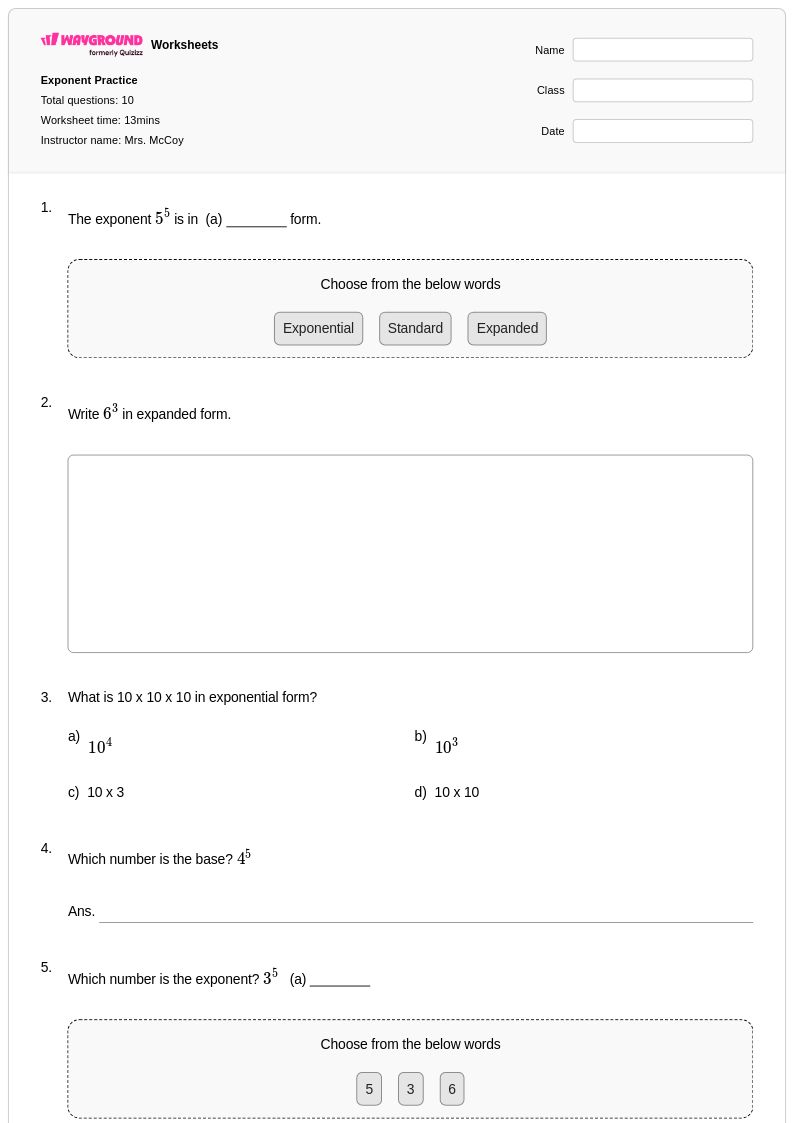
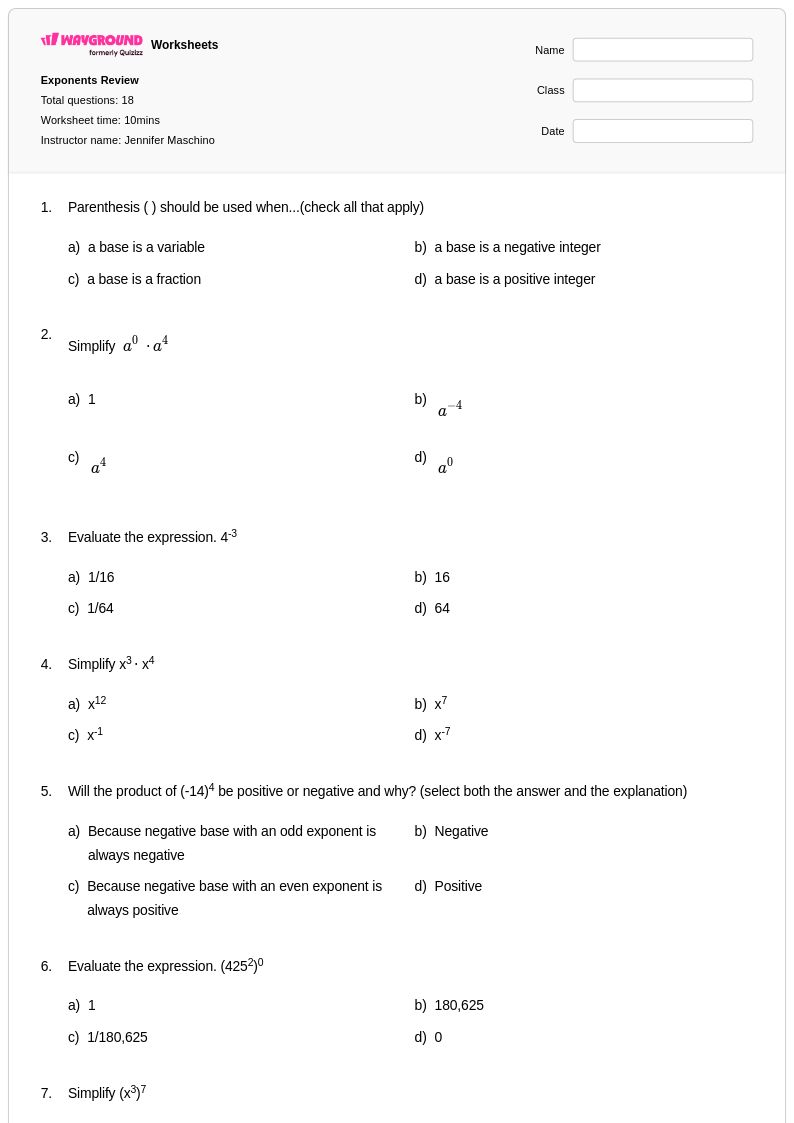
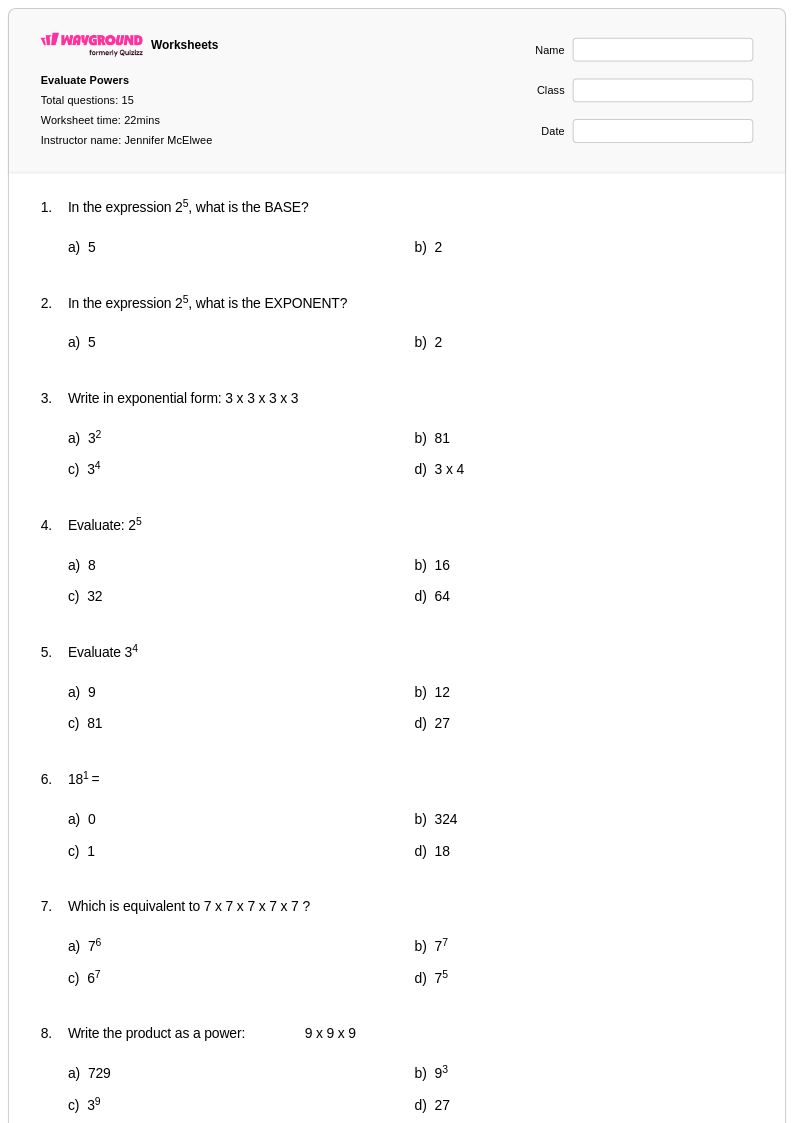
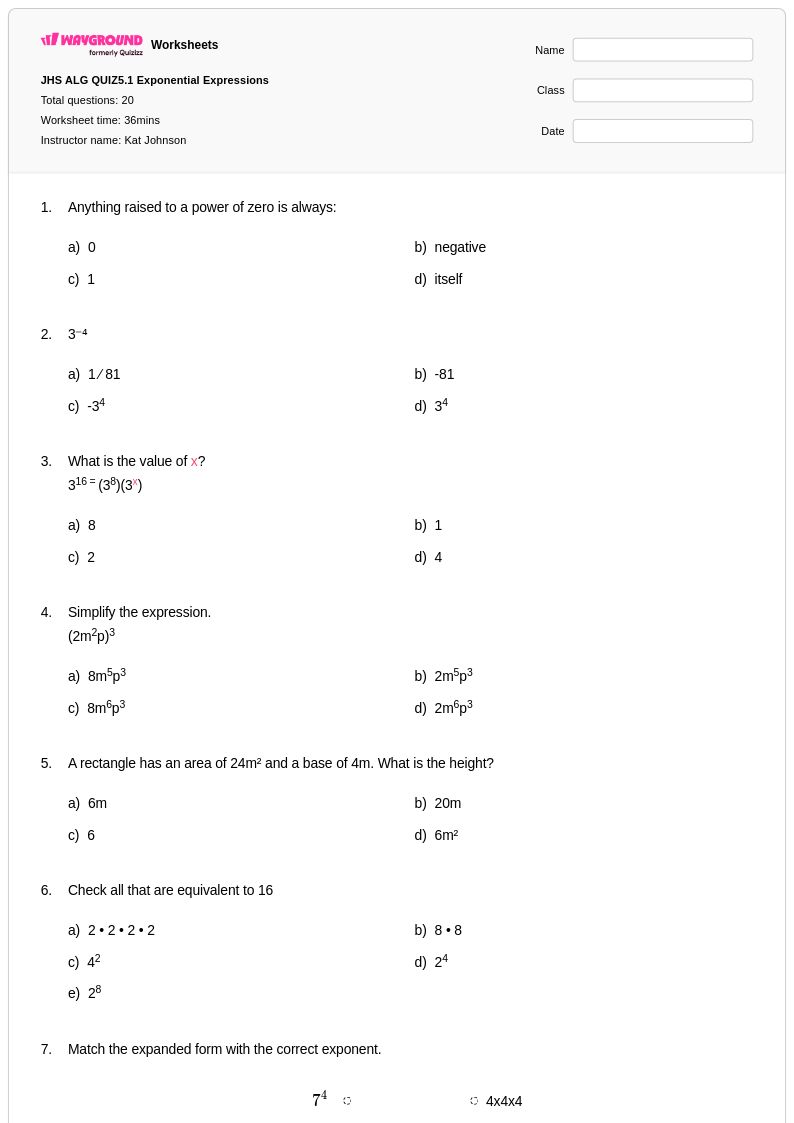
Enhance students' understanding of exponentiation with Wayground's comprehensive collection of free mathematics worksheets, featuring engaging practice problems, printable PDFs, and complete answer keys to master powers and exponential expressions.
Exponentiation worksheets available through Wayground (formerly Quizizz) provide comprehensive practice opportunities for students to master the fundamental concept of repeated multiplication and power notation. These carefully designed resources strengthen critical mathematical skills including understanding base and exponent relationships, calculating powers of whole numbers and fractions, working with negative and zero exponents, and applying the laws of exponents in algebraic expressions. Each worksheet collection includes detailed answer keys that support both independent study and classroom instruction, while the free printables offer educators flexible options for homework assignments, classroom practice problems, and assessment preparation. The pdf format ensures consistent formatting across devices and makes distribution seamless for teachers working with diverse learning environments.
Wayground (formerly Quizizz) empowers mathematics educators with access to millions of teacher-created exponentiation resources that can be easily discovered through robust search and filtering capabilities. The platform's standards alignment features help teachers identify worksheets that match specific curriculum requirements, while built-in differentiation tools enable customization based on individual student needs and learning objectives. Teachers can modify existing worksheets or create entirely new practice sets, with the flexibility to deliver content in both printable and digital formats including downloadable pdf files. These comprehensive features streamline lesson planning by providing ready-to-use materials for skill practice, targeted remediation for struggling learners, and enrichment opportunities for advanced students, ultimately supporting effective mathematics instruction across diverse classroom settings.
FAQs
How do I teach exponentiation to students who are new to the concept?
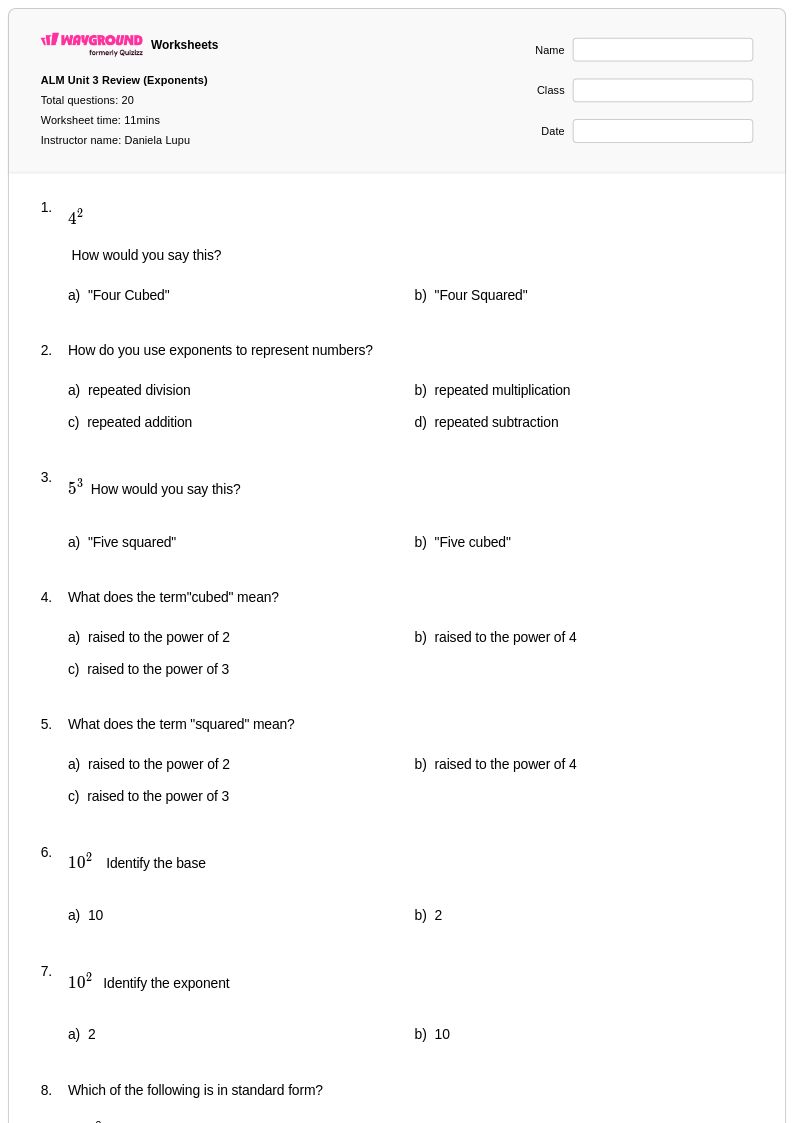
Start with repeated multiplication before introducing notation. Show students that 2³ is just 2 × 2 × 2, and let them compute it that way first. Once the pattern clicks, introduce the base-exponent structure as shorthand. From there, build toward zero and negative exponents by extending the pattern: if 2³ = 8 and 2² = 4 and 2¹ = 2, students can reason their way to 2⁰ = 1 rather than just memorizing it.
What exercises help students practice exponentiation effectively?
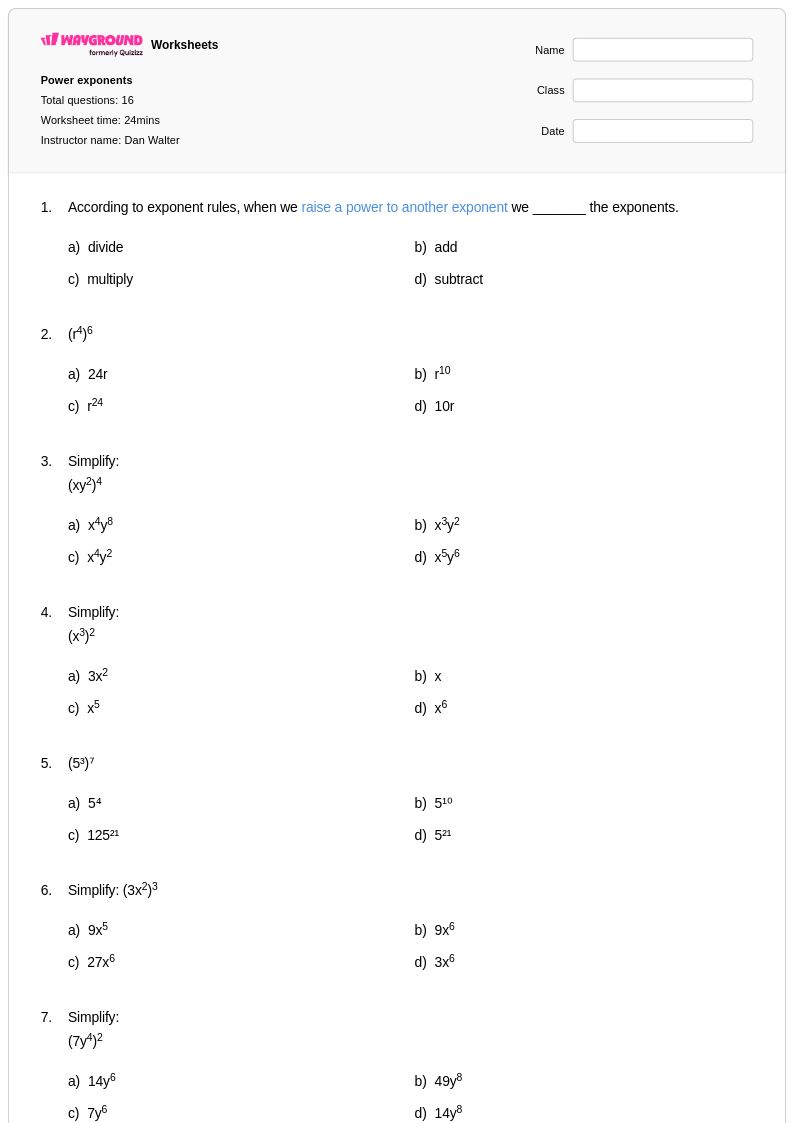
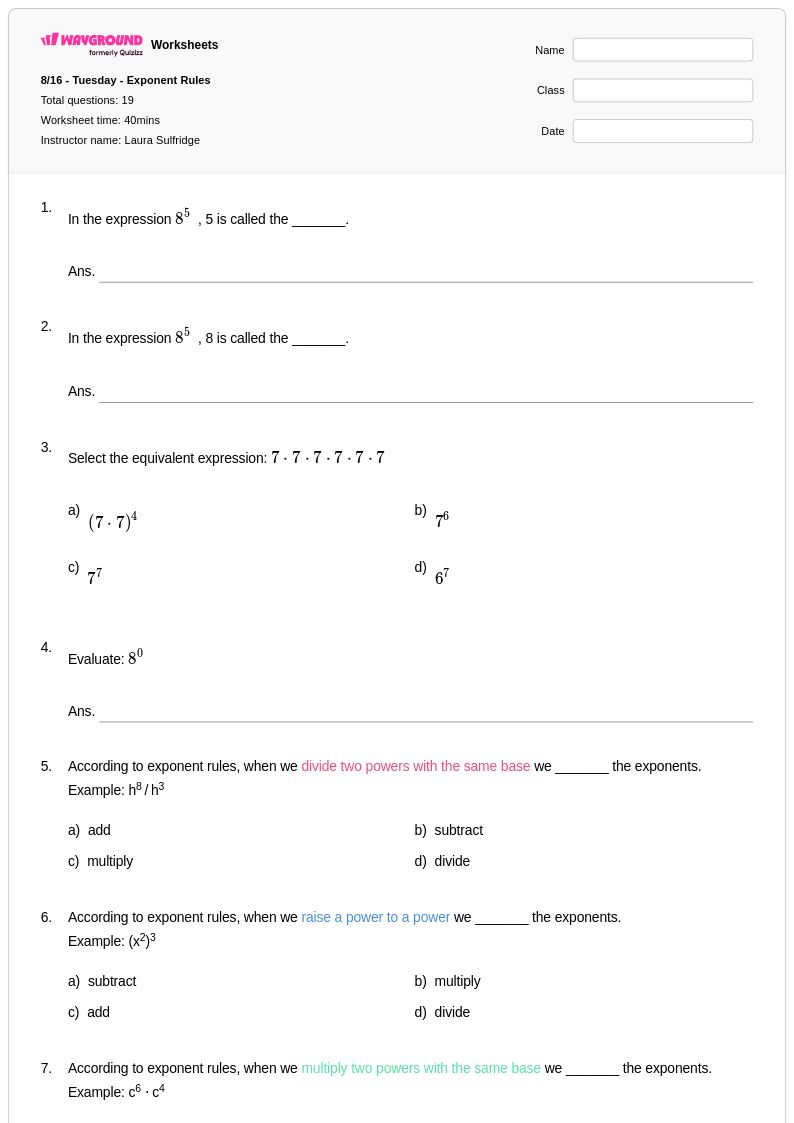
The most productive practice moves through three stages: evaluating expressions (compute 3⁴), translating between forms (write 81 as a power of 3), and applying exponent laws to simplify algebraic expressions. Mixing all three in a single worksheet session keeps practice from feeling mechanical and surfaces which stage is actually causing difficulty.
What mistakes do students commonly make with exponents?
The most persistent error is multiplying the base by the exponent instead of using repeated multiplication — students write 2³ = 6 instead of 8. A close second is mishandling negative exponents: students often negate the result (writing 2⁻³ = −8) rather than taking the reciprocal. Both errors usually signal that the underlying definition hasn't fully landed, so revisiting the repeated-multiplication foundation tends to fix them faster than more drill.
How do I use Wayground's exponentiation worksheets in my classroom?
You can run any worksheet as a digital quiz hosted on Wayground or download it as a printable PDF — same problems, either format. Every worksheet includes a complete answer key, so students can self-check during independent practice. If you go the print route, the Wayground for Teachers app lets you scan or capture student submissions for grading without re-entering anything manually.
Is exponentiation aligned to Common Core standards, and where does it fit in the progression?
Yes. Common Core introduces exponents in Grade 6 as a way to express repeated multiplication and read/write exponential notation. By Grade 8, students are expected to apply the full set of integer exponent rules and connect exponentiation to scientific notation. In high school, the progression extends to rational exponents and exponential functions, so the fluency built in middle school directly supports work with radicals and function modeling later on.
How can I differentiate exponentiation practice for mixed-ability classes?
For students who struggle with the notation itself, Wayground's read-aloud feature can reduce the cognitive load of parsing unfamiliar symbols while they focus on the math. For students with processing or attention challenges, reduced answer choices keeps multiple-choice items from becoming overwhelming. You can also generate an alternate version of the same worksheet with a larger font or dyslexia-friendly typeface — so every student is working on the same content without the layout getting in the way.
What grade level is exponentiation taught?
Exponentiation is formally introduced in Grade 6, where students learn exponential notation and evaluate simple powers. It deepens through Grades 7 and 8 with negative exponents, exponent laws, and scientific notation, then extends in Grade 9 into rational exponents and exponential functions. Students may encounter informal ideas about repeated multiplication earlier, but systematic instruction typically spans the middle-to-early-high-school years.