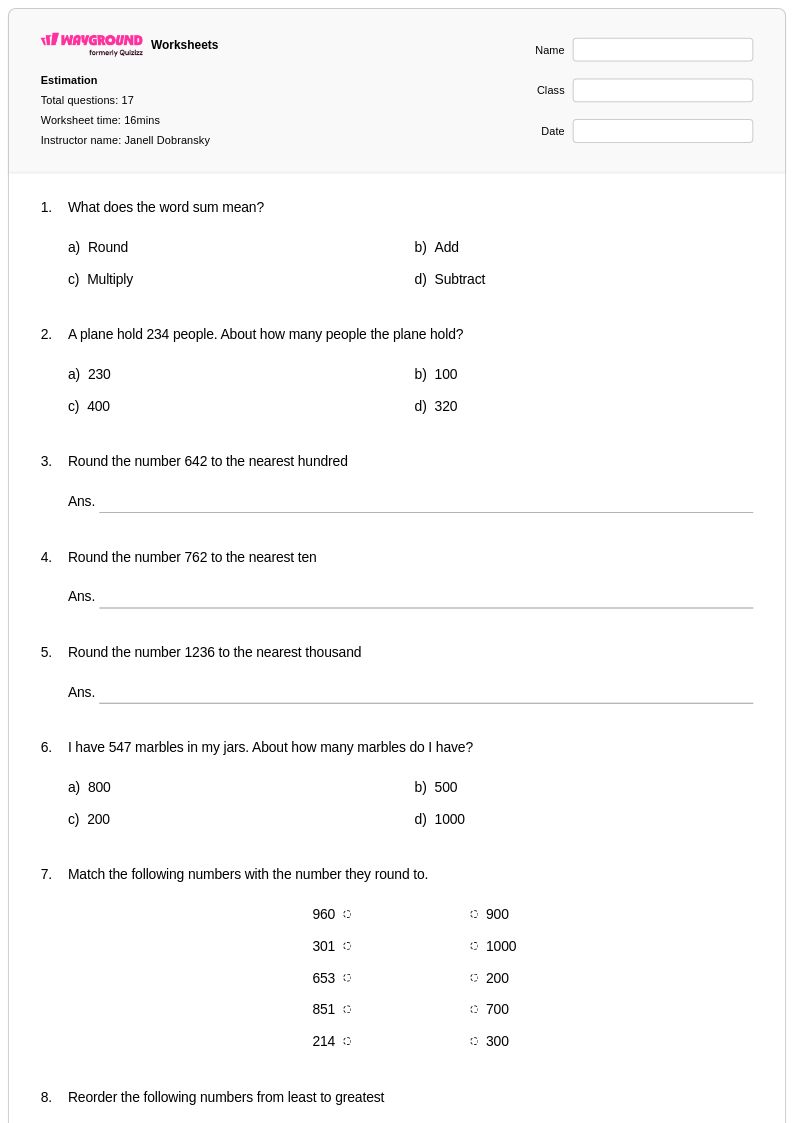
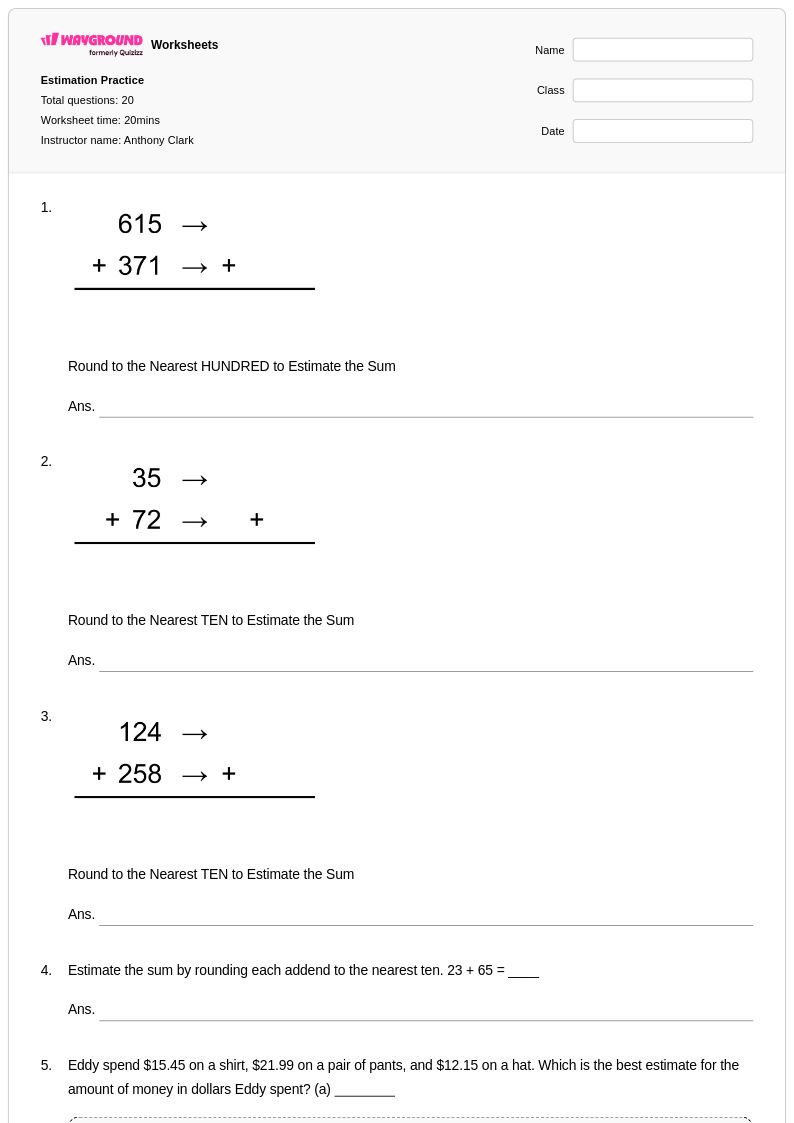
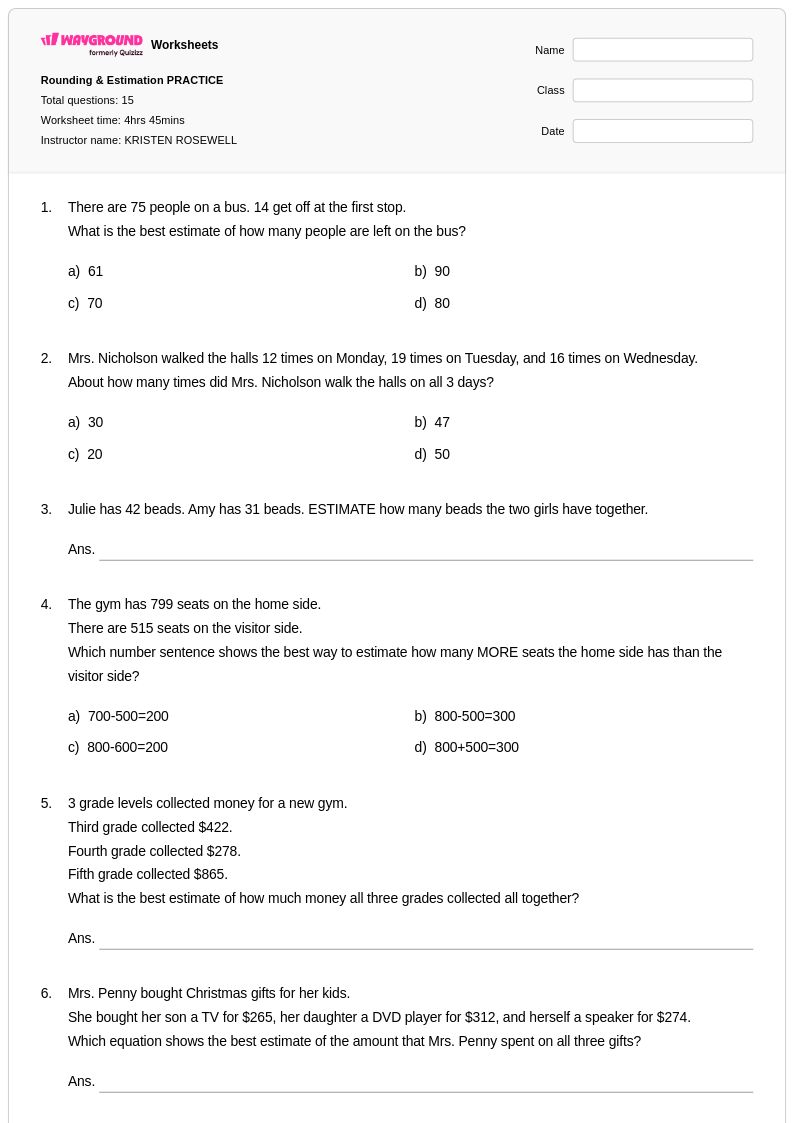
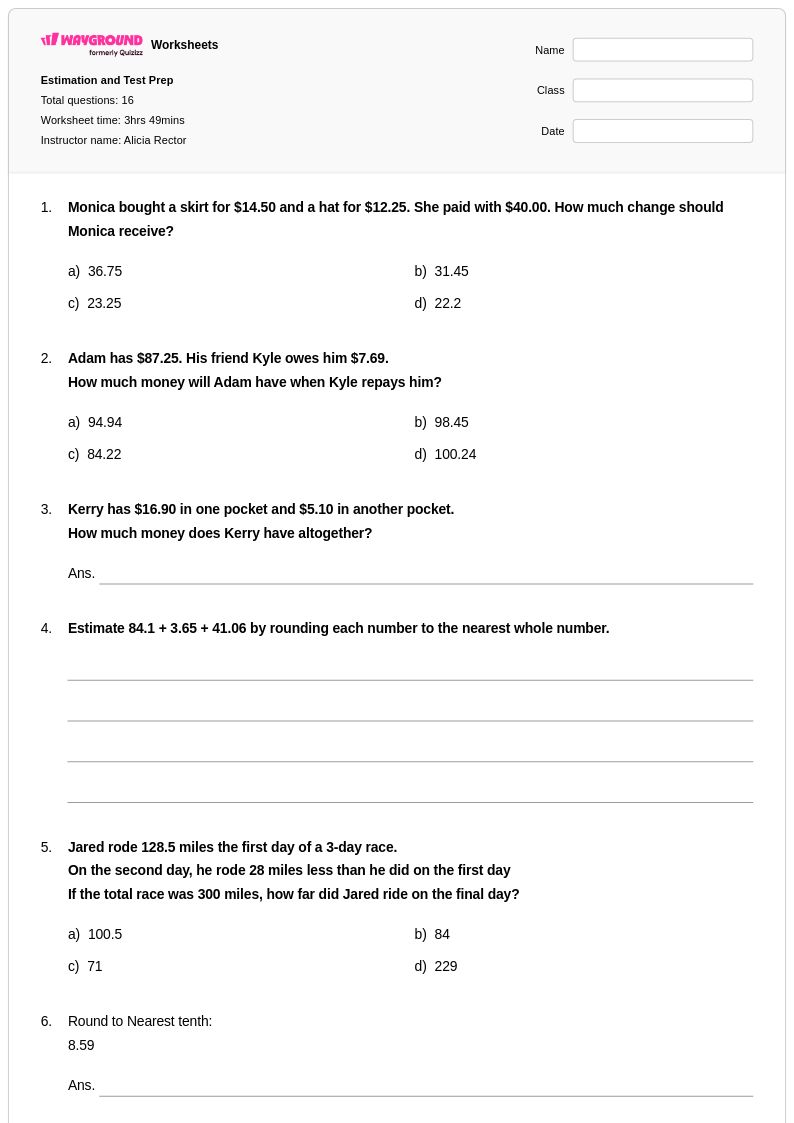
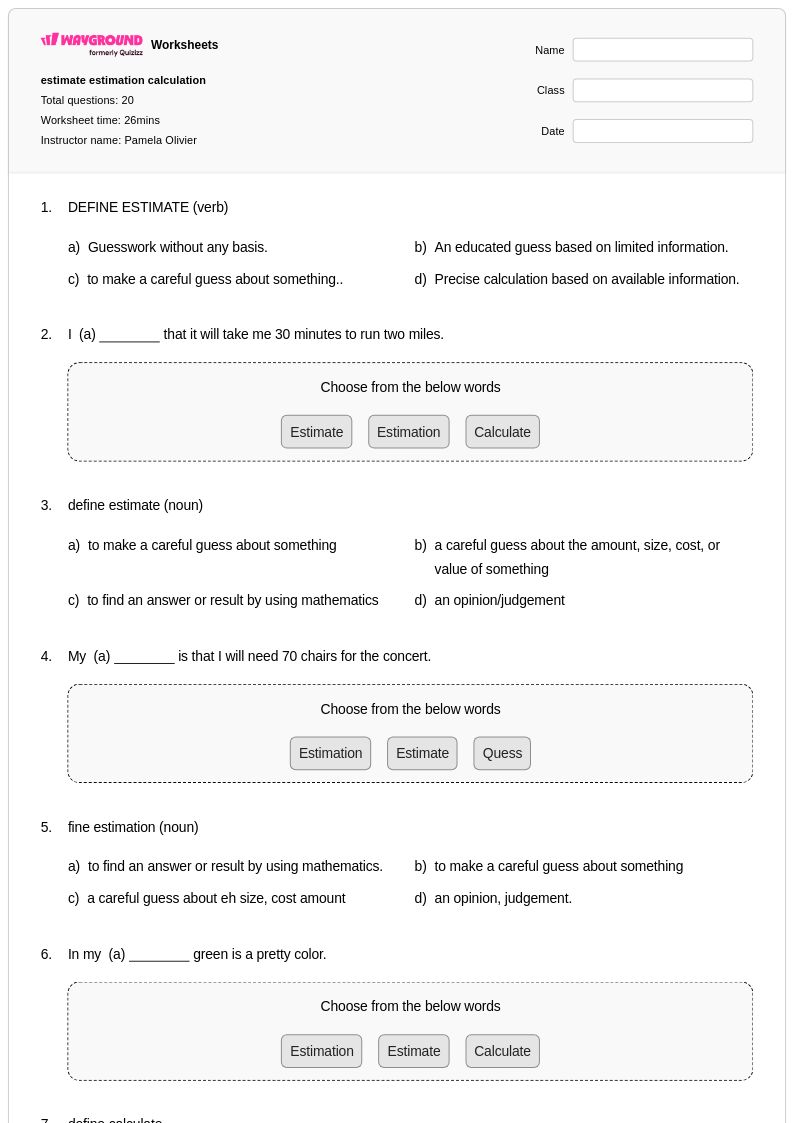
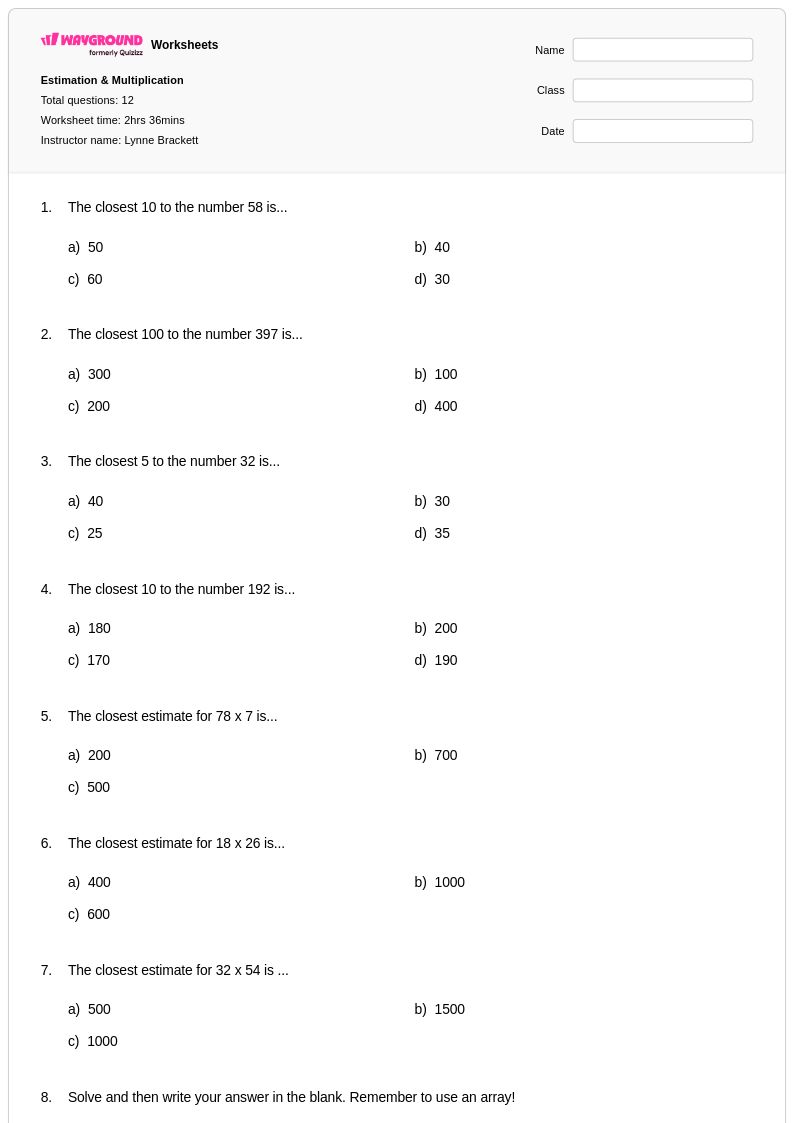
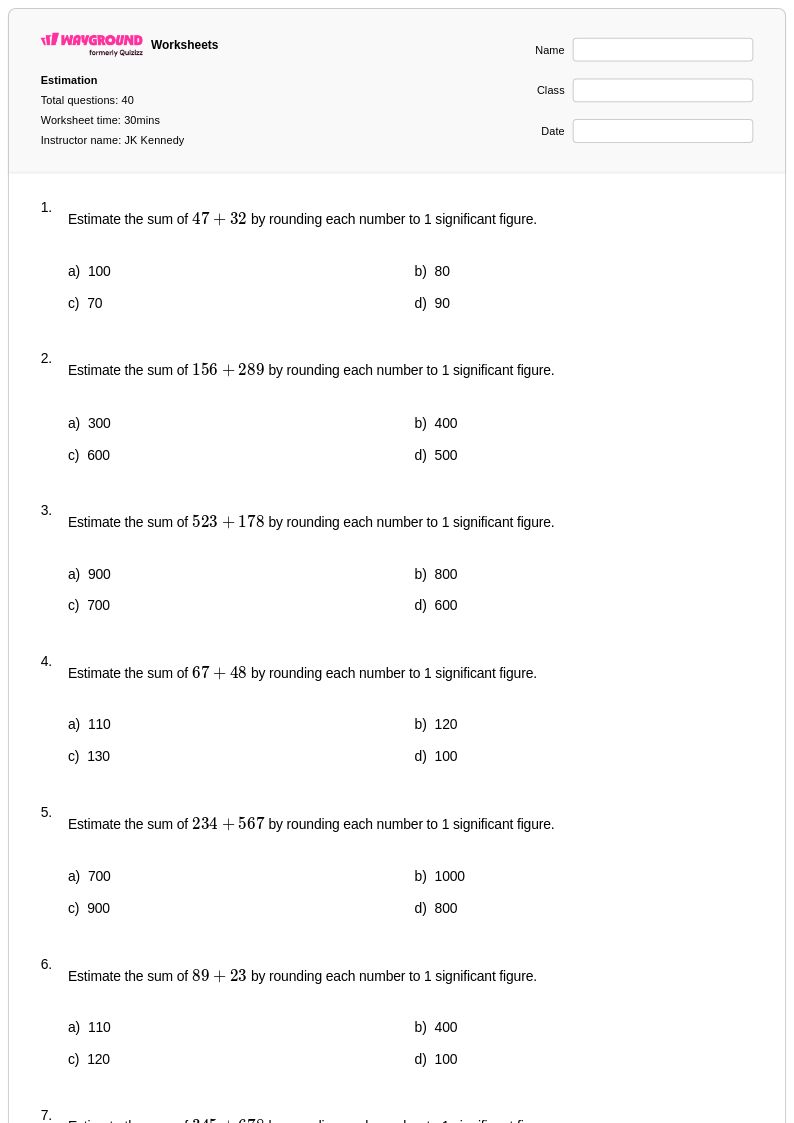
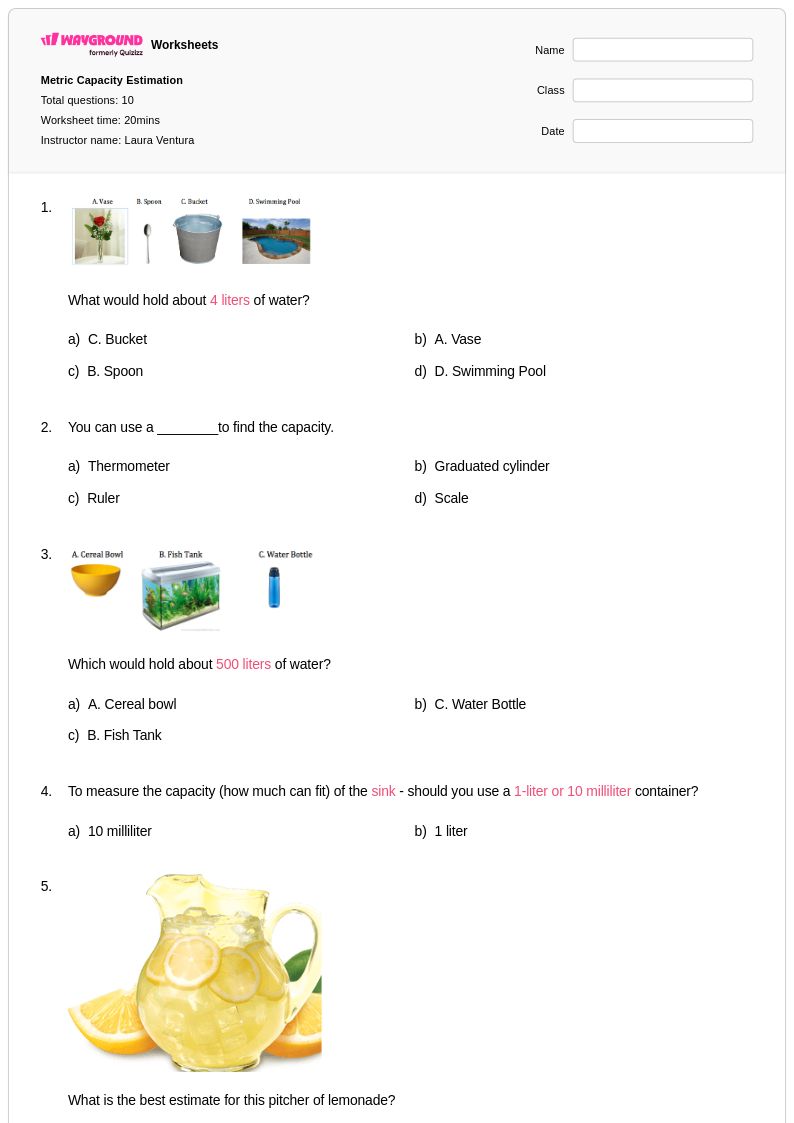
Master estimation skills with Wayground's comprehensive collection of free number sense worksheets, featuring engaging practice problems, printable PDFs, and complete answer keys to help students develop mathematical reasoning abilities.
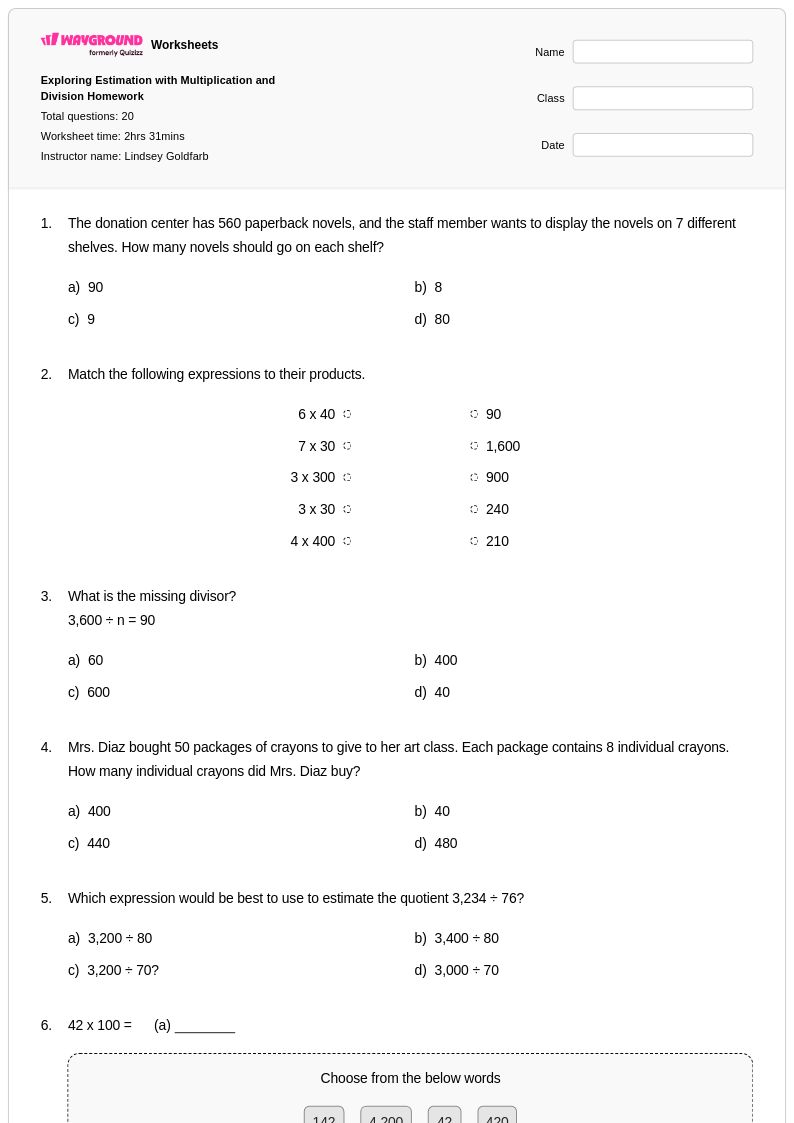
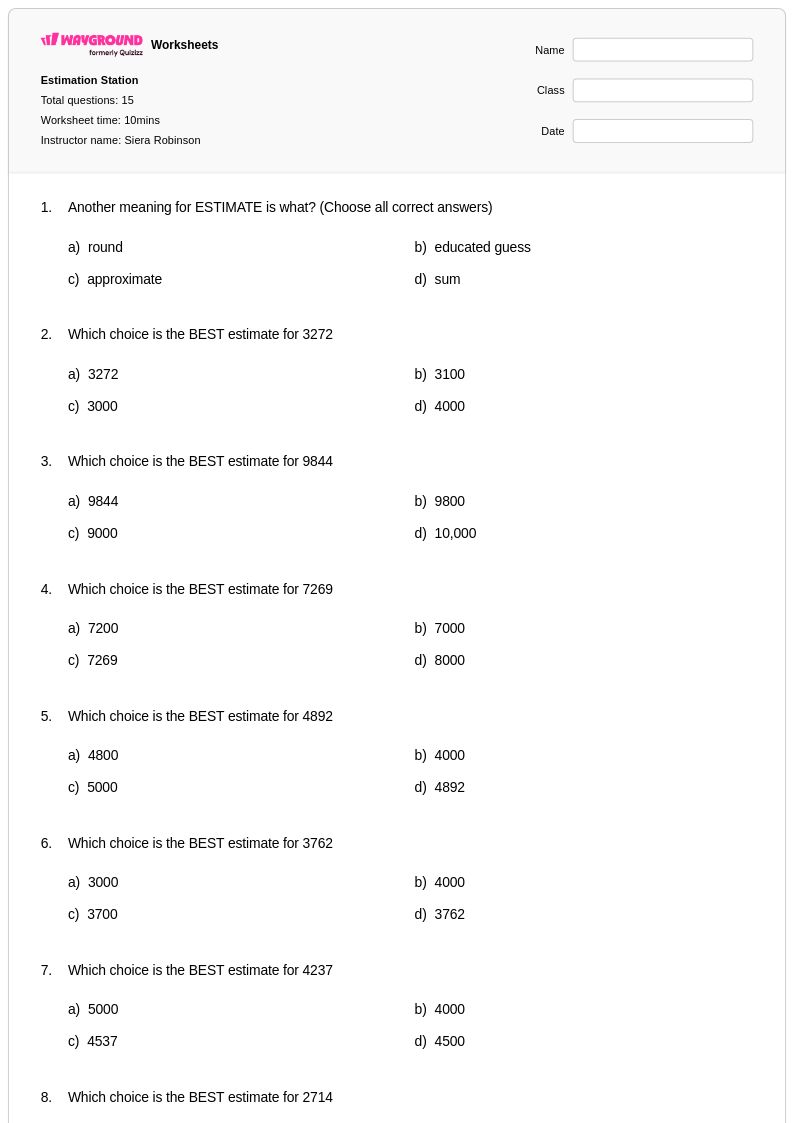
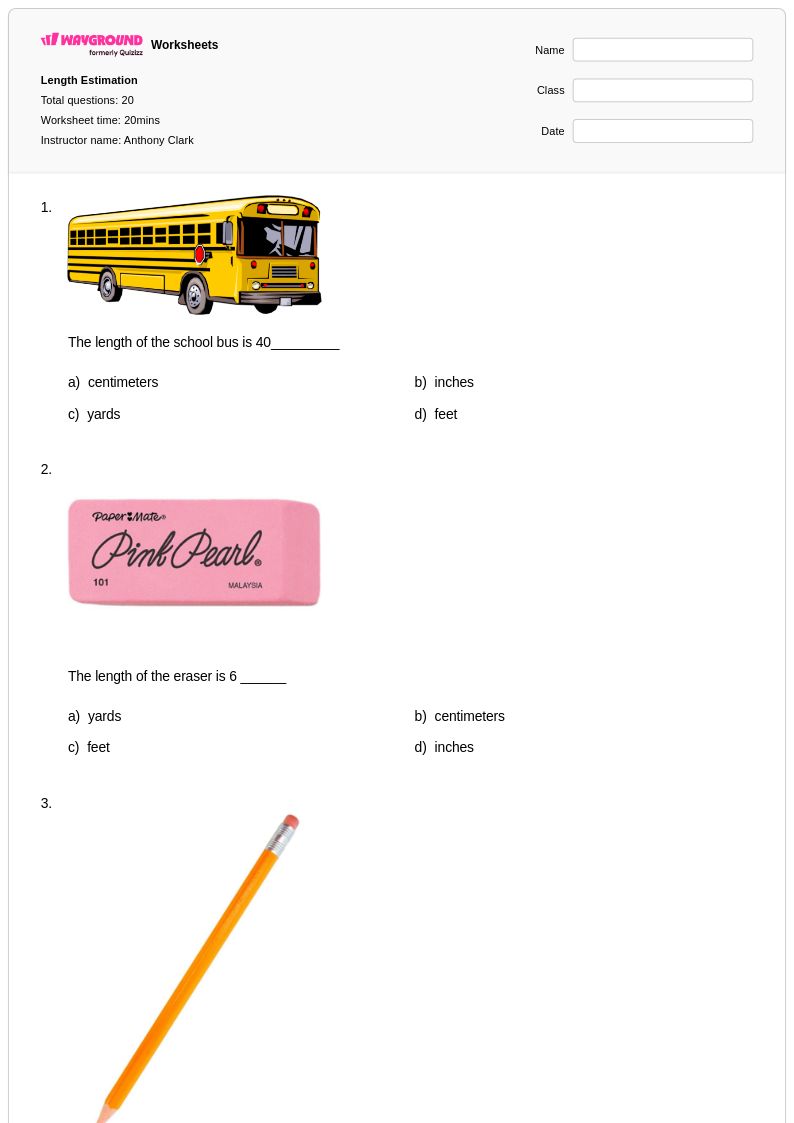
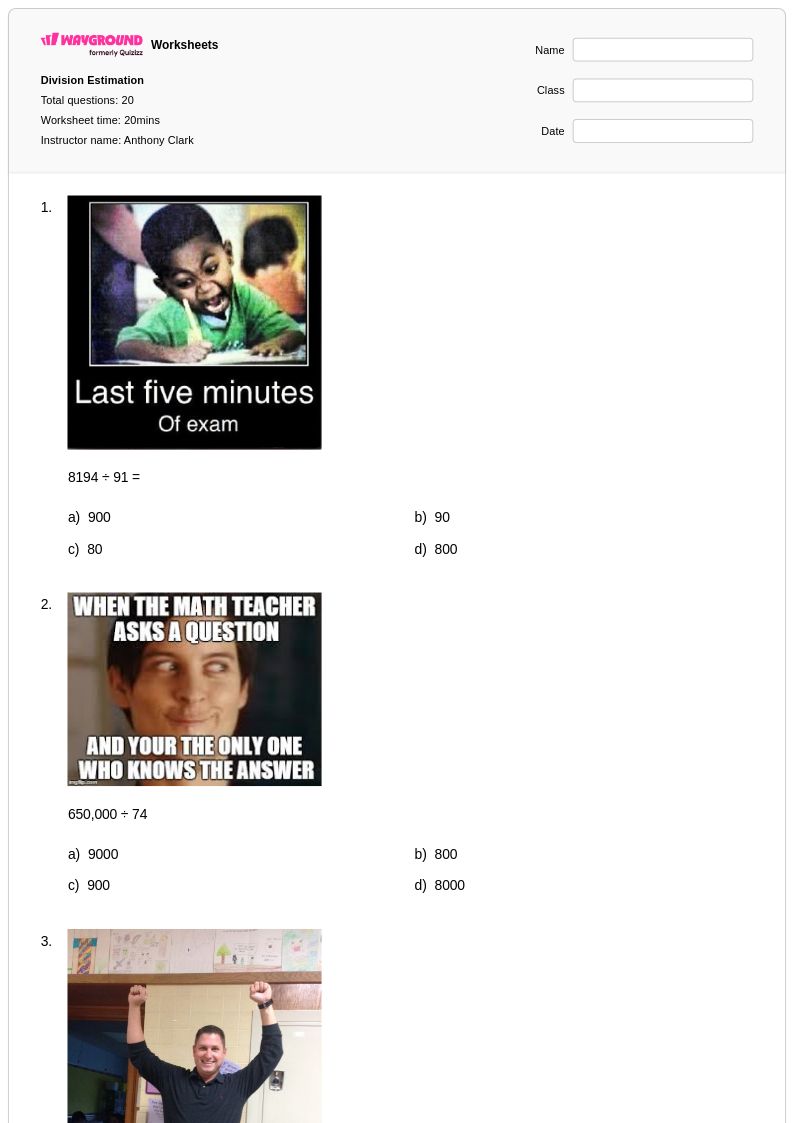
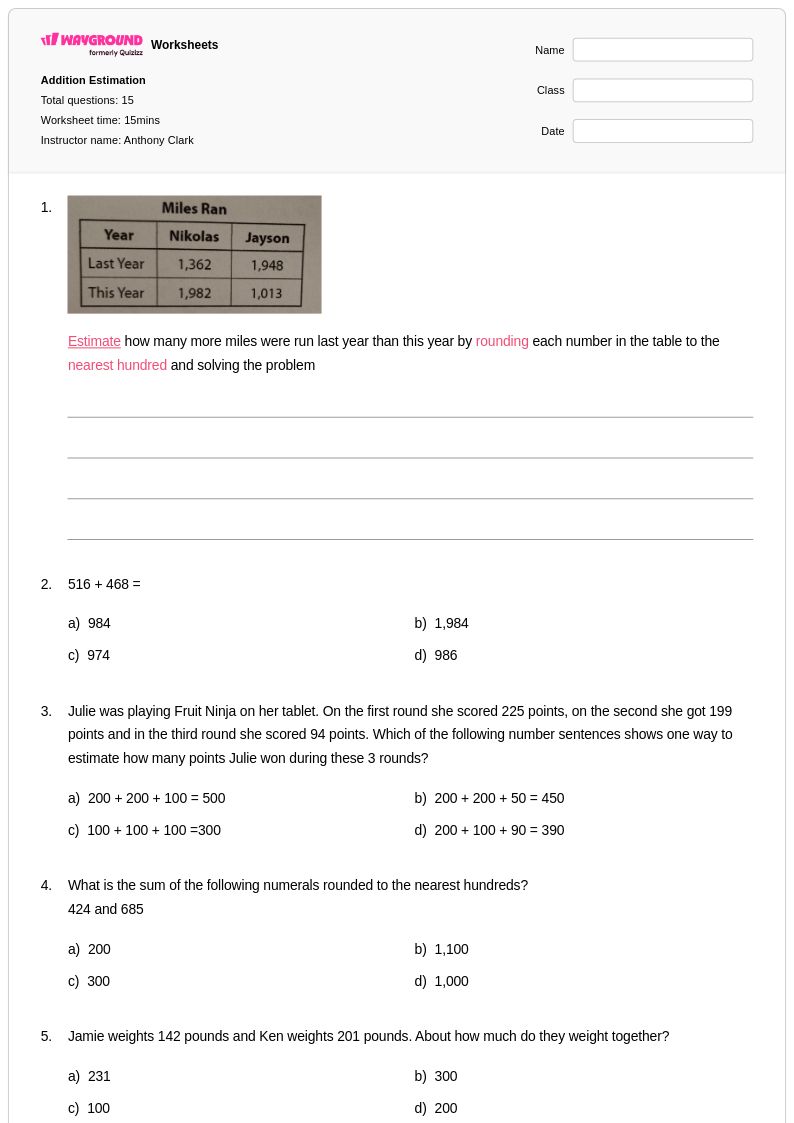
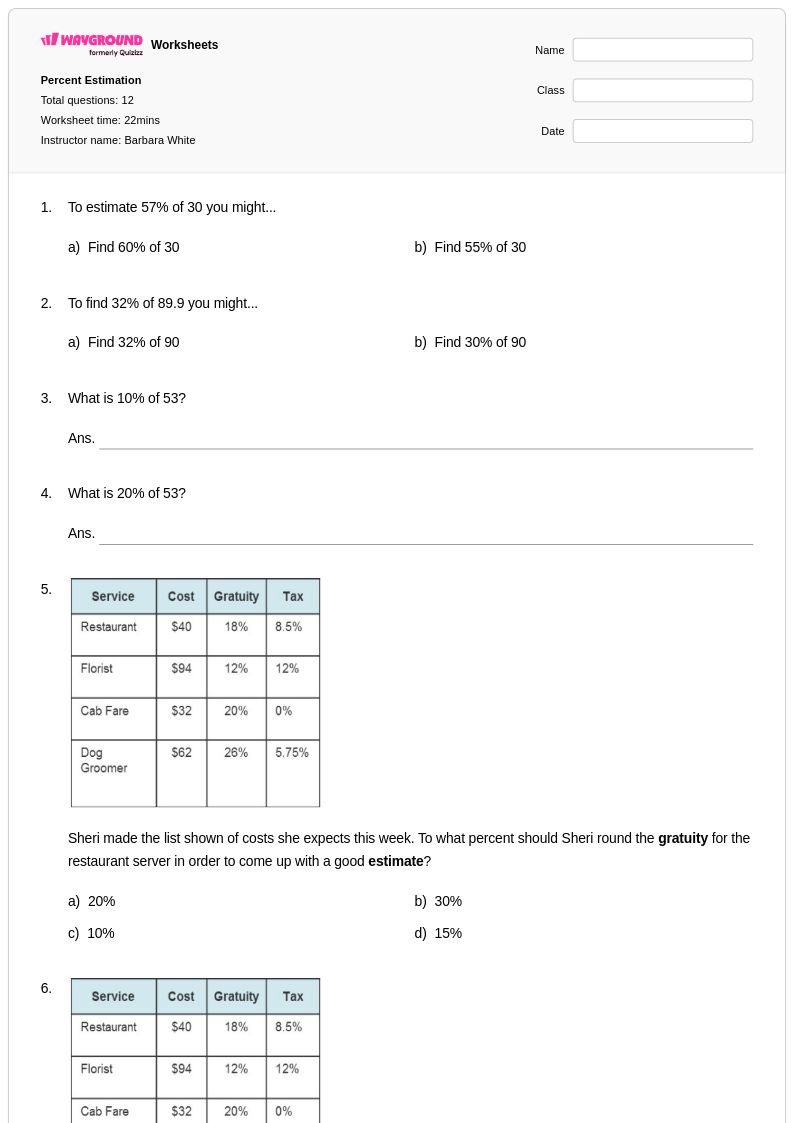
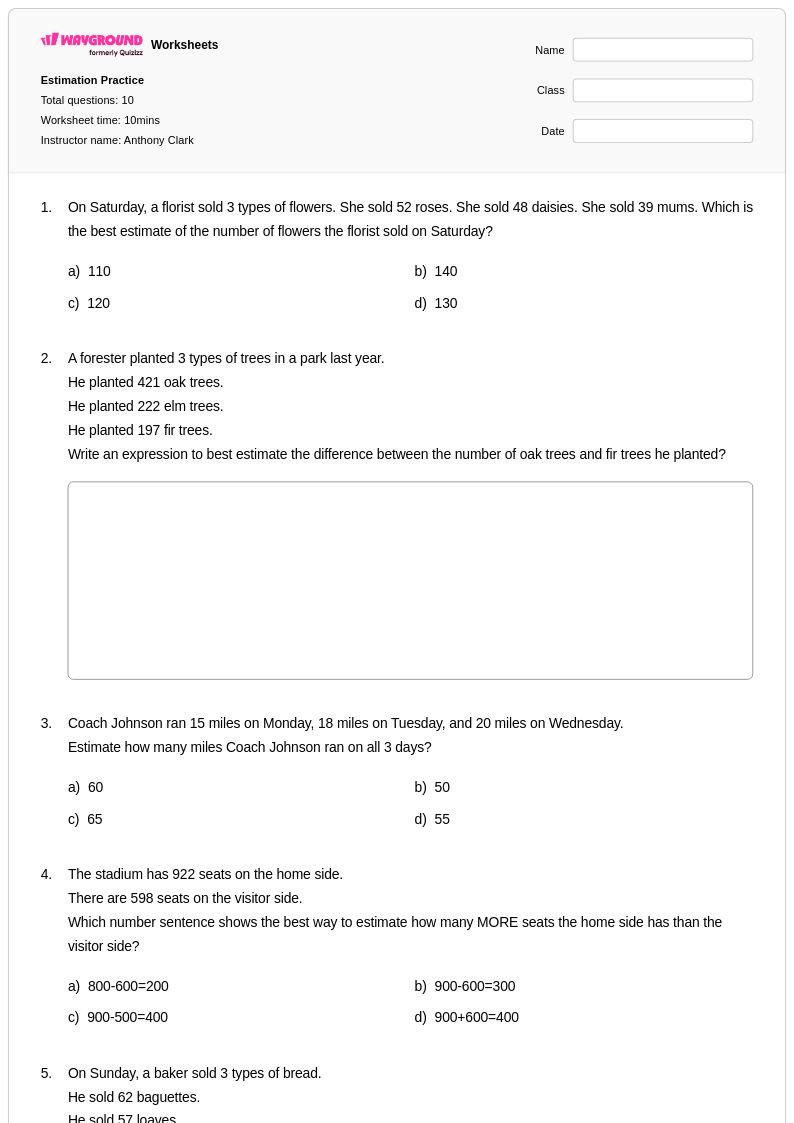
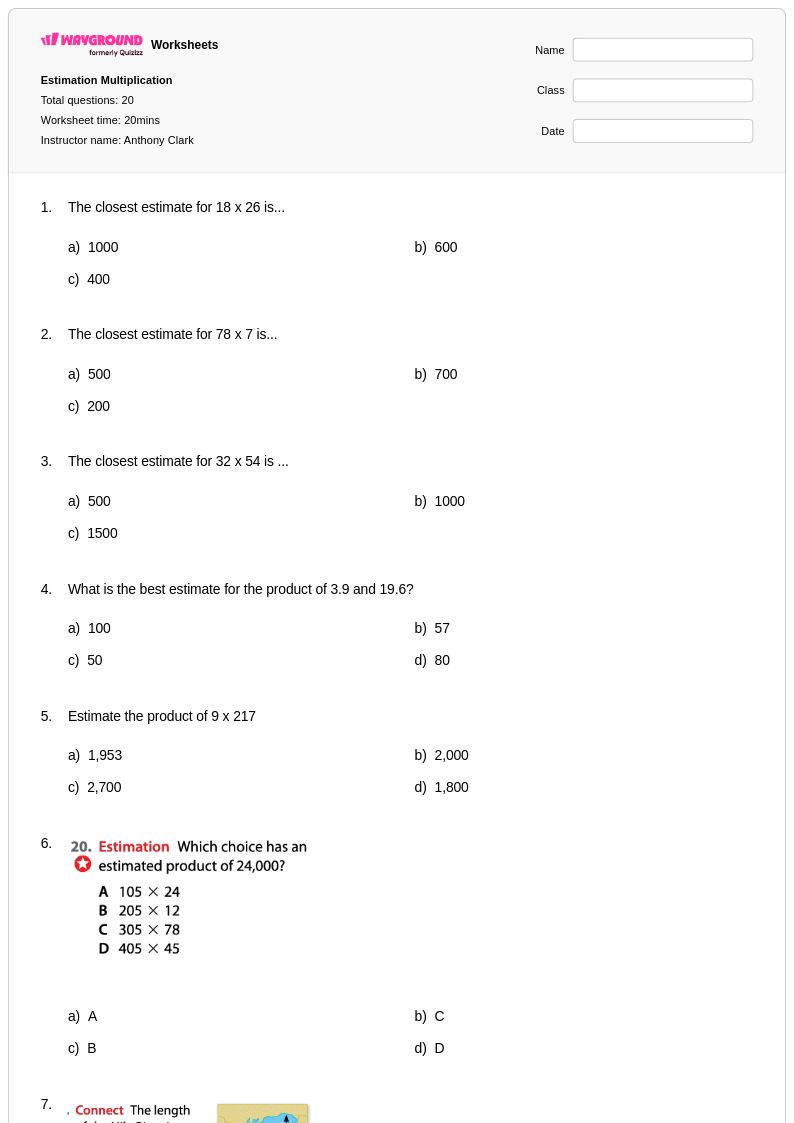
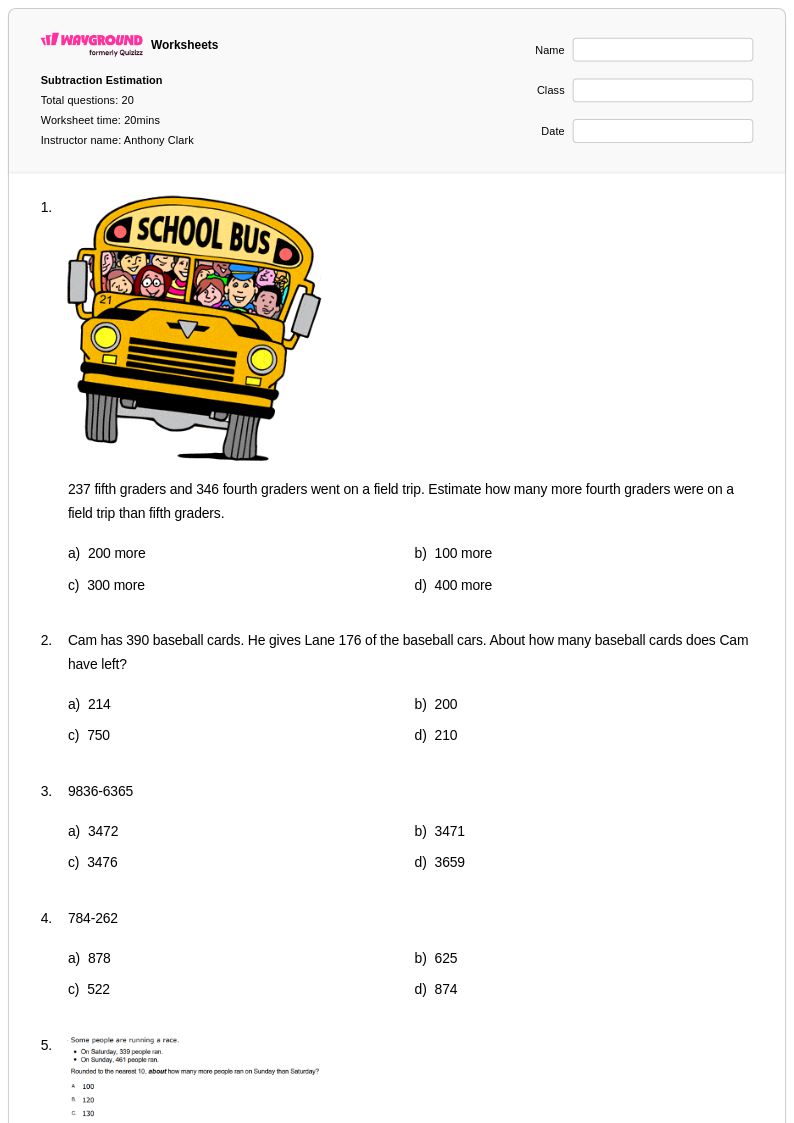
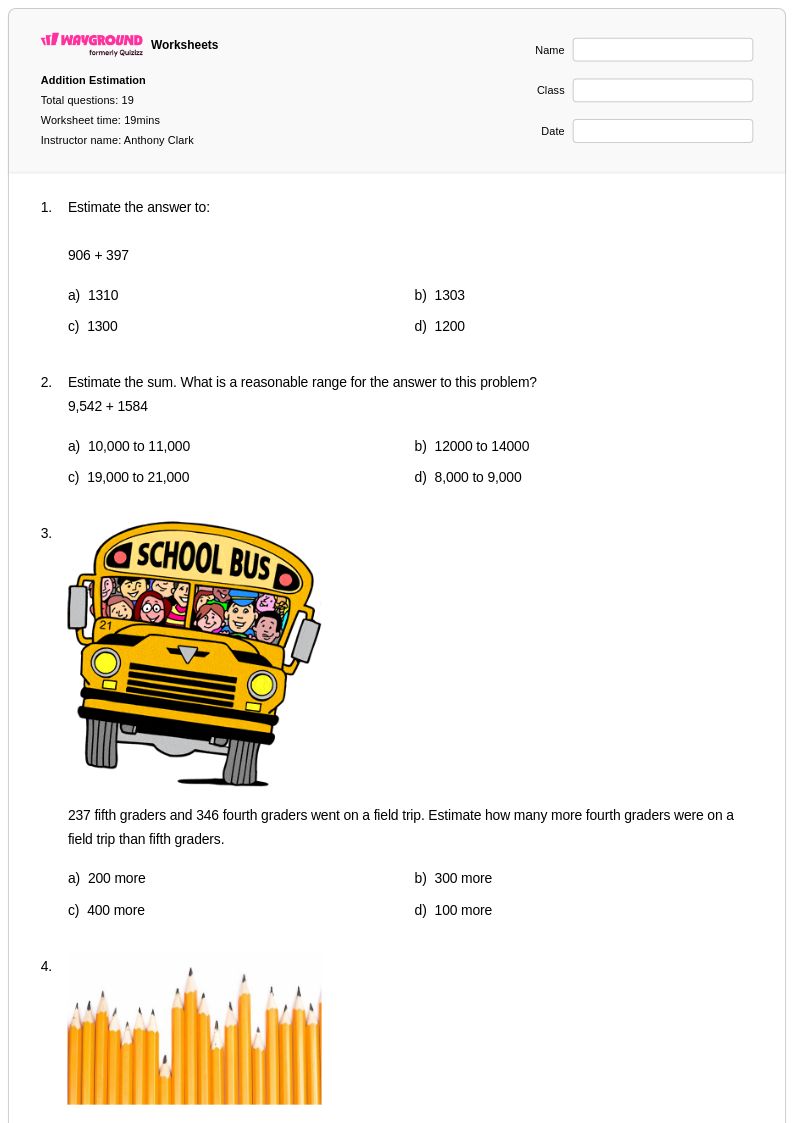
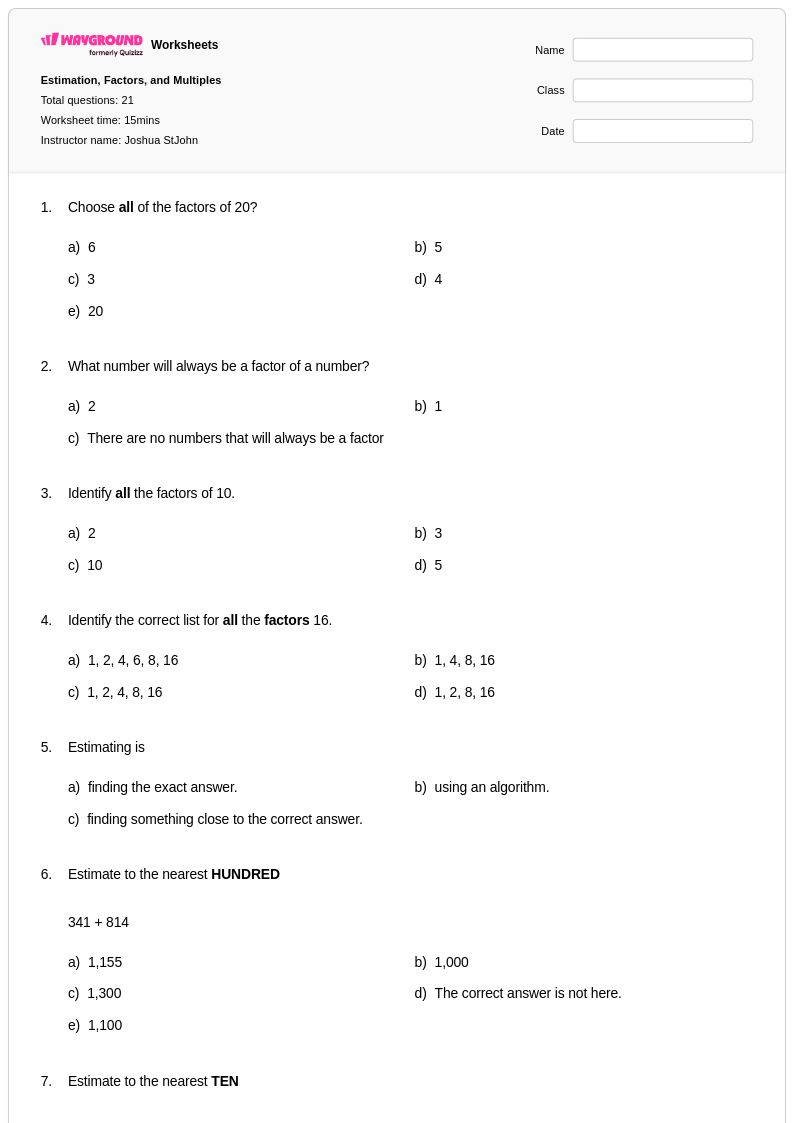
Estimation worksheets available through Wayground (formerly Quizizz) provide comprehensive practice opportunities for students to develop critical mathematical reasoning skills through approximation and mental math strategies. These carefully designed printables focus on building number sense by teaching students to make reasonable judgments about quantities, measurements, and computational results without requiring exact calculations. The worksheets include diverse practice problems that cover estimation techniques for addition, subtraction, multiplication, division, rounding numbers, and real-world applications such as estimating costs, distances, and time. Each worksheet comes with a detailed answer key and clear explanations of estimation strategies, making them valuable free resources for both classroom instruction and independent practice. Students work through progressively challenging scenarios that strengthen their ability to benchmark numbers, use compatible numbers, and apply front-end estimation methods.
Wayground (formerly Quizizz) supports educators with an extensive collection of teacher-created estimation resources that can be easily accessed through robust search and filtering capabilities. The platform's millions of educational materials include worksheets aligned to mathematical standards, ensuring that teachers can find age-appropriate content that matches their curriculum requirements. These estimation worksheet collections offer flexible customization options, allowing educators to modify problems, adjust difficulty levels, and differentiate instruction for diverse learning needs. Available in both printable pdf format and digital versions, these resources streamline lesson planning while providing targeted support for remediation, skill reinforcement, and enrichment activities. Teachers can efficiently identify students who need additional practice with specific estimation strategies and provide immediate feedback using the comprehensive answer keys and assessment tools integrated throughout the worksheet collections.
FAQs
How do I teach estimation strategies in math class?
Start by anchoring estimation to situations where an exact answer is impractical — shopping totals, travel time, crowd size. From there, introduce specific strategies one at a time: rounding to a convenient place value, using compatible numbers (swapping 47 + 38 for 50 + 40), and front-end estimation for multi-digit addition. Students need to see that estimation is a deliberate skill, not just a guess, so always ask them to explain their reasoning before revealing the actual answer.
What exercises help students practice estimation?
The most effective practice mixes operation types and contexts. Good exercise formats include: estimating sums and differences before solving, comparing an estimate to the exact answer to judge reasonableness, and real-world scenarios like estimating the cost of a grocery list or the distance between two cities. Wayground's estimation worksheets cover all of these — addition, subtraction, multiplication, division, rounding, and applied contexts — so students build flexibility across problem types rather than drilling one technique in isolation.
What mistakes do students commonly make with estimation?
The most persistent error is over-precision: students round every number to the nearest one or ten out of habit rather than choosing a place value that makes mental math easy. A related problem is treating the estimate as wrong if it doesn't match the exact answer — students need repeated exposure to the idea that a reasonable estimate is a correct answer to a different question. Watch also for students who skip estimation entirely and just compute, which signals they haven't internalized when approximation is the appropriate tool.
How do I use Wayground's estimation worksheets in my classroom?
Each worksheet is available as a printable PDF and as a digital quiz hosted on Wayground, so you can assign the same content whether your class is on devices or working on paper. Every worksheet includes a complete answer key, which makes it practical for independent practice, homework, or sub plans. If you go the print route, the Wayground for Teachers app lets you scan or capture student work for grading without re-entering answers by hand.
How does estimation fit into the Common Core math progression?
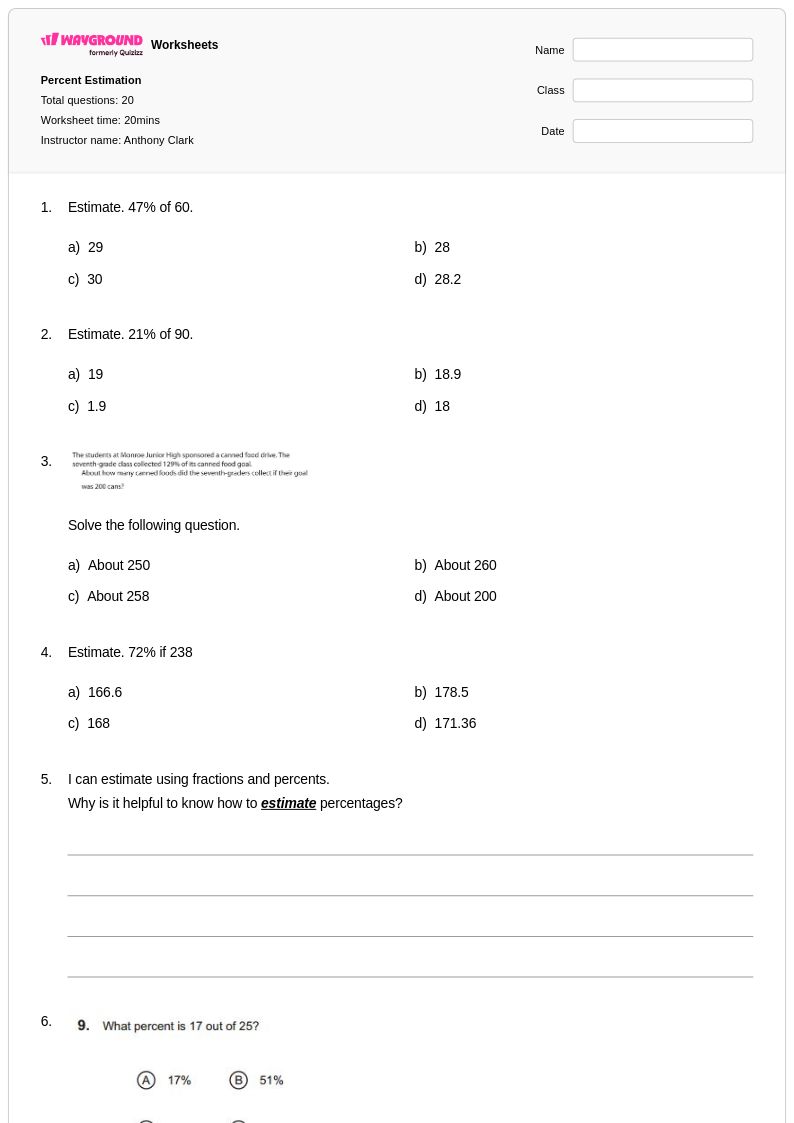
Common Core treats estimation as a thread running through the entire K–8 progression rather than a standalone unit. In the early grades, students estimate quantities and lengths. By the middle grades, the focus shifts to estimating the results of operations — judging whether a computed answer is reasonable — and eventually to estimating with fractions, decimals, and percents. The underlying expectation at every level is that students can assess the reasonableness of an answer, which means estimation practice directly supports the standard of checking computed results against a mental benchmark.
How can I differentiate estimation practice for mixed-ability classes?
For students who struggle with the abstract side of estimation, Wayground's worksheet-level tools let you increase font size, widen spacing, or apply a dyslexia-friendly font so the format doesn't add friction to the math. For students who need more support during a digital session, the Read Aloud accommodation reads questions aloud and Reduced answer choices lowers the number of options they're weighing at once — both useful when the cognitive load of reading or choosing is competing with the estimation thinking itself.
What grade levels are estimation worksheets appropriate for?
Estimation is taught across K–8, but the focus shifts significantly by grade. Kindergarten through Grade 2 centers on visual quantity estimation and comparing groups. Grades 3–5 move into estimating with operations — rounding addends, estimating products. Middle school applies estimation to fractions, decimals, and measurement conversions. Wayground's collection spans this full range, so the right starting point depends on which estimation skill your students are currently building.