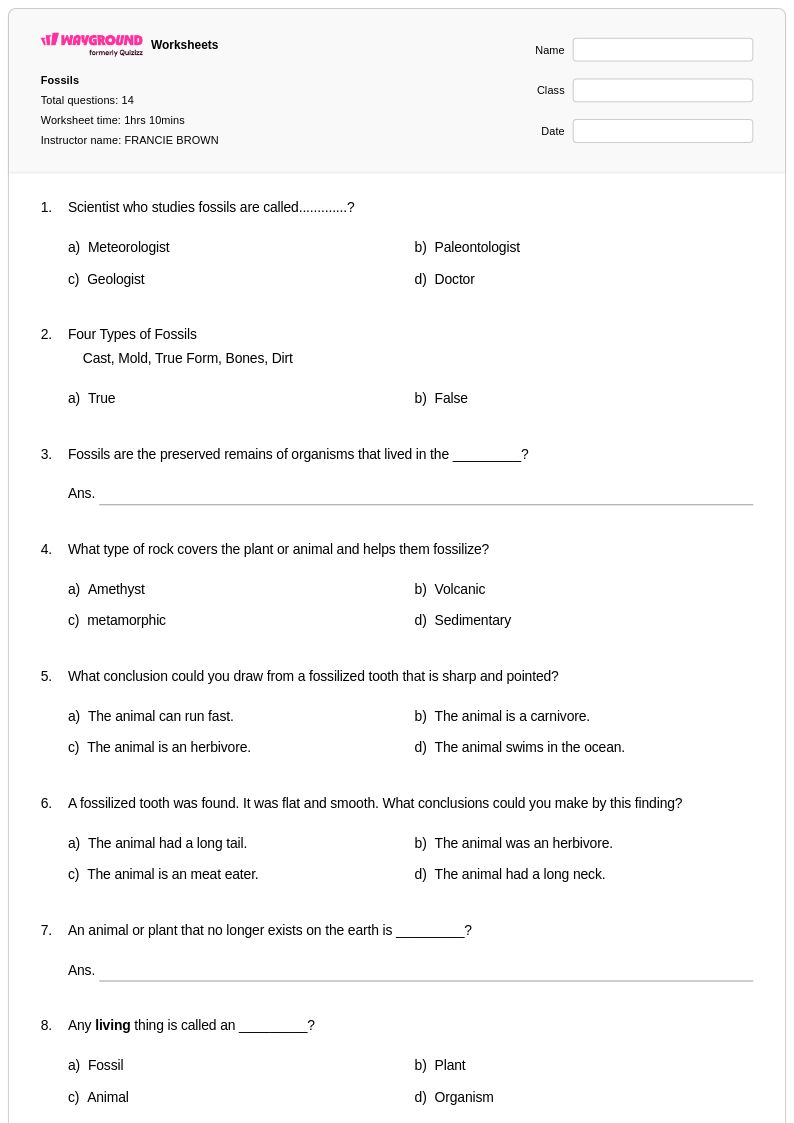
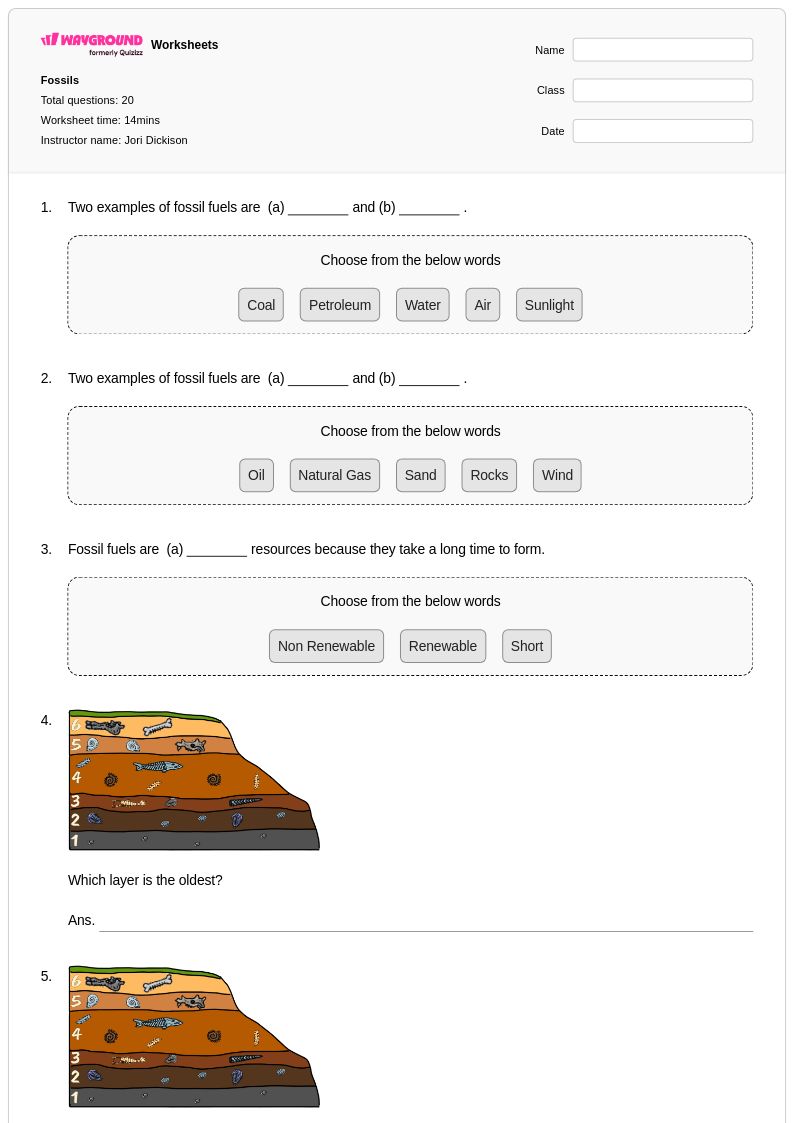
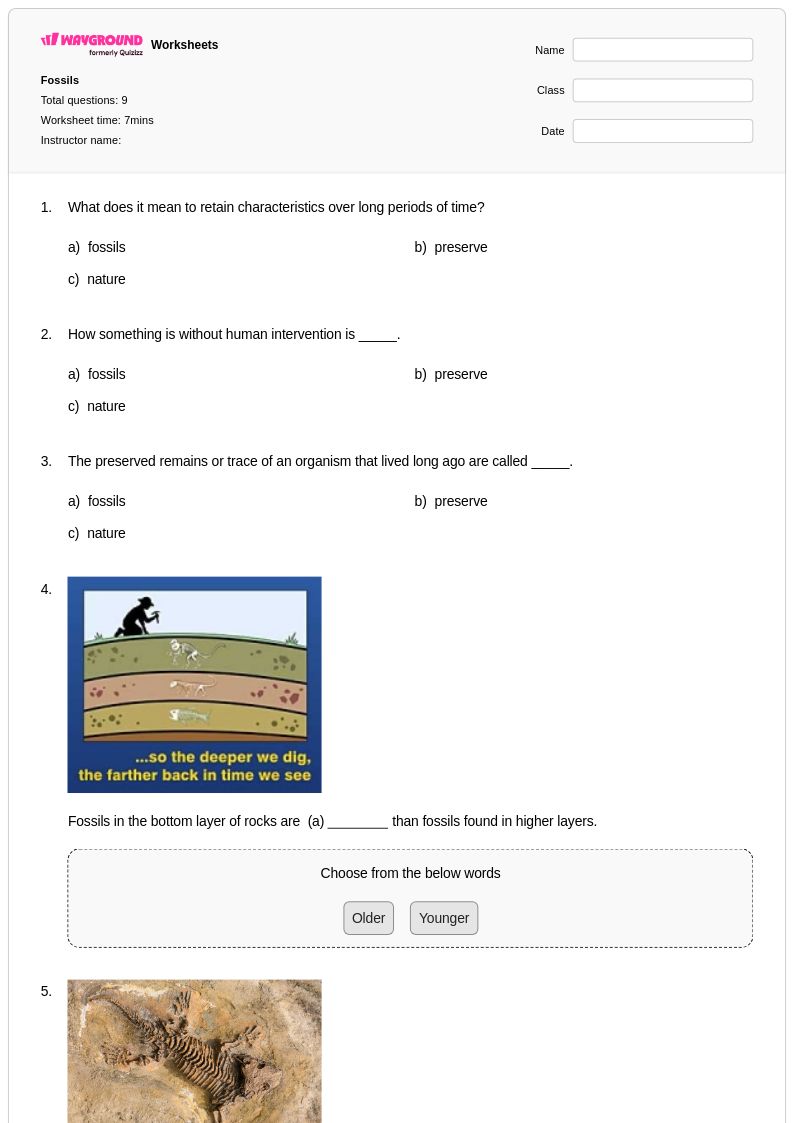
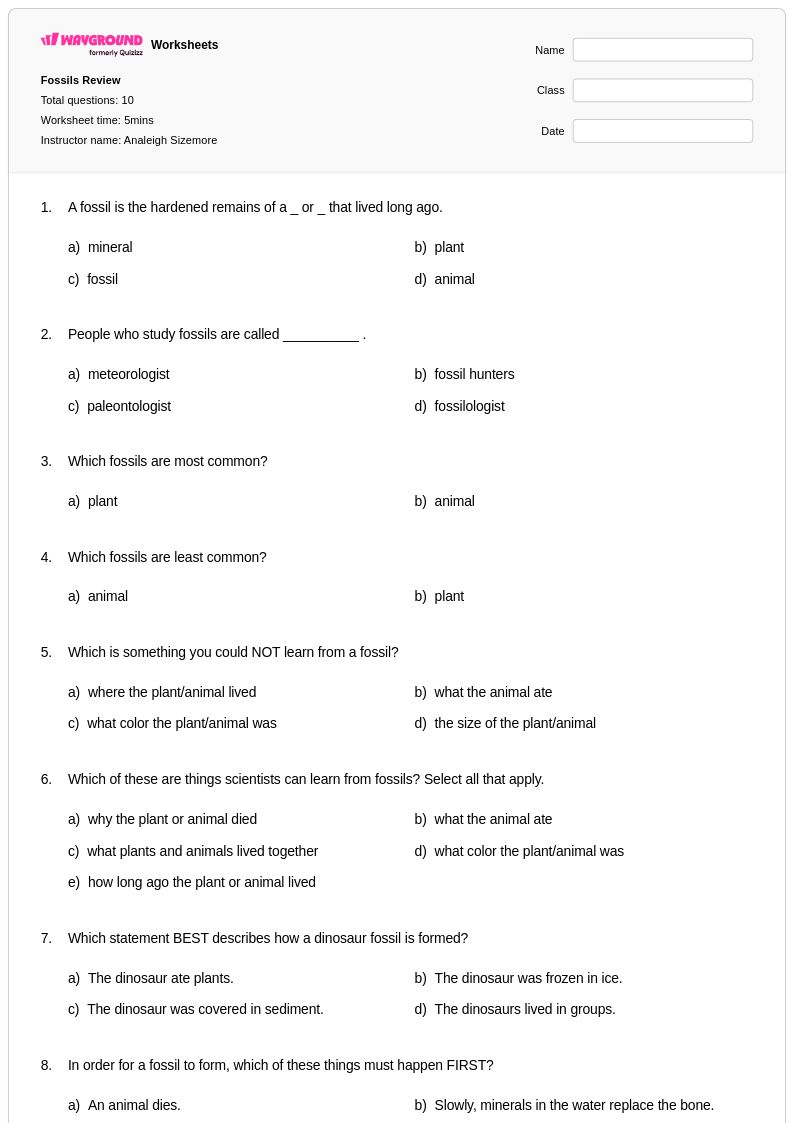
Discover Grade 3 fossils worksheets and printables through Wayground that help young scientists explore prehistoric life, featuring engaging practice problems, free PDF downloads, and complete answer keys.
Fossils worksheets for Grade 3 students available through Wayground (formerly Quizizz) provide young learners with engaging opportunities to explore paleontology and Earth's ancient history. These comprehensive educational resources help third graders develop foundational scientific observation skills while discovering how organisms from long ago became preserved in rock layers. The worksheets strengthen critical thinking abilities as students analyze fossil evidence, compare ancient and modern life forms, and understand the processes of fossilization. Each printable resource includes structured practice problems that guide students through identifying different fossil types, understanding geological time concepts, and making connections between past and present ecosystems. Teachers can access complete answer keys and free pdf downloads to support classroom instruction and independent learning activities.
Wayground (formerly Quizizz) empowers educators with millions of teacher-created fossil worksheet collections that streamline lesson planning and enhance student engagement in Grade 3 science curricula. The platform's robust search and filtering capabilities allow teachers to quickly locate age-appropriate materials aligned with educational standards, while differentiation tools enable customization for diverse learning needs and abilities. These fossil-focused resources are available in both printable and digital formats, including downloadable pdf versions that facilitate flexible classroom implementation. Teachers can efficiently plan remediation activities for struggling learners, provide enrichment opportunities for advanced students, and offer targeted skill practice that reinforces key paleontology concepts. The extensive collection supports various instructional approaches, from guided discovery lessons to independent research projects, helping educators create comprehensive learning experiences that build scientific literacy and foster curiosity about Earth's prehistoric past.
FAQs
How do I teach fossils to middle school students?
Start by grounding students in fossil formation — how organisms become buried, mineralized, and preserved in sedimentary rock layers over millions of years. From there, move into fossil identification and what specific fossil types (molds, casts, trace fossils) reveal about ancient environments. Connecting fossils to the geological time scale early on helps students build a mental framework for understanding deep time, which makes later concepts like extinction events and evolutionary change far more accessible.
What kinds of practice activities help students understand fossil evidence?
Activities that ask students to interpret fossil records to reconstruct past environments are particularly effective because they require both factual recall and scientific reasoning. Comparative anatomy exercises — where students analyze skeletal structures of extinct and living species — reinforce the concept of evolutionary relationships. Practice problems centered on fossil formation sequences and sedimentary layering help students understand how geological context determines what a fossil can and cannot tell us.
What mistakes do students commonly make when learning about fossils?
A common misconception is that all organisms that ever lived have left fossils — students often don't realize how rare fossilization actually is and how specific conditions must be met. Many students also confuse fossil age with depth inconsistently, assuming older always means deeper without understanding how geological disturbances can disrupt rock layers. Another frequent error is conflating a fossil's age with the age of the rock surrounding it after transport or re-deposition.
How can I differentiate fossil instruction for students at different levels?
For students beginning their study of prehistoric life, focus on basic fossil identification and formation processes using visual, labeled diagrams. More advanced learners can engage with radiometric dating concepts and phylogenetic relationships that require interpreting more complex evidence. On Wayground, teachers can apply accommodations like Read Aloud for students who need audio support, reduced answer choices to lower cognitive load, or extended time — all configurable per student without disrupting the rest of the class.
How do I use Wayground's fossil worksheets in my classroom?
Wayground's fossil worksheets are available as printable PDFs for traditional classroom use and in digital formats for technology-integrated environments, so they work whether your students are at desks or on devices. You can also host any worksheet as a live quiz directly on Wayground, which makes them suitable for formative assessment, review sessions, or independent practice. Each worksheet includes a complete answer key, reducing prep time and making it straightforward to use them for both instruction and self-paced student review.
How do fossils connect to evolutionary biology in the science curriculum?
Fossils serve as direct physical evidence of evolutionary processes, making them one of the most concrete tools for teaching natural selection and adaptation. Comparative anatomy of extinct species preserved in the fossil record allows students to trace lineages and understand how traits changed over geological time. This connection between paleontology and evolutionary biology is a core thread in most life and earth science curricula and is especially important when addressing concepts like mass extinction and adaptive radiation.