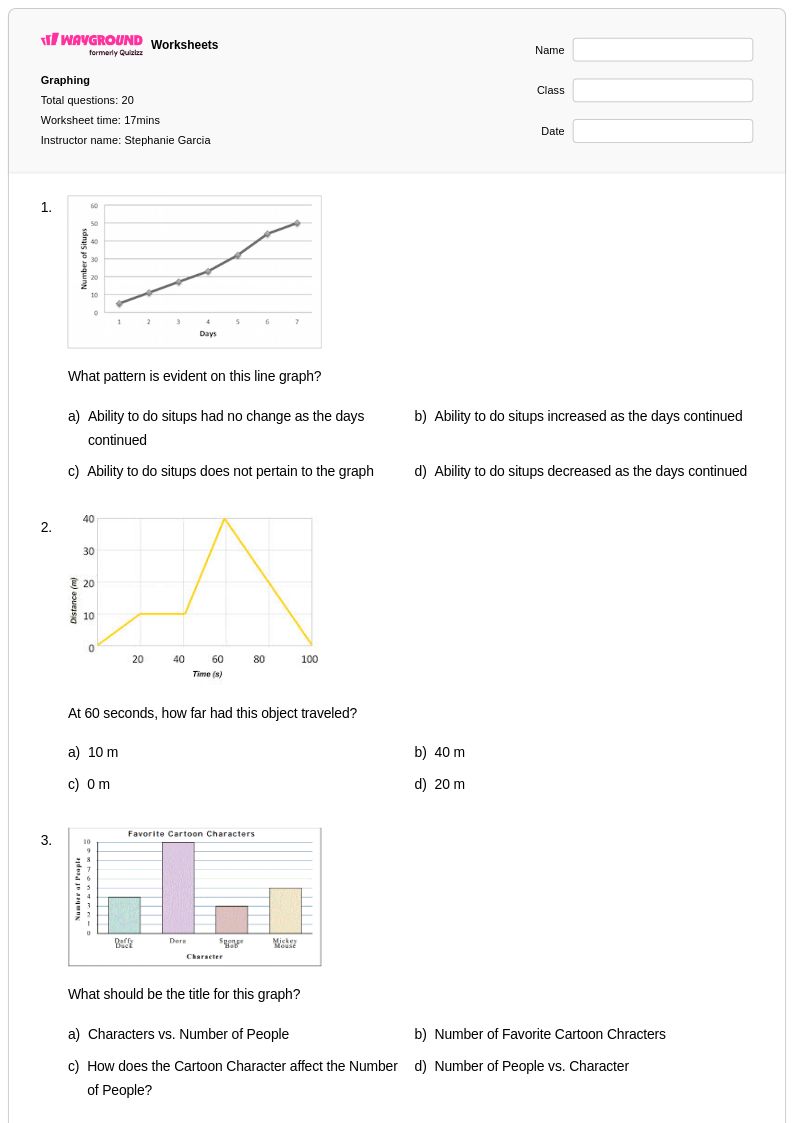
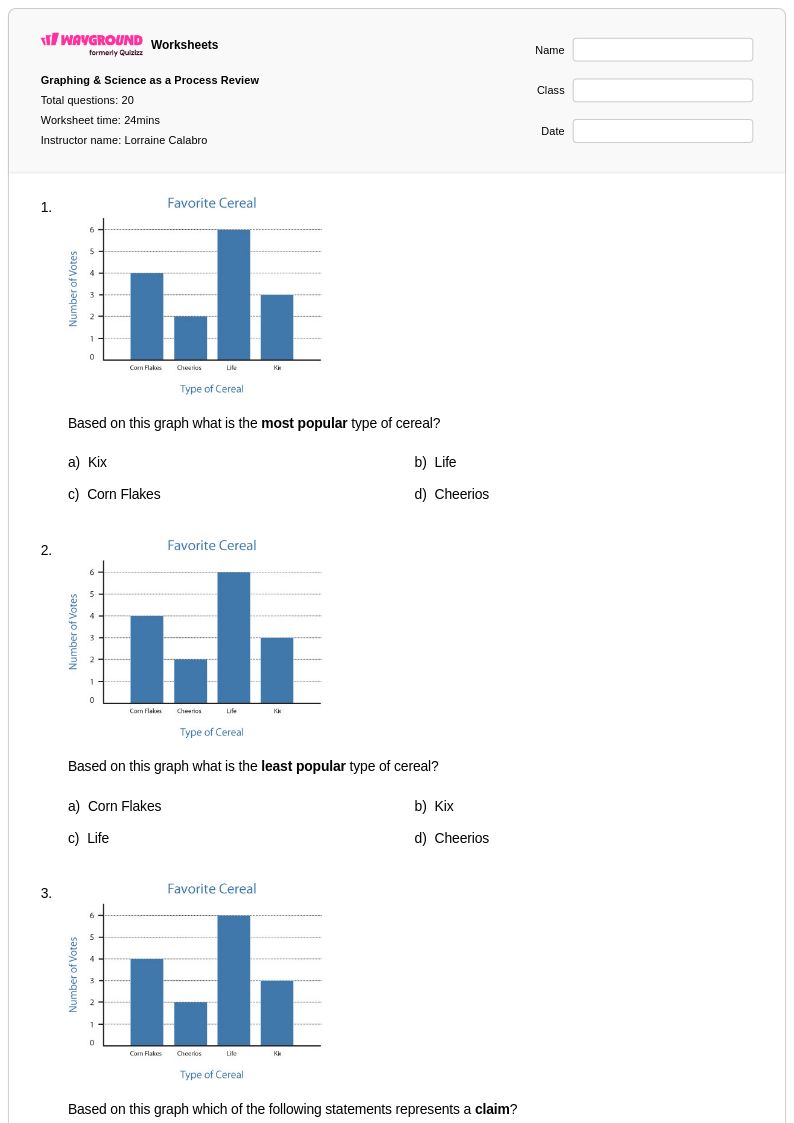
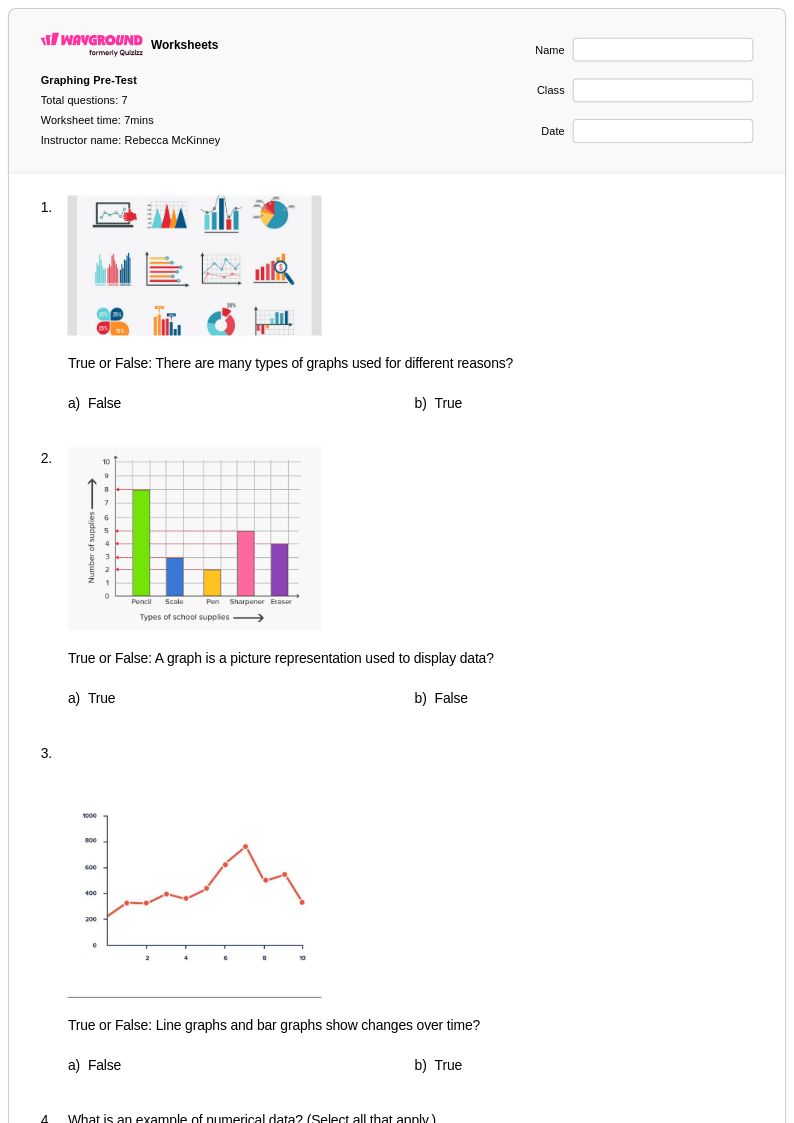
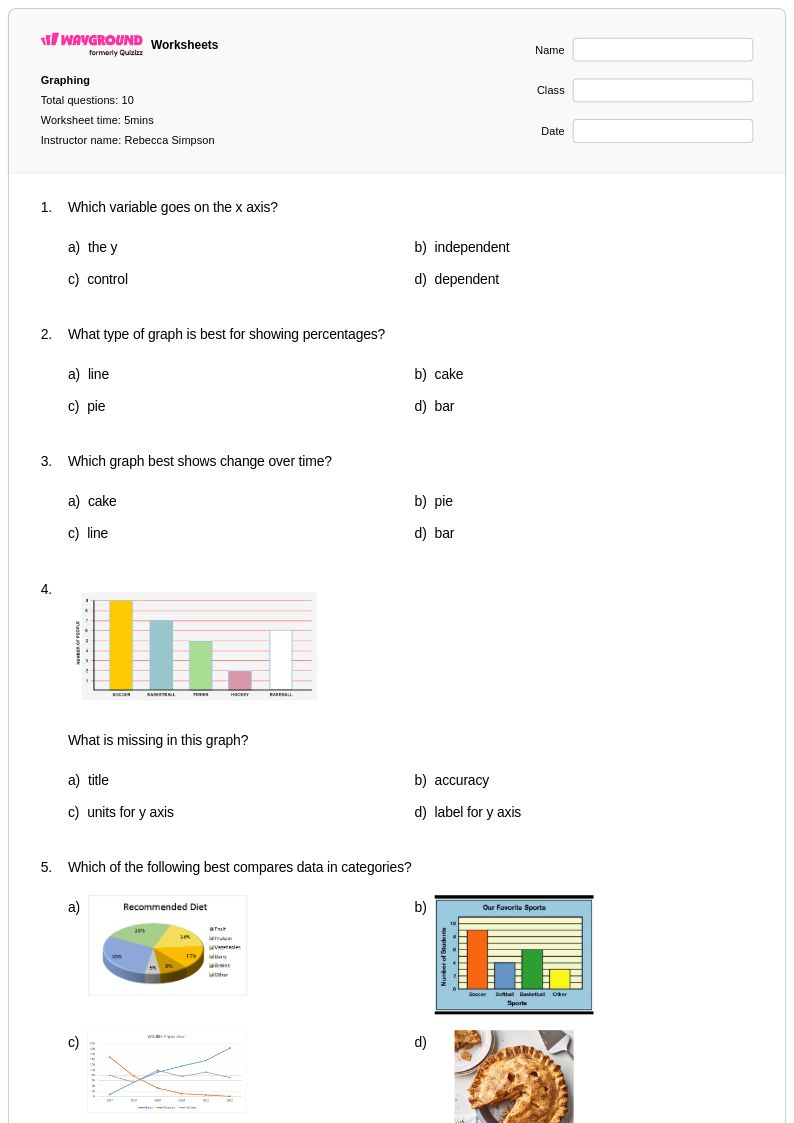
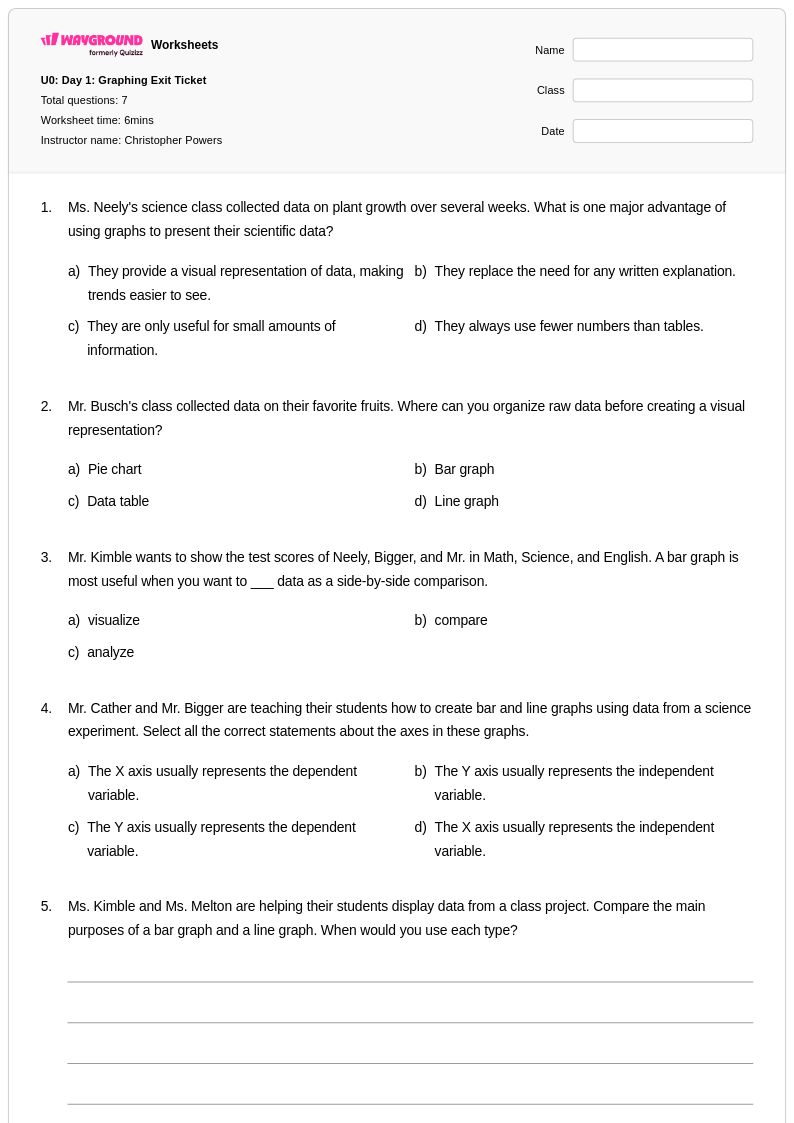
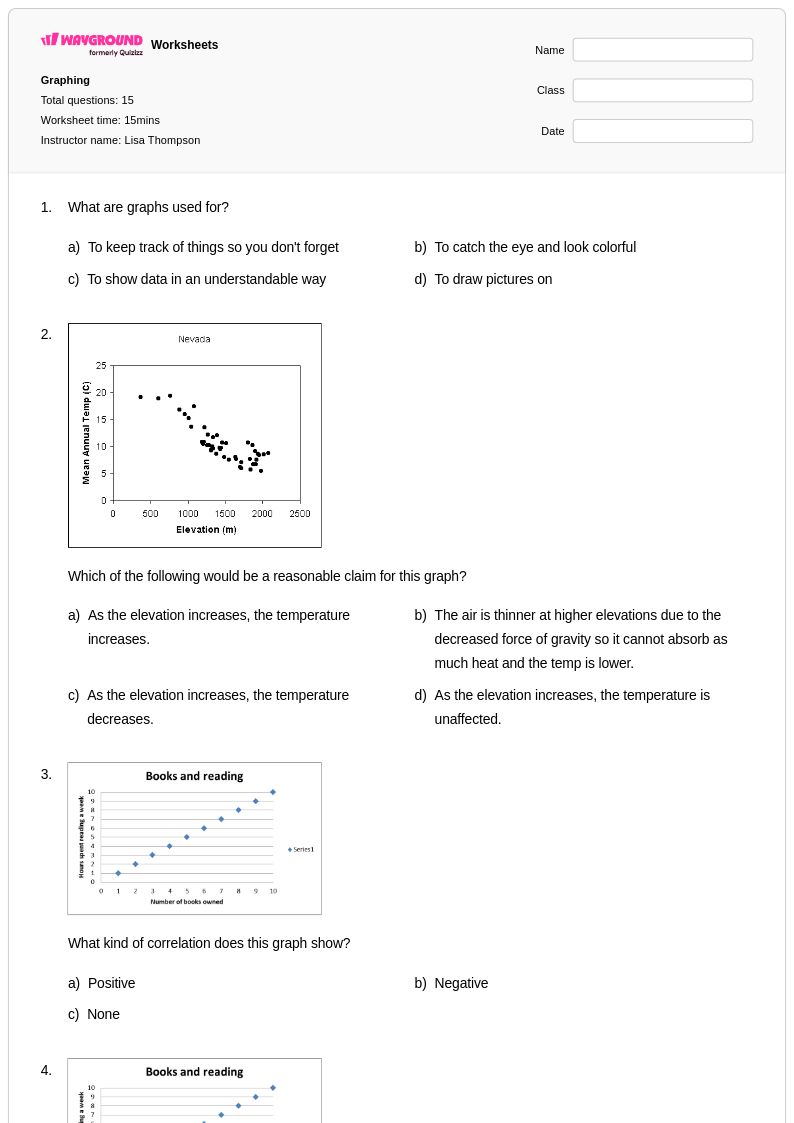
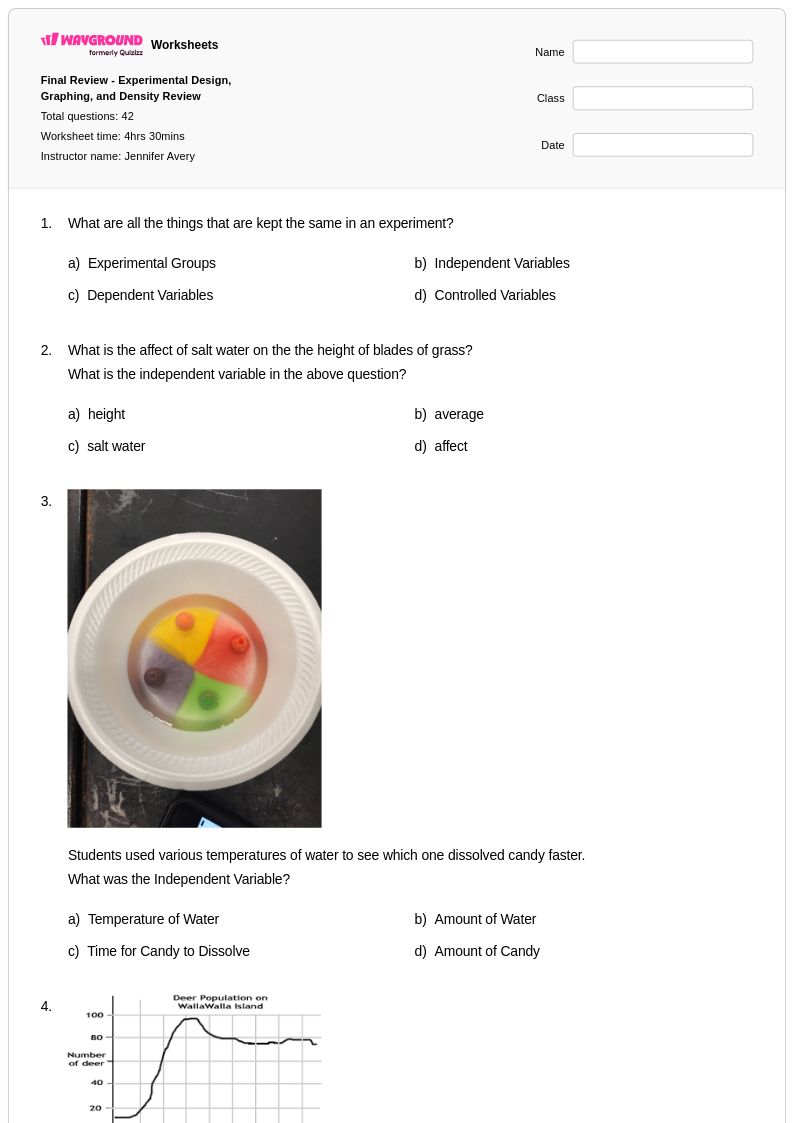
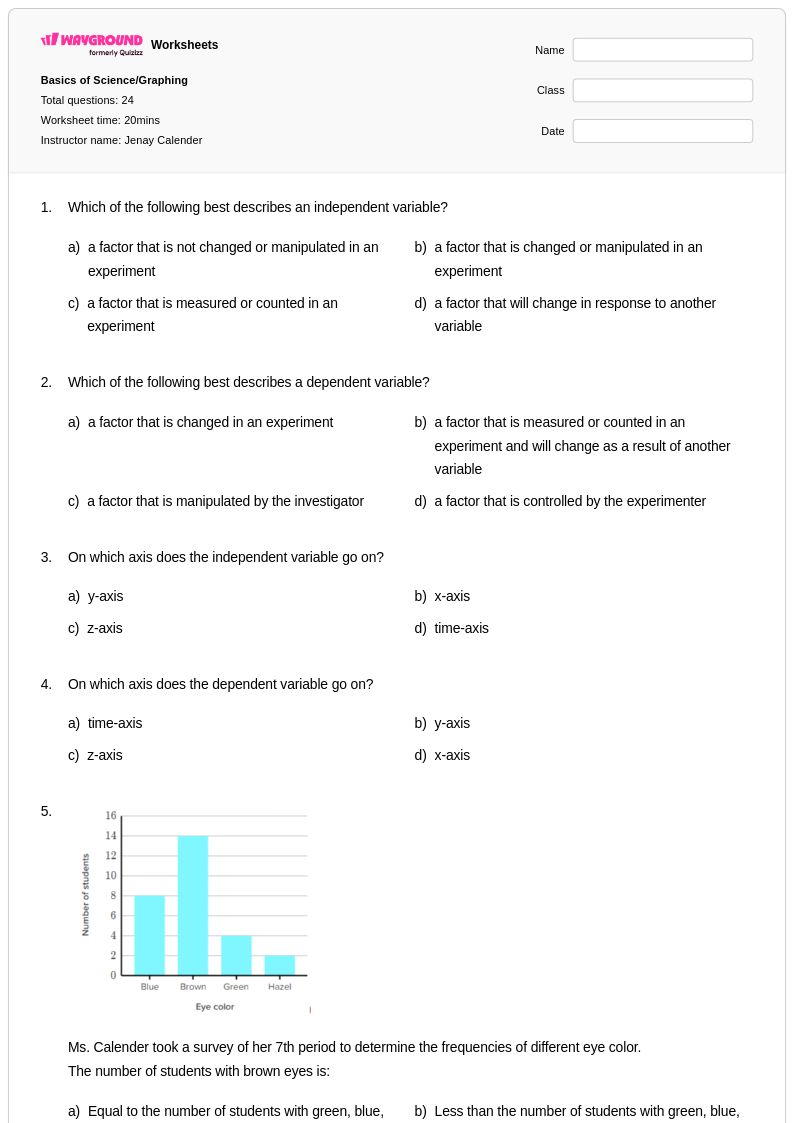
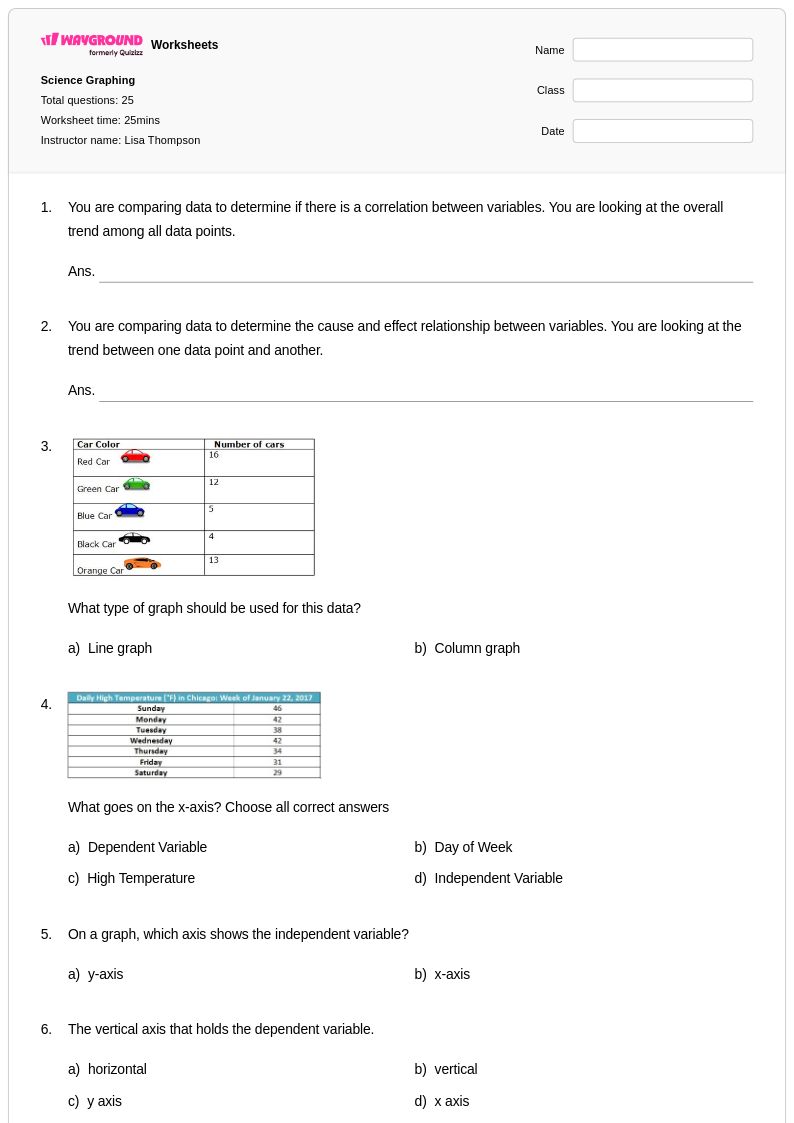
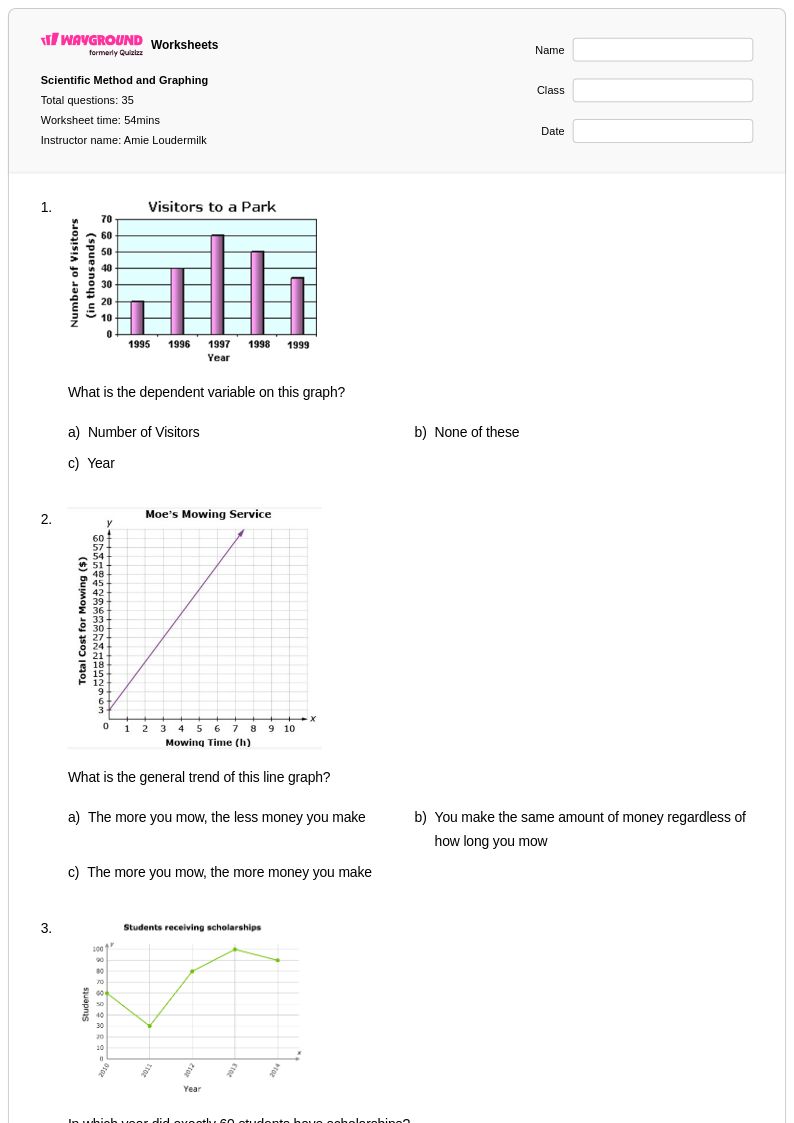
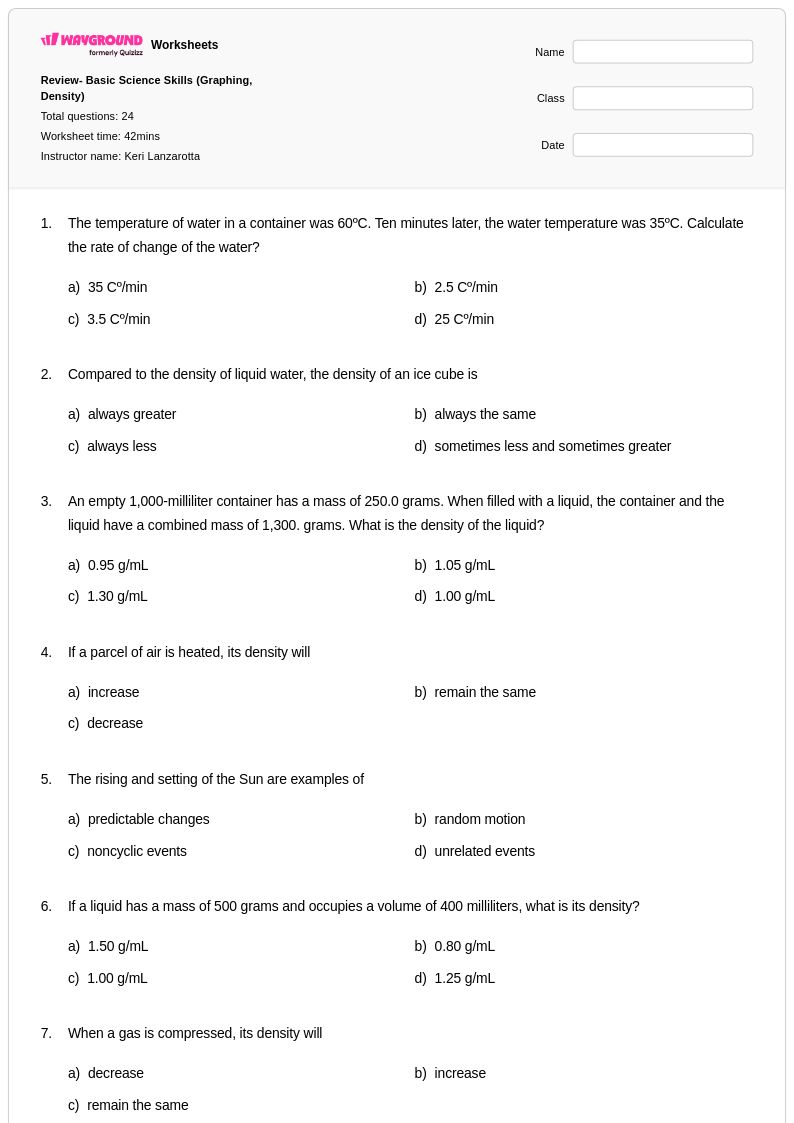
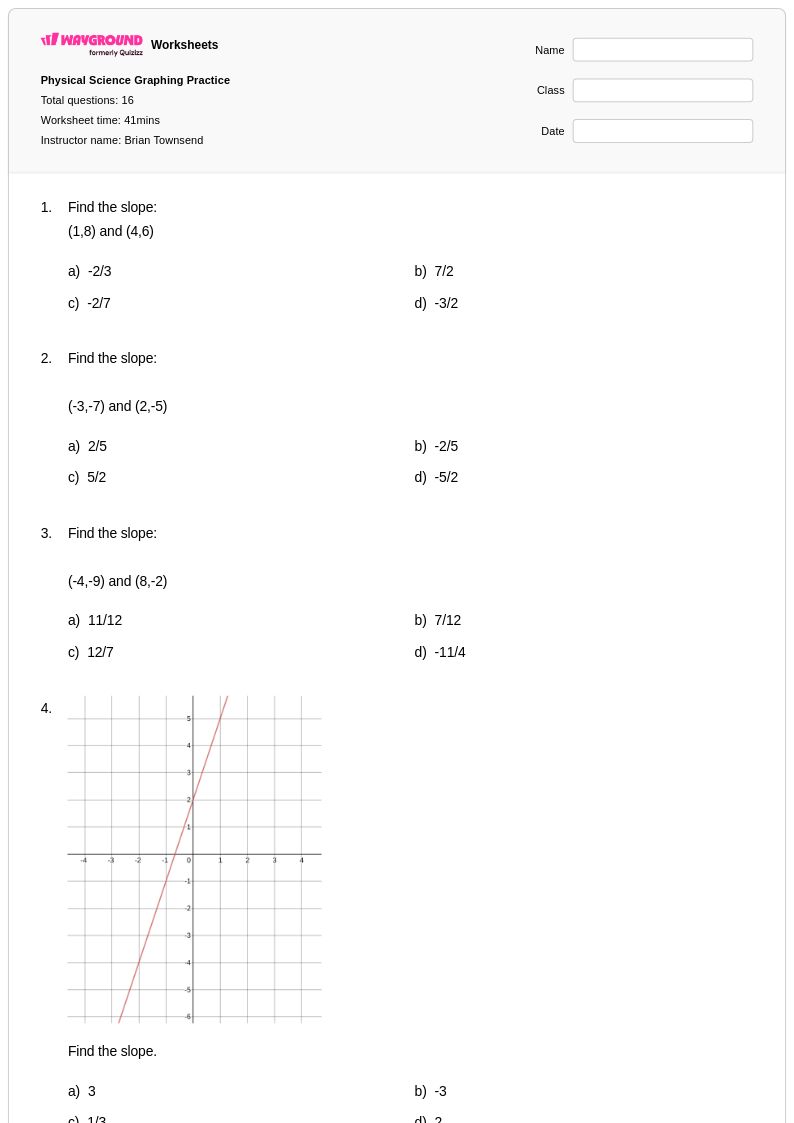
Master Grade 9 physics graphing concepts with Wayground's comprehensive collection of free worksheets, featuring printable PDFs with practice problems and complete answer keys to strengthen data visualization and analytical skills.
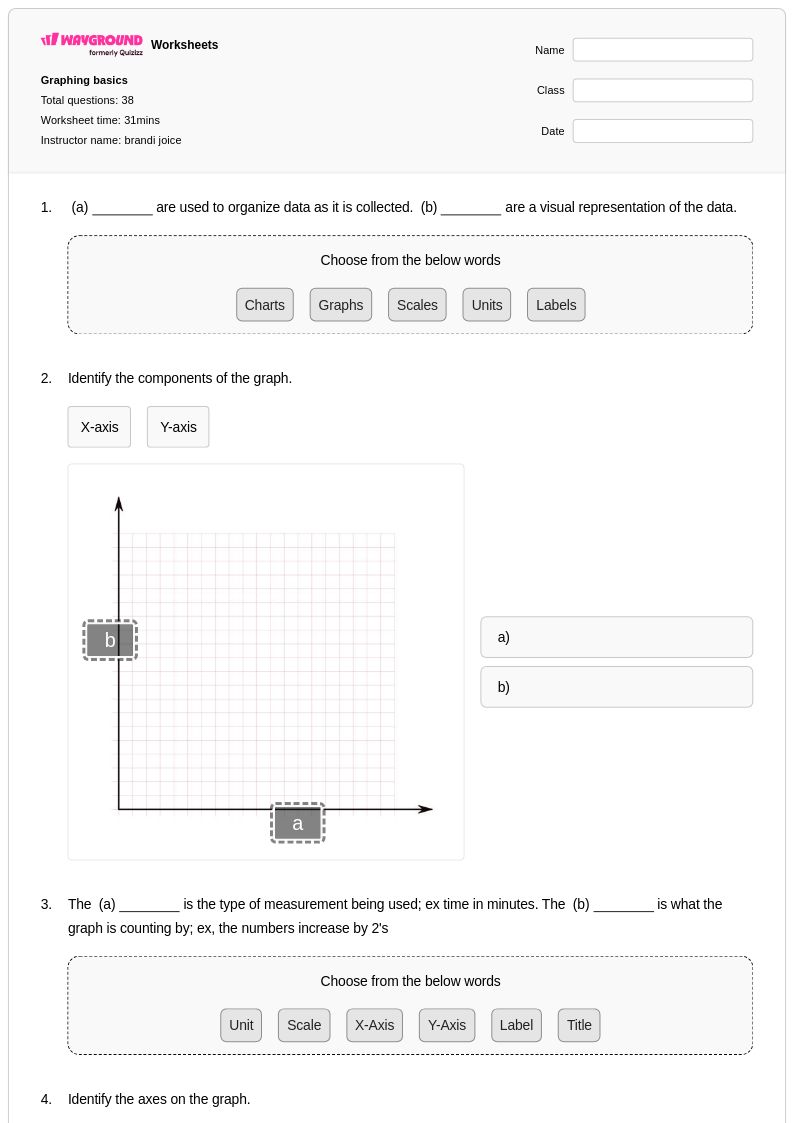
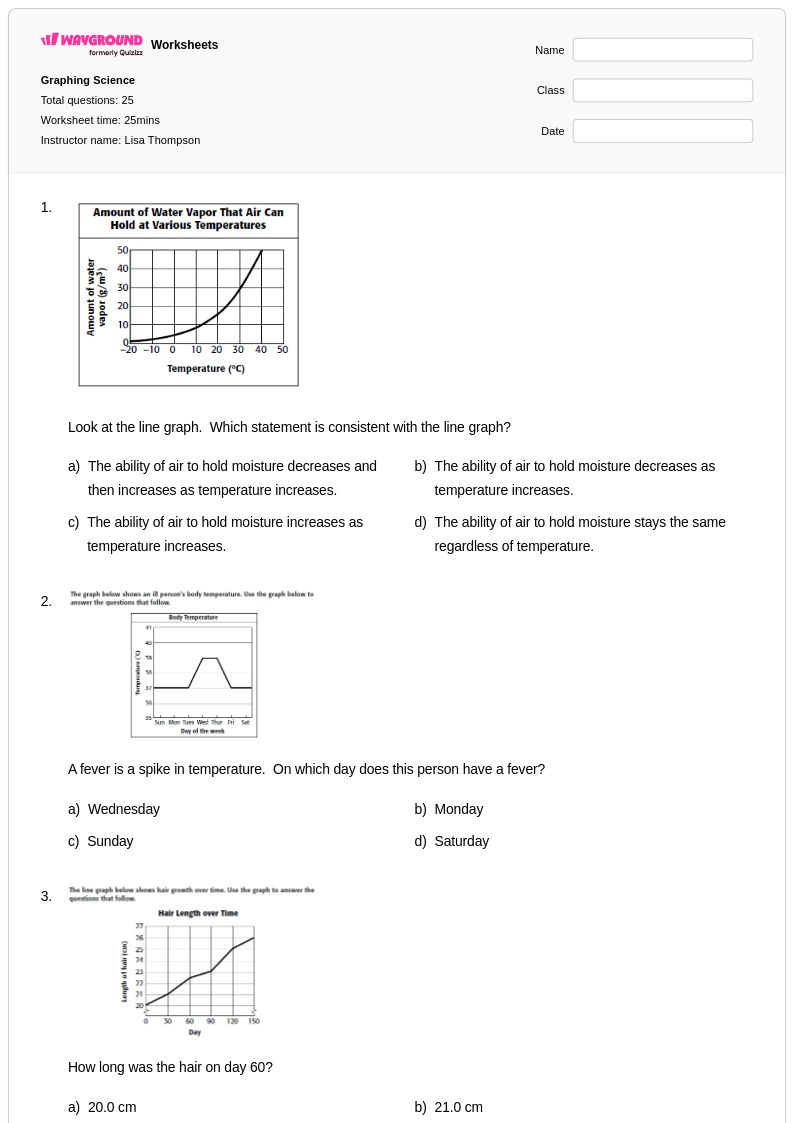
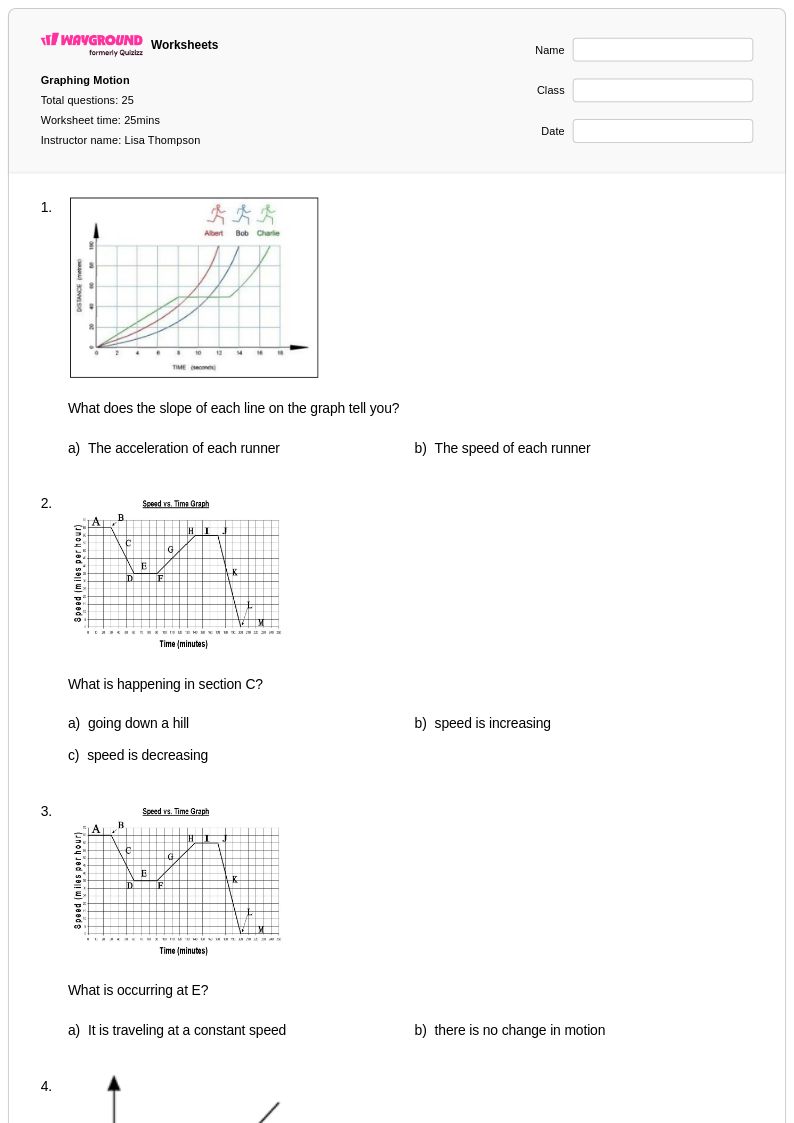
Grade 9 graphing worksheets available through Wayground (formerly Quizizz) provide comprehensive practice with visual data representation and analysis skills essential for physics mastery. These carefully designed printables focus on interpreting and creating various graph types including position-time graphs, velocity-time graphs, acceleration graphs, and force diagrams that demonstrate fundamental physics relationships. Students develop critical analytical skills by working through practice problems that require reading coordinate points, calculating slopes to determine rates of change, identifying linear and non-linear relationships, and translating between graphical and mathematical representations of physical phenomena. Each worksheet collection includes detailed answer keys and free pdf downloads, enabling students to practice independently while building confidence in graphing techniques that form the foundation for advanced physics concepts.
Wayground (formerly Quizizz) supports physics educators with millions of teacher-created graphing resources specifically aligned to Grade 9 physics standards and curriculum requirements. The platform's robust search and filtering system allows teachers to quickly locate worksheets targeting specific graphing skills, from basic coordinate plotting to complex motion analysis, while differentiation tools enable customization for diverse learning needs and ability levels. These comprehensive collections are available in both printable and digital formats, including downloadable pdf versions, making them ideal for classroom instruction, homework assignments, remediation support, and enrichment activities. Teachers can seamlessly integrate these graphing worksheets into lesson planning to reinforce data analysis concepts, provide targeted skill practice, and assess student understanding of the visual representation techniques that are fundamental to physics problem-solving and scientific reasoning.
FAQs
How do I teach graphing skills in a physics class?
Effective graphing instruction in physics starts with connecting graph construction to real experimental data students have collected themselves, which gives the skill immediate meaning. Teach students to label axes with units before plotting any points, and explicitly model how to choose appropriate scales. Progress from position-time graphs to velocity-time and acceleration-time graphs in sequence, since each builds on interpretation skills developed in the previous type. Discussing what the slope and intercept represent physically — not just mathematically — deepens conceptual understanding.
What are the most common graphing mistakes students make in physics?
The most frequent errors include inconsistent or poorly chosen axis scales, missing or incorrect units on axis labels, and connecting data points with jagged lines instead of a smooth best-fit line or curve. Students also commonly misinterpret the slope of a velocity-time graph, confusing it with speed rather than recognizing it as acceleration. Another persistent misconception is treating a flat (horizontal) line on a velocity-time graph as rest rather than as constant velocity.
What practice exercises help students get better at reading and interpreting physics graphs?
Targeted practice should include extracting slope values from motion graphs and translating them into physical quantities with correct units. Students benefit from exercises that ask them to sketch a graph from a written description of motion, then work in reverse by writing a narrative from a given graph. Practice problems that require determining instantaneous versus average values from curved graphs are especially effective at building deeper interpretation skills.
How can I use graphing worksheets to support struggling students in physics?
For students who struggle with graphing, scaffolded worksheets that provide pre-labeled axes and partially plotted data reduce the entry barrier while keeping the analytical challenge intact. Breaking the task into explicit steps — scale selection, axis labeling, plotting, and interpretation — and assessing each separately helps pinpoint where a student's understanding breaks down. On Wayground, teachers can enable Read Aloud so question text is read to students who need it, and Reduced Answer Choices to lower cognitive load for students who find multiple-option interpretation questions overwhelming.
How do I use Wayground's graphing worksheets in my classroom?
Wayground's graphing worksheets are available as printable PDFs for traditional classroom use and in digital formats for technology-integrated environments, giving teachers flexibility regardless of their setup. Teachers can also host the worksheets as a live quiz on Wayground, making it easy to collect and review student responses in real time. Each worksheet includes a complete answer key, so they work equally well as guided practice, independent work, or homework assignments.
How do I differentiate graphing instruction for advanced physics students?
Advanced learners benefit from graphing tasks that go beyond accurate plotting and require them to extract quantitative meaning — such as calculating the area under a velocity-time curve to find displacement, or determining instantaneous acceleration from a tangent line on a curved graph. Providing raw, messy experimental data (rather than clean textbook values) and asking students to evaluate the quality of their own graphs develops the critical analysis skills central to scientific reasoning.