Free Printable Ions and Isotopes Worksheets for Grade 7
Discover free Grade 7 ions and isotopes worksheets and printables from Wayground that help students master atomic structure concepts through engaging practice problems and comprehensive answer keys.
Explore printable Ions and Isotopes worksheets for Grade 7
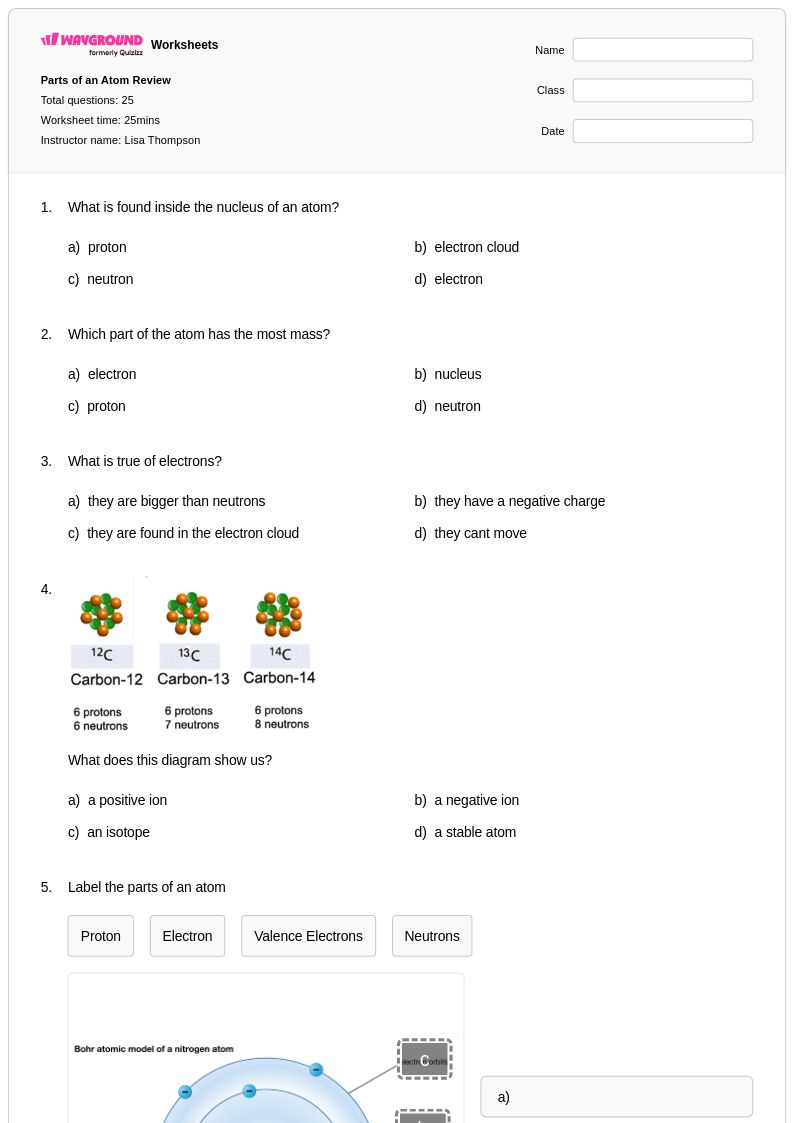
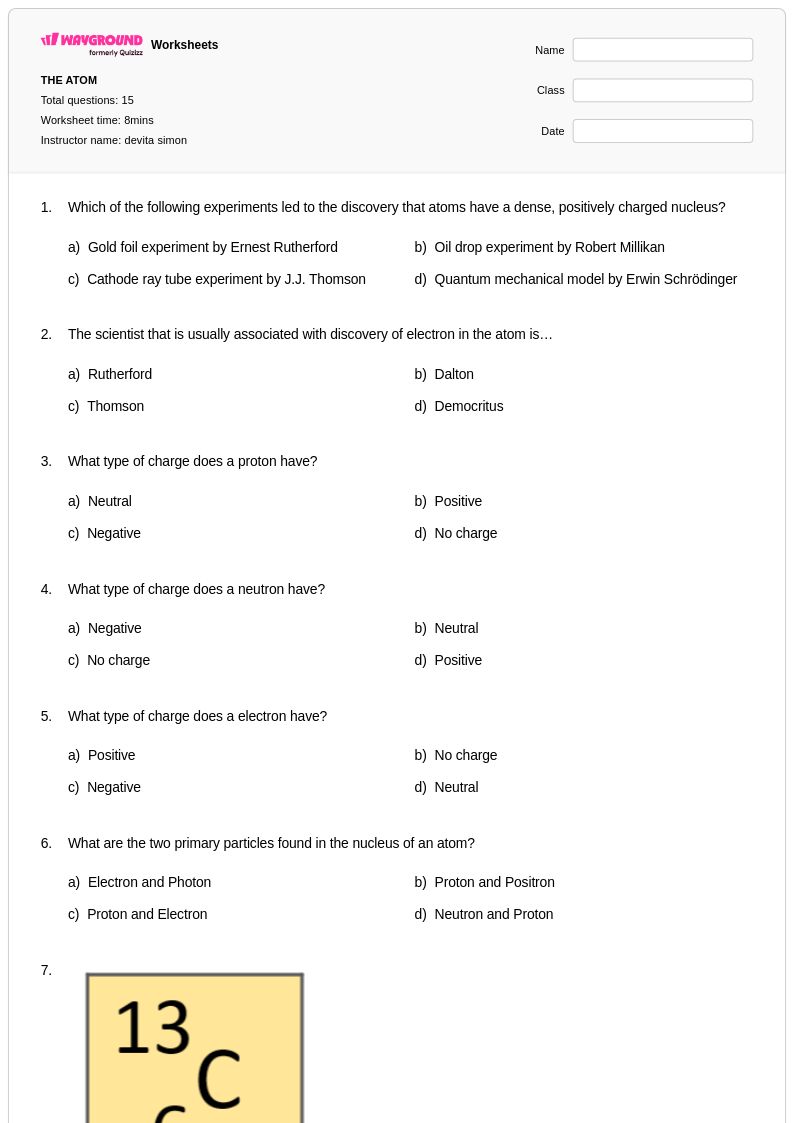
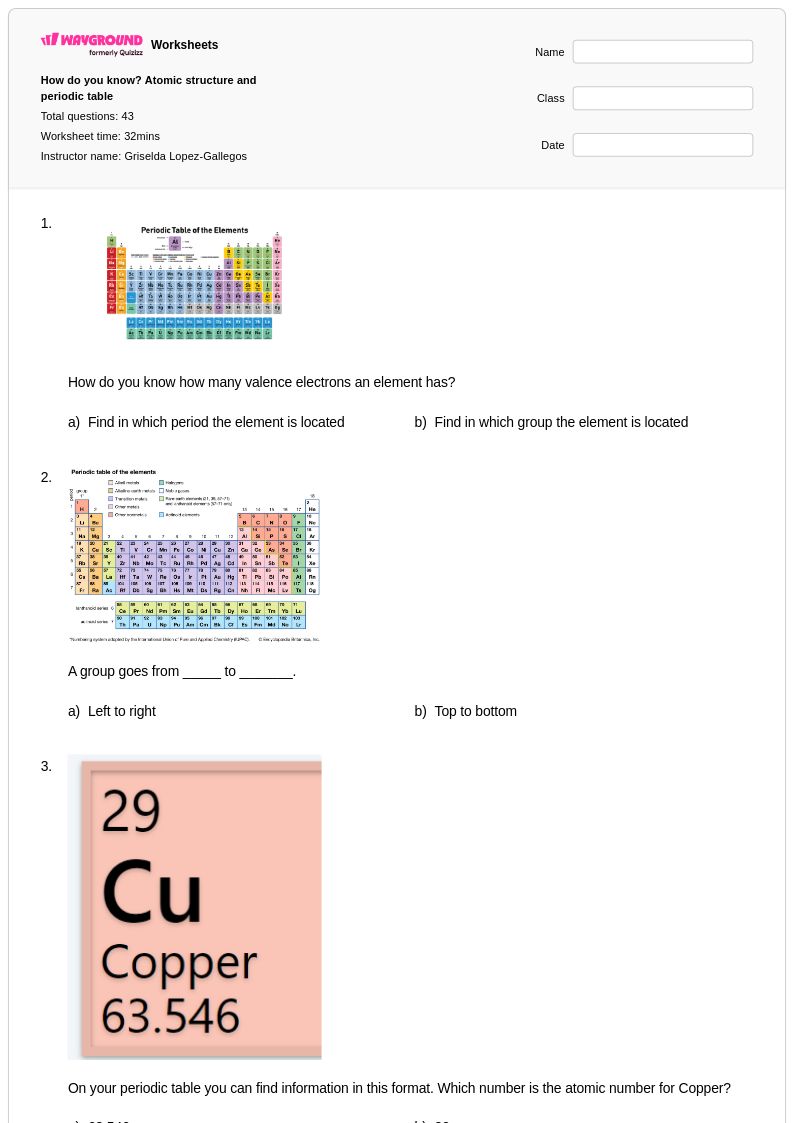
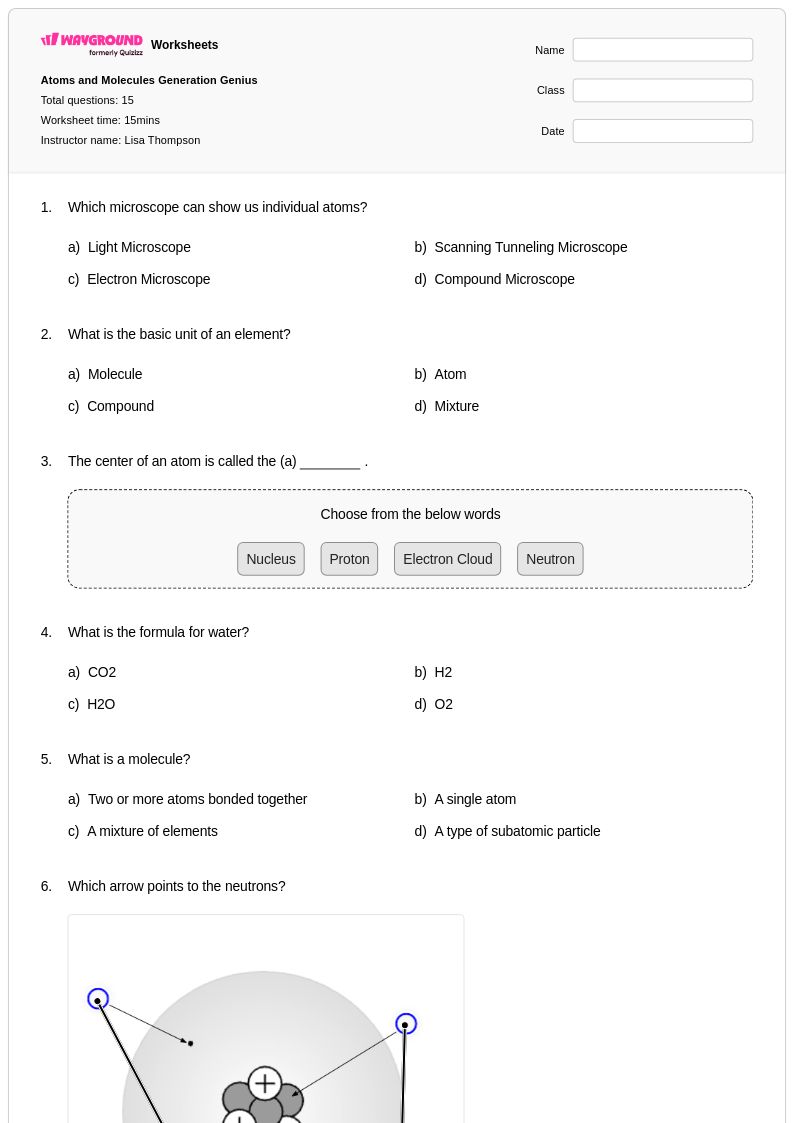
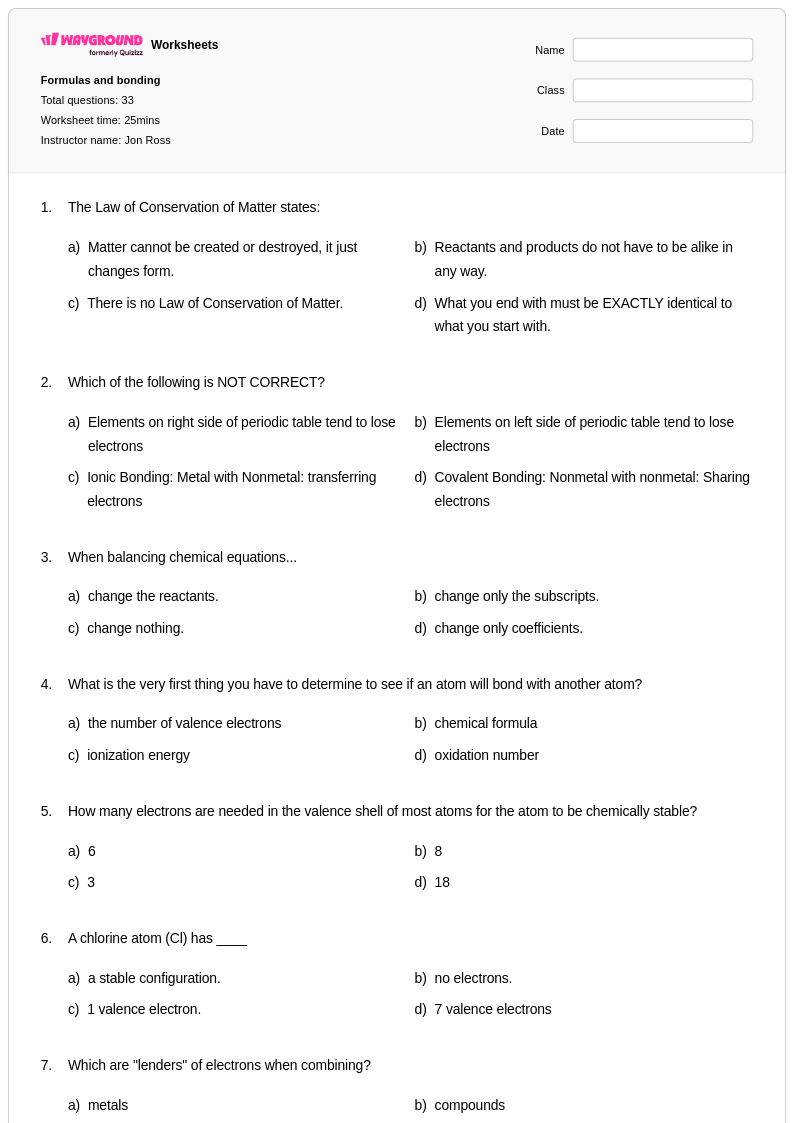
Ions and isotopes represent fundamental concepts in Grade 7 chemistry that help students understand atomic structure and chemical behavior at the molecular level. Wayground's comprehensive collection of ions and isotopes worksheets provides middle school educators with expertly designed practice problems that guide students through distinguishing between atoms, ions, and isotopes while mastering electron configuration and atomic notation. These free printable resources include detailed answer keys and cover essential skills such as calculating the number of protons, neutrons, and electrons in various atomic species, determining ionic charges, and interpreting isotopic symbols. Students work through progressively challenging exercises that reinforce their understanding of how atoms gain or lose electrons to form ions and how isotopes of the same element differ in their neutron count while maintaining identical chemical properties.
Wayground's extensive library features millions of teacher-created worksheets specifically focused on ions and isotopes, offering robust search and filtering capabilities that allow educators to quickly locate materials aligned with their curriculum standards and student needs. The platform's differentiation tools enable teachers to customize worksheet difficulty levels and question types, ensuring appropriate challenges for diverse learners while supporting both remediation and enrichment goals. These versatile resources are available in multiple formats including downloadable PDF files for traditional classroom use and interactive digital versions for modern learning environments. Teachers can efficiently plan comprehensive lesson sequences, assess student comprehension of atomic theory concepts, and provide targeted skill practice that builds confidence in understanding the relationship between atomic structure and chemical properties.
FAQs
How do I teach the difference between ions and isotopes to chemistry students?
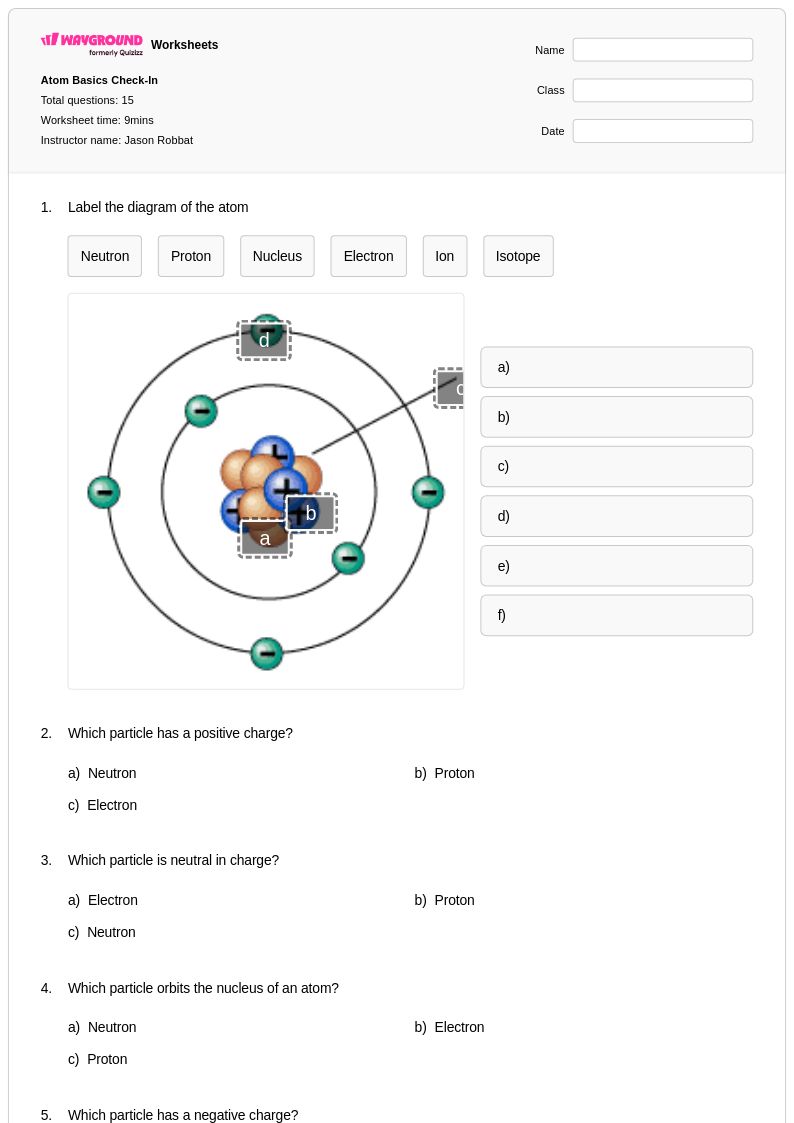
Ions and isotopes are often confused because both involve changes to an atom, but they involve different subatomic particles. Ions form when an atom gains or loses electrons, changing its charge, while isotopes are atoms of the same element with different numbers of neutrons, affecting atomic mass but not charge. A useful teaching approach is to anchor both concepts to the periodic table — ions relate to valence electrons and group trends, while isotopes connect to atomic mass calculations and nuclear stability. Using side-by-side comparison diagrams of atomic models helps students visually distinguish the two before moving into notation and problem-solving.
What exercises help students practice identifying ions and isotopes?
Effective practice for ions and isotopes includes exercises where students determine the number of protons, neutrons, and electrons from nuclear notation, then classify the particle as a neutral atom, ion, or isotope. Problems that ask students to write the ionic charge given the number of electrons gained or lost build fluency with ion formation patterns. Isotope-specific practice should include calculating average atomic mass from isotopic abundance data, which bridges conceptual understanding with quantitative chemistry skills. Structured worksheets with answer keys allow students to self-check and correct misconceptions before they become entrenched.
What mistakes do students commonly make when working with ions and isotopes?
The most common misconception is that isotopes have different numbers of protons, which students confuse with the definition of a different element entirely. Students also frequently mix up mass number and atomic number when reading isotopic notation, leading to errors in neutron calculations. For ions, a persistent error is reversing the sign of the charge — for example, writing a cation as negative when an atom loses electrons. Teachers should build in explicit practice identifying what changes and what stays constant in each case, reinforcing that proton count defines the element and never changes in either ions or isotopes.
How can I use ions and isotopes worksheets to support students with different learning needs?
Ions and isotopes worksheets on Wayground can be assigned digitally, which allows teachers to apply student-level accommodations directly within the platform. For students who need additional support, the Read Aloud feature can audio-read questions, and reduced answer choices can lower cognitive load on multiple-choice items. Extended time settings can be configured per student for timed practice sessions, and reading mode offers adjustable font sizes and themes for accessibility. These accommodations are saved for future sessions and applied without notifying other students, making differentiation straightforward and discreet.
How do I use Wayground's ions and isotopes worksheets in my classroom?
Wayground's ions and isotopes worksheets are available as printable PDFs for traditional classroom use and in digital formats for technology-integrated environments, giving teachers flexibility in how they assign and collect student work. Teachers can also host worksheets as a quiz directly on Wayground, enabling real-time tracking of student responses and performance. Printable versions with answer keys work well for in-class guided practice or homework, while the digital format supports independent or blended learning workflows. Both formats include complete answer keys to support efficient grading and student self-assessment.
How does isotopic notation work, and how do I help students read it accurately?
Isotopic notation expresses an element's mass number as a superscript and atomic number as a subscript to the left of the element symbol, such as ¹⁴C for carbon-14. Students can calculate the number of neutrons by subtracting the atomic number from the mass number, a step that becomes automatic with repeated practice. A common scaffold is to have students fill in a table with columns for element name, atomic number, mass number, protons, neutrons, and electrons — working from notation to values and back again reinforces both reading and writing isotopic symbols accurately.
How do ion formation and electron configuration connect, and how should I sequence this instruction?
Ion formation is best taught after students have a solid understanding of electron configuration, particularly valence electrons and the octet rule. Once students can identify how many valence electrons an atom has, predicting whether it will gain or lose electrons to form a stable ion becomes a logical next step rather than a memorized rule. Instructional sequencing should move from electron dot diagrams to ionic charge prediction, then to writing ionic formulas, with each stage reinforced through targeted practice problems. This progression helps students see ion formation as a chemically motivated process rather than an arbitrary fact.