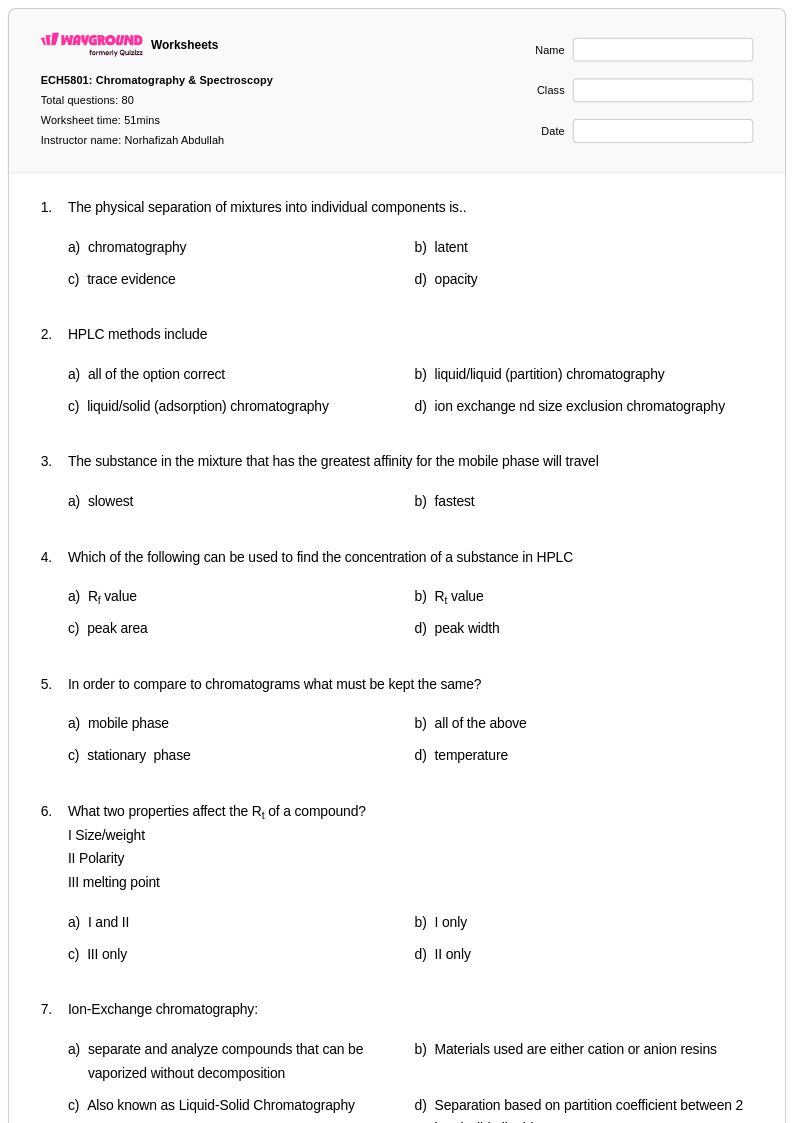
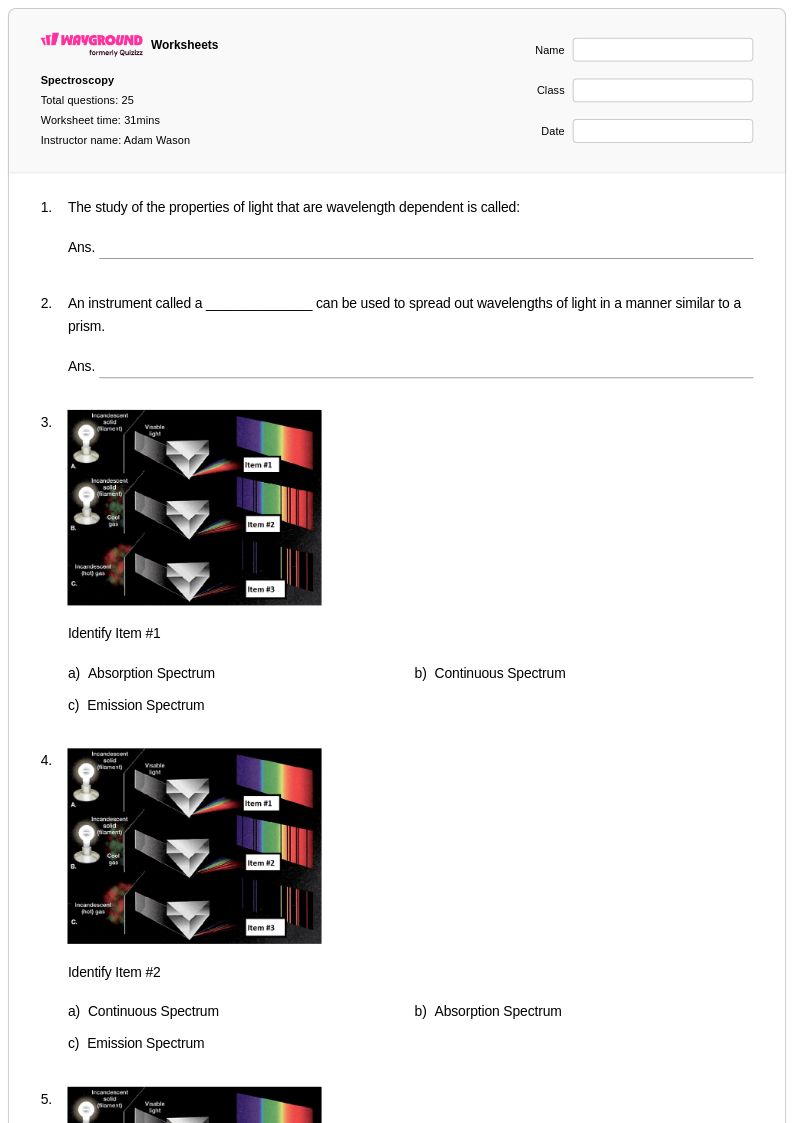
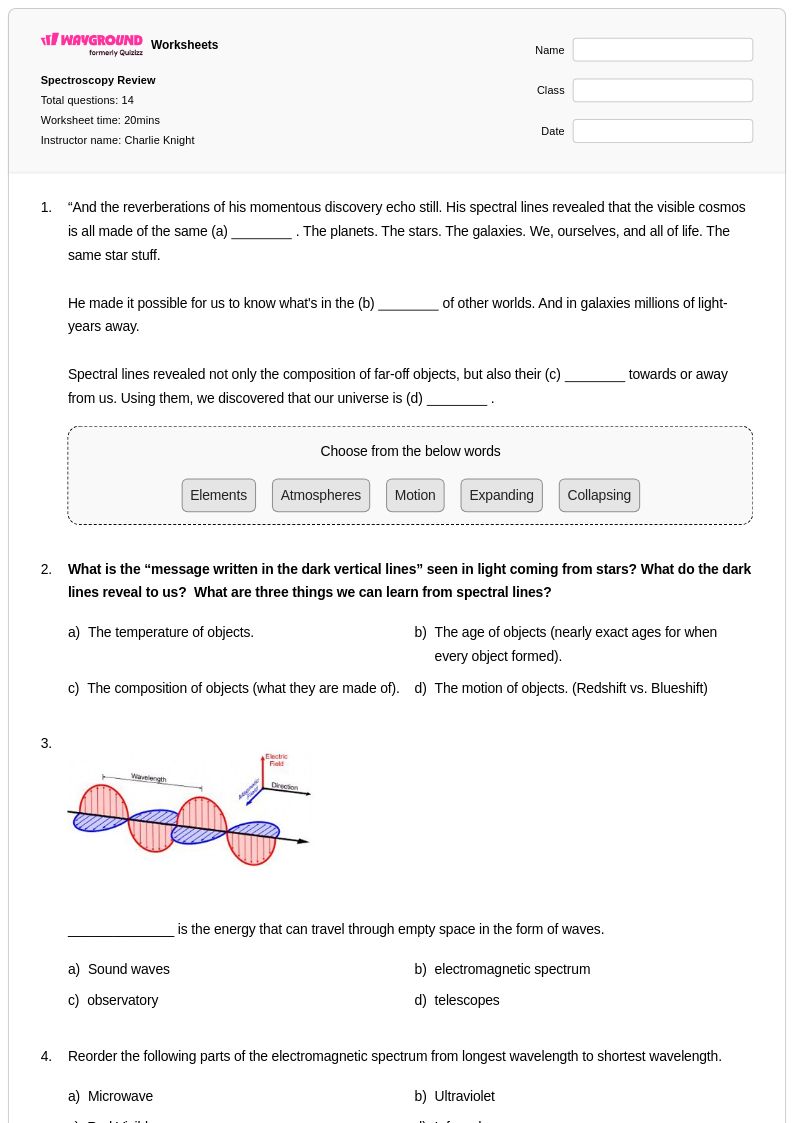
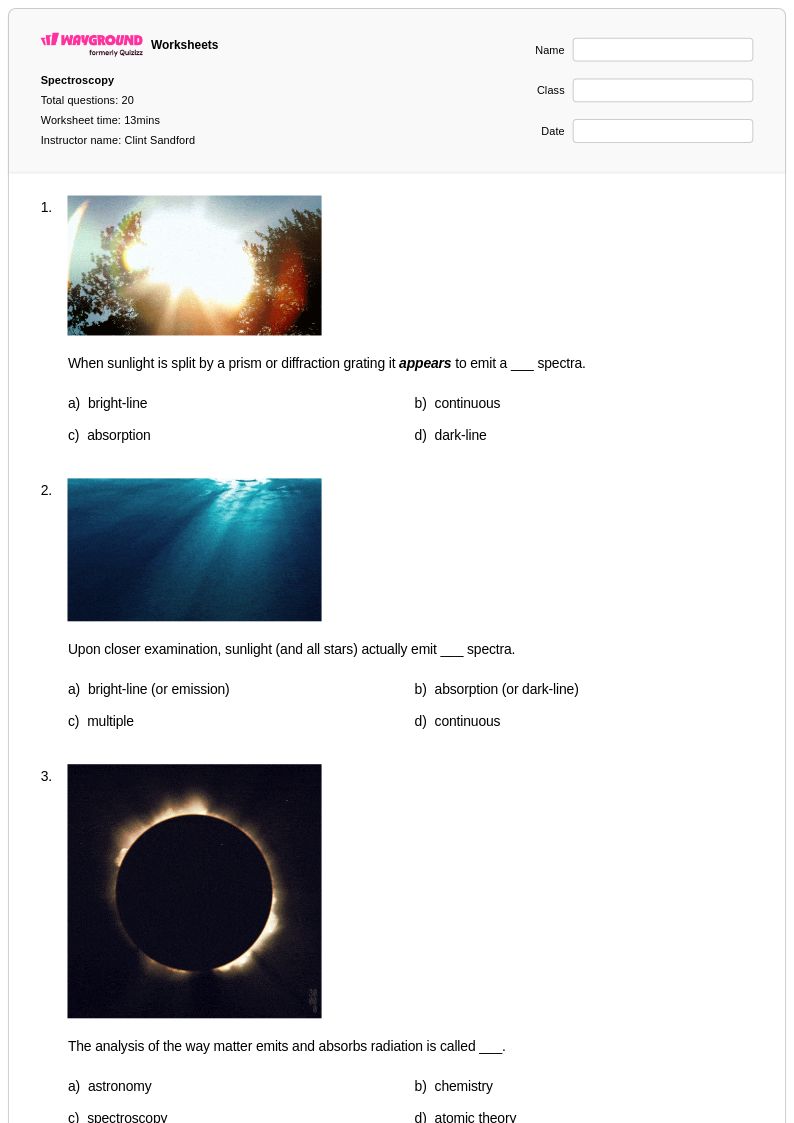
Enhance your understanding of IR spectroscopy with Wayground's comprehensive collection of free worksheets and printables, featuring practice problems and answer keys to master molecular identification and functional group analysis.
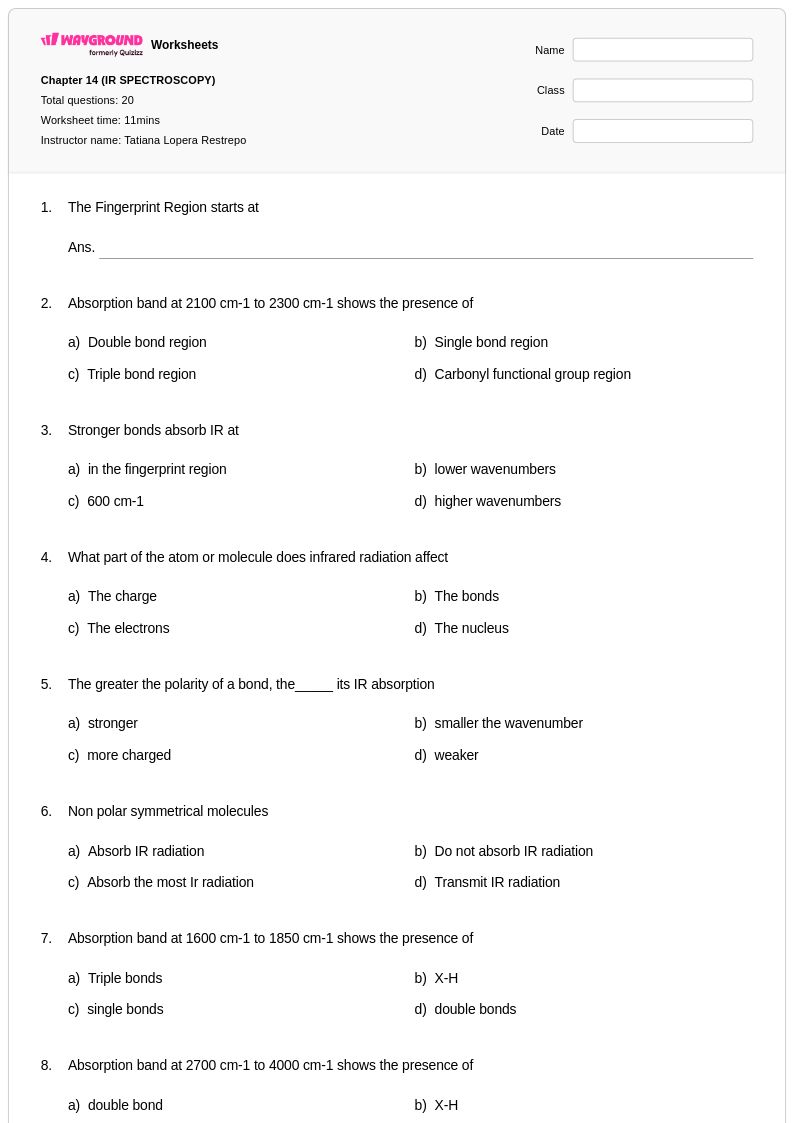
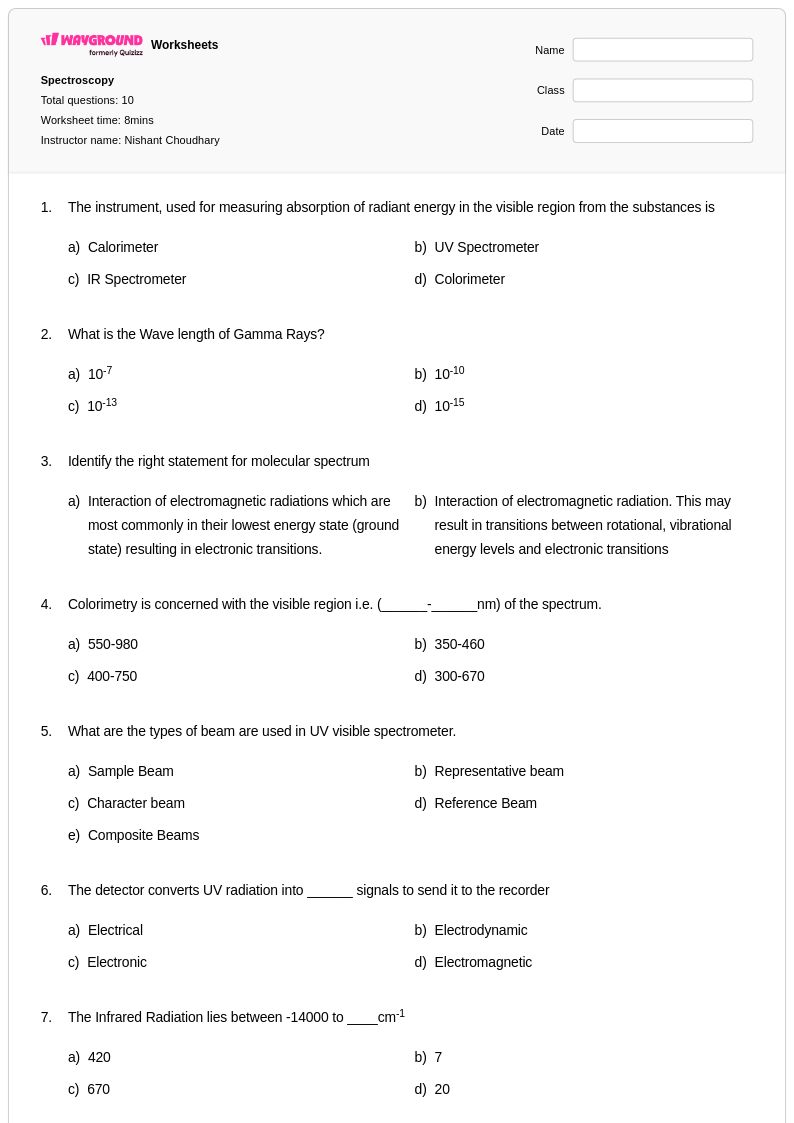
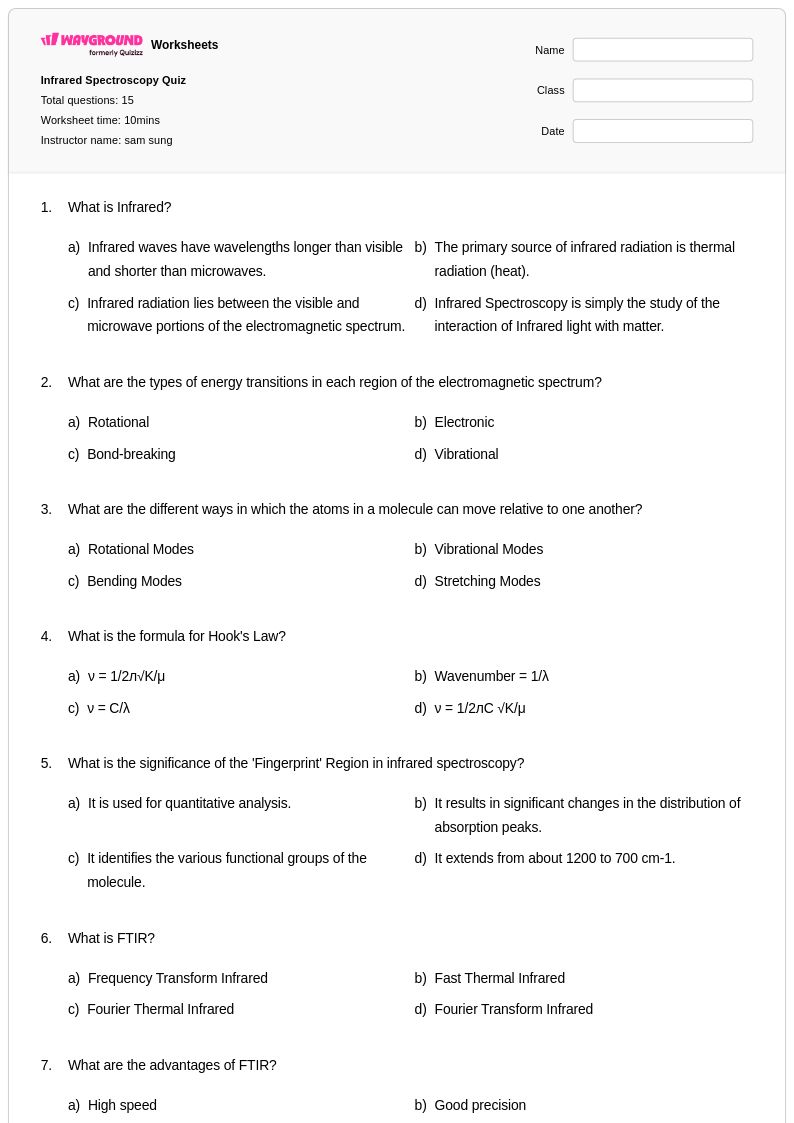
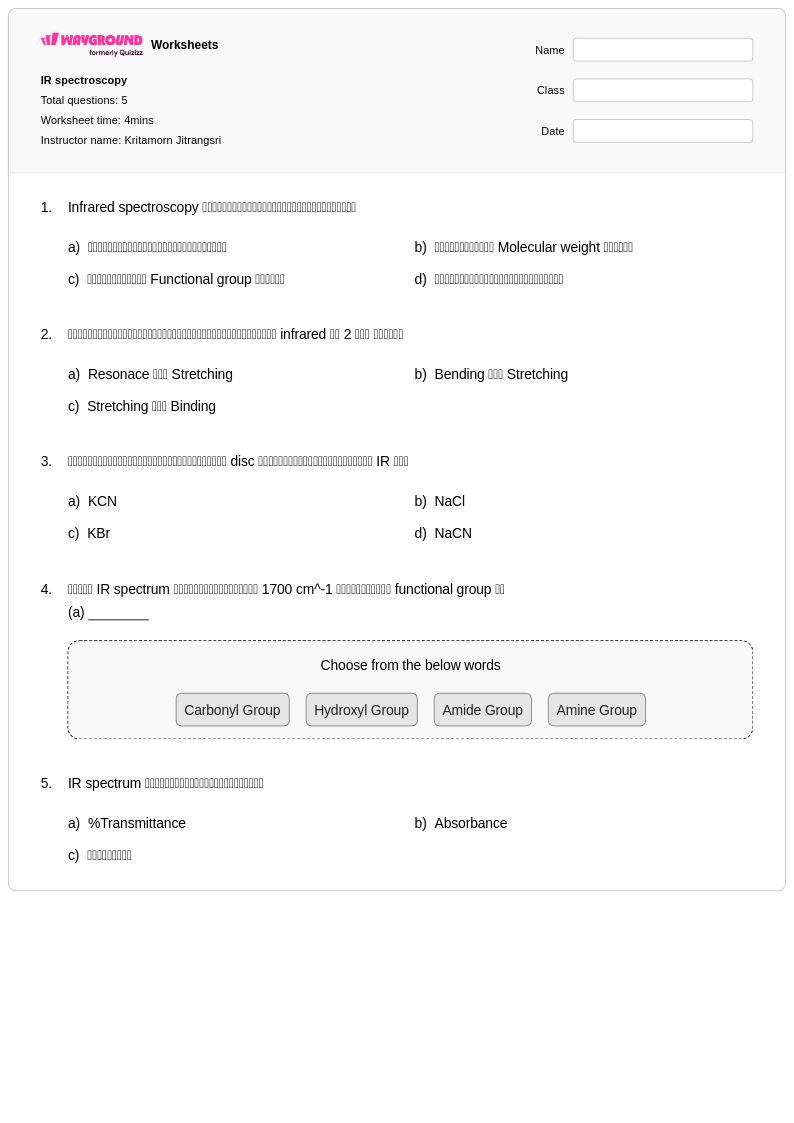
IR Spectroscopy worksheets available through Wayground (formerly Quizizz) provide comprehensive practice materials that help students master the fundamental principles of infrared spectroscopy and molecular structure analysis. These expertly designed worksheets focus on developing critical skills including peak identification, functional group recognition, molecular fingerprinting, and spectral interpretation techniques essential for organic chemistry success. Students work through practice problems that challenge them to analyze IR spectra, correlate absorption frequencies with specific bonds and functional groups, and predict molecular structures based on spectroscopic data. Each worksheet collection includes detailed answer keys and explanations, with free printable pdf formats that make classroom implementation seamless while reinforcing the connection between molecular vibrations and characteristic absorption patterns.
Wayground (formerly Quizizz) supports chemistry educators with an extensive library of millions of teacher-created IR Spectroscopy resources that streamline lesson planning and enhance student understanding of this complex analytical technique. The platform's robust search and filtering capabilities allow teachers to quickly locate worksheets aligned with specific chemistry standards and learning objectives, while differentiation tools enable customization for varying skill levels and learning needs. Available in both printable pdf and interactive digital formats, these resources facilitate flexible instruction whether used for initial concept introduction, targeted remediation, or advanced enrichment activities. Teachers can easily modify existing worksheets or combine multiple resources to create comprehensive practice sets that address specific spectroscopic concepts, from basic peak assignment to complex structural determination problems, ensuring students develop confidence in interpreting infrared spectra across diverse molecular systems.
FAQs
How do I teach IR spectroscopy to chemistry students?
Start by grounding students in the physics of molecular vibrations — specifically how bonds stretch and bend at characteristic frequencies when exposed to infrared radiation. From there, build pattern recognition skills by having students repeatedly match absorption peaks to functional groups using reference tables before moving to independent interpretation. Scaffolding is key: begin with simple molecules containing one or two functional groups, then progress to complex spectra where students must distinguish overlapping signals and apply the fingerprint region.
What practice exercises help students get better at reading IR spectra?
The most effective practice involves giving students an unknown IR spectrum and asking them to identify functional groups present based on characteristic absorption frequencies — for example, recognizing a broad O-H stretch near 3200–3550 cm⁻¹ or a sharp C=O peak around 1700–1750 cm⁻¹. Pairing spectral interpretation with molecular structure prediction reinforces the connection between spectroscopic data and chemical identity. Repeated exposure to varied spectra, including both simple reference compounds and structurally complex unknowns, builds the fluency needed for exam performance and lab work.
What mistakes do students commonly make when interpreting IR spectra?
The most common error is over-relying on a single peak to draw structural conclusions rather than interpreting the full spectrum holistically. Students frequently confuse N-H and O-H stretches, both of which appear in the 3200–3500 cm⁻¹ region, without accounting for peak shape differences — O-H tends to be broader. Another frequent misconception is ignoring the fingerprint region (600–1400 cm⁻¹), which students often dismiss as noise rather than recognizing its value for confirming molecular identity through comparison with known spectra.
How do I use IR spectroscopy worksheets effectively in my chemistry class?
IR spectroscopy worksheets work well as structured practice after initial instruction, giving students the repetition needed to internalize absorption frequency patterns for key functional groups. Wayground's IR spectroscopy worksheets are available as printable PDFs for traditional classroom use and in digital formats for technology-integrated environments, including the option to host them as a quiz directly on Wayground. For students who need additional support, Wayground also offers accommodations such as read-aloud functionality and extended time, which can be configured per student without disrupting the rest of the class.
How do I differentiate IR spectroscopy instruction for students at different skill levels?
For students who are newer to spectral interpretation, limit initial practice to spectra with one or two prominent peaks and provide a functional group reference table. More advanced students can work with multi-functional group molecules where they must rule out structural possibilities systematically. On Wayground, teachers can apply differentiation settings — such as reduced answer choices or extended time — to individual students, allowing the same worksheet to serve the whole class while adjusting cognitive demand for those who need it.
What functional groups should students be able to identify from an IR spectrum?
At a minimum, students in an introductory organic chemistry course should be able to identify O-H (alcohols and carboxylic acids), N-H (amines and amides), C=O (carbonyls including ketones, aldehydes, esters, and carboxylic acids), C-H (alkyl and aromatic), and C≡N (nitriles) from their characteristic absorption regions. Distinguishing between closely related functional groups — such as a ketone C=O near 1715 cm⁻¹ versus an ester C=O near 1735 cm⁻¹ — requires targeted practice with varied examples and immediate feedback to correct misidentification patterns early.