Explore Wayground's free rate laws worksheets and printables that help students master chemical kinetics through practice problems, PDF resources, and comprehensive answer keys for effective chemistry learning.
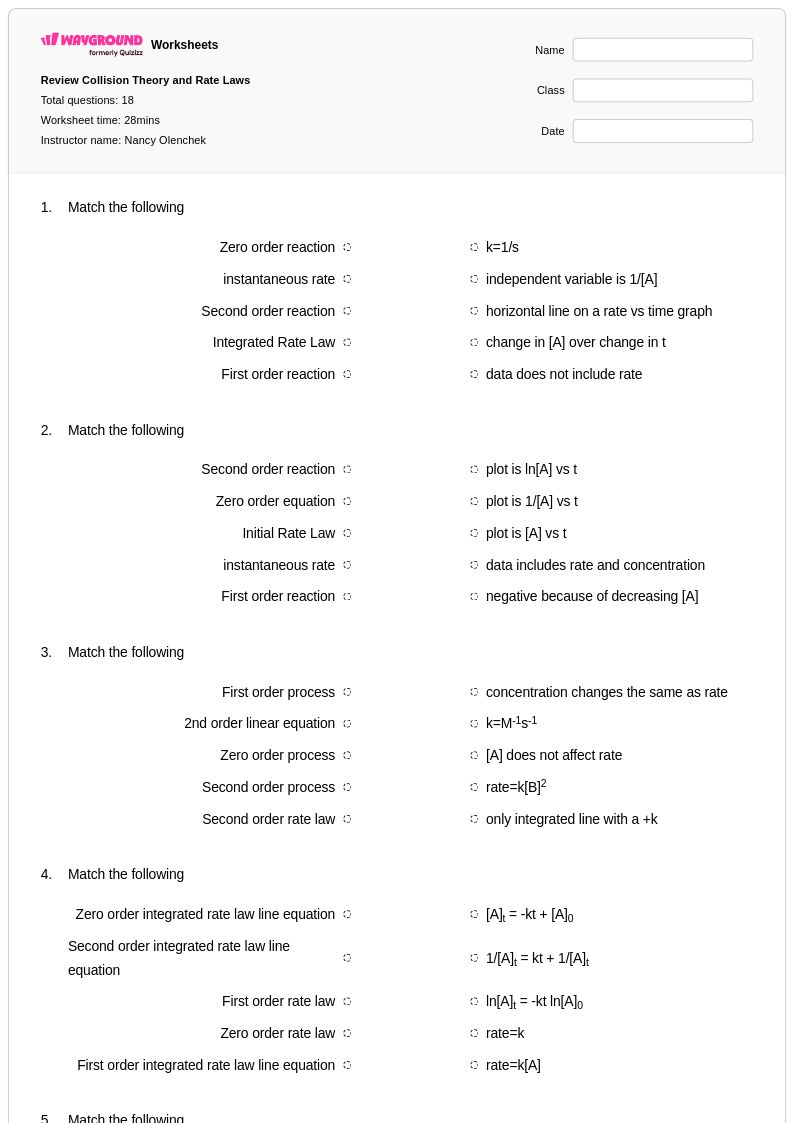
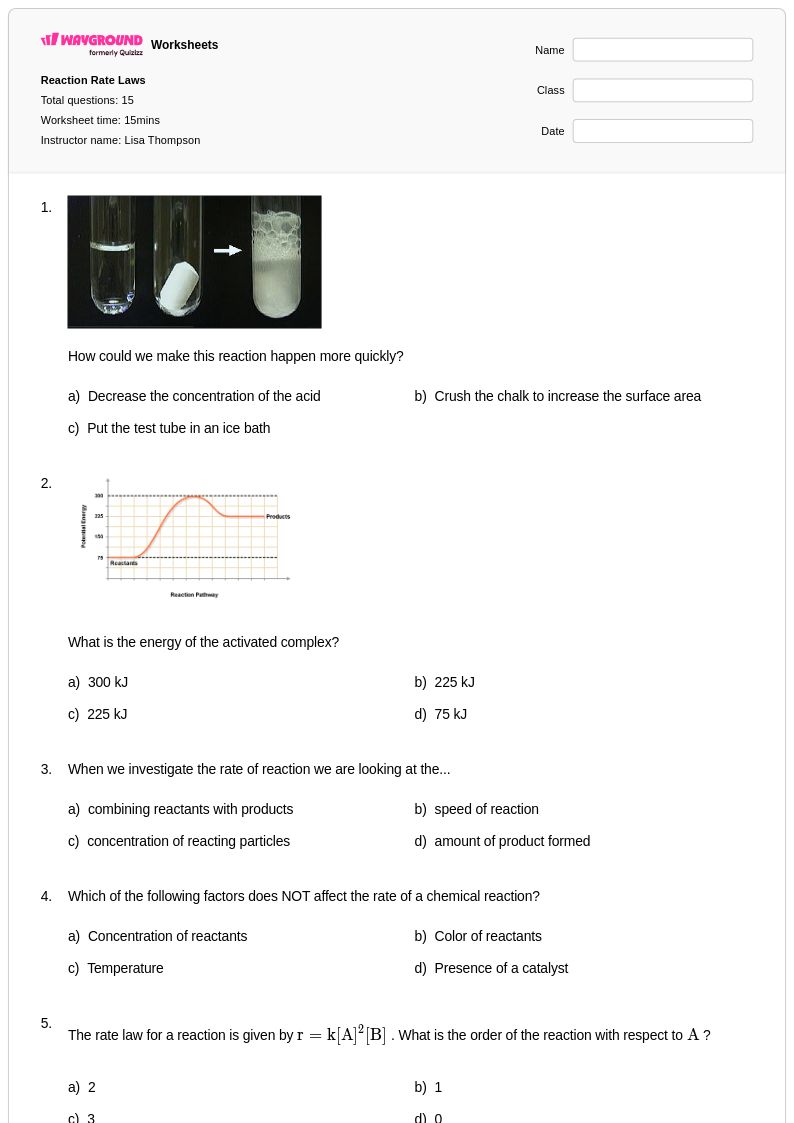
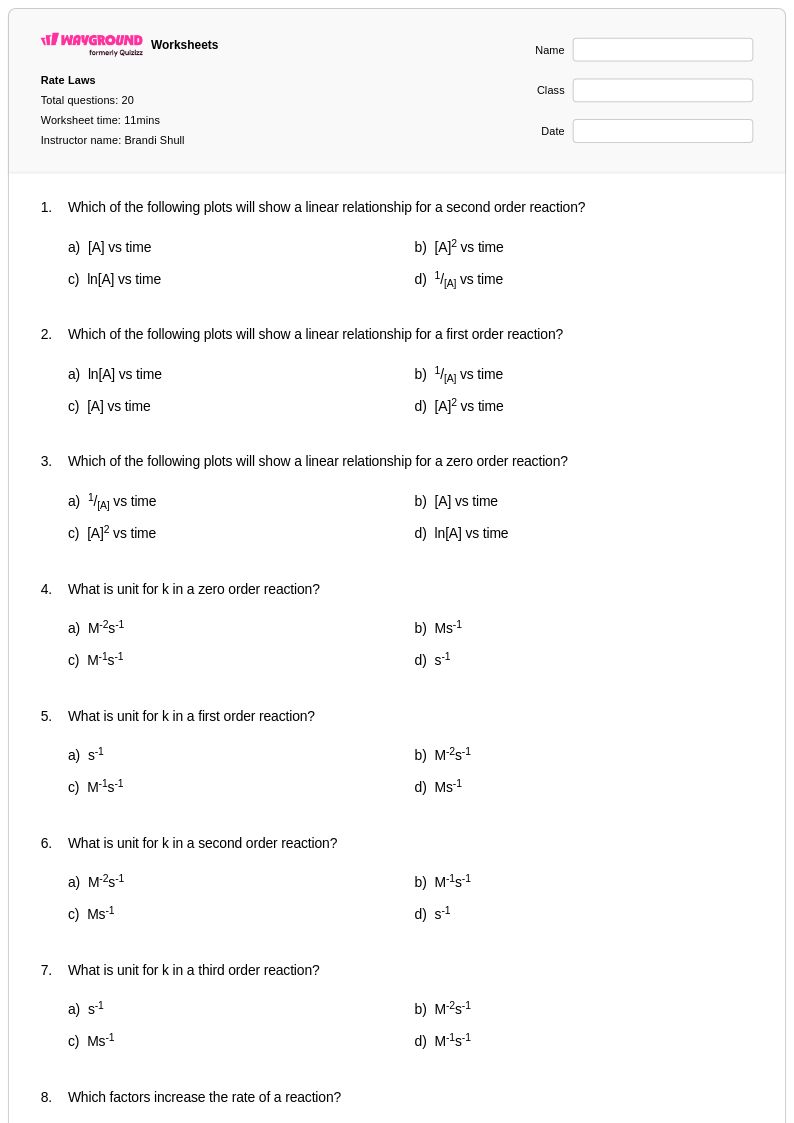
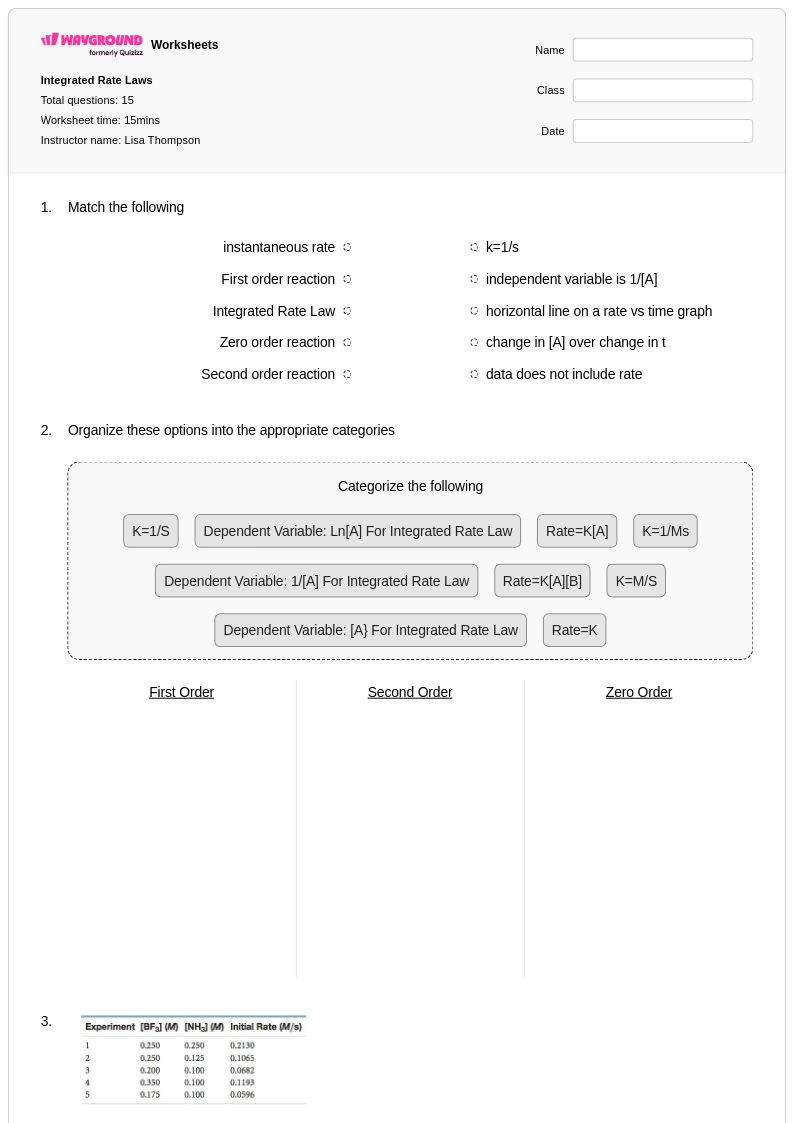
Rate laws worksheets available through Wayground (formerly Quizizz) provide comprehensive practice opportunities for students to master the fundamental principles governing chemical reaction rates. These carefully designed educational resources focus on helping learners understand how to determine reaction orders, calculate rate constants, and interpret experimental data to derive rate law expressions. Students develop critical analytical skills as they work through practice problems involving integrated rate laws, half-life calculations, and the relationship between concentration and time in zero, first, and second-order reactions. The worksheets include detailed answer keys that guide students through complex problem-solving strategies, and many are available as free printables in convenient pdf format, making them accessible for both classroom instruction and independent study.
Wayground (formerly Quizizz) empowers educators with millions of teacher-created rate laws resources that streamline lesson planning and enhance student learning outcomes. The platform's robust search and filtering capabilities allow teachers to quickly locate worksheets aligned with specific chemistry standards and curriculum requirements, whether focusing on elementary rate law concepts or advanced kinetics applications. These versatile materials support differentiated instruction through customizable difficulty levels and can be seamlessly adapted for various learning environments in both printable and digital formats. Teachers utilize these comprehensive worksheet collections for targeted skill practice, remediation of challenging kinetics concepts, and enrichment activities that deepen student understanding of reaction mechanisms and catalysis, ultimately building a stronger foundation in chemical kinetics across diverse academic settings.
FAQs
How do I teach rate laws in chemistry class?
Teaching rate laws effectively starts with building student understanding of how reactant concentration affects reaction speed before introducing mathematical expressions. Begin with qualitative observations, then move to writing rate law expressions in the form rate = k[A]^m[B]^n, where students practice identifying reaction orders from experimental data. Connecting rate laws to real lab data helps students see the concept as an analytical tool rather than an abstract formula. Reinforcing with structured practice problems that progress from zero-order to second-order reactions builds confidence before tackling integrated rate laws and half-life calculations.
What exercises help students practice rate laws?
Effective rate laws practice includes exercises where students determine reaction order from initial rate data tables, calculate rate constants using given concentrations, and apply integrated rate law equations to find concentration at a specific time. Half-life calculation problems for first-order and second-order reactions are particularly valuable because they require students to apply multiple steps in sequence. Graphical analysis exercises, where students interpret concentration-versus-time plots to identify reaction order, strengthen both analytical and data interpretation skills.
What mistakes do students commonly make when working with rate laws?
One of the most frequent errors is confusing reaction order with stoichiometric coefficients, leading students to incorrectly write rate law exponents directly from a balanced equation rather than determining them experimentally. Students also commonly misapply integrated rate law formulas by selecting the wrong equation for the reaction order at hand. Another persistent misconception is assuming that the rate constant k is unitless, when in fact its units vary depending on the overall order of the reaction. Targeted practice problems that explicitly require students to justify their choice of formula can help address these patterns.
How do I use Wayground's rate laws worksheets in my classroom?
Wayground's rate laws worksheets are available as printable PDFs for traditional classroom use and in digital formats for technology-integrated learning environments, including the option to host them as a quiz directly on Wayground. Teachers can use the printable versions for in-class problem sets or homework, while the digital format supports self-paced practice and instant feedback. Both formats include complete answer keys, making them equally useful for guided instruction or independent student review.
How can I differentiate rate laws instruction for students who are struggling?
For students who struggle with rate laws, reducing cognitive load by scaffolding problems is key, starting with single-reactant rate expressions before introducing multi-reactant systems. On Wayground's digital platform, teachers can apply accommodations such as read aloud support for students who need questions read to them, reduced answer choices to limit decision fatigue, and extended time per question for students who need more processing time. These settings can be assigned to individual students without disrupting the experience for the rest of the class.
How do integrated rate laws connect to reaction order, and why does it matter for student understanding?
Integrated rate laws are the mathematical expressions derived by integrating the differential rate law for each reaction order, allowing students to calculate concentration as a function of time rather than as a function of rate alone. Understanding this connection matters because it gives students a practical tool for predicting how much reactant remains after a given time interval, which is directly applied in half-life problems and real-world contexts like radioactive decay and pharmacokinetics. Students who grasp why each reaction order produces a distinct integrated form, linear for first-order when plotting ln[A] versus time, are better equipped to interpret experimental data accurately.