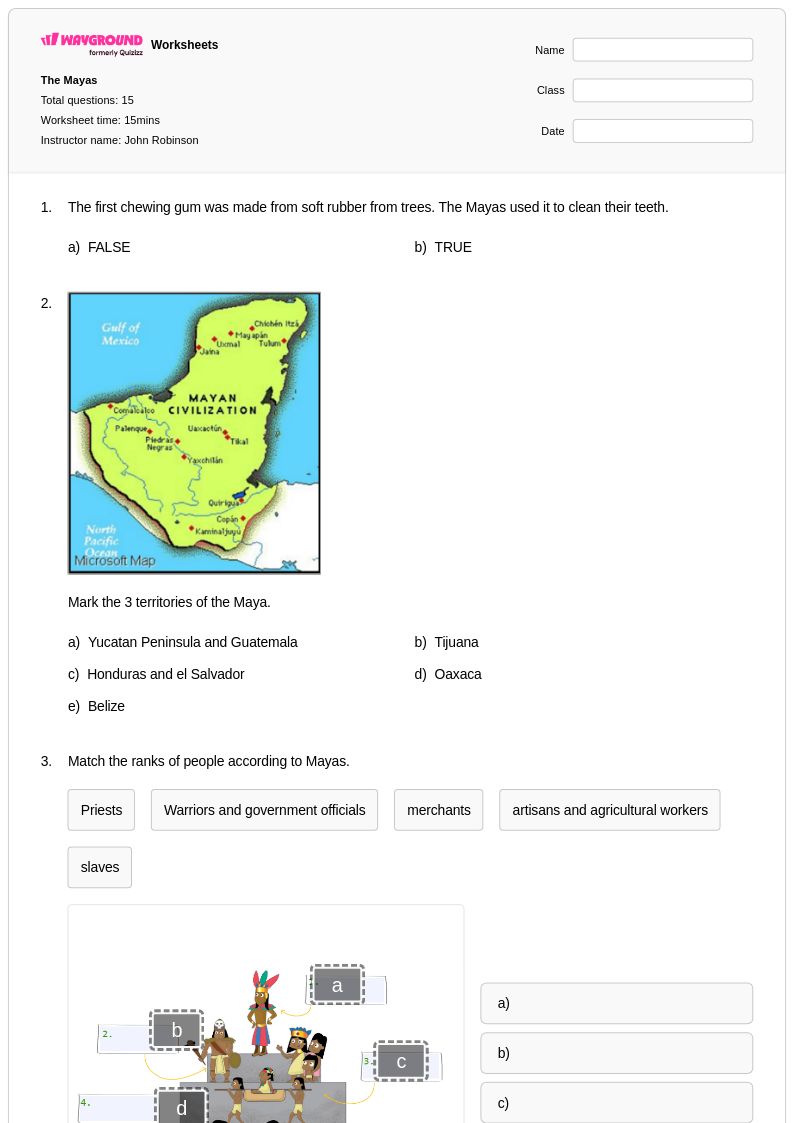
Free Printable Mayan Mathematics Worksheets for Grade 7
Explore Grade 7 Mayan Mathematics worksheets and printables from Wayground that help students master ancient number systems, calendar calculations, and mathematical concepts through engaging practice problems with complete answer keys.
Explore printable Mayan Mathematics worksheets for Grade 7
Mayan Mathematics worksheets for Grade 7 students available through Wayground (formerly Quizizz) provide comprehensive exploration of one of history's most sophisticated numerical systems. These educational resources guide seventh-grade learners through the fascinating world of Maya mathematical concepts, including their vigesimal base-20 counting system, the revolutionary use of zero as a placeholder, and the intricate bar-and-dot notation that enabled complex astronomical calculations. Students develop critical thinking skills as they decode ancient mathematical symbols, solve practice problems using Mayan numerical methods, and compare these historical techniques to modern mathematical approaches. Each worksheet collection includes detailed answer keys and is available as free printables in convenient pdf format, allowing educators to seamlessly integrate these engaging activities into their Social Studies curriculum while reinforcing mathematical reasoning skills.
Wayground (formerly Quizizz) empowers educators with access to millions of teacher-created resources specifically designed for Grade 7 Mayan Mathematics instruction, featuring robust search and filtering capabilities that help teachers quickly locate materials aligned with curriculum standards and learning objectives. The platform's differentiation tools enable instructors to customize worksheets based on individual student needs, supporting both remediation for struggling learners and enrichment opportunities for advanced students ready to explore more complex Maya mathematical concepts. Teachers can access these resources in both printable and digital formats, including downloadable pdfs perfect for classroom distribution or remote learning environments. This flexibility streamlines lesson planning while providing targeted skill practice that bridges ancient mathematical innovations with contemporary learning goals, ensuring students develop a deeper appreciation for the intellectual achievements of Maya civilization while strengthening their own analytical and problem-solving abilities.
FAQs
How do I teach the Mayan number system to students?
Start by introducing the Maya's base-20 (vigesimal) positional system and its three symbols: a dot for one, a bar for five, and a shell for zero. Contrast this with the base-10 system students already know to build conceptual bridges. Hands-on activities where students encode and decode Maya numerals reinforce understanding before moving into calendar calculations or trade-based math problems.
Why is zero important in Mayan mathematics and how should I explain it?
The Maya independently developed zero as a positional placeholder centuries before it was adopted in Europe, making it one of the most significant mathematical innovations in history. When teaching this, emphasize that zero was not just an absence of value but a functional symbol that made large number calculations possible. Comparing Maya use of zero to its role in the modern decimal system helps students appreciate both the concept and its historical significance.
What exercises help students practice reading and writing Maya numerals?
Effective practice exercises include converting base-10 numbers into Maya notation using dots, bars, and the shell zero, as well as working in reverse by decoding Maya numerals into modern equivalents. Adding and subtracting within the Maya system builds deeper fluency. Worksheets that connect numeral practice to real-world Maya applications, such as calendar dates or trade quantities, make the exercises more contextually meaningful.
What mistakes do students commonly make when learning Mayan mathematics?
The most common error is misapplying place value, particularly forgetting that Maya notation is vertical and that positional values increase from bottom to top. Students also frequently confuse the bar-and-dot notation by miscounting dots or misreading a bar as five individual units rather than a single five-unit symbol. A recurring misconception is treating the Maya calendar system as purely symbolic rather than understanding the precise astronomical mathematics underlying it.
How can I connect Mayan mathematics to broader social studies or history curriculum?
Mayan mathematics integrates naturally into units on Mesoamerican civilizations, ancient world history, or the history of mathematics. Use it to show students that advanced mathematical thinking was not exclusive to European or Middle Eastern traditions, challenging Eurocentric narratives. Connecting Maya numerical systems to their architecture, agricultural cycles, and astronomical observations reinforces how mathematics was embedded in every aspect of Maya society.
How do I use Mayan Mathematics worksheets from Wayground in my classroom?
Wayground's Mayan Mathematics worksheets are available as printable PDFs for traditional classroom use and in digital formats for technology-integrated environments, including the option to host them as a quiz directly on Wayground. Teachers can use the printable versions for individual desk work or small-group activities, while the digital format supports remote learning or 1:1 device classrooms. Built-in answer keys make it straightforward to provide immediate feedback or use the worksheets for self-paced review.

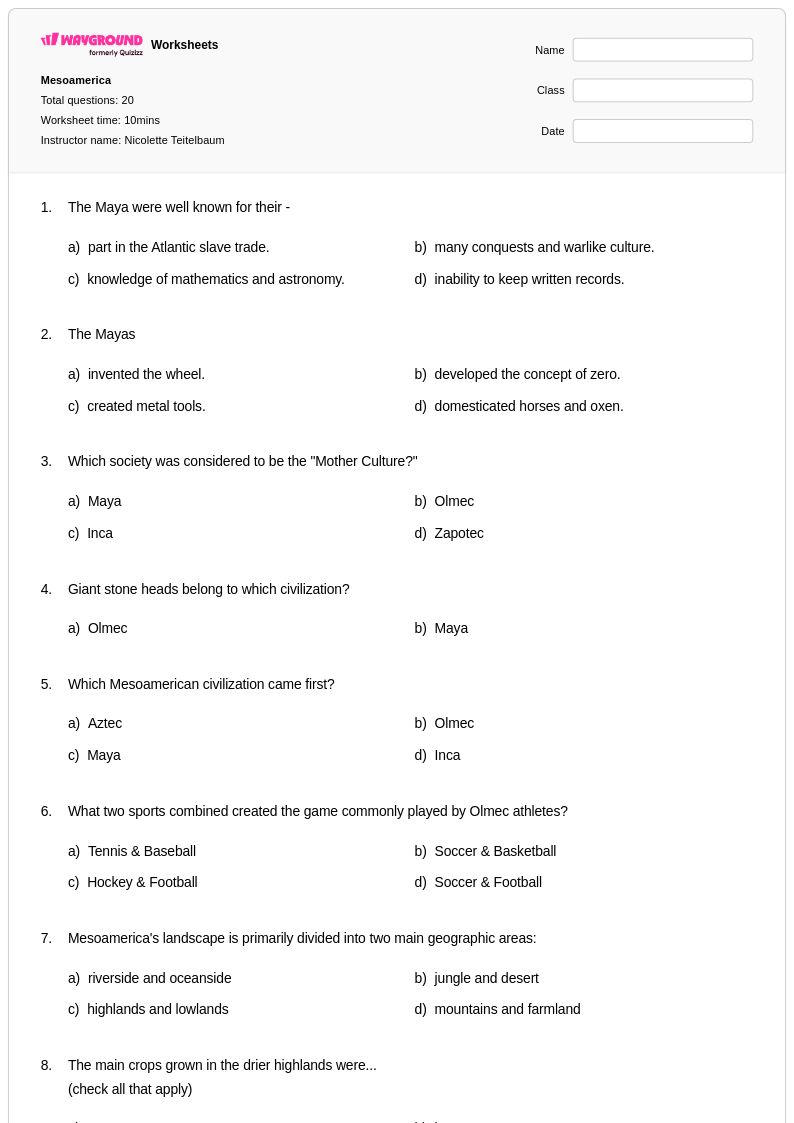
![Mayan Review [New] - Printable Mayan-mathematics Worksheets Grade 7 - Quizizz](https://quizizz-static.s3.amazonaws.com/_media/worksheets-new/6446713778c20d001d20ac1c-mayan-review-new)