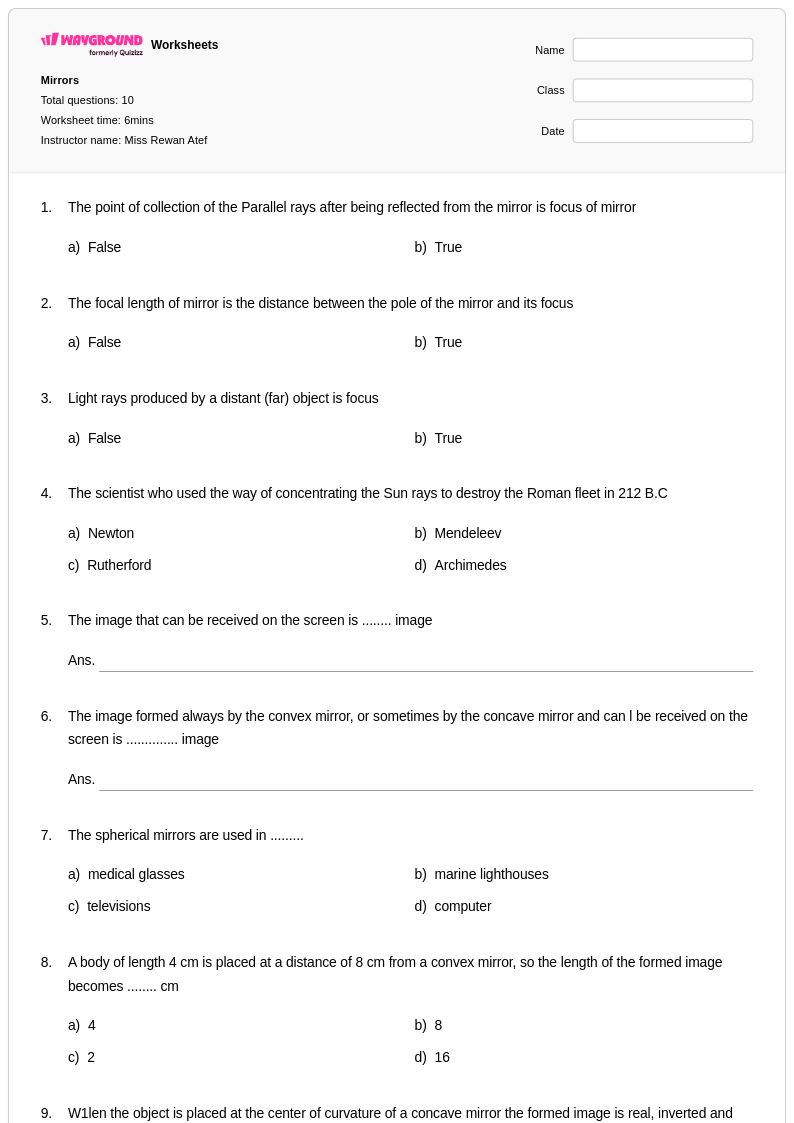
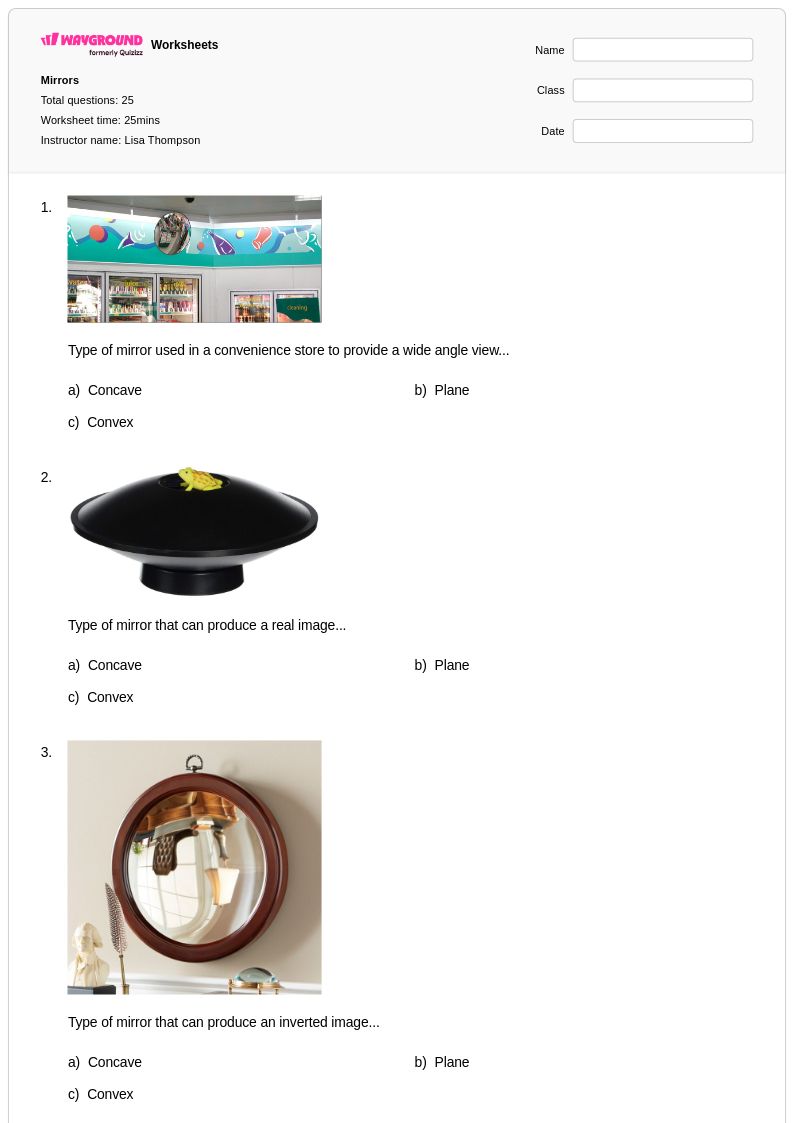
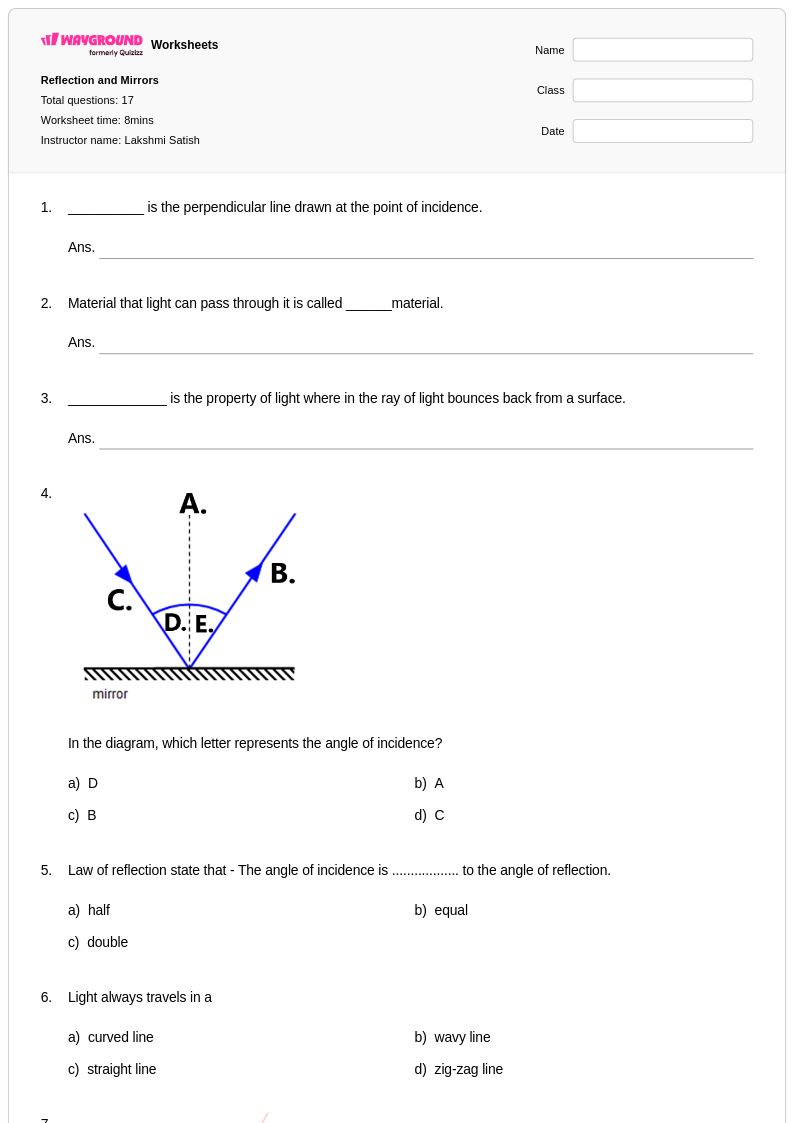
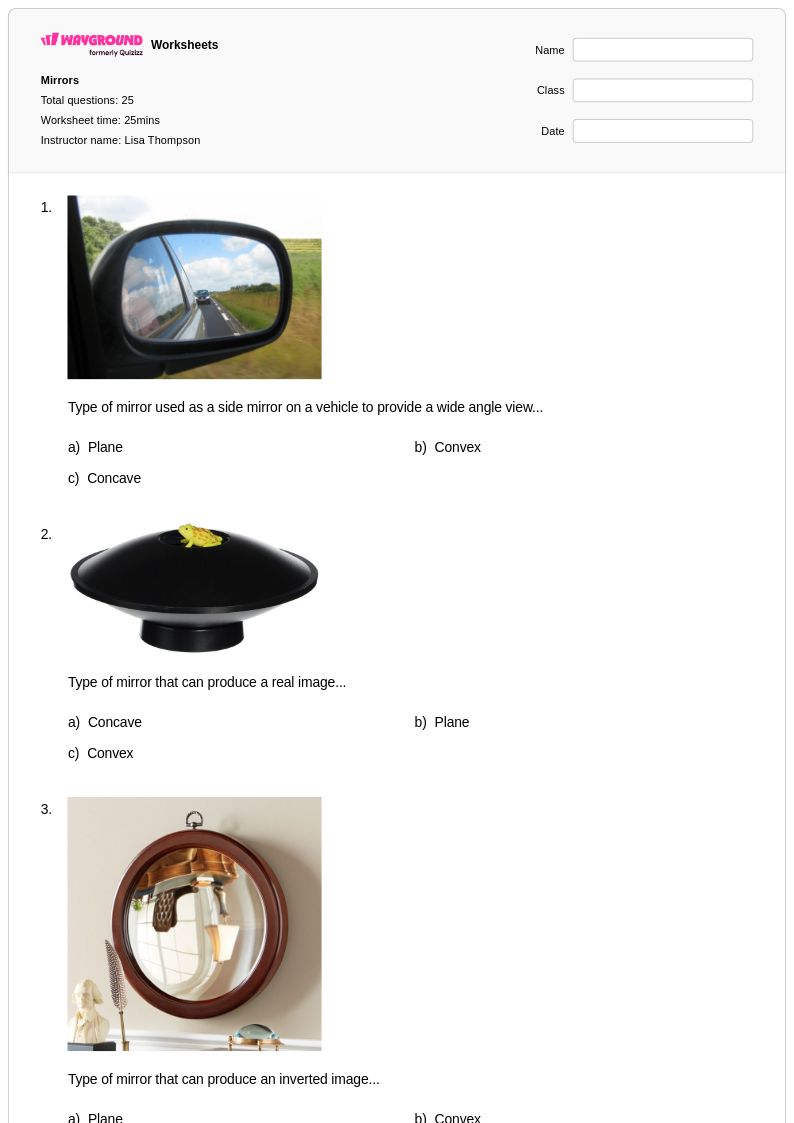
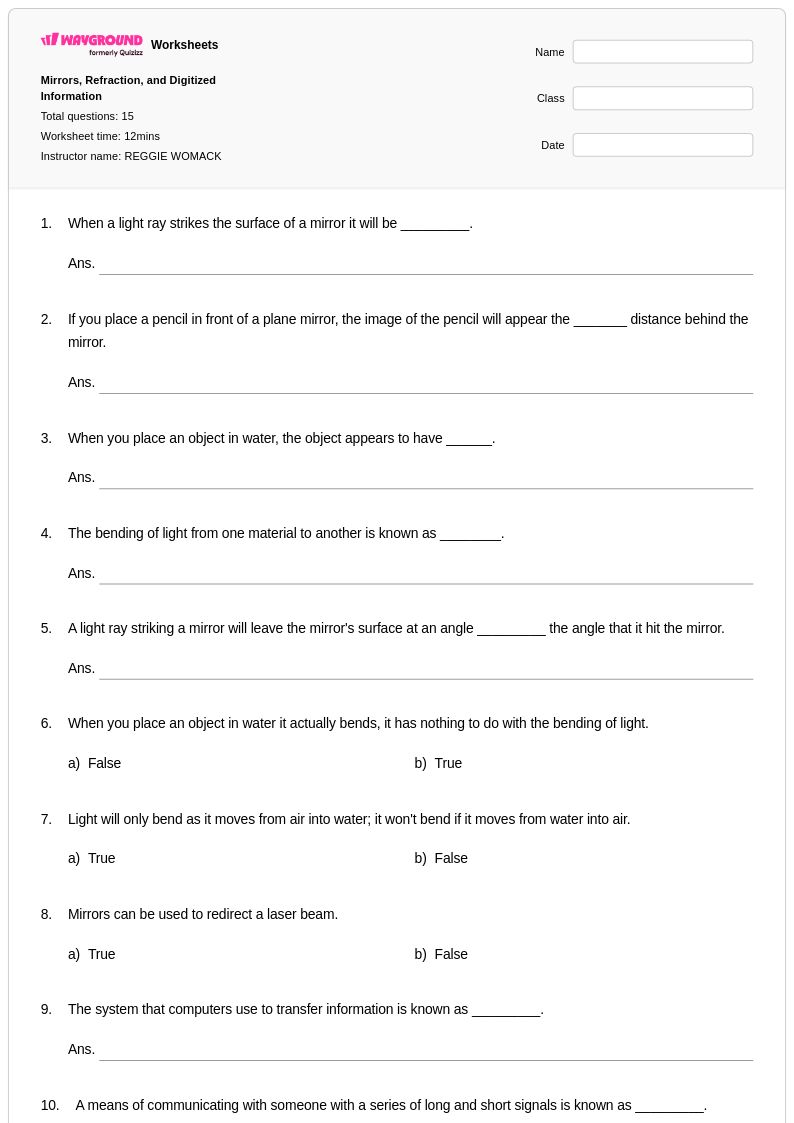
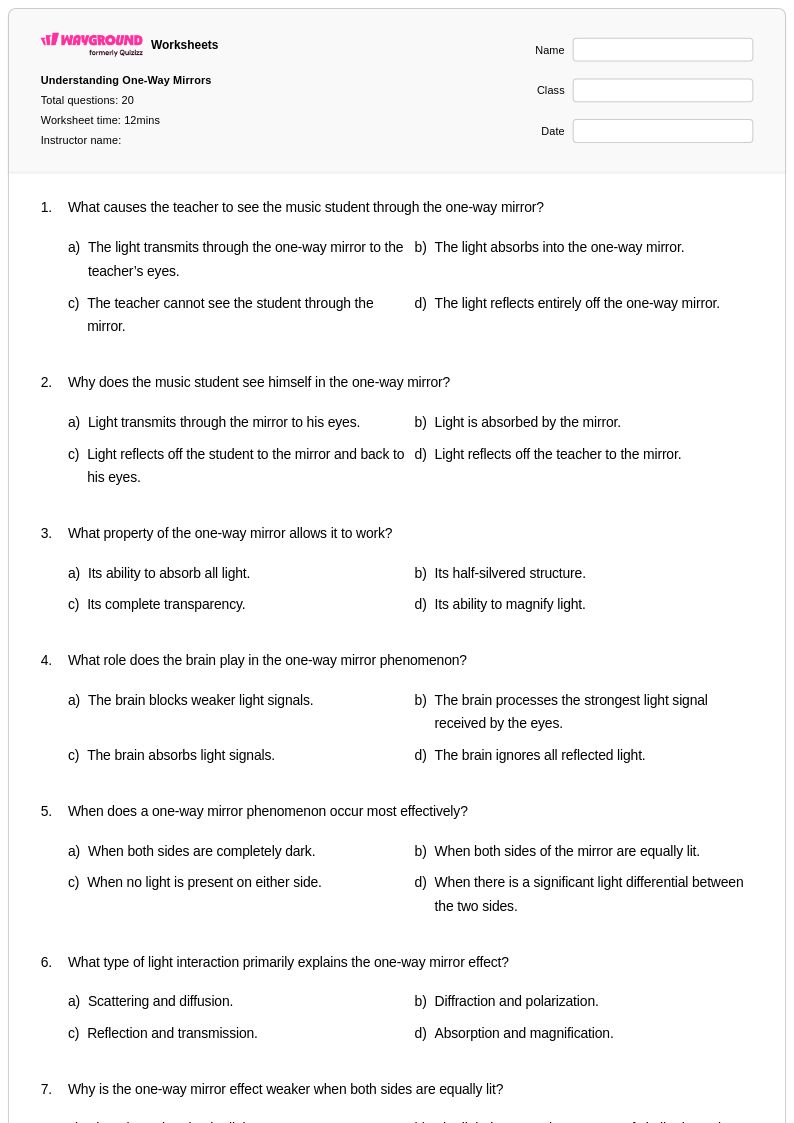
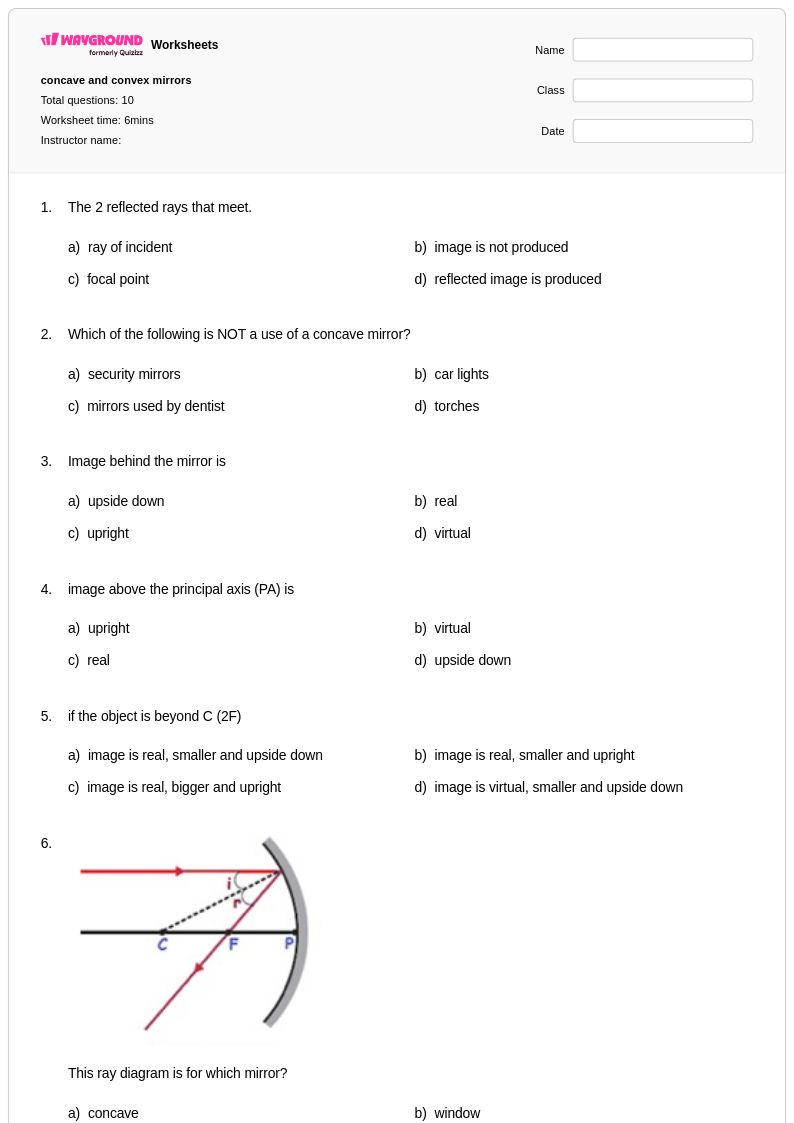
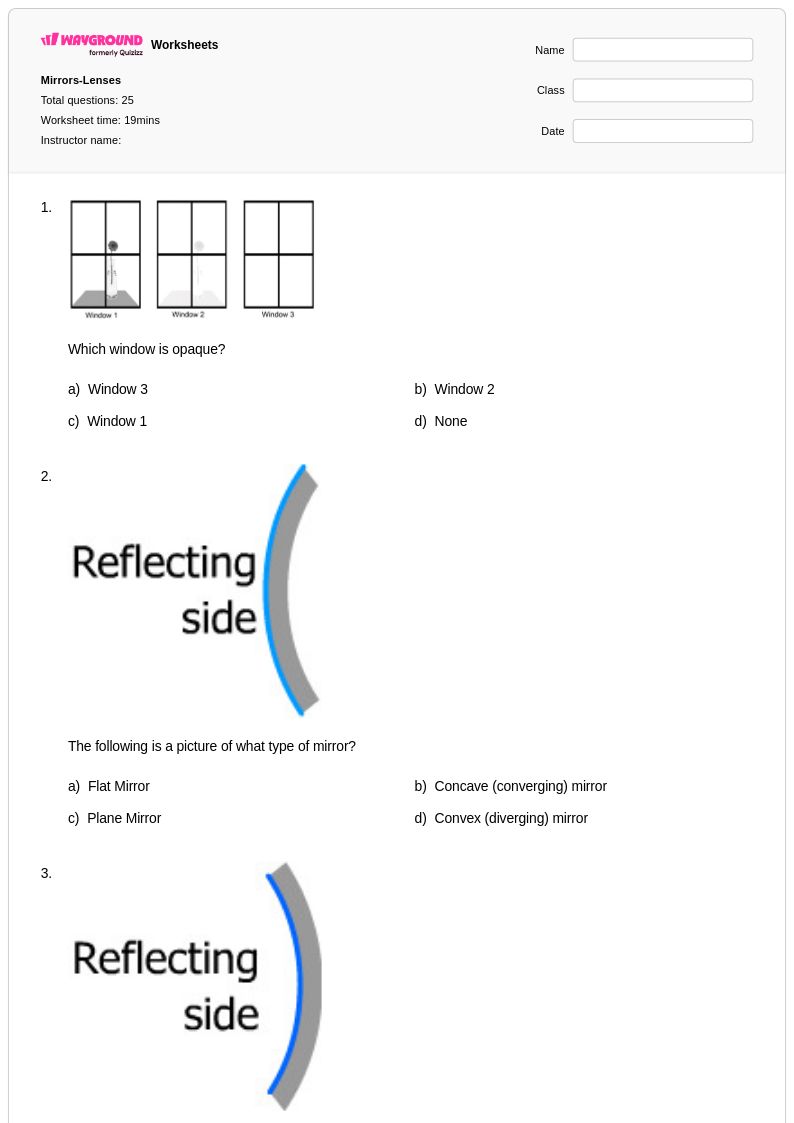
Explore Wayground's comprehensive collection of mirrors worksheets and printables that help students master reflection, image formation, and mirror types through engaging practice problems with detailed answer keys.
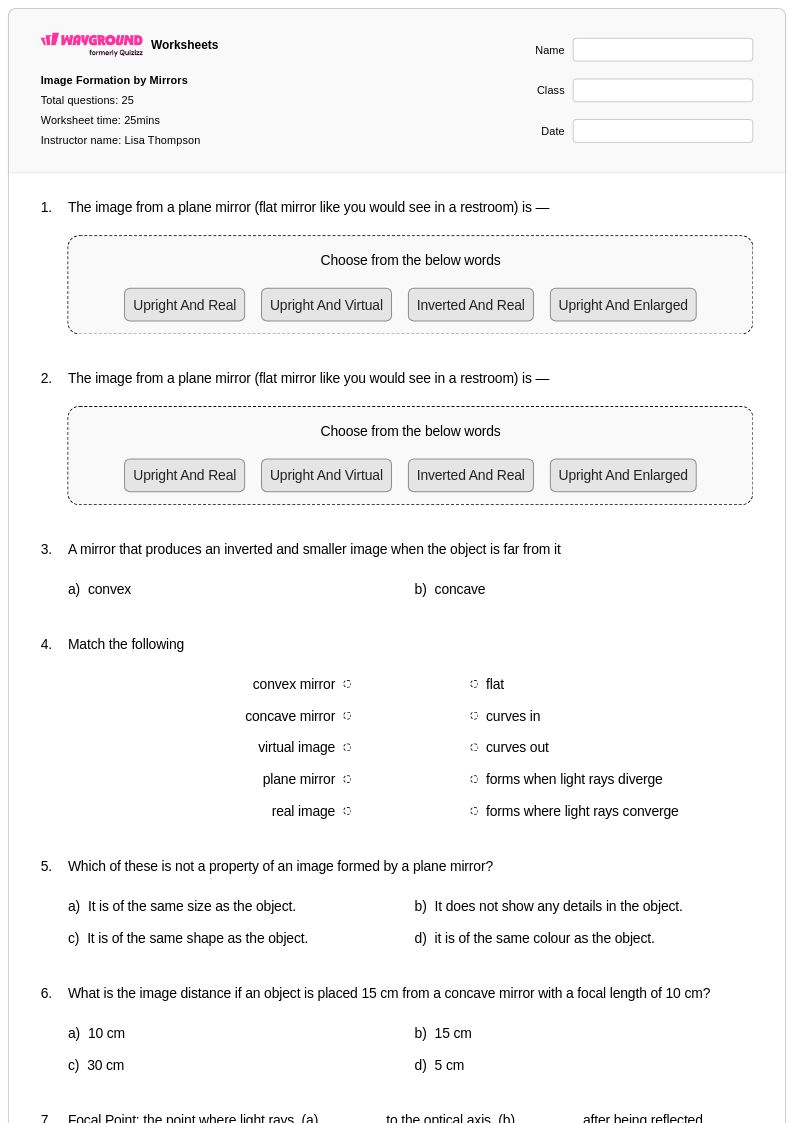
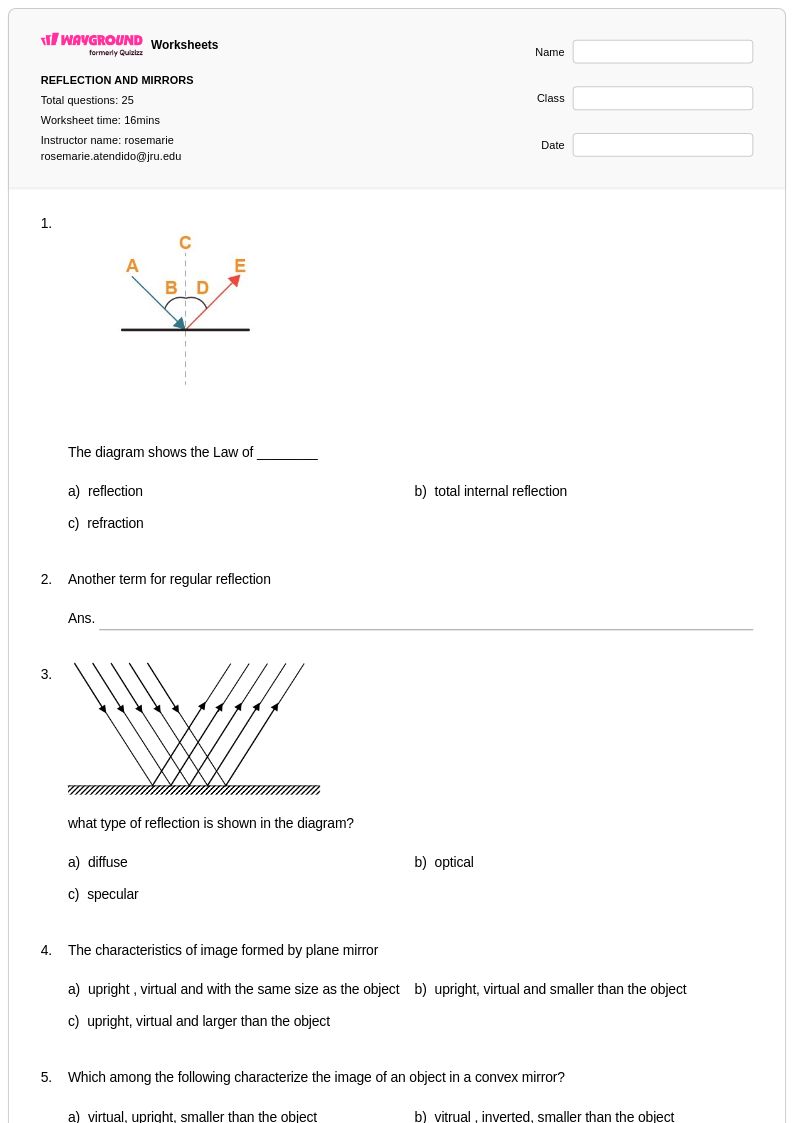
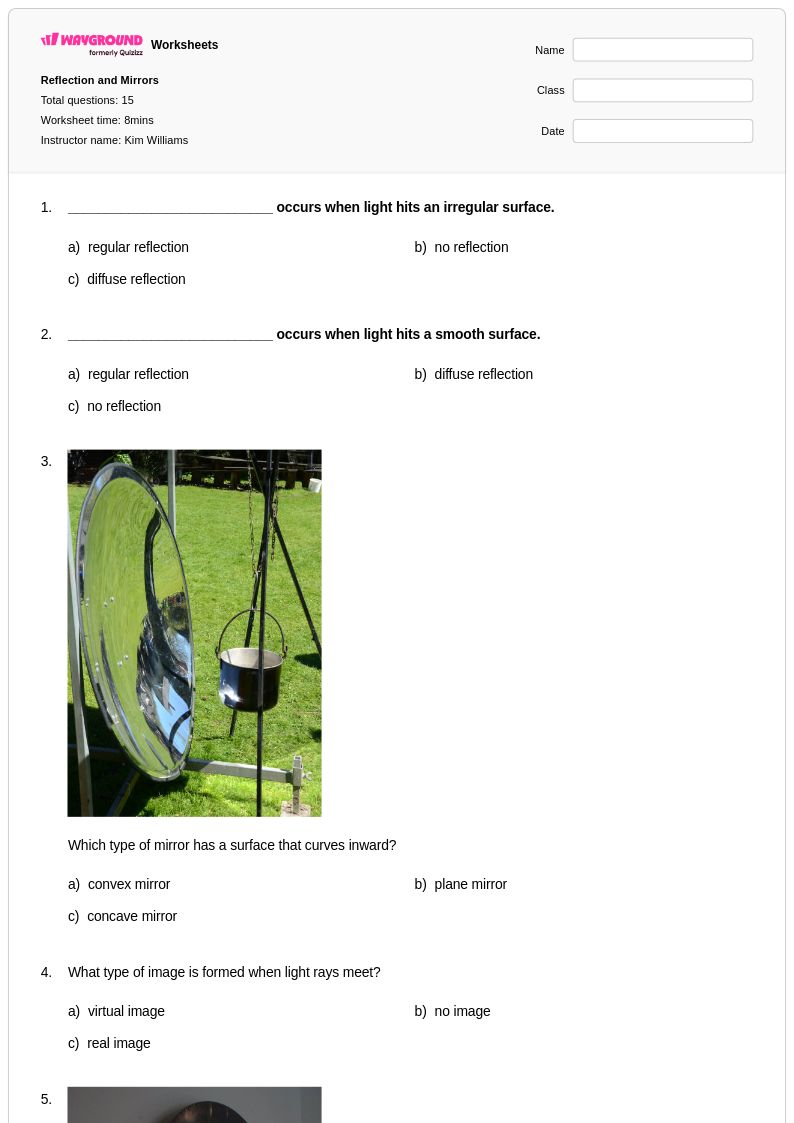
Mirrors worksheets available through Wayground (formerly Quizizz) provide comprehensive practice materials that strengthen students' understanding of reflection, image formation, and the fundamental principles governing plane, concave, and convex mirrors. These expertly designed resources help students master critical concepts including the law of reflection, ray diagrams, focal points, and the mathematical relationships between object distance, image distance, and magnification. The collection includes free printables with detailed answer keys that guide students through complex problem-solving scenarios, from determining image characteristics in plane mirrors to calculating focal lengths in curved mirrors. Each worksheet incorporates carefully structured practice problems that build conceptual understanding while developing quantitative analysis skills essential for geometric optics mastery.
Wayground (formerly Quizizz) empowers educators with millions of teacher-created mirror worksheets that support diverse classroom needs through robust search and filtering capabilities aligned with science standards. The platform's differentiation tools enable teachers to customize content difficulty levels, ensuring appropriate challenge for students across varying ability ranges, while flexible formatting options provide both printable pdf versions for traditional classroom use and digital formats for interactive learning environments. These comprehensive resources streamline lesson planning by offering ready-to-use materials for initial instruction, targeted remediation of misconceptions about reflection principles, and enrichment activities that extend learning beyond basic mirror concepts. Teachers can efficiently identify worksheets that address specific learning objectives, from fundamental reflection laws to advanced applications in optical instruments, supporting systematic skill development in geometric optics.
FAQs
How do I teach students the difference between plane, concave, and convex mirrors?
Start by grounding students in the law of reflection before introducing mirror types, since all three types obey the same reflection principle but produce different image characteristics. Use ray diagrams to show how parallel rays behave differently when striking a flat versus curved surface. Plane mirrors always produce virtual, upright, same-size images, while concave mirrors can produce real or virtual images depending on object distance, and convex mirrors always produce virtual, upright, diminished images. Connecting each mirror type to a real-world application, such as car side mirrors for convex or satellite dishes for concave, helps students anchor abstract concepts to observable phenomena.
What exercises help students practice ray diagrams for mirrors?
The most effective practice involves drawing the three principal rays (parallel to the principal axis, through the focal point, and through the center of curvature) for objects placed at varying distances from the mirror. Students should practice locating images for at least five object positions: beyond C, at C, between C and F, at F, and inside F for concave mirrors. Structured worksheets that require students to first sketch the diagram, then predict image characteristics (real or virtual, upright or inverted, magnified or diminished), and finally verify using the mirror equation reinforce both qualitative and quantitative understanding.
What mistakes do students commonly make when solving mirror equation problems?
The most frequent error is sign convention mistakes: students often assign positive values to image distances for virtual images, when the convention requires a negative sign for images formed behind the mirror. A second common error is confusing focal length with radius of curvature, leading to calculation errors since f = R/2. Students also frequently misinterpret magnification: a negative magnification value means the image is inverted, not that it is smaller, and students conflate sign with size. Targeted practice problems that isolate each variable and require students to state sign conventions explicitly before solving help reduce these errors.
How can I use mirrors worksheets to identify and address student misconceptions about reflection?
Diagnostic worksheets that ask students to predict image location before drawing ray diagrams are effective at surfacing misconceptions, particularly the belief that a concave mirror always magnifies or that moving closer to a plane mirror makes the image larger. After students complete prediction tasks, comparing their predictions against completed ray diagrams creates a natural error-analysis moment. Focusing remediation on the conceptual logic of each ray rule, rather than rote memorization, helps students self-correct because they can reconstruct the reasoning rather than recall a memorized result.
How do I use Wayground's mirrors worksheets in my classroom?
Wayground's mirrors worksheets are available as printable PDFs for traditional classroom use and in digital formats for technology-integrated learning environments, so they can be distributed however your classroom is set up. You can also host any worksheet as a live quiz on Wayground, which allows you to monitor student responses in real time and identify which concepts need reteaching. The worksheets include detailed answer keys, making them practical for independent practice, homework, or formative assessment without additional prep time.
How do I support students with different ability levels when teaching mirrors and geometric optics?
Differentiating mirrors instruction typically means separating qualitative tasks (describing image characteristics from a ray diagram) from quantitative tasks (applying the mirror equation) so students build conceptual understanding before numerical fluency. For students who need additional support, Wayground's digital format includes accommodation options such as read aloud for question text, reduced answer choices to lower cognitive load, and extended time settings that can be configured individually without affecting other students' experience. For advanced students, enrichment problems involving compound mirror systems or applications in optical instruments extend learning beyond standard curriculum expectations.