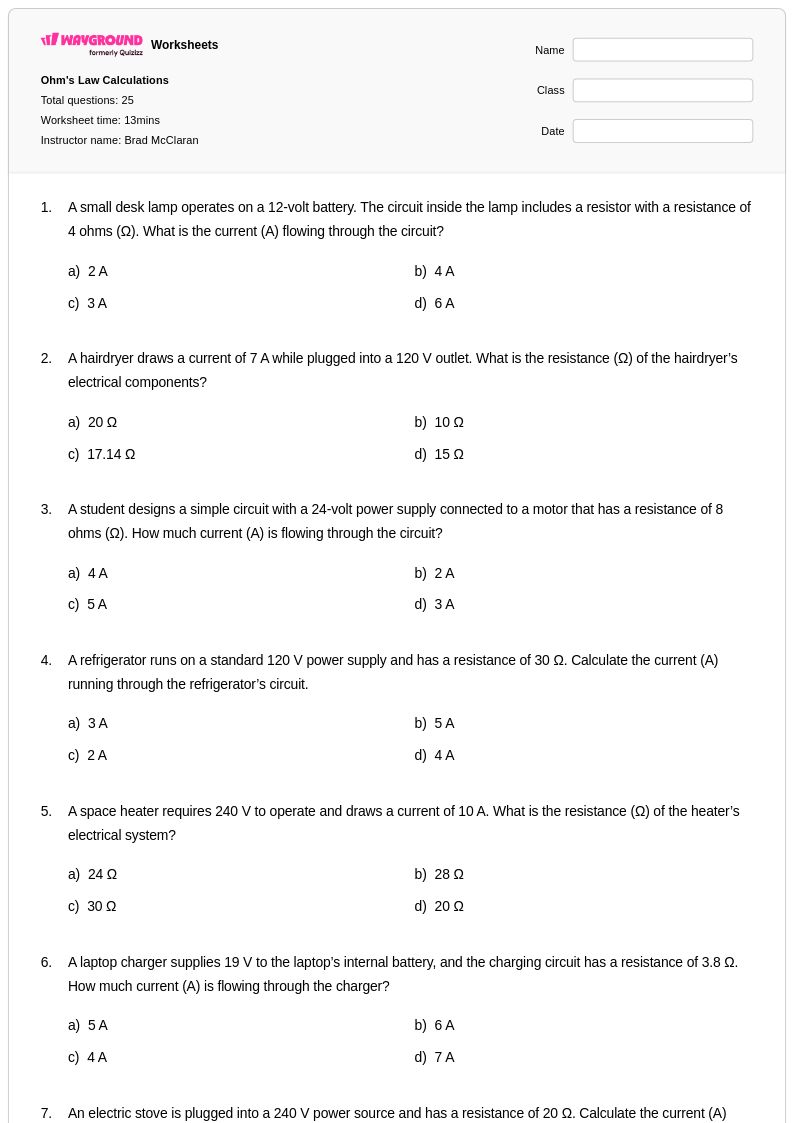
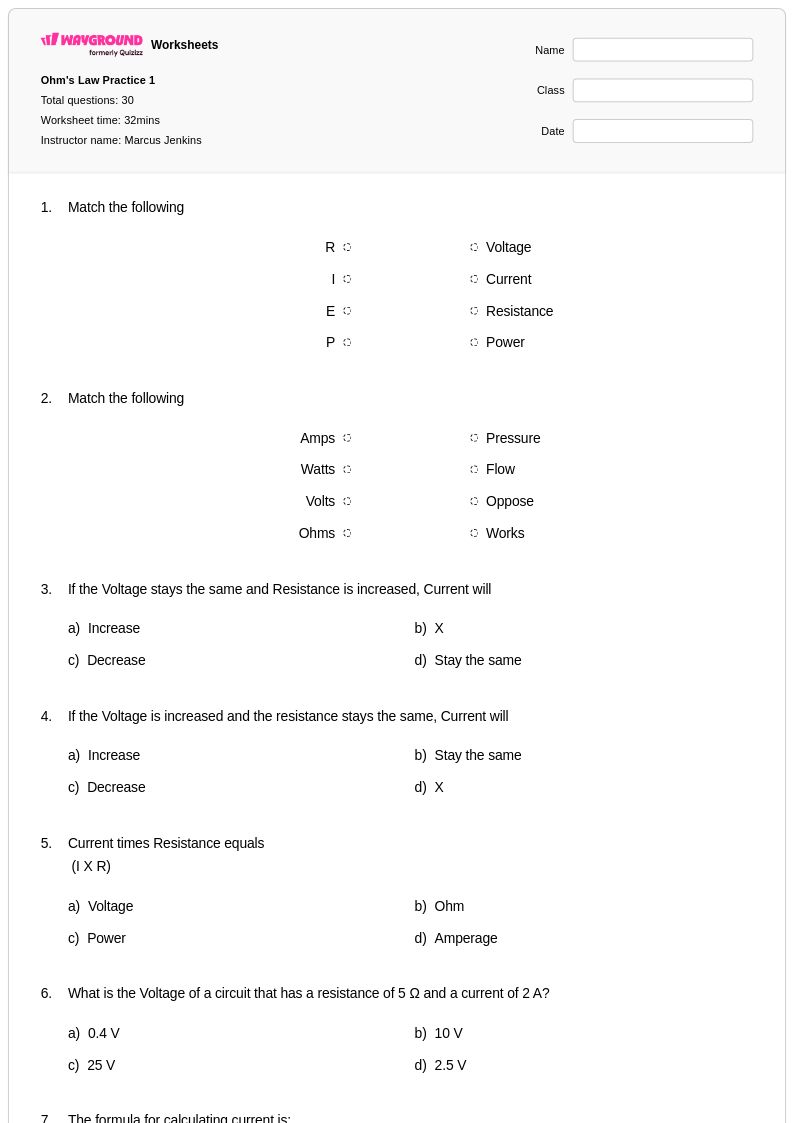
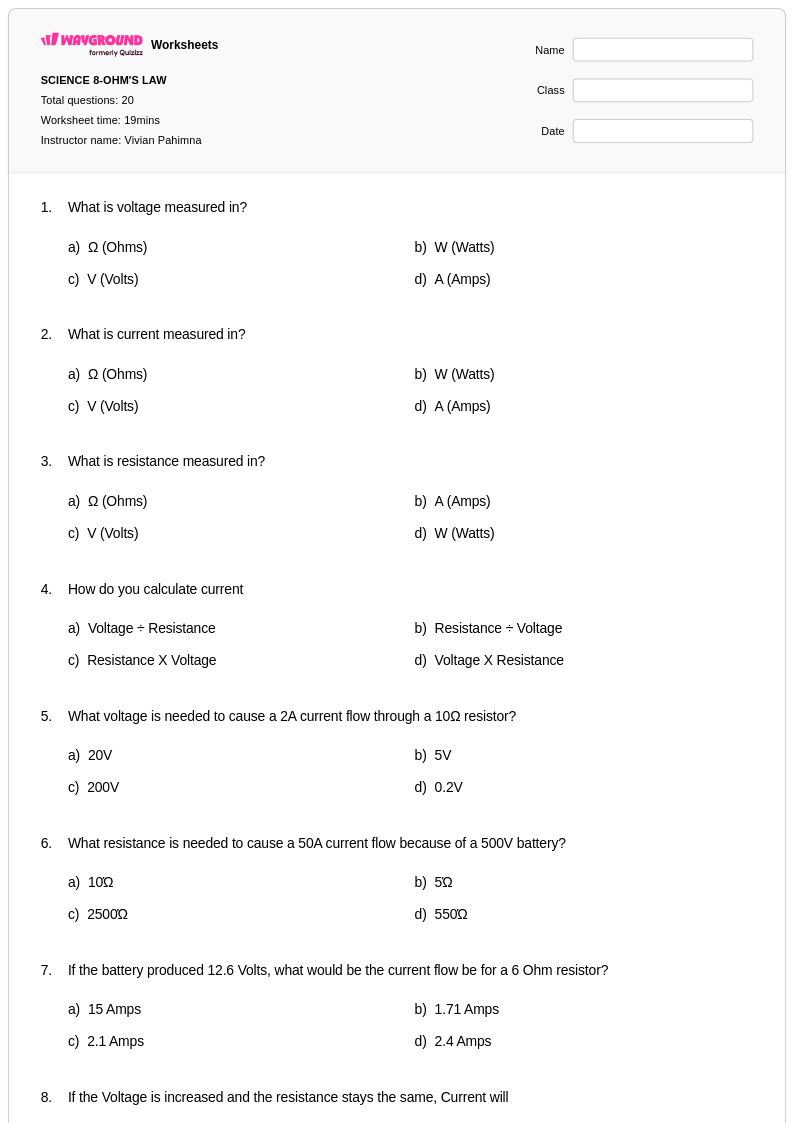
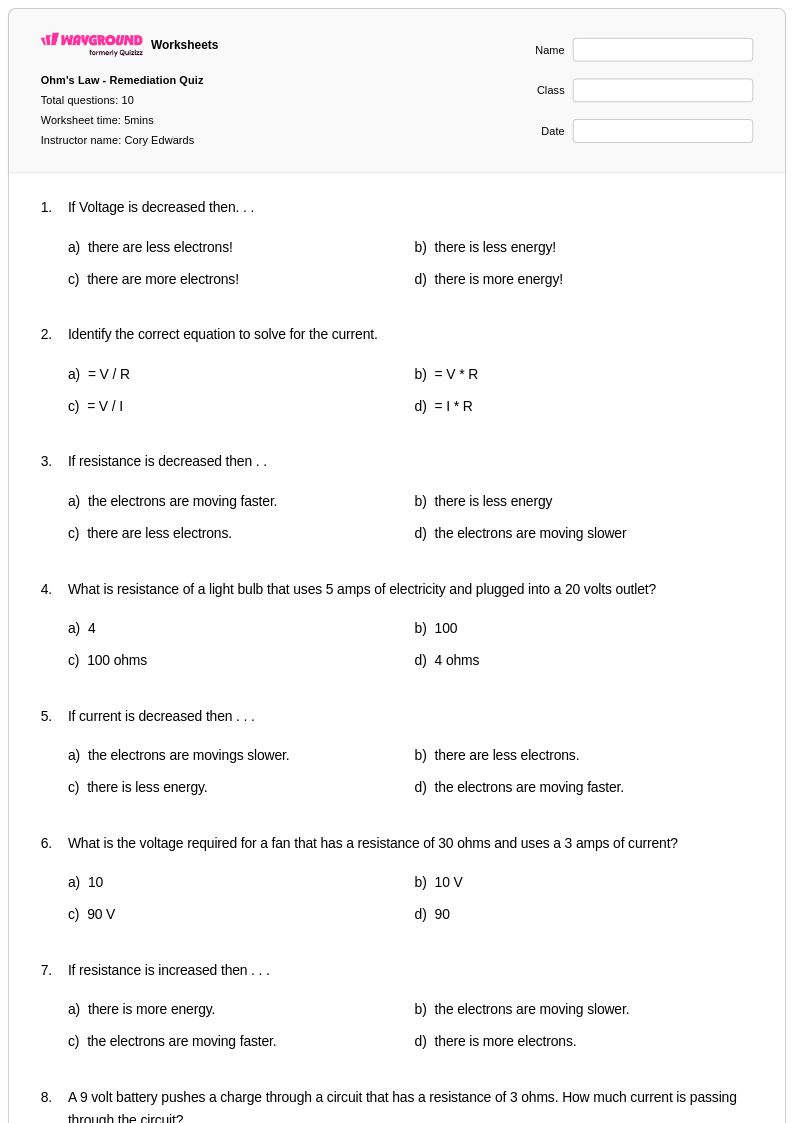
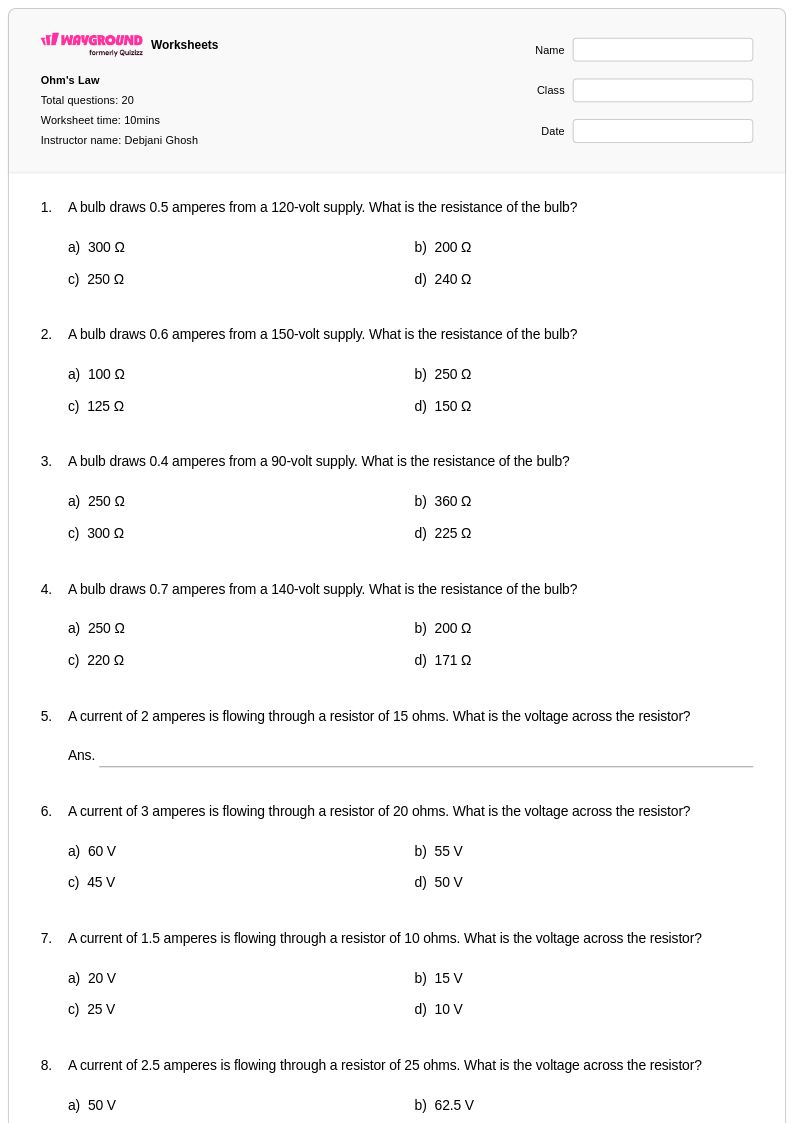
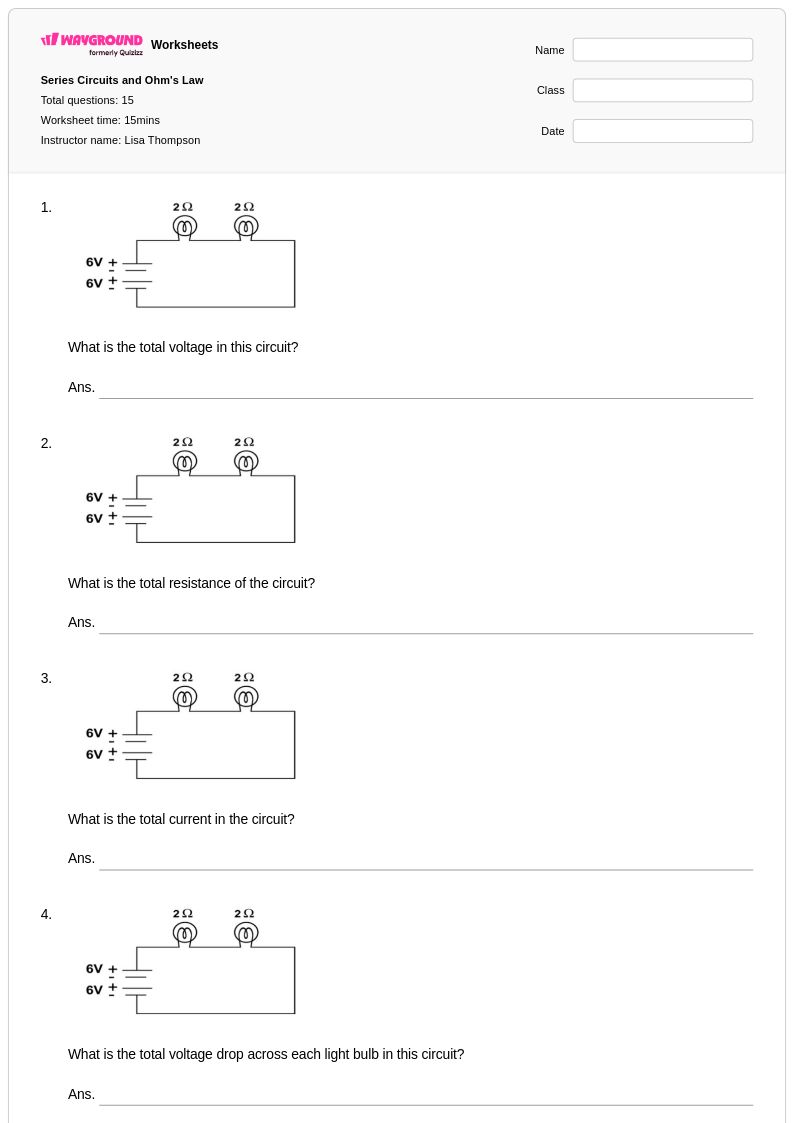
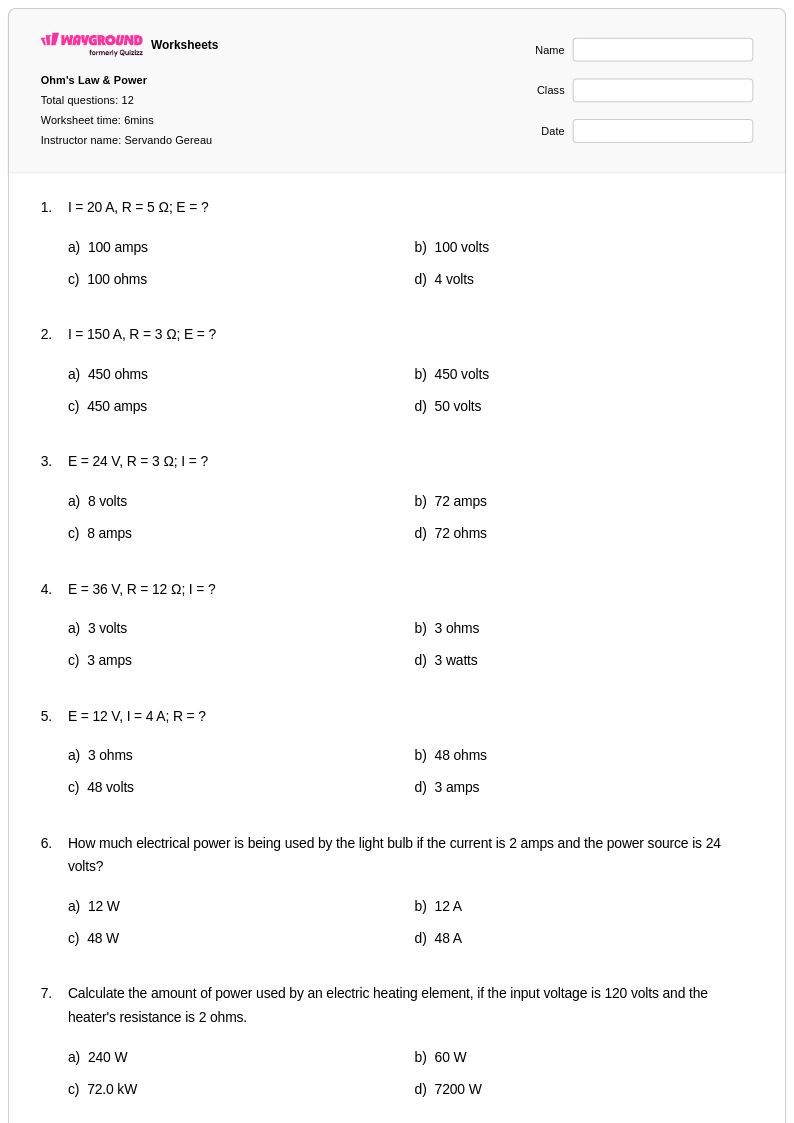
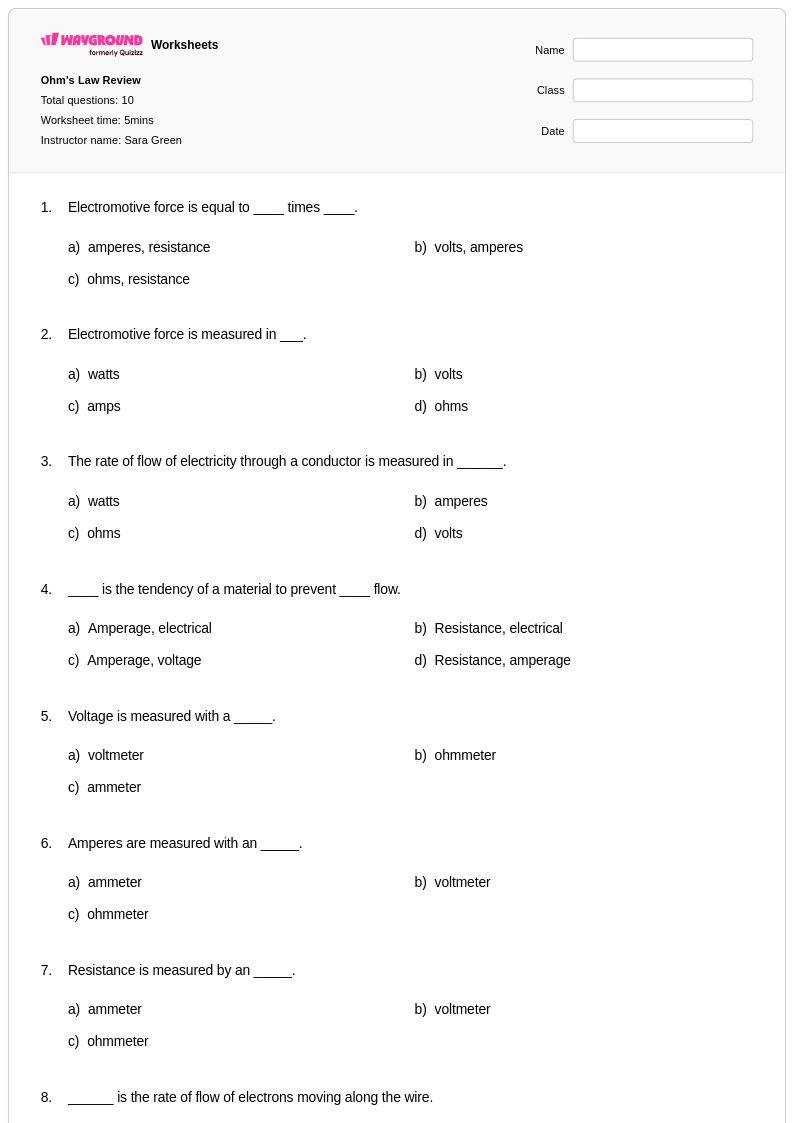
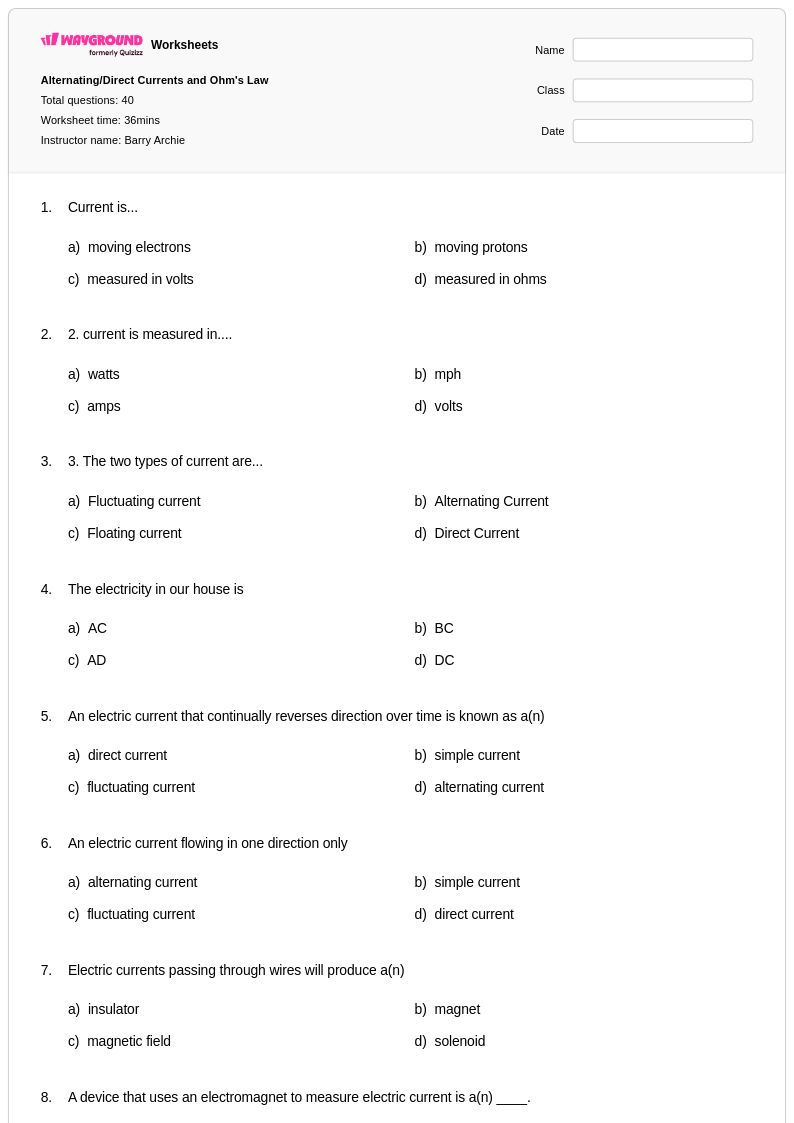
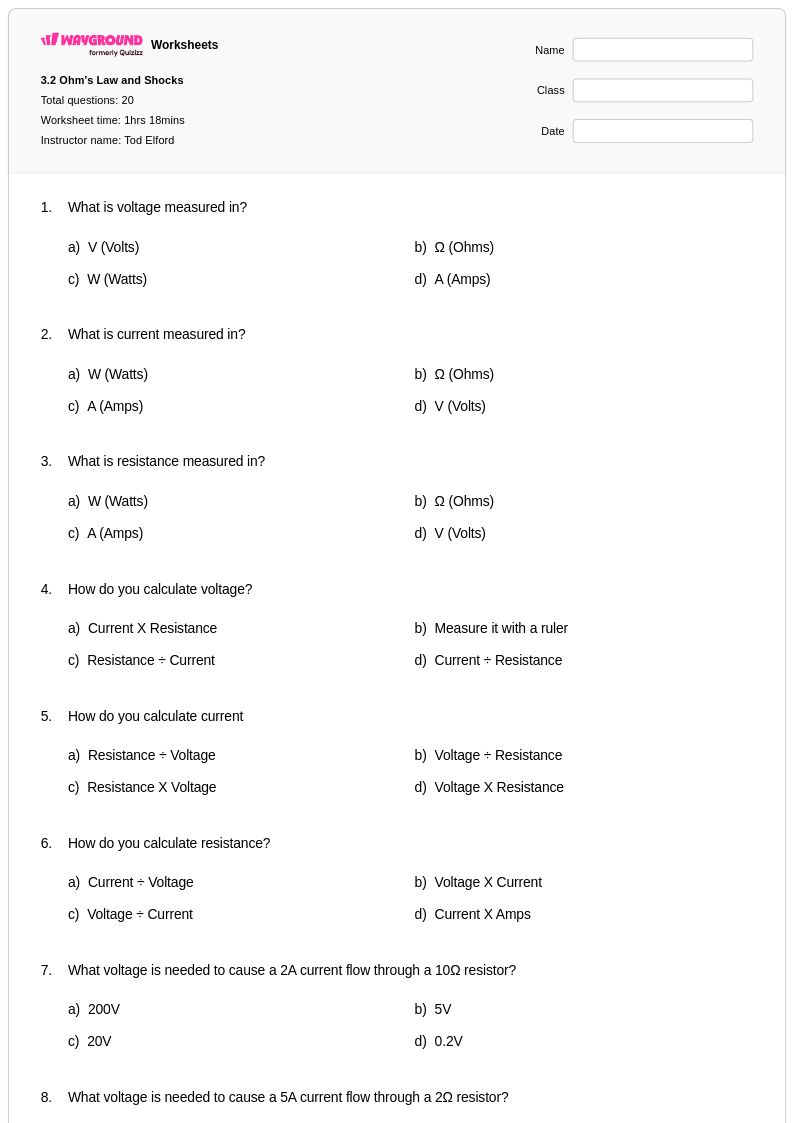
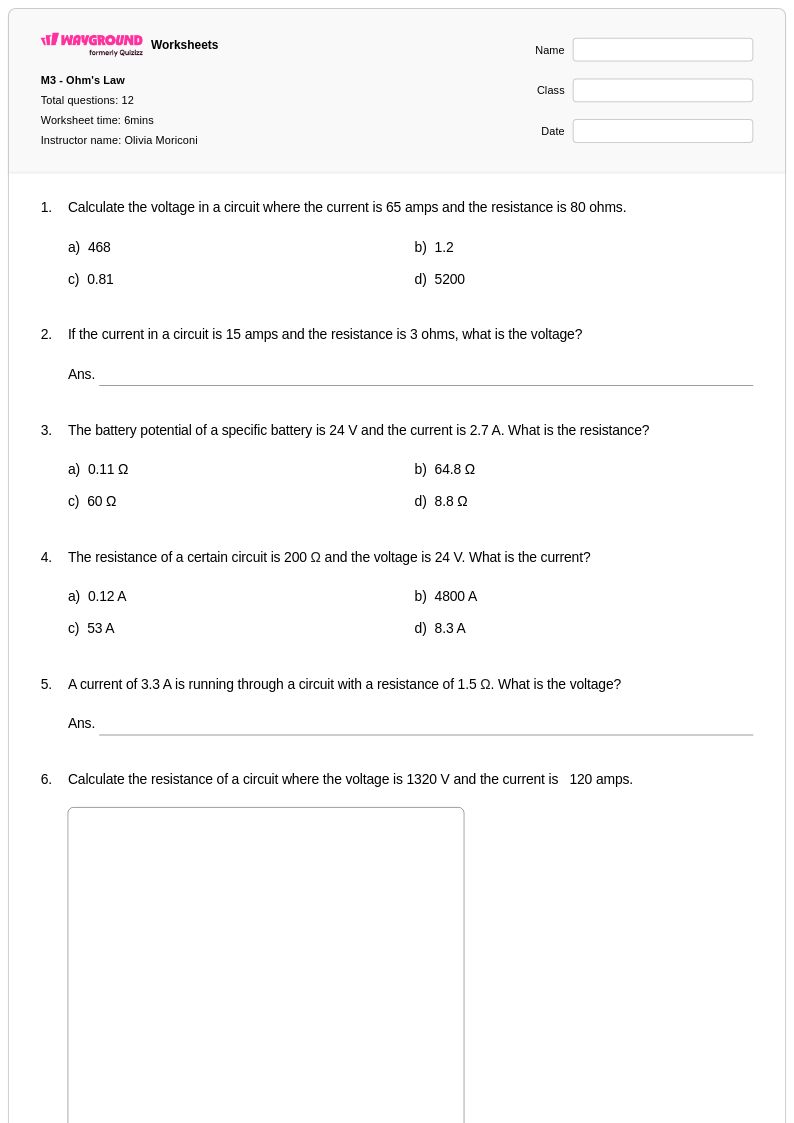
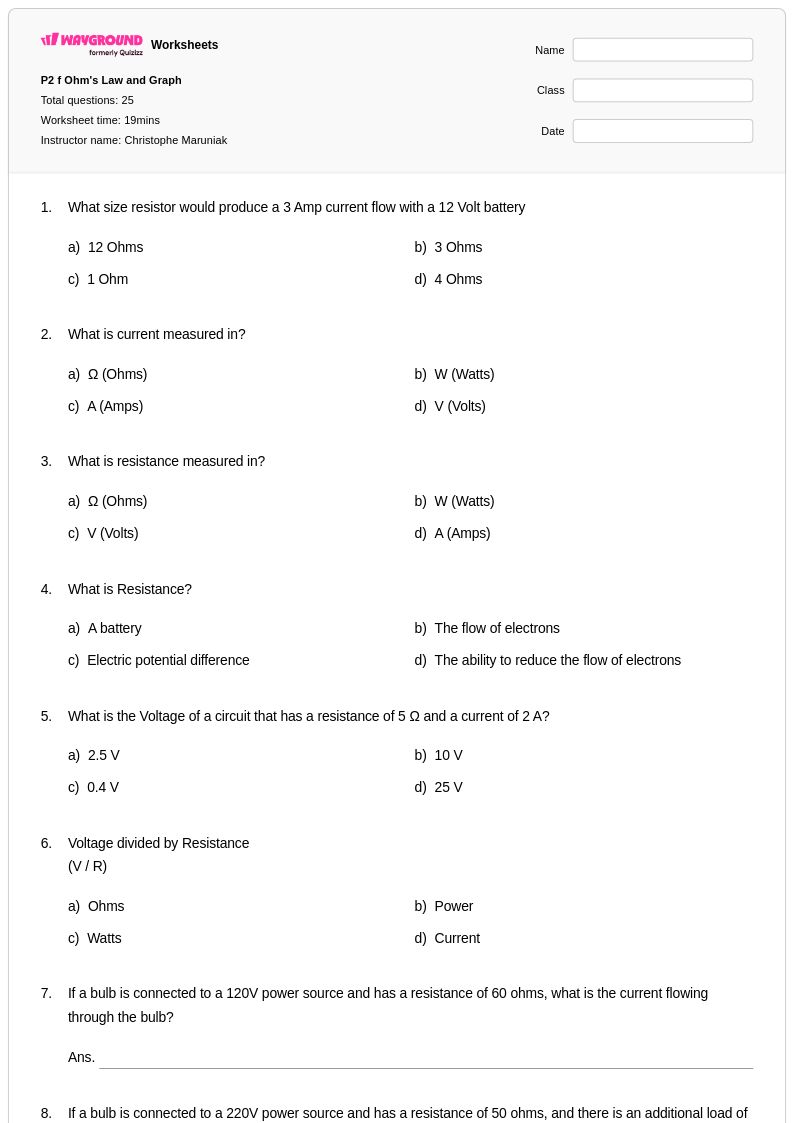
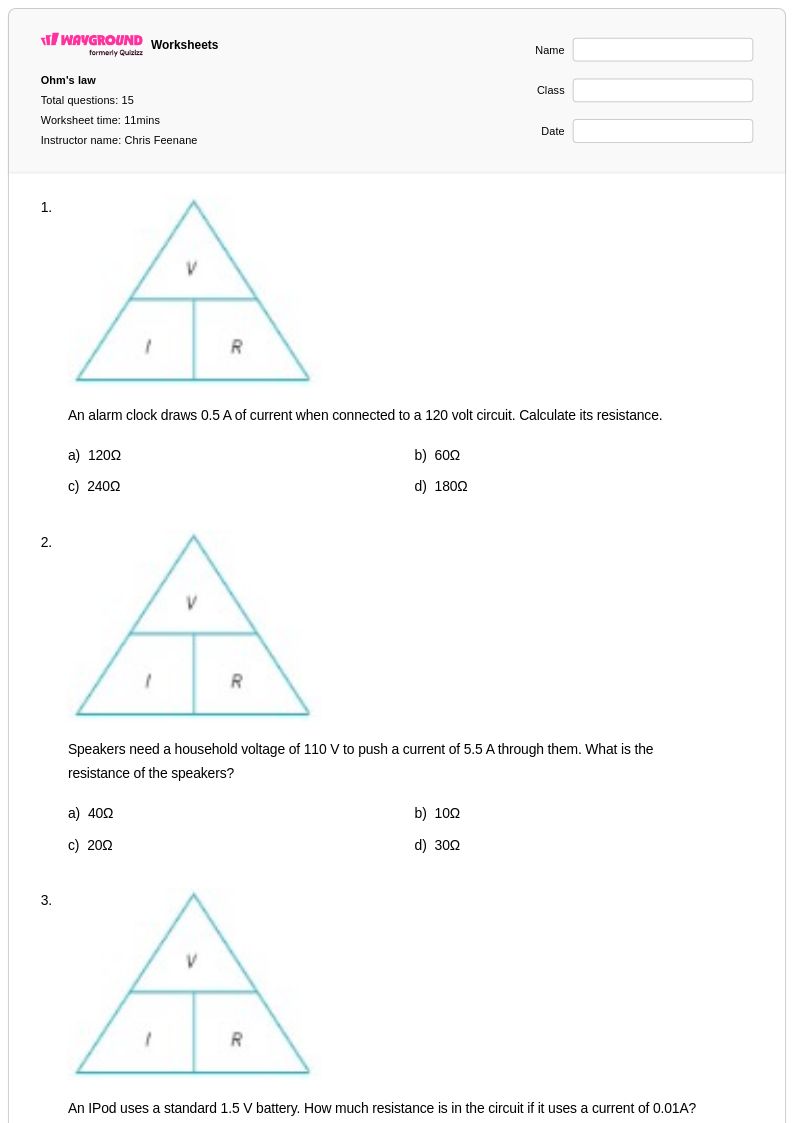
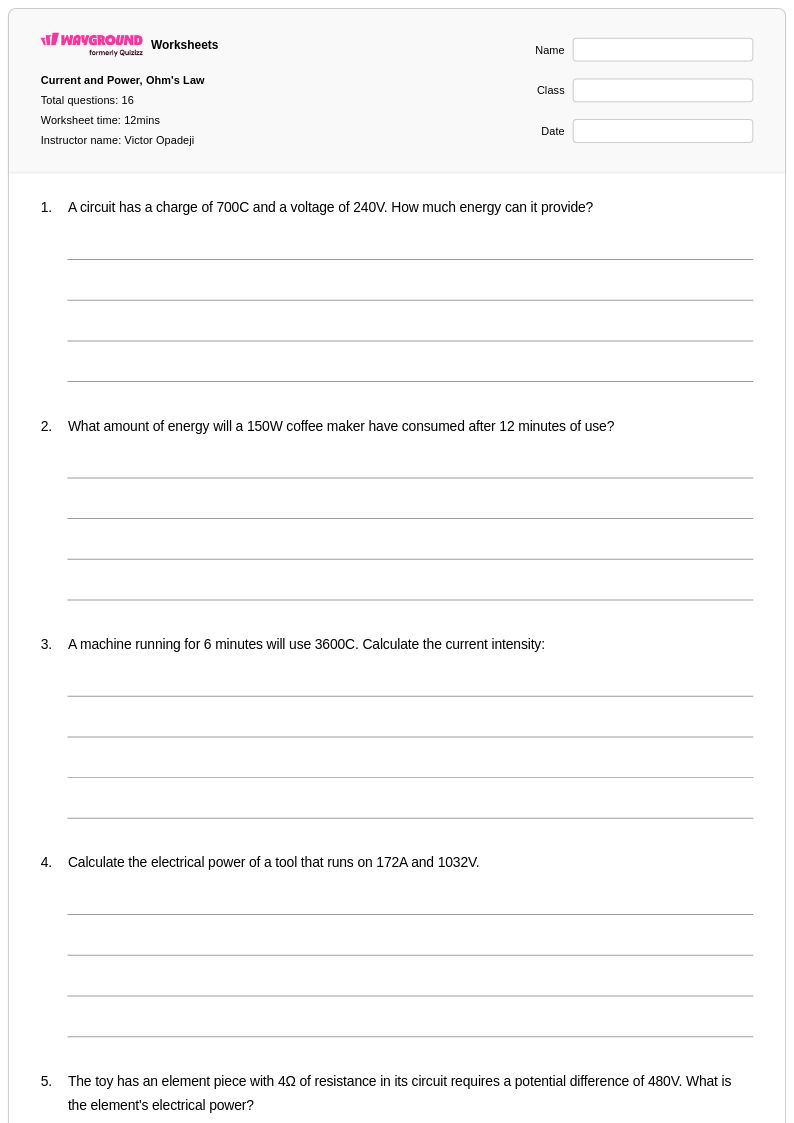
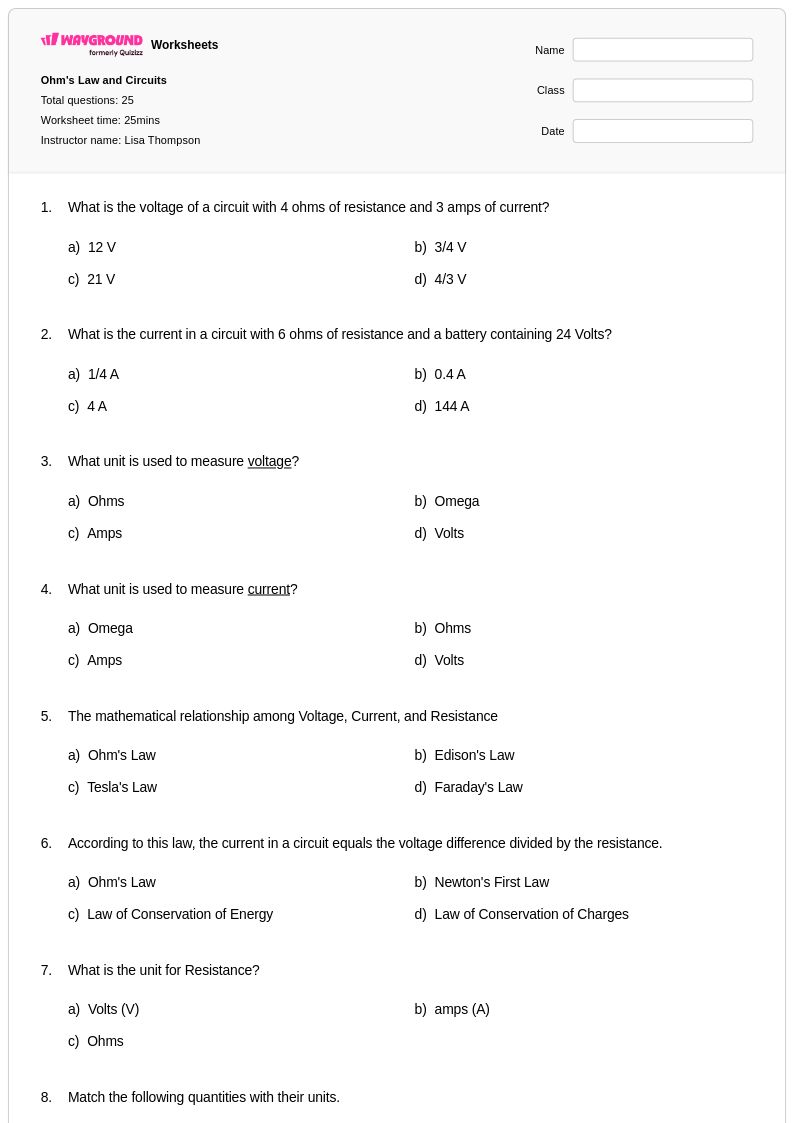
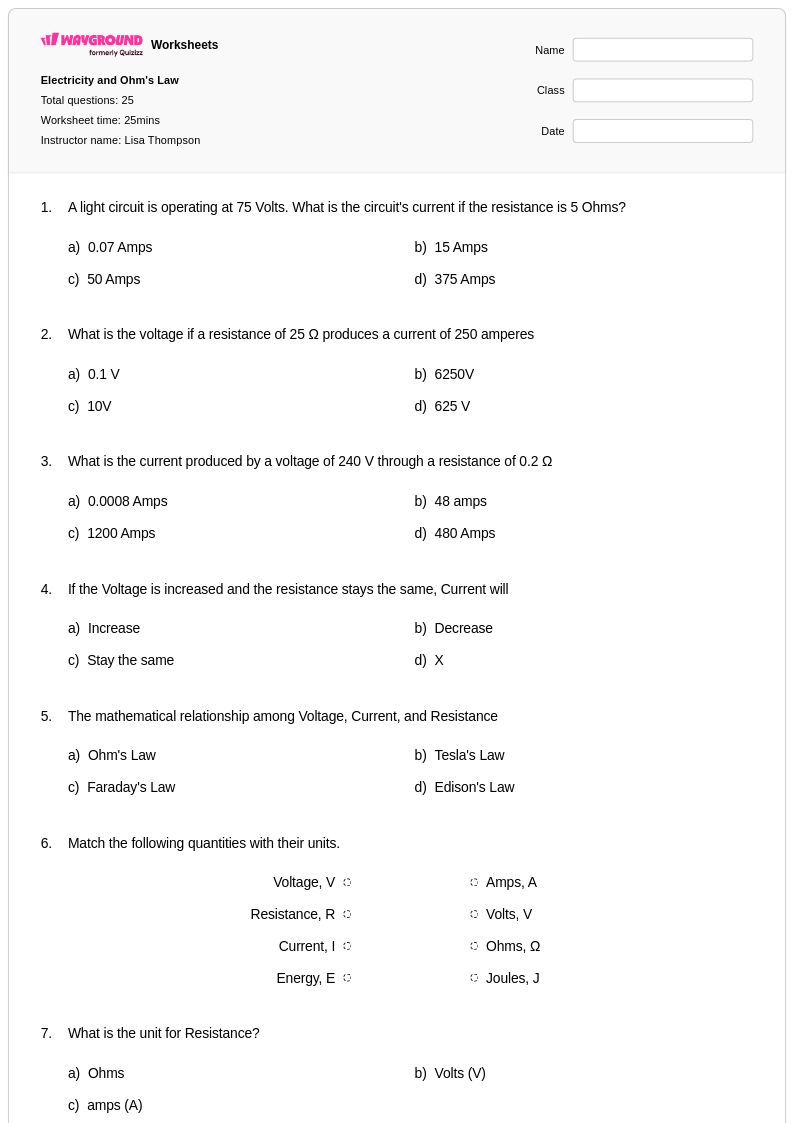
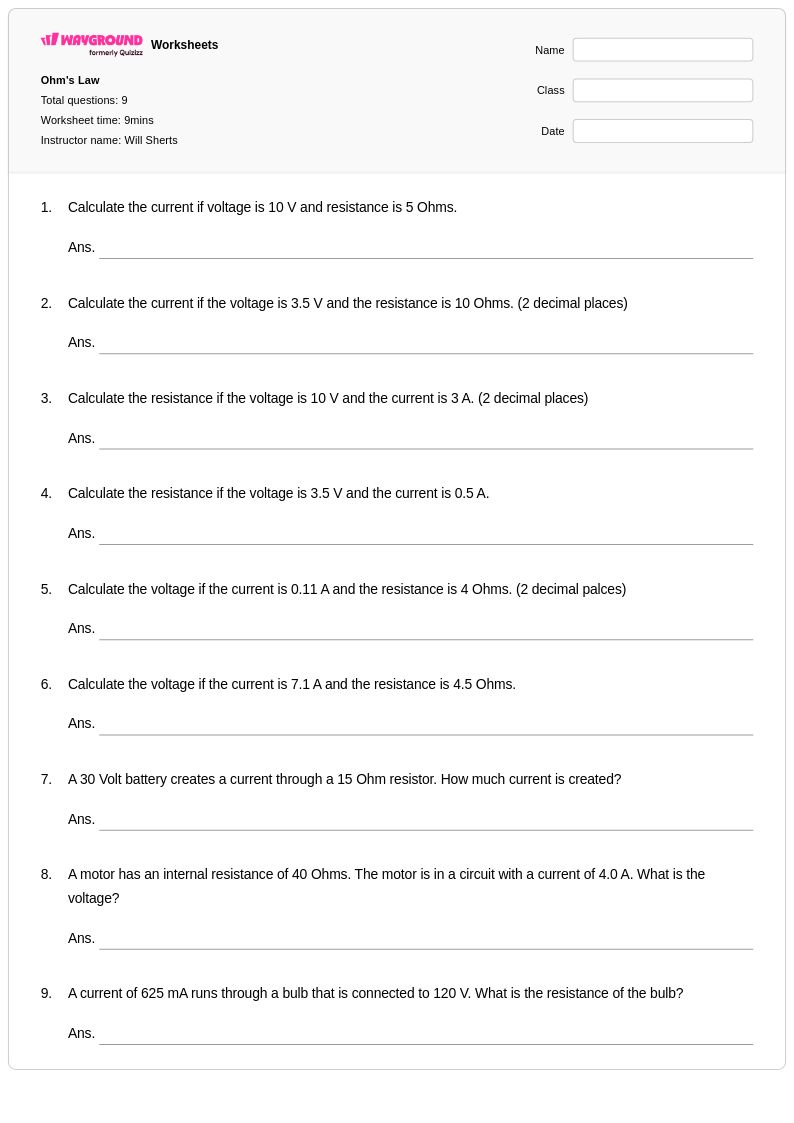
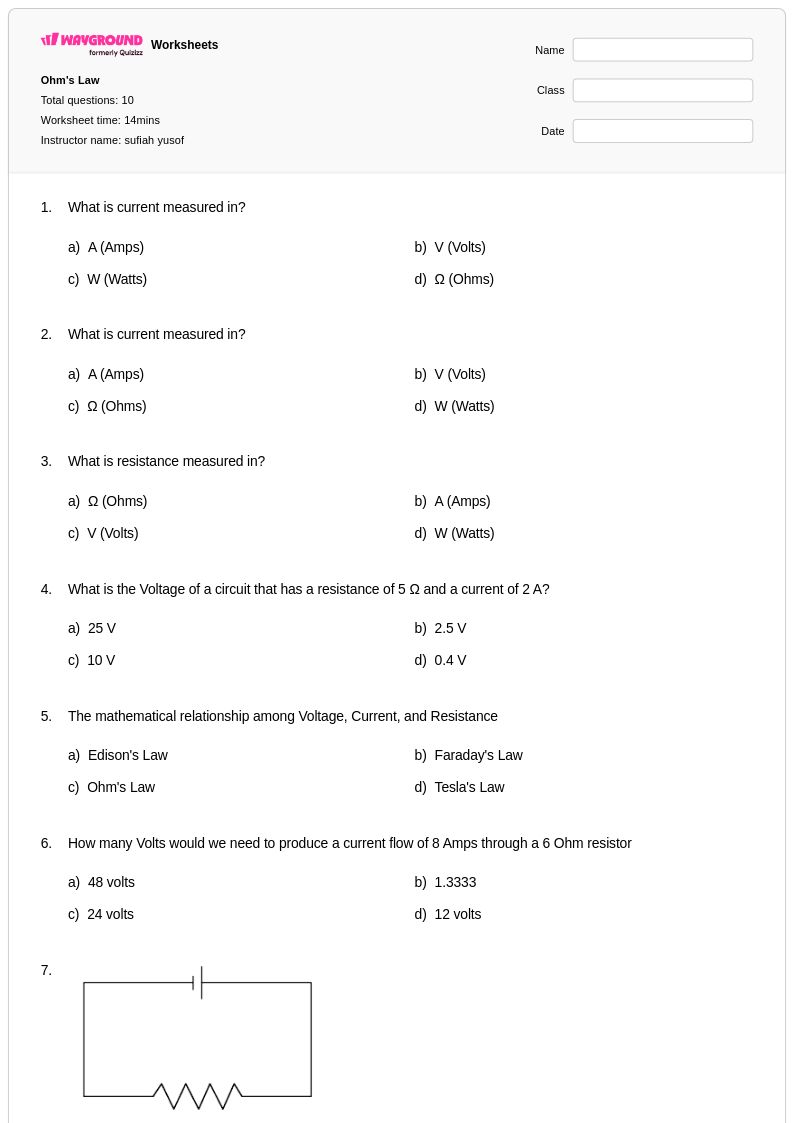
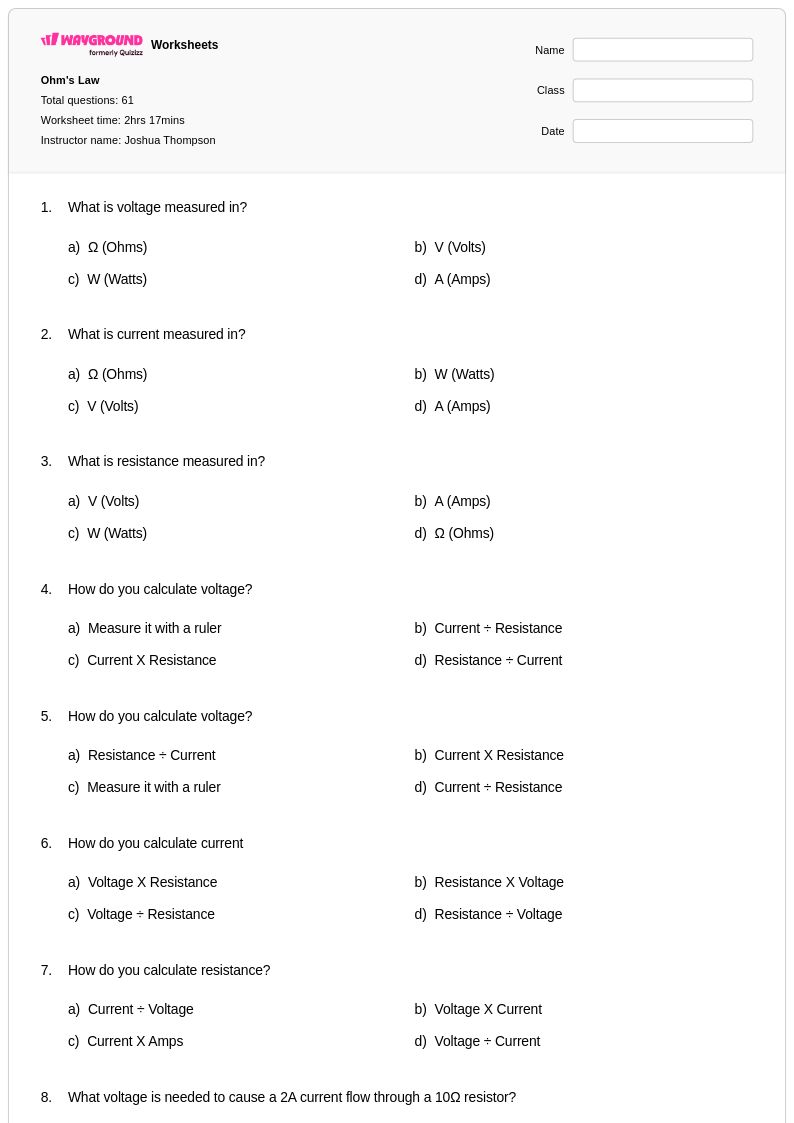
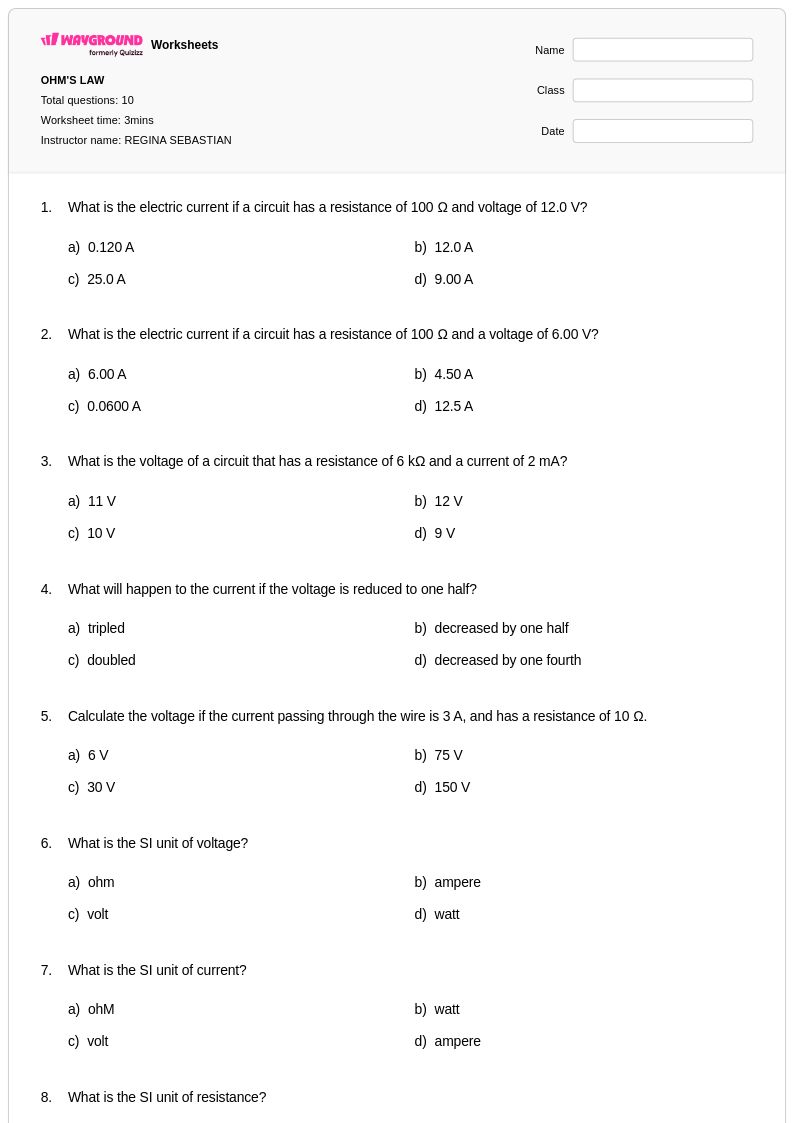
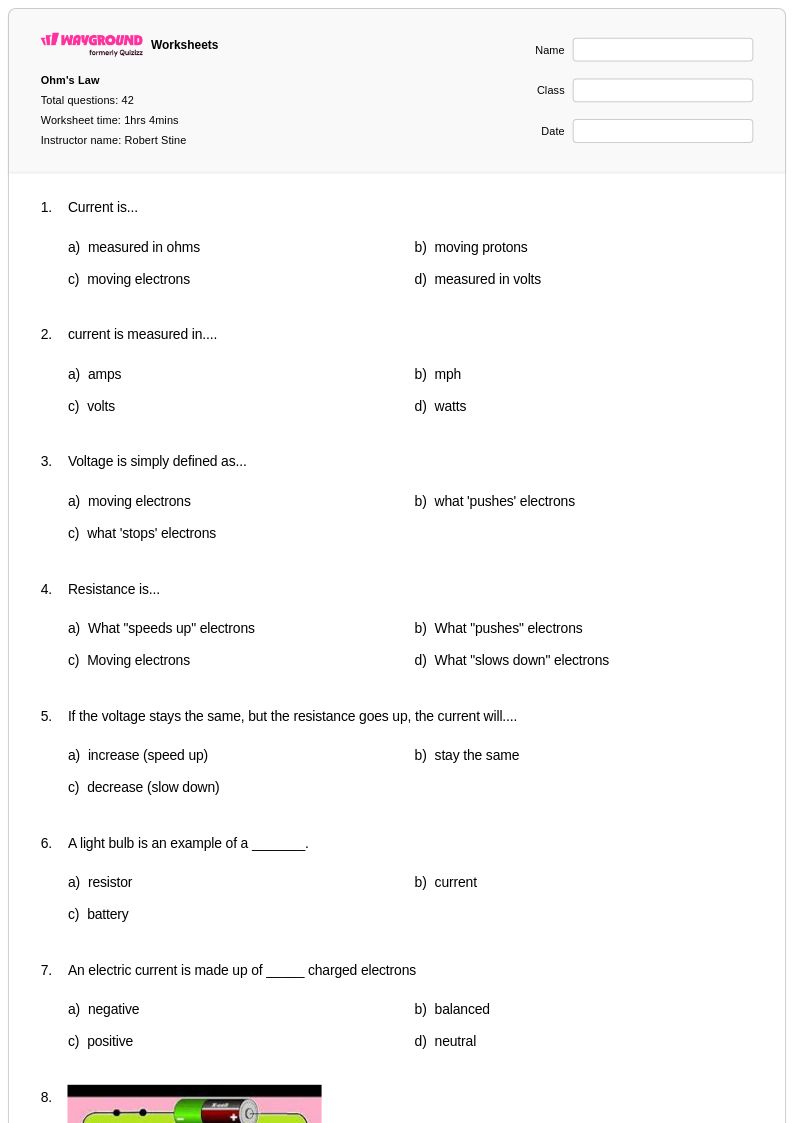
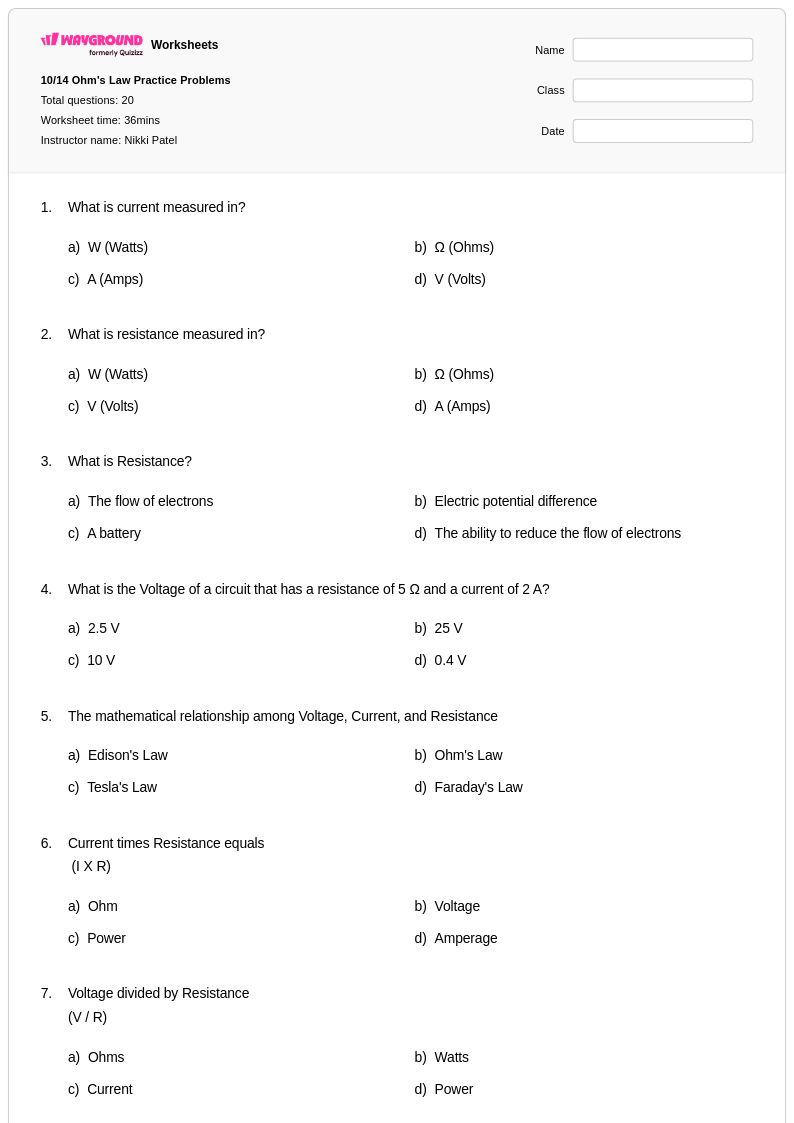
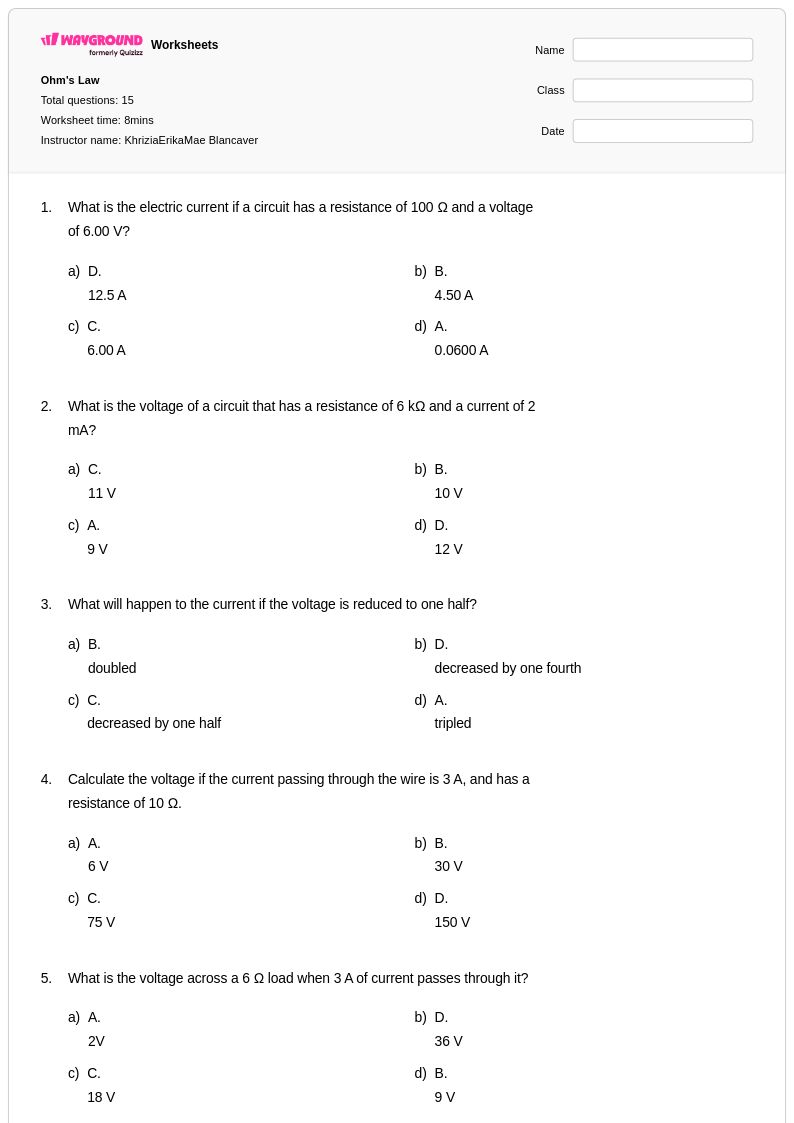
Master Ohm's Law with Wayground's comprehensive collection of free physics worksheets, featuring printable PDFs with practice problems and answer keys to help students understand voltage, current, and resistance relationships.
Ohm's Law worksheets available through Wayground (formerly Quizizz) provide students with comprehensive practice in understanding the fundamental relationship between voltage, current, and resistance in electrical circuits. These expertly designed resources strengthen critical physics skills including calculating unknown variables using the V=IR formula, analyzing circuit diagrams, and applying mathematical reasoning to real-world electrical scenarios. Students work through systematic practice problems that build confidence in manipulating the Ohm's Law equation, interpreting electrical measurements, and understanding how changes in one variable affect the others. Each worksheet collection includes detailed answer keys and is available as free printables in convenient pdf format, allowing educators to seamlessly integrate hands-on problem-solving into their physics curriculum while reinforcing essential quantitative analysis skills.
Wayground (formerly Quizizz) empowers educators with access to millions of teacher-created Ohm's Law worksheet resources that feature robust search and filtering capabilities to locate materials perfectly suited to specific learning objectives and standards alignment requirements. The platform's differentiation tools enable teachers to customize worksheets for varying skill levels, while flexible formatting options provide both printable pdf versions and interactive digital formats to accommodate diverse classroom environments. These comprehensive collections support instructional planning by offering scaffolded practice sequences, targeted remediation materials for students struggling with electrical circuit concepts, and enrichment activities that challenge advanced learners to apply Ohm's Law in complex scenarios. Teachers can efficiently organize skill-building practice sessions, create formative assessments, and develop supplementary materials that reinforce the mathematical foundations essential for success in advanced physics coursework.
FAQs
How do I teach Ohm's Law to students who struggle with the math?
Start by building the conceptual relationship before introducing the formula: voltage is the push, current is the flow, and resistance is what opposes it. Once students understand the proportional relationships intuitively, introduce V=IR as a tool to quantify what they already understand. From there, use a triangle diagram (V on top, I and R on the bottom) to help students isolate the unknown variable before they attempt any calculation. Scaffolded practice problems that begin with whole numbers and gradually introduce decimals and unit conversions help students build procedural confidence alongside conceptual understanding.
What practice problems are most effective for reinforcing Ohm's Law?
The most effective Ohm's Law practice moves through three stages: solving for each of the three variables in isolation, interpreting circuit diagrams to identify the given values, and applying the formula to real-world scenarios such as household appliances or automotive systems. Problems that ask students to predict what happens to current when resistance doubles reinforce proportional reasoning rather than rote calculation. Including problems with unit conversions (milliamps to amps, kilohms to ohms) also prepares students for the variety of formats they will encounter on assessments.
What mistakes do students commonly make when applying Ohm's Law?
The most frequent error is unit inconsistency: students mix milliamps with amps or kilohms with ohms without converting first, which produces answers that are off by a factor of 1,000. A second common mistake is misidentifying which variable is unknown, particularly when problems present information in non-standard order. Students also frequently invert the relationship between resistance and current, incorrectly assuming that higher resistance means higher current. Targeted practice that isolates each of these error types, with immediate feedback from an answer key, helps students recognize and self-correct these patterns.
How can I differentiate Ohm's Law instruction for students at different skill levels?
For struggling students, begin with single-step problems where only one variable is unknown and all values use clean whole numbers, then introduce visual supports like labeled circuit diagrams. On-level students can work through multi-step problems that require unit conversion or apply Ohm's Law to series and parallel circuit contexts. Advanced learners benefit from open-ended scenarios where they must determine which variable to solve for based on a real-world constraint. On Wayground, teachers can assign accommodations such as reduced answer choices or read-aloud support to individual students, ensuring each learner engages with the material at the appropriate level of challenge.
How do I use Ohm's Law worksheets from Wayground in my classroom?
Wayground's Ohm's Law worksheets are available as printable PDFs for traditional classroom use and in digital formats for technology-integrated environments, including the option to host them as a quiz directly on the Wayground platform. Printable versions work well for guided practice, homework, or in-class problem sets where students show their work step by step. Digital formats allow teachers to assign practice remotely, track completion, and apply student-level accommodations such as extended time or read-aloud support. Each worksheet includes a complete answer key, making them practical for both independent student work and teacher-led review sessions.