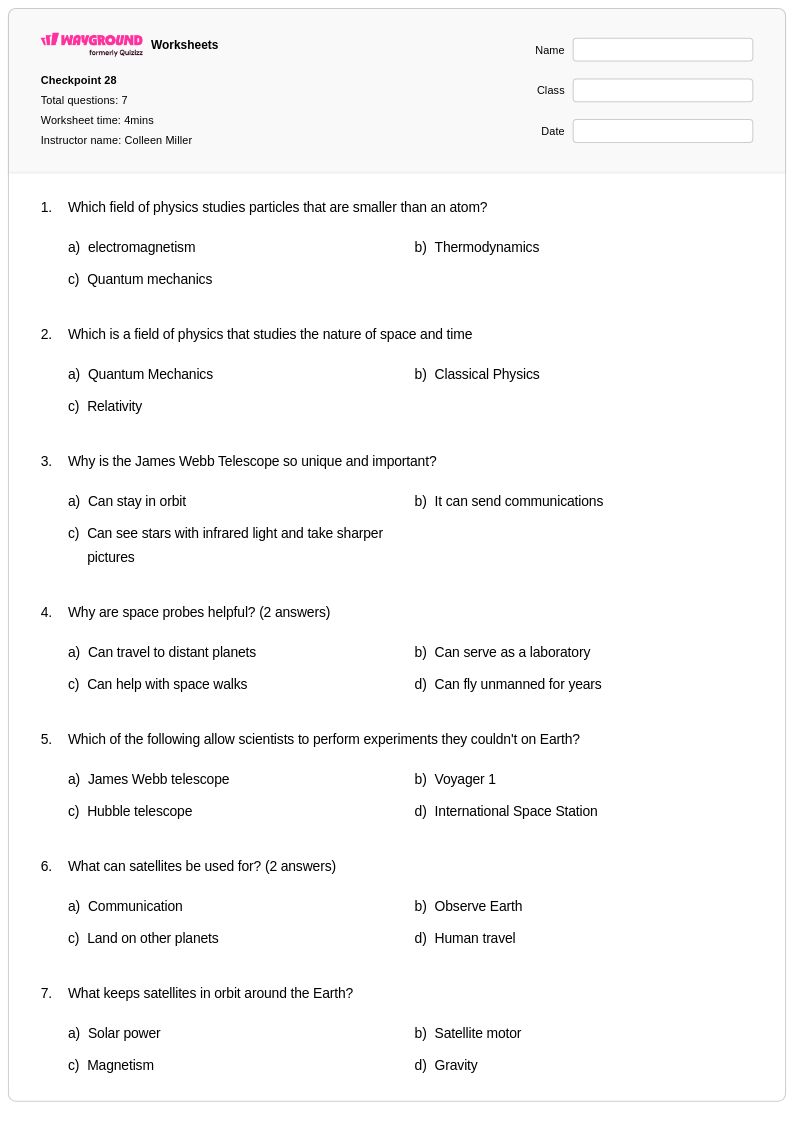
Explore Wayground's free quantum physics worksheets and printables featuring practice problems on wave-particle duality, uncertainty principles, and quantum mechanics fundamentals, complete with detailed answer keys for comprehensive learning.
Quantum physics worksheets available through Wayground (formerly Quizizz) provide comprehensive coverage of the fundamental principles that govern matter and energy at the subatomic level. These expertly designed resources help students master complex concepts including wave-particle duality, quantum superposition, Heisenberg's uncertainty principle, and quantum entanglement through structured practice problems that build conceptual understanding progressively. Each worksheet collection includes detailed answer keys and explanations that guide students through the mathematical formulations and theoretical frameworks essential to quantum mechanics. Available as free printables and interactive digital resources, these materials strengthen critical thinking skills while developing students' ability to apply quantum mechanical principles to solve real-world problems in atomic and molecular physics.
Wayground (formerly Quizizz) empowers educators with access to millions of teacher-created quantum physics resources that can be easily customized to meet diverse classroom needs. The platform's robust search and filtering capabilities allow teachers to quickly locate worksheets aligned with specific learning standards and differentiate instruction based on individual student requirements. These comprehensive collections are available in both printable pdf formats and digital interactive versions, enabling flexible implementation across various teaching environments. Teachers can seamlessly integrate these resources into their lesson planning for initial concept introduction, targeted skill practice, remediation support, or enrichment activities, while the platform's customization tools allow for modifications that address specific curriculum requirements and student learning objectives in quantum physics education.
FAQs
How do I teach quantum physics concepts to high school or introductory college students?
Start with classical physics analogies before introducing quantum phenomena — for example, compare wave behavior in water to the wave nature of electrons before addressing wave-particle duality directly. Sequence instruction from foundational concepts like photon energy and the photoelectric effect before moving to Heisenberg's uncertainty principle and quantum superposition. Building conceptual understanding before introducing the mathematical formalism helps students avoid treating quantum mechanics as purely abstract.
What exercises help students practice quantum mechanics fundamentals?
Structured practice problems that require students to apply Planck's equation, de Broglie wavelength calculations, and the Heisenberg uncertainty principle to concrete scenarios are among the most effective exercises. Worksheets that pair mathematical problems with conceptual explanation prompts are especially useful because they force students to connect equations to physical meaning rather than relying on formula substitution alone. Progressive problem sets that increase in complexity help students build confidence before tackling multi-step quantum mechanics problems.
What mistakes do students commonly make when learning quantum physics?
One of the most common misconceptions is treating wave-particle duality as meaning a particle is sometimes a wave and sometimes a particle, rather than understanding it as an inherent quantum property. Students also frequently misinterpret Heisenberg's uncertainty principle as a limitation of measurement instruments rather than a fundamental feature of quantum systems. Another persistent error is conflating quantum superposition with simply not knowing a value, rather than recognizing that a quantum system genuinely exists in multiple states simultaneously until measured.
How do I differentiate quantum physics instruction for students at different levels?
For students who need additional support, reduce the mathematical complexity by focusing on conceptual understanding and qualitative descriptions of wave-particle duality and uncertainty before introducing calculations. Advanced students can be challenged with problems involving quantum entanglement or multi-electron systems. On Wayground, teachers can apply per-student accommodations such as read aloud, extended time, and reduced answer choices, which is particularly helpful for making abstract quantum physics content more accessible to students with diverse learning needs.
How can I use Wayground's quantum physics worksheets in my classroom?
Wayground's quantum physics worksheets are available as printable PDFs for traditional classroom use and in digital interactive formats for technology-integrated environments, giving teachers flexibility in how they assign and deliver practice. Teachers can also host worksheets as a quiz directly on Wayground, making them suitable for formative assessment, independent practice, or homework. All worksheets include detailed answer keys, so they can be used for self-paced review or teacher-led instruction with minimal additional preparation.
How do I address the abstract nature of quantum physics when students struggle to connect it to real-world applications?
Grounding quantum mechanics in concrete technologies helps make abstract principles tangible — lasers, semiconductors, MRI machines, and solar cells all operate on quantum mechanical principles students can investigate. Asking students to research a specific application and trace it back to a quantum principle, such as tunneling in transistors or energy quantization in LEDs, builds the connection between theory and practice. This approach also gives students a sense of why quantum physics is worth studying beyond the mathematics.