Free Printable Relative Mass Worksheets for Grade 7
Grade 7 relative mass chemistry worksheets from Wayground help students master atomic mass concepts through engaging printables, practice problems, and comprehensive answer keys for effective learning.
Explore printable Relative Mass worksheets for Grade 7
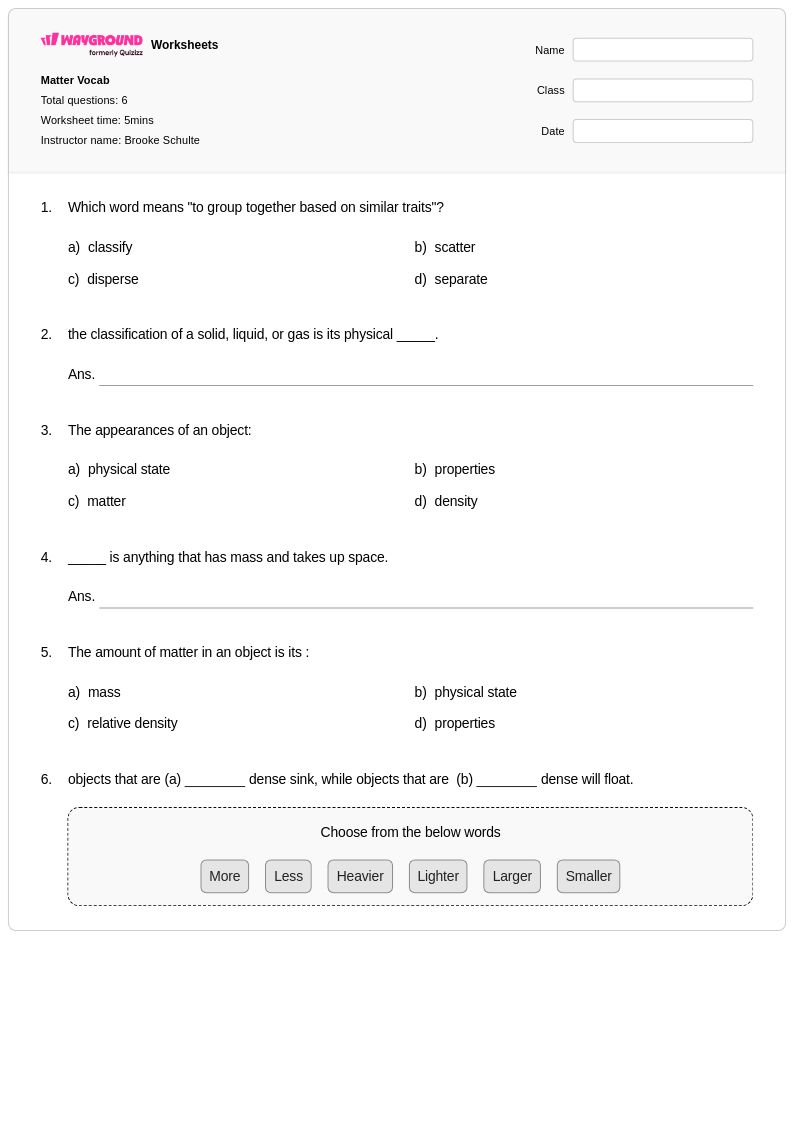
Relative mass worksheets for Grade 7 chemistry students available through Wayground (formerly Quizizz) provide comprehensive practice with atomic mass calculations, isotope comparisons, and molecular weight determinations. These carefully designed educational resources help seventh-grade students develop essential skills in understanding how scientists measure and compare the masses of atoms and molecules using the atomic mass unit scale. The worksheets feature progressive practice problems that guide students through calculating relative atomic mass from isotope data, comparing masses of different elements, and applying relative mass concepts to real-world chemistry scenarios. Each worksheet collection includes detailed answer keys and is available as free printable PDF resources, allowing students to work through problems systematically while building confidence in this fundamental chemistry concept.
Wayground's extensive library supports chemistry teachers with millions of teacher-created worksheet resources specifically focused on relative mass concepts for middle school learners. The platform's advanced search and filtering capabilities enable educators to quickly locate worksheets that align with specific curriculum standards and match their students' varying skill levels. Teachers can easily customize existing worksheets or combine multiple resources to create differentiated learning experiences that address individual student needs for remediation or enrichment. The flexible format options, including both digital interactive versions and downloadable PDF printables, allow seamless integration into classroom instruction, homework assignments, and assessment preparation, making lesson planning more efficient while ensuring students receive targeted practice with relative mass calculations and conceptual understanding.
FAQs
How do I teach relative atomic mass to chemistry students?
Start by grounding students in the concept that atomic mass is not an absolute weight but a value relative to carbon-12, which is assigned a mass of exactly 12 atomic mass units. From there, introduce isotopes and explain that the relative atomic mass of an element is a weighted average based on the natural abundance of each isotope. Using worked examples with real elements like chlorine or copper helps students see how isotope percentages translate into a single atomic mass value on the periodic table.
What practice problems help students get better at relative atomic mass calculations?
The most effective practice moves students from structured to open-ended problems: begin with two-isotope calculations where abundance percentages are given, then progress to problems where students must determine missing abundance values or identify an unknown element from its calculated mass. Comparing relative atomic mass across elements and linking calculations to stoichiometry reinforces why the concept matters beyond isolated computation.
What mistakes do students commonly make when calculating relative atomic mass?
The most frequent error is treating isotope percentages as whole numbers rather than converting them to decimals before multiplying by isotope mass, which throws off the weighted average entirely. Students also confuse mass number (a whole number count of protons and neutrons) with relative atomic mass (a decimal reflecting natural abundance), leading to incorrect values. A third common mistake is assuming all isotopes contribute equally to the average rather than weighting by abundance.
How can I differentiate relative mass worksheets for students at different ability levels?
For struggling students, reduce the complexity to two-isotope problems with clearly labeled data tables and step-by-step calculation scaffolds. Advanced students benefit from multi-isotope problems, reverse-calculation tasks where the atomic mass is given and they must find an unknown abundance, and extension problems connecting relative mass to percentage composition or molar mass. On Wayground, teachers can apply accommodations such as reduced answer choices or extended time to individual students, keeping differentiation invisible to the rest of the class.
How do I use Wayground's relative mass worksheets in my classroom?
Wayground's relative mass worksheets are available as printable PDFs for traditional classroom use and in digital formats for technology-integrated environments, including the option to host them as a quiz directly on Wayground. Teachers can use them for guided practice after introducing isotope concepts, as independent review before assessments, or as targeted remediation for students who struggled with atomic mass on prior work. Each worksheet includes a complete answer key, so grading and feedback are straightforward regardless of format.
How does relative atomic mass connect to other chemistry topics I need to teach?
Relative atomic mass is a gateway concept that underpins molar mass, stoichiometry, and percentage composition, meaning students who are shaky on it will struggle across multiple units. It also reinforces understanding of isotopes and atomic structure, making it a high-leverage topic to solidify early in a chemistry course. Connecting relative mass calculations explicitly to how the periodic table is organized helps students see it as a recurring tool rather than a one-time calculation.